 Add to Chrome
 Add to Firefox
 Add to Edge
RoboCulture: A Robotics Platform for Automated Biological Experimentation
May 20, 2025
Automating biological experimentation remains challenging due to the need for millimeter-scale precision, long and multi-step experiments, and the dynamic nature of living systems. Current liquid handlers only partially automate workflows, requiring human intervention for plate loading, tip replacement, and calibration. Industrial solutions offer more automation but are costly and lack the flexibility needed in research settings. Meanwhile, research in autonomous robotics has yet to bridge the gap for long-duration, failure-sensitive biological experiments. We introduce RoboCulture, a cost-effective and flexible platform that uses a general-purpose robotic manipulator to automate key biological tasks. RoboCulture performs liquid handling, interacts with lab equipment, and leverages computer vision for real-time decisions using optical density-based growth monitoring. We demonstrate a fully autonomous 15-hour yeast culture experiment where RoboCulture uses vision and force feedback and a modular behavior tree framework to robustly execute, monitor, and manage experiments.

Search-TTA: A Multimodal Test-Time Adaptation Framework for Visual Search in the Wild
May 16, 2025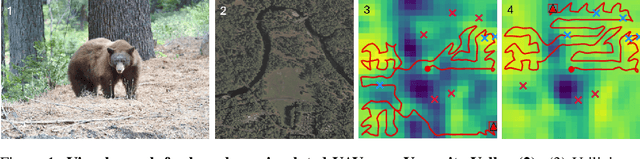
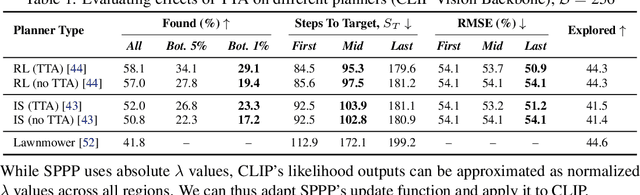
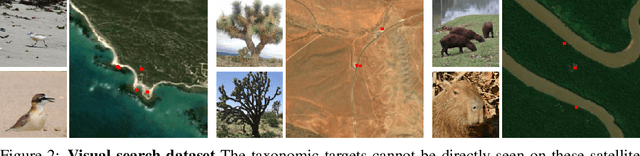
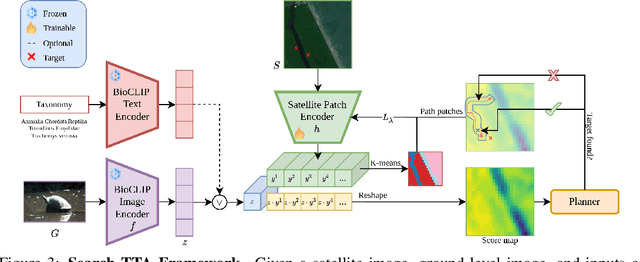
To perform autonomous visual search for environmental monitoring, a robot may leverage satellite imagery as a prior map. This can help inform coarse, high-level search and exploration strategies, even when such images lack sufficient resolution to allow fine-grained, explicit visual recognition of targets. However, there are some challenges to overcome with using satellite images to direct visual search. For one, targets that are unseen in satellite images are underrepresented (compared to ground images) in most existing datasets, and thus vision models trained on these datasets fail to reason effectively based on indirect visual cues. Furthermore, approaches which leverage large Vision Language Models (VLMs) for generalization may yield inaccurate outputs due to hallucination, leading to inefficient search. To address these challenges, we introduce Search-TTA, a multimodal test-time adaptation framework that can accept text and/or image input. First, we pretrain a remote sensing image encoder to align with CLIP's visual encoder to output probability distributions of target presence used for visual search. Second, our framework dynamically refines CLIP's predictions during search using a test-time adaptation mechanism. Through a feedback loop inspired by Spatial Poisson Point Processes, gradient updates (weighted by uncertainty) are used to correct (potentially inaccurate) predictions and improve search performance. To validate Search-TTA's performance, we curate a visual search dataset based on internet-scale ecological data. We find that Search-TTA improves planner performance by up to 9.7%, particularly in cases with poor initial CLIP predictions. It also achieves comparable performance to state-of-the-art VLMs. Finally, we deploy Search-TTA on a real UAV via hardware-in-the-loop testing, by simulating its operation within a large-scale simulation that provides onboard sensing.
RaSCL: Radar to Satellite Crossview Localization
Apr 22, 2025GNSS is unreliable, inaccurate, and insufficient in many real-time autonomous field applications. In this work, we present a GNSS-free global localization solution that contains a method of registering imaging radar on the ground with overhead RGB imagery, with joint optimization of relative poses from odometry and global poses from our overhead registration. Previous works have used various combinations of ground sensors and overhead imagery, and different feature extraction and matching methods. These include various handcrafted and deep-learning-based methods for extracting features from overhead imagery. Our work presents insights on extracting essential features from RGB overhead images for effective global localization against overhead imagery using only ground radar and a single georeferenced initial guess. We motivate our method by evaluating it on datasets in diverse geographic conditions and robotic platforms, including on an Unmanned Surface Vessel (USV) as well as urban and suburban driving datasets.
SICNav-Diffusion: Safe and Interactive Crowd Navigation with Diffusion Trajectory Predictions
Mar 11, 2025To navigate crowds without collisions, robots must interact with humans by forecasting their future motion and reacting accordingly. While learning-based prediction models have shown success in generating likely human trajectory predictions, integrating these stochastic models into a robot controller presents several challenges. The controller needs to account for interactive coupling between planned robot motion and human predictions while ensuring both predictions and robot actions are safe (i.e. collision-free). To address these challenges, we present a receding horizon crowd navigation method for single-robot multi-human environments. We first propose a diffusion model to generate joint trajectory predictions for all humans in the scene. We then incorporate these multi-modal predictions into a SICNav Bilevel MPC problem that simultaneously solves for a robot plan (upper-level) and acts as a safety filter to refine the predictions for non-collision (lower-level). Combining planning and prediction refinement into one bilevel problem ensures that the robot plan and human predictions are coupled. We validate the open-loop trajectory prediction performance of our diffusion model on the commonly used ETH/UCY benchmark and evaluate the closed-loop performance of our robot navigation method in simulation and extensive real-robot experiments demonstrating safe, efficient, and reactive robot motion.
AnyPlace: Learning Generalized Object Placement for Robot Manipulation
Feb 06, 2025Object placement in robotic tasks is inherently challenging due to the diversity of object geometries and placement configurations. To address this, we propose AnyPlace, a two-stage method trained entirely on synthetic data, capable of predicting a wide range of feasible placement poses for real-world tasks. Our key insight is that by leveraging a Vision-Language Model (VLM) to identify rough placement locations, we focus only on the relevant regions for local placement, which enables us to train the low-level placement-pose-prediction model to capture diverse placements efficiently. For training, we generate a fully synthetic dataset of randomly generated objects in different placement configurations (insertion, stacking, hanging) and train local placement-prediction models. We conduct extensive evaluations in simulation, demonstrating that our method outperforms baselines in terms of success rate, coverage of possible placement modes, and precision. In real-world experiments, we show how our approach directly transfers models trained purely on synthetic data to the real world, where it successfully performs placements in scenarios where other models struggle -- such as with varying object geometries, diverse placement modes, and achieving high precision for fine placement. More at: https://any-place.github.io.
Accelerating Discovery in Natural Science Laboratories with AI and Robotics: Perspectives and Challenges from the 2024 IEEE ICRA Workshop, Yokohama, Japan
Jan 12, 2025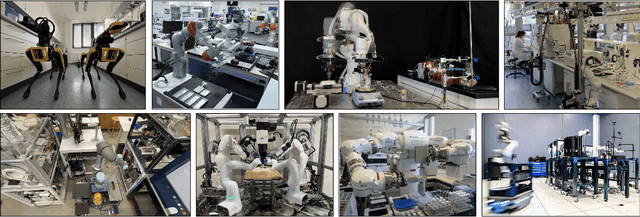
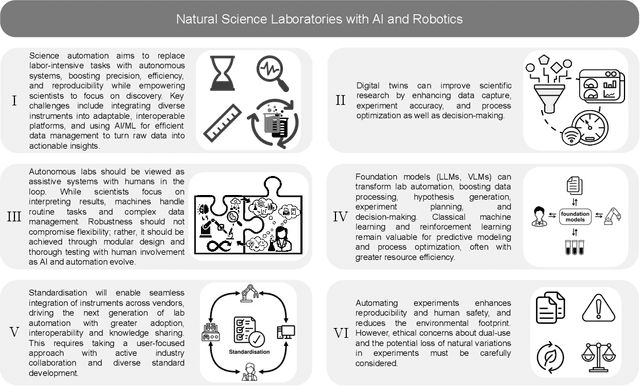
Science laboratory automation enables accelerated discovery in life sciences and materials. However, it requires interdisciplinary collaboration to address challenges such as robust and flexible autonomy, reproducibility, throughput, standardization, the role of human scientists, and ethics. This article highlights these issues, reflecting perspectives from leading experts in laboratory automation across different disciplines of the natural sciences.
Synthetica: Large Scale Synthetic Data for Robot Perception
Oct 28, 2024
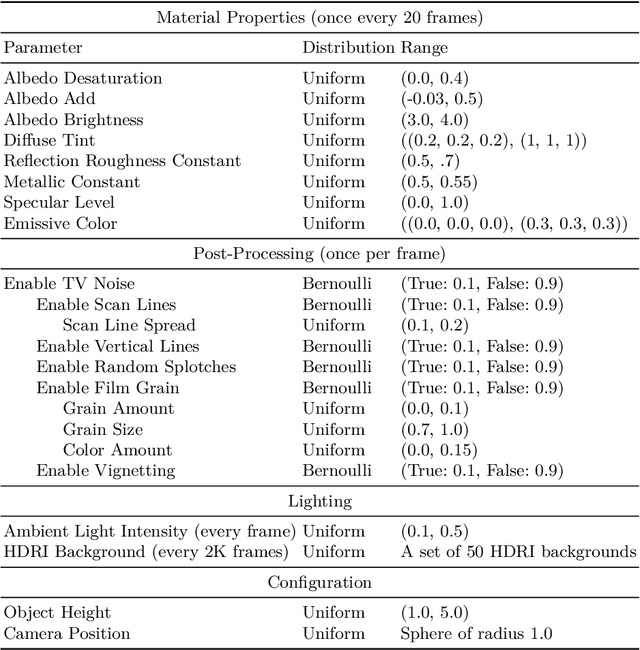
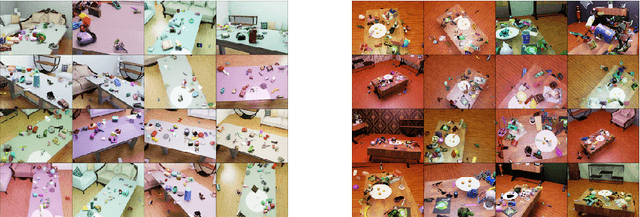
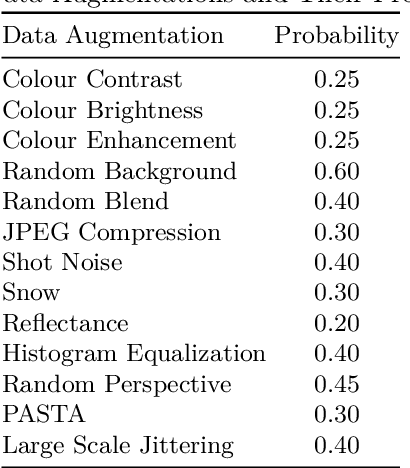
Vision-based object detectors are a crucial basis for robotics applications as they provide valuable information about object localisation in the environment. These need to ensure high reliability in different lighting conditions, occlusions, and visual artifacts, all while running in real-time. Collecting and annotating real-world data for these networks is prohibitively time consuming and costly, especially for custom assets, such as industrial objects, making it untenable for generalization to in-the-wild scenarios. To this end, we present Synthetica, a method for large-scale synthetic data generation for training robust state estimators. This paper focuses on the task of object detection, an important problem which can serve as the front-end for most state estimation problems, such as pose estimation. Leveraging data from a photorealistic ray-tracing renderer, we scale up data generation, generating 2.7 million images, to train highly accurate real-time detection transformers. We present a collection of rendering randomization and training-time data augmentation techniques conducive to robust sim-to-real performance for vision tasks. We demonstrate state-of-the-art performance on the task of object detection while having detectors that run at 50-100Hz which is 9 times faster than the prior SOTA. We further demonstrate the usefulness of our training methodology for robotics applications by showcasing a pipeline for use in the real world with custom objects for which there do not exist prior datasets. Our work highlights the importance of scaling synthetic data generation for robust sim-to-real transfer while achieving the fastest real-time inference speeds. Videos and supplementary information can be found at this URL: https://sites.google.com/view/synthetica-vision.
Automated Planning Domain Inference for Task and Motion Planning
Oct 21, 2024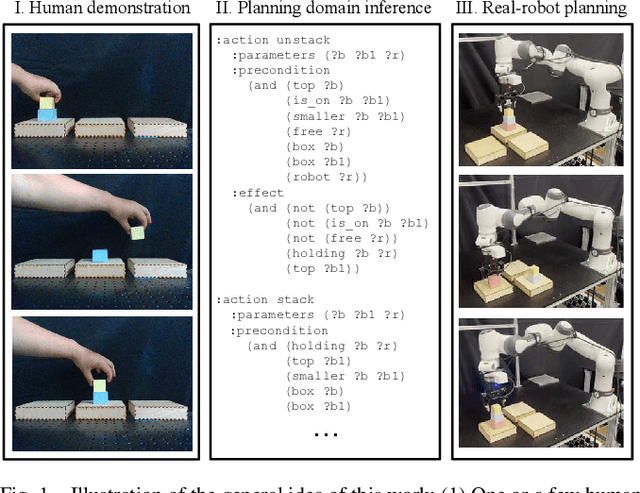
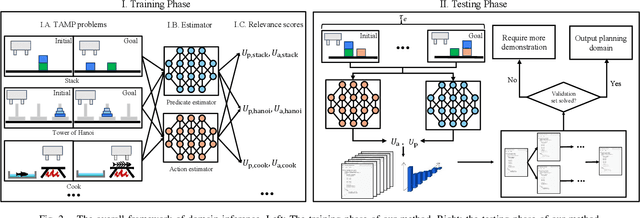
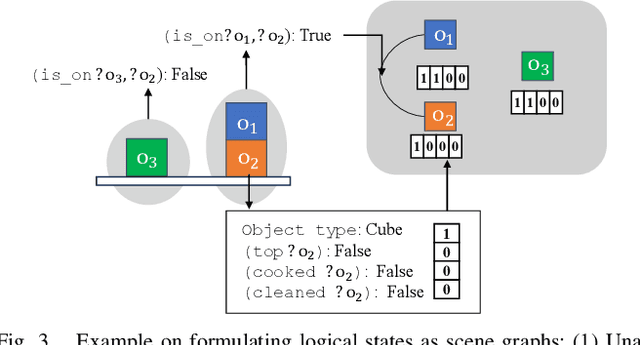
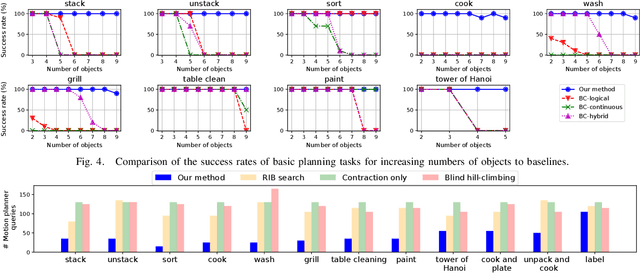
Task and motion planning (TAMP) frameworks address long and complex planning problems by integrating high-level task planners with low-level motion planners. However, existing TAMP methods rely heavily on the manual design of planning domains that specify the preconditions and postconditions of all high-level actions. This paper proposes a method to automate planning domain inference from a handful of test-time trajectory demonstrations, reducing the reliance on human design. Our approach incorporates a deep learning-based estimator that predicts the appropriate components of a domain for a new task and a search algorithm that refines this prediction, reducing the size and ensuring the utility of the inferred domain. Our method is able to generate new domains from minimal demonstrations at test time, enabling robots to handle complex tasks more efficiently. We demonstrate that our approach outperforms behavior cloning baselines, which directly imitate planner behavior, in terms of planning performance and generalization across a variety of tasks. Additionally, our method reduces computational costs and data amount requirements at test time for inferring new planning domains.
Gaussian Splatting Visual MPC for Granular Media Manipulation
Oct 13, 2024
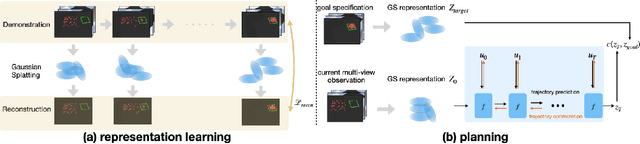


Recent advancements in learned 3D representations have enabled significant progress in solving complex robotic manipulation tasks, particularly for rigid-body objects. However, manipulating granular materials such as beans, nuts, and rice, remains challenging due to the intricate physics of particle interactions, high-dimensional and partially observable state, inability to visually track individual particles in a pile, and the computational demands of accurate dynamics prediction. Current deep latent dynamics models often struggle to generalize in granular material manipulation due to a lack of inductive biases. In this work, we propose a novel approach that learns a visual dynamics model over Gaussian splatting representations of scenes and leverages this model for manipulating granular media via Model-Predictive Control. Our method enables efficient optimization for complex manipulation tasks on piles of granular media. We evaluate our approach in both simulated and real-world settings, demonstrating its ability to solve unseen planning tasks and generalize to new environments in a zero-shot transfer. We also show significant prediction and manipulation performance improvements compared to existing granular media manipulation methods.
Exploring and Addressing Reward Confusion in Offline Preference Learning
Jul 22, 2024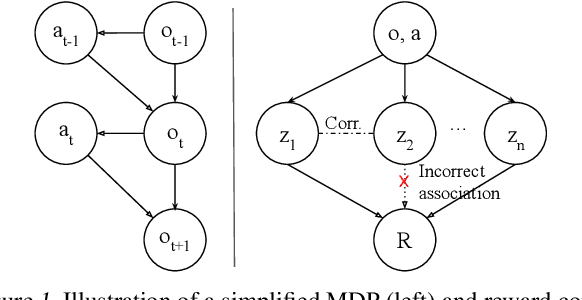
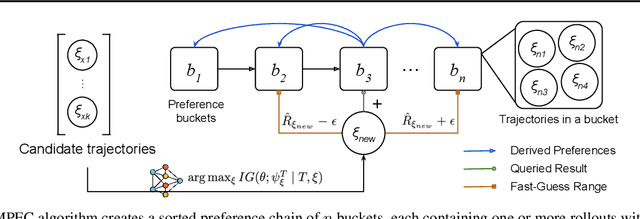
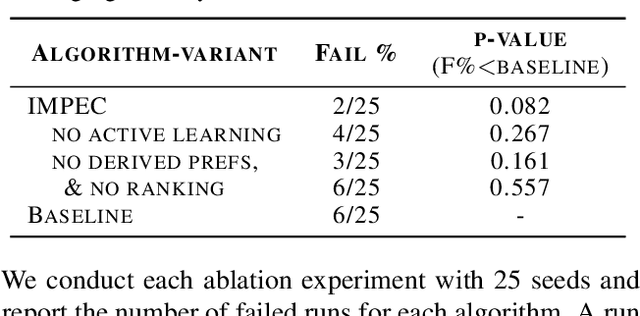
Spurious correlations in a reward model's training data can prevent Reinforcement Learning from Human Feedback (RLHF) from identifying the desired goal and induce unwanted behaviors. This paper shows that offline RLHF is susceptible to reward confusion, especially in the presence of spurious correlations in offline data. We create a benchmark to study this problem and propose a method that can significantly reduce reward confusion by leveraging transitivity of preferences while building a global preference chain with active learning.