 Add to Chrome
 Add to Firefox
 Add to Edge
Are All Tokens Necessary for Visual Place Recognition? An Empirical Study of Token Reduction for Efficient Inference
Jul 17, 2026
Recent visual place recognition (VPR) methods based on vision transformers, particularly foundation models, have achieved remarkable recognition performance. However, these models process all visual tokens throughout the entire network, resulting in substantial computational overhead, which hinders their deployment in real-time and resource-constrained scenarios. A natural question thus arises: are all visual tokens necessary for VPR? To answer this question, we present the first systematic benchmark of token reduction for efficient visual place recognition. Our benchmark comprehensively evaluates representative token pruning, token merging, and hybrid pruning-merging methods across multiple state-of-the-art VPR models and diverse benchmark datasets covering urban, suburban, and natural environments. We further investigate token reduction from multiple perspectives, including recognition performance under different reduction configurations, computational complexity, inference speed, qualitative visualization, and deployment efficiency on edge devices. Through extensive experiments and in-depth analysis, our benchmark reveals multiple important characteristics of token reduction in VPR and provides several practical insights into the trade-offs between accuracy and inference efficiency. For example, token reduction can reduce computational cost by up to 29\% and improve throughput by up to 44\%, while incurring less than 1\% degradation in recognition accuracy. Overall, this work establishes a comprehensive foundation for future research on token-efficient VPR and efficient visual retrieval systems. Our codes and models will be available at https://github.com/Tong-Jin01/TokenReduction4VPR

Selectivity Drives Efficiency: Dataset Pruning for Visual Place Recognition
Jul 16, 2026Recent visual place recognition (VPR) studies have increasingly relied on large-scale datasets to train more robust and discriminative models. Although this trend significantly improves recognition performance, it also introduces substantial storage and training costs, especially when new architectures or training strategies need to be repeatedly developed and evaluated. Dataset pruning (DP) provides a promising way to improve data efficiency by retaining only informative training data. However, conventional DP methods mainly follow the sample-wise classification paradigm, which overlooks the relation-dependent training nature of VPR, where supervision is typically formed by image pairs rather than independent images. To address this issue, we propose a place-wise dataset pruning framework tailored for VPR. Instead of pruning individual images, our method treats each place as the basic pruning unit and introduces two complementary novel metrics, i.e., intra-place diversity (IPD) and inter-place similarity (IPS), to evaluate the training value of each place. By jointly considering these two metrics, our method ranks all places and constructs a compact yet informative coreset, thereby allowing the pruned dataset to still support the training of robust and discriminative VPR models. Extensive experiments demonstrate that our method consistently outperforms state-of-the-art DP baselines under different pruning ratios while reducing selection and training costs. Moreover, by pruning a merged dataset roughly 3.5$\times$ the size of GSV-Cities to a comparable scale, our coreset maintains highly competitive performance, achieving 94.5\% R@1 on MSLS-val and 97.0\% R@1 on Nordland with only NetVLAD. Codes will be made publicly available.
The Quality-Utility Paradox: Why High-Reward Data Impairs Small Model Mathematical Reasoning
Jun 15, 2026Knowledge distillation from powerful reasoning models is widely used to improve Small Language Models (SLMs) on mathematical reasoning, often assuming that traces with higher reward model scores provide more useful supervision. We identify a counterintuitive \textbf{Quality-Utility Paradox} in mathematical reasoning distillation. Data refined or synthesized by a stronger Oracle obtains higher perceived quality according to reward models, yet consistently underperforms traces generated by the SLM itself and selected through rejection sampling across Qwen2.5, LLaMA-3, and DeepSeek families. Our analysis shows that Oracle refinement couples logical repair with distributional drift away from the SLM's native reasoning distribution. This drift increases the learner's adaptation cost and can outweigh the benefit of improved reasoning logic. To test this mechanism, we introduce \textbf{Style-Aligned Refinement}, which preserves the native trajectory of the SLM while retaining logical repair from the Oracle. This intervention lowers adaptation cost and restores downstream utility. These findings suggest that effective mathematical reasoning distillation should jointly optimize perceived solution quality and learner-data compatibility, rather than relying solely on reward-model scores. The datasets and code are available at https://github.com/Dracoqhl/Quality-Utility-Paradox.
Where, What, Why, and Importance: Structured Defect Grounding for Text-to-Image Feedback
Jun 04, 2026Despite generating increasingly photorealistic images, text-to-image (T2I) models still exhibit localized, subtle, and structurally complex failures. Diagnosing these failures requires instance-level feedback that answers where a defect occurs, what type it is, why it is defective, and its importance to overall image quality. While recent dense-feedback methods move beyond scalar supervision, their heatmap-centric representations still formulate diagnosis as pixel-field regression, making it difficult to localize variable-cardinality defects and bind semantic reasons to individual failures. To address this representation bottleneck, we propose Structured Defect Grounding (SDG), which casts T2I diagnosis as structured set prediction by modeling each defect as a (location, type, reason, importance) tuple. To make this formulation trainable and measurable, we introduce SDG-30K, a 30K-image dataset with box-grounded annotations across four modern T2I generators, together with a dedicated evaluation protocol, SDG-Eval. Building on this structured representation, we further present a diagnosis-to-alignment framework in which a Vision-Language Model (VLM) serves as the SDG detector, and BoxFlow-GRPO converts predicted defect sets into box-derived, importance-weighted spatial rewards for diffusion model alignment. Extensive experiments show that our SDG detector outperforms leading proprietary VLMs on structured defect grounding, while SDG-guided rewards consistently improve T2I alignment and support localized image refinement. These results establish SDG as a unified, instance-level interface for diagnosing, evaluating, and enhancing modern generative models.
GazeOnce360: Fisheye-Based 360° Multi-Person Gaze Estimation with Global-Local Feature Fusion
Mar 17, 2026We present GazeOnce360, a novel end-to-end model for multi-person gaze estimation from a single tabletop-mounted upward-facing fisheye camera. Unlike conventional approaches that rely on forward-facing cameras in constrained viewpoints, we address the underexplored setting of estimating the 3D gaze direction of multiple people distributed across a 360° scene from an upward fisheye perspective. To support research in this setting, we introduce MPSGaze360, a large-scale synthetic dataset rendered using Unreal Engine, featuring diverse multi-person configurations with accurate 3D gaze and eye landmark annotations. Our model tackles the severe distortion and perspective variation inherent in fisheye imagery by incorporating rotational convolutions and eye landmark supervision. To better capture fine-grained eye features crucial for gaze estimation, we propose a dual-resolution architecture that fuses global low-resolution context with high-resolution local eye regions. Experimental results demonstrate the effectiveness of each component in our model. This work highlights the feasibility and potential of fisheye-based 360° gaze estimation in practical multi-person scenarios. Project page: https://caizhuojiang.github.io/GazeOnce360/.
Requesting Expert Reasoning: Augmenting LLM Agents with Learned Collaborative Intervention
Feb 26, 2026Large Language Model (LLM) based agents excel at general reasoning but often fail in specialized domains where success hinges on long-tail knowledge absent from their training data. While human experts can provide this missing knowledge, their guidance is often unstructured and unreliable, making its direct integration into an agent's plan problematic. To address this, we introduce AHCE (Active Human-Augmented Challenge Engagement), a framework for on-demand Human-AI collaboration. At its core, the Human Feedback Module (HFM) employs a learned policy to treat the human expert as an interactive reasoning tool. Extensive experiments in Minecraft demonstrate the framework's effectiveness, increasing task success rates by 32% on normal difficulty tasks and nearly 70% on highly difficult tasks, all with minimal human intervention. Our work demonstrates that successfully augmenting agents requires learning how to request expert reasoning, moving beyond simple requests for help.
Towards Implicit Aggregation: Robust Image Representation for Place Recognition in the Transformer Era
Nov 08, 2025Visual place recognition (VPR) is typically regarded as a specific image retrieval task, whose core lies in representing images as global descriptors. Over the past decade, dominant VPR methods (e.g., NetVLAD) have followed a paradigm that first extracts the patch features/tokens of the input image using a backbone, and then aggregates these patch features into a global descriptor via an aggregator. This backbone-plus-aggregator paradigm has achieved overwhelming dominance in the CNN era and remains widely used in transformer-based models. In this paper, however, we argue that a dedicated aggregator is not necessary in the transformer era, that is, we can obtain robust global descriptors only with the backbone. Specifically, we introduce some learnable aggregation tokens, which are prepended to the patch tokens before a particular transformer block. All these tokens will be jointly processed and interact globally via the intrinsic self-attention mechanism, implicitly aggregating useful information within the patch tokens to the aggregation tokens. Finally, we only take these aggregation tokens from the last output tokens and concatenate them as the global representation. Although implicit aggregation can provide robust global descriptors in an extremely simple manner, where and how to insert additional tokens, as well as the initialization of tokens, remains an open issue worthy of further exploration. To this end, we also propose the optimal token insertion strategy and token initialization method derived from empirical studies. Experimental results show that our method outperforms state-of-the-art methods on several VPR datasets with higher efficiency and ranks 1st on the MSLS challenge leaderboard. The code is available at https://github.com/lu-feng/image.
Enhancing Sa2VA for Referent Video Object Segmentation: 2nd Solution for 7th LSVOS RVOS Track
Sep 19, 2025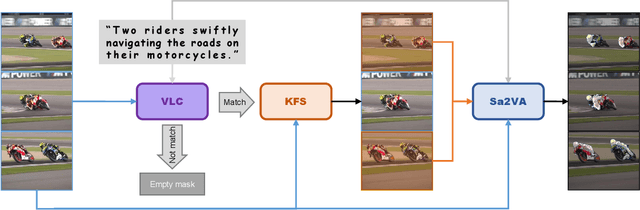
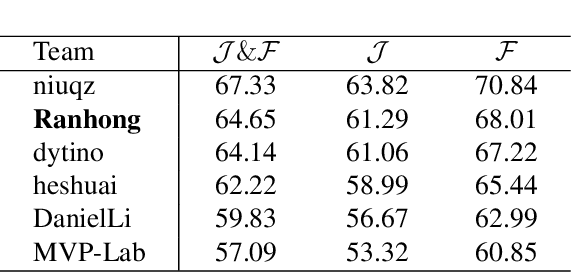
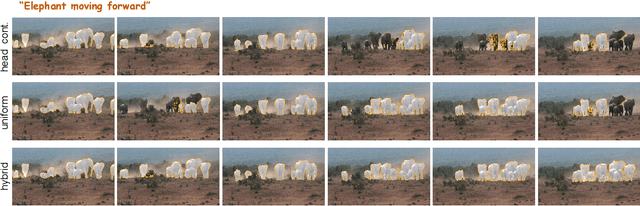
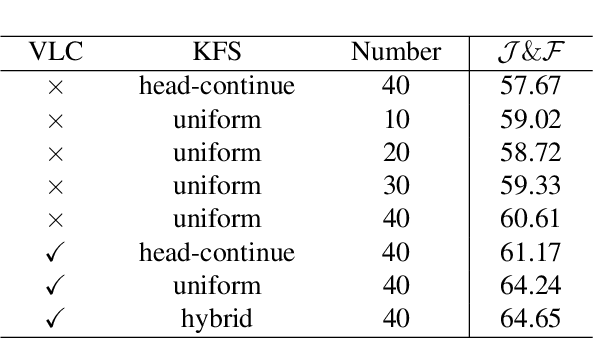
Referential Video Object Segmentation (RVOS) aims to segment all objects in a video that match a given natural language description, bridging the gap between vision and language understanding. Recent work, such as Sa2VA, combines Large Language Models (LLMs) with SAM~2, leveraging the strong video reasoning capability of LLMs to guide video segmentation. In this work, we present a training-free framework that substantially improves Sa2VA's performance on the RVOS task. Our method introduces two key components: (1) a Video-Language Checker that explicitly verifies whether the subject and action described in the query actually appear in the video, thereby reducing false positives; and (2) a Key-Frame Sampler that adaptively selects informative frames to better capture both early object appearances and long-range temporal context. Without any additional training, our approach achieves a J&F score of 64.14% on the MeViS test set, ranking 2nd place in the RVOS track of the 7th LSVOS Challenge at ICCV 2025.
Pseudo-Label Enhanced Cascaded Framework: 2nd Technical Report for LSVOS 2025 VOS Track
Sep 18, 2025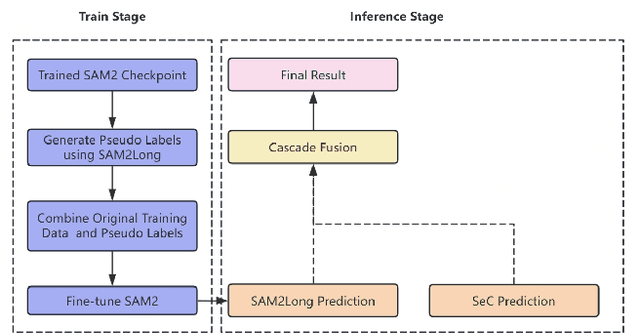
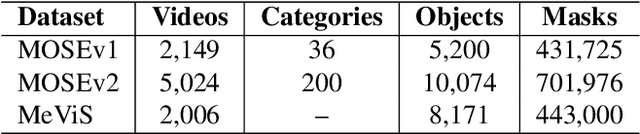
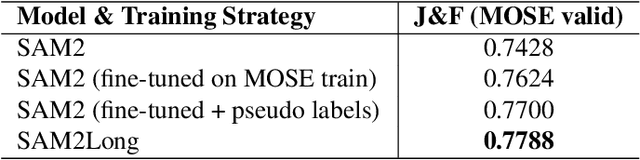
Complex Video Object Segmentation (VOS) presents significant challenges in accurately segmenting objects across frames, especially in the presence of small and similar targets, frequent occlusions, rapid motion, and complex interactions. In this report, we present our solution for the LSVOS 2025 VOS Track based on the SAM2 framework. We adopt a pseudo-labeling strategy during training: a trained SAM2 checkpoint is deployed within the SAM2Long framework to generate pseudo labels for the MOSE test set, which are then combined with existing data for further training. For inference, the SAM2Long framework is employed to obtain our primary segmentation results, while an open-source SeC model runs in parallel to produce complementary predictions. A cascaded decision mechanism dynamically integrates outputs from both models, exploiting the temporal stability of SAM2Long and the concept-level robustness of SeC. Benefiting from pseudo-label training and cascaded multi-model inference, our approach achieves a J\&F score of 0.8616 on the MOSE test set -- +1.4 points over our SAM2Long baseline -- securing the 2nd place in the LSVOS 2025 VOS Track, and demonstrating strong robustness and accuracy in long, complex video segmentation scenarios.
In the Eye of MLLM: Benchmarking Egocentric Video Intent Understanding with Gaze-Guided Prompting
Sep 09, 2025The emergence of advanced multimodal large language models (MLLMs) has significantly enhanced AI assistants' ability to process complex information across modalities. Recently, egocentric videos, by directly capturing user focus, actions, and context in an unified coordinate, offer an exciting opportunity to enable proactive and personalized AI user experiences with MLLMs. However, existing benchmarks overlook the crucial role of gaze as an indicator of user intent. To address this gap, we introduce EgoGazeVQA, an egocentric gaze-guided video question answering benchmark that leverages gaze information to improve the understanding of longer daily-life videos. EgoGazeVQA consists of gaze-based QA pairs generated by MLLMs and refined by human annotators. Our experiments reveal that existing MLLMs struggle to accurately interpret user intentions. In contrast, our gaze-guided intent prompting methods significantly enhance performance by integrating spatial, temporal, and intent-related cues. We further conduct experiments on gaze-related fine-tuning and analyze how gaze estimation accuracy impacts prompting effectiveness. These results underscore the value of gaze for more personalized and effective AI assistants in egocentric settings.