 Add to Chrome
 Add to Firefox
 Add to Edge
Requesting Expert Reasoning: Augmenting LLM Agents with Learned Collaborative Intervention
Feb 26, 2026
Large Language Model (LLM) based agents excel at general reasoning but often fail in specialized domains where success hinges on long-tail knowledge absent from their training data. While human experts can provide this missing knowledge, their guidance is often unstructured and unreliable, making its direct integration into an agent's plan problematic. To address this, we introduce AHCE (Active Human-Augmented Challenge Engagement), a framework for on-demand Human-AI collaboration. At its core, the Human Feedback Module (HFM) employs a learned policy to treat the human expert as an interactive reasoning tool. Extensive experiments in Minecraft demonstrate the framework's effectiveness, increasing task success rates by 32% on normal difficulty tasks and nearly 70% on highly difficult tasks, all with minimal human intervention. Our work demonstrates that successfully augmenting agents requires learning how to request expert reasoning, moving beyond simple requests for help.

CauseJudger: Identifying the Cause with LLMs for Abductive Logical Reasoning
Sep 09, 2024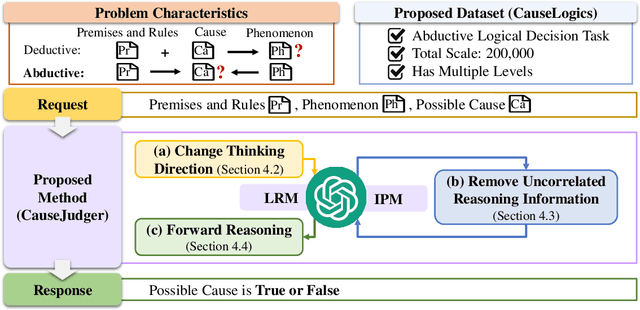
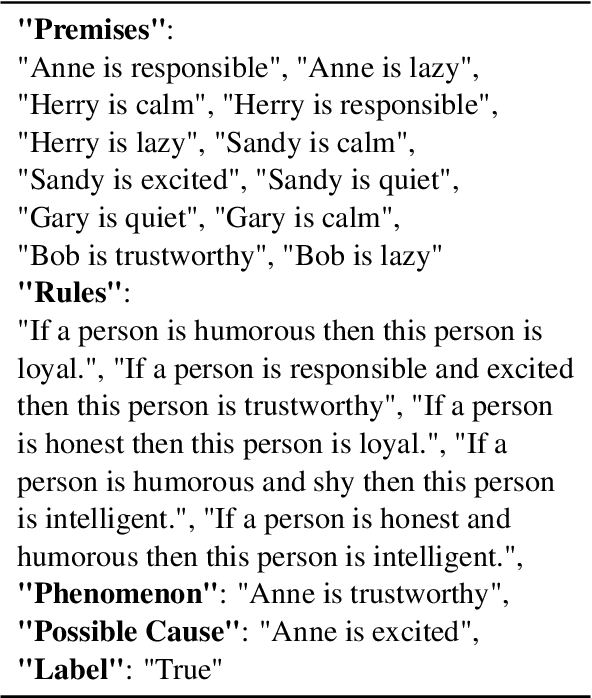
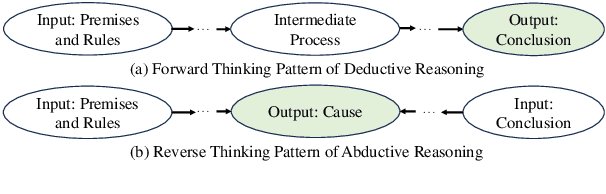
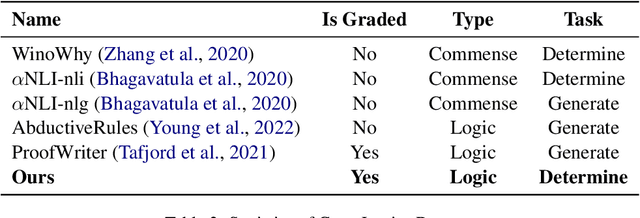
Large language models (LLMs) have been utilized in solving diverse reasoning tasks, encompassing common sense, arithmetic and deduction tasks. However, with difficulties of reversing thinking patterns and irrelevant premises, how to determine the authenticity of the cause in abductive logical reasoning remains underexplored. Inspired by hypothesis and verification method and identification of irrelevant information in human thinking process, we propose a new framework for LLMs abductive logical reasoning called CauseJudger (CJ), which identifies the authenticity of possible cause by transforming thinking from reverse to forward and removing irrelevant information. In addition, we construct an abductive logical reasoning dataset for decision task called CauseLogics, which contains 200,000 tasks of varying reasoning lengths. Our experiments show the efficiency of CJ with overall experiments and ablation experiments as well as case studies on our dataset and reconstructed public dataset. Notably, CJ's implementation is efficient, requiring only two calls to LLM. Its impact is profound: when using gpt-3.5, CJ achieves a maximum correctness improvement of 41% compared to Zero-Shot-CoT. Moreover, with gpt-4, CJ attains an accuracy exceeding 90% across all datasets.