 Add to Chrome
 Add to Firefox
 Add to Edge
Are All Tokens Necessary for Visual Place Recognition? An Empirical Study of Token Reduction for Efficient Inference
Jul 17, 2026
Recent visual place recognition (VPR) methods based on vision transformers, particularly foundation models, have achieved remarkable recognition performance. However, these models process all visual tokens throughout the entire network, resulting in substantial computational overhead, which hinders their deployment in real-time and resource-constrained scenarios. A natural question thus arises: are all visual tokens necessary for VPR? To answer this question, we present the first systematic benchmark of token reduction for efficient visual place recognition. Our benchmark comprehensively evaluates representative token pruning, token merging, and hybrid pruning-merging methods across multiple state-of-the-art VPR models and diverse benchmark datasets covering urban, suburban, and natural environments. We further investigate token reduction from multiple perspectives, including recognition performance under different reduction configurations, computational complexity, inference speed, qualitative visualization, and deployment efficiency on edge devices. Through extensive experiments and in-depth analysis, our benchmark reveals multiple important characteristics of token reduction in VPR and provides several practical insights into the trade-offs between accuracy and inference efficiency. For example, token reduction can reduce computational cost by up to 29\% and improve throughput by up to 44\%, while incurring less than 1\% degradation in recognition accuracy. Overall, this work establishes a comprehensive foundation for future research on token-efficient VPR and efficient visual retrieval systems. Our codes and models will be available at https://github.com/Tong-Jin01/TokenReduction4VPR

Selectivity Drives Efficiency: Dataset Pruning for Visual Place Recognition
Jul 16, 2026Recent visual place recognition (VPR) studies have increasingly relied on large-scale datasets to train more robust and discriminative models. Although this trend significantly improves recognition performance, it also introduces substantial storage and training costs, especially when new architectures or training strategies need to be repeatedly developed and evaluated. Dataset pruning (DP) provides a promising way to improve data efficiency by retaining only informative training data. However, conventional DP methods mainly follow the sample-wise classification paradigm, which overlooks the relation-dependent training nature of VPR, where supervision is typically formed by image pairs rather than independent images. To address this issue, we propose a place-wise dataset pruning framework tailored for VPR. Instead of pruning individual images, our method treats each place as the basic pruning unit and introduces two complementary novel metrics, i.e., intra-place diversity (IPD) and inter-place similarity (IPS), to evaluate the training value of each place. By jointly considering these two metrics, our method ranks all places and constructs a compact yet informative coreset, thereby allowing the pruned dataset to still support the training of robust and discriminative VPR models. Extensive experiments demonstrate that our method consistently outperforms state-of-the-art DP baselines under different pruning ratios while reducing selection and training costs. Moreover, by pruning a merged dataset roughly 3.5$\times$ the size of GSV-Cities to a comparable scale, our coreset maintains highly competitive performance, achieving 94.5\% R@1 on MSLS-val and 97.0\% R@1 on Nordland with only NetVLAD. Codes will be made publicly available.
EDTformer: An Efficient Decoder Transformer for Visual Place Recognition
Dec 01, 2024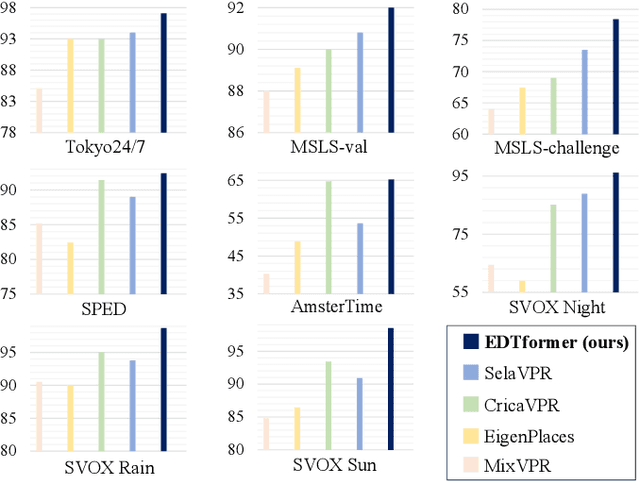
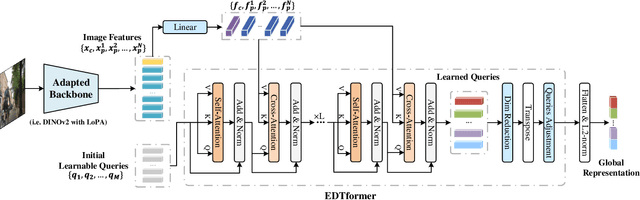
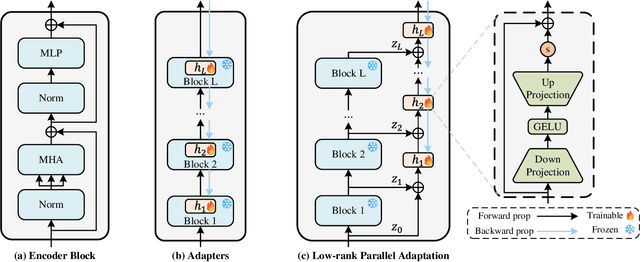

Visual place recognition (VPR) aims to determine the general geographical location of a query image by retrieving visually similar images from a large geo-tagged database. To obtain a global representation for each place image, most approaches typically focus on the aggregation of deep features extracted from a backbone through using current prominent architectures (e.g., CNNs, MLPs, pooling layer and transformer encoder), giving little attention to the transformer decoder. However, we argue that its strong capability in capturing contextual dependencies and generating accurate features holds considerable potential for the VPR task. To this end, we propose an Efficient Decoder Transformer (EDTformer) for feature aggregation, which consists of several stacked simplified decoder blocks followed by two linear layers to directly generate robust and discriminative global representations for VPR. Specifically, we do this by formulating deep features as the keys and values, as well as a set of independent learnable parameters as the queries. EDTformer can fully utilize the contextual information within deep features, then gradually decode and aggregate the effective features into the learnable queries to form the final global representations. Moreover, to provide powerful deep features for EDTformer and further facilitate the robustness, we use the foundation model DINOv2 as the backbone and propose a Low-Rank Parallel Adaptation (LoPA) method to enhance it, which can refine the intermediate features of the backbone progressively in a memory- and parameter-efficient way. As a result, our method not only outperforms single-stage VPR methods on multiple benchmark datasets, but also outperforms two-stage VPR methods which add a re-ranking with considerable cost. Code will be available at https://github.com/Tong-Jin01/EDTformer.