 Add to Chrome
 Add to Firefox
 Add to Edge
MaskAlign: Token-Subset Representation Alignment for Efficient Diffusion Training
Jun 07, 2026
Representation alignment with pretrained vision models has recently shown strong potential for accelerating diffusion transformer training. By aligning intermediate diffusion features with clean-image representations from self-supervised vision encoders, existing methods improve convergence and generation quality. However, such alignment also introduces a non-trivial constraint: diffusion models operate on noisy inputs whose usable information varies across timesteps, while the reference features are extracted from clean images. In this paper, we revisit this mismatch from a token-level perspective. We find that, under full-token representation alignment, tokens with large alignment-gradient norms exhibit a stable spatial preference, suggesting that the alignment objective does not affect all tokens uniformly and may encourage the model to rely on the complete set of clean-image tokens. To address this issue, we propose MaskAlign, a token-subset representation alignment method that applies alignment to randomly sampled token subsets during training. By exposing the model to different token subsets across iterations, MaskAlign reduces the dependence of representation alignment on the complete token set and encourages alignment behavior that is more stable under token-subset perturbations. To mitigate the information loss caused by directly dropping tokens, we further introduce a lightweight pre-mask token mixing block that shares information across tokens before masking.

Where, What, Why, and Importance: Structured Defect Grounding for Text-to-Image Feedback
Jun 04, 2026Despite generating increasingly photorealistic images, text-to-image (T2I) models still exhibit localized, subtle, and structurally complex failures. Diagnosing these failures requires instance-level feedback that answers where a defect occurs, what type it is, why it is defective, and its importance to overall image quality. While recent dense-feedback methods move beyond scalar supervision, their heatmap-centric representations still formulate diagnosis as pixel-field regression, making it difficult to localize variable-cardinality defects and bind semantic reasons to individual failures. To address this representation bottleneck, we propose Structured Defect Grounding (SDG), which casts T2I diagnosis as structured set prediction by modeling each defect as a (location, type, reason, importance) tuple. To make this formulation trainable and measurable, we introduce SDG-30K, a 30K-image dataset with box-grounded annotations across four modern T2I generators, together with a dedicated evaluation protocol, SDG-Eval. Building on this structured representation, we further present a diagnosis-to-alignment framework in which a Vision-Language Model (VLM) serves as the SDG detector, and BoxFlow-GRPO converts predicted defect sets into box-derived, importance-weighted spatial rewards for diffusion model alignment. Extensive experiments show that our SDG detector outperforms leading proprietary VLMs on structured defect grounding, while SDG-guided rewards consistently improve T2I alignment and support localized image refinement. These results establish SDG as a unified, instance-level interface for diagnosing, evaluating, and enhancing modern generative models.
Ingredients: Blending Custom Photos with Video Diffusion Transformers
Jan 03, 2025
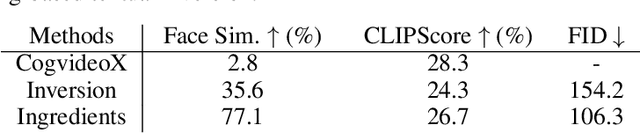


This paper presents a powerful framework to customize video creations by incorporating multiple specific identity (ID) photos, with video diffusion Transformers, referred to as \texttt{Ingredients}. Generally, our method consists of three primary modules: (\textbf{i}) a facial extractor that captures versatile and precise facial features for each human ID from both global and local perspectives; (\textbf{ii}) a multi-scale projector that maps face embeddings into the contextual space of image query in video diffusion transformers; (\textbf{iii}) an ID router that dynamically combines and allocates multiple ID embedding to the corresponding space-time regions. Leveraging a meticulously curated text-video dataset and a multi-stage training protocol, \texttt{Ingredients} demonstrates superior performance in turning custom photos into dynamic and personalized video content. Qualitative evaluations highlight the advantages of proposed method, positioning it as a significant advancement toward more effective generative video control tools in Transformer-based architecture, compared to existing methods. The data, code, and model weights are publicly available at: \url{https://github.com/feizc/Ingredients}.
Video Diffusion Transformers are In-Context Learners
Dec 14, 2024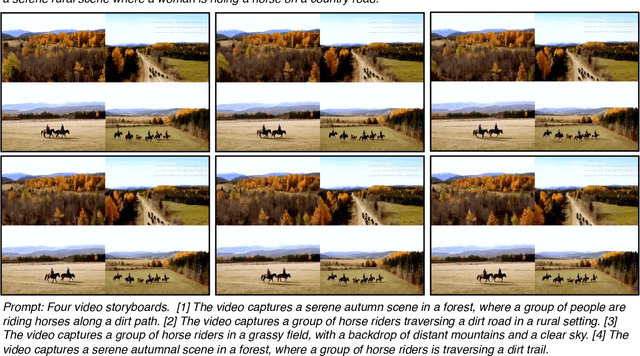
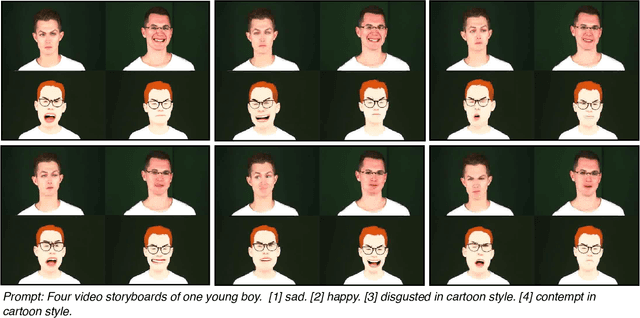
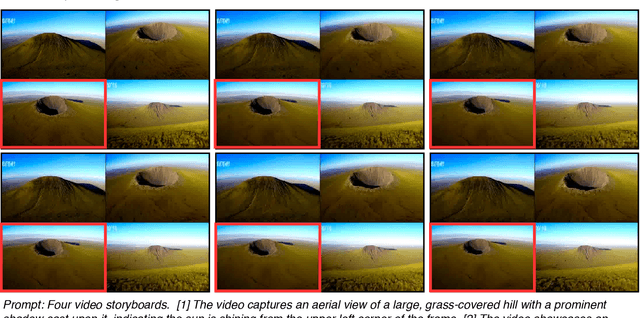
This paper investigates a solution for enabling in-context capabilities of video diffusion transformers, with minimal tuning required for activation. Specifically, we propose a simple pipeline to leverage in-context generation: ($\textbf{i}$) concatenate videos along spacial or time dimension, ($\textbf{ii}$) jointly caption multi-scene video clips from one source, and ($\textbf{iii}$) apply task-specific fine-tuning using carefully curated small datasets. Through a series of diverse controllable tasks, we demonstrate qualitatively that existing advanced text-to-video models can effectively perform in-context generation. Notably, it allows for the creation of consistent multi-scene videos exceeding 30 seconds in duration, without additional computational overhead. Importantly, this method requires no modifications to the original models, results in high-fidelity video outputs that better align with prompt specifications and maintain role consistency. Our framework presents a valuable tool for the research community and offers critical insights for advancing product-level controllable video generation systems. The data, code, and model weights are publicly available at: \url{https://github.com/feizc/Video-In-Context}.
MovieCharacter: A Tuning-Free Framework for Controllable Character Video Synthesis
Oct 28, 2024
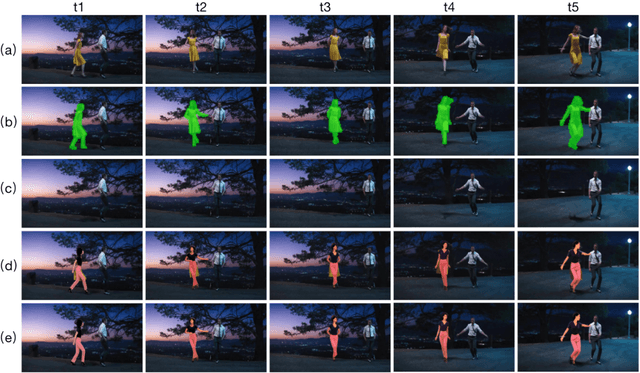


Recent advancements in character video synthesis still depend on extensive fine-tuning or complex 3D modeling processes, which can restrict accessibility and hinder real-time applicability. To address these challenges, we propose a simple yet effective tuning-free framework for character video synthesis, named MovieCharacter, designed to streamline the synthesis process while ensuring high-quality outcomes. Our framework decomposes the synthesis task into distinct, manageable modules: character segmentation and tracking, video object removal, character motion imitation, and video composition. This modular design not only facilitates flexible customization but also ensures that each component operates collaboratively to effectively meet user needs. By leveraging existing open-source models and integrating well-established techniques, MovieCharacter achieves impressive synthesis results without necessitating substantial resources or proprietary datasets. Experimental results demonstrate that our framework enhances the efficiency, accessibility, and adaptability of character video synthesis, paving the way for broader creative and interactive applications.
FLUX that Plays Music
Sep 01, 2024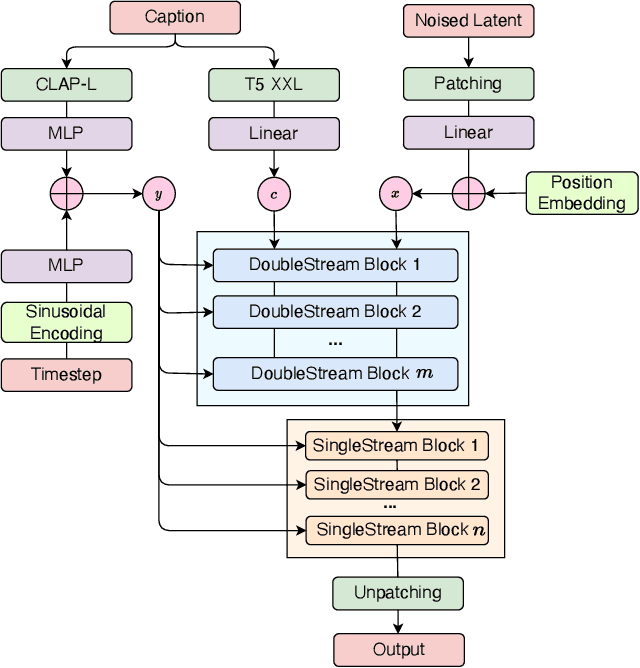
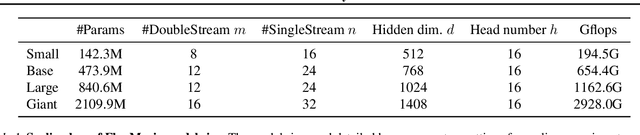
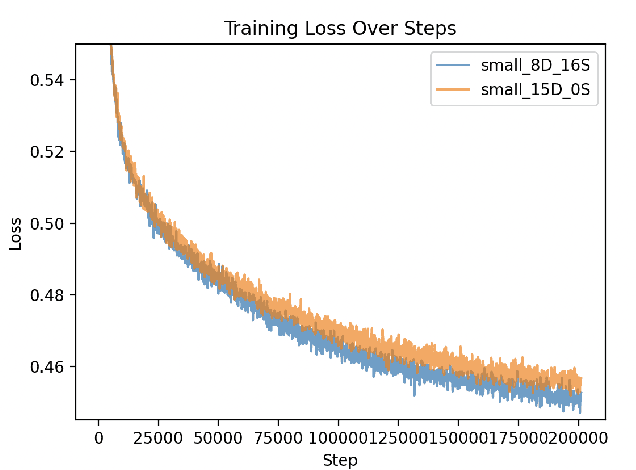
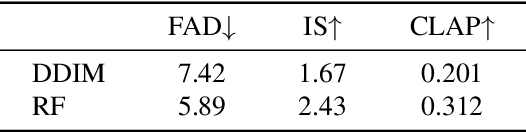
This paper explores a simple extension of diffusion-based rectified flow Transformers for text-to-music generation, termed as FluxMusic. Generally, along with design in advanced Flux\footnote{https://github.com/black-forest-labs/flux} model, we transfers it into a latent VAE space of mel-spectrum. It involves first applying a sequence of independent attention to the double text-music stream, followed by a stacked single music stream for denoised patch prediction. We employ multiple pre-trained text encoders to sufficiently capture caption semantic information as well as inference flexibility. In between, coarse textual information, in conjunction with time step embeddings, is utilized in a modulation mechanism, while fine-grained textual details are concatenated with the music patch sequence as inputs. Through an in-depth study, we demonstrate that rectified flow training with an optimized architecture significantly outperforms established diffusion methods for the text-to-music task, as evidenced by various automatic metrics and human preference evaluations. Our experimental data, code, and model weights are made publicly available at: \url{https://github.com/feizc/FluxMusic}.
Scaling Diffusion Transformers to 16 Billion Parameters
Jul 16, 2024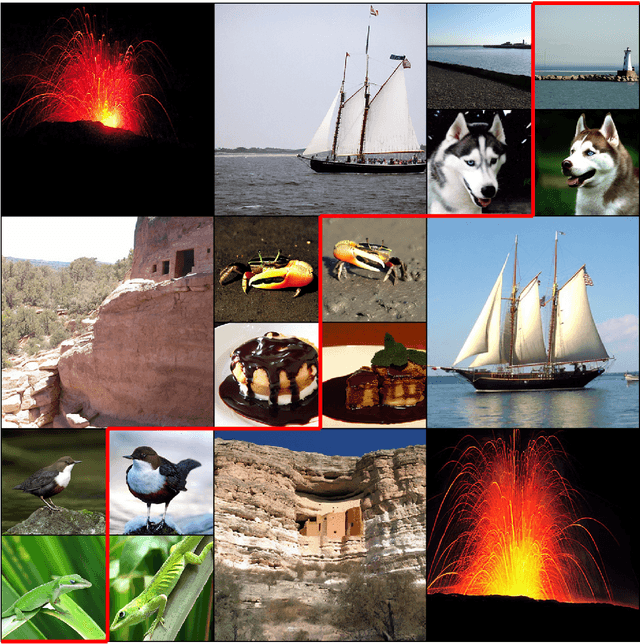


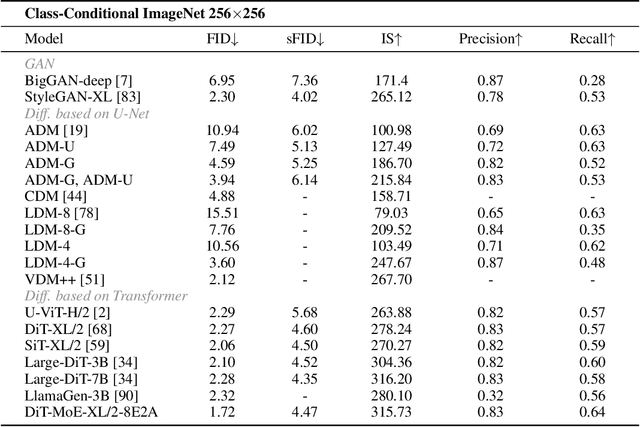
In this paper, we present DiT-MoE, a sparse version of the diffusion Transformer, that is scalable and competitive with dense networks while exhibiting highly optimized inference. The DiT-MoE includes two simple designs: shared expert routing and expert-level balance loss, thereby capturing common knowledge and reducing redundancy among the different routed experts. When applied to conditional image generation, a deep analysis of experts specialization gains some interesting observations: (i) Expert selection shows preference with spatial position and denoising time step, while insensitive with different class-conditional information; (ii) As the MoE layers go deeper, the selection of experts gradually shifts from specific spacial position to dispersion and balance. (iii) Expert specialization tends to be more concentrated at the early time step and then gradually uniform after half. We attribute it to the diffusion process that first models the low-frequency spatial information and then high-frequency complex information. Based on the above guidance, a series of DiT-MoE experimentally achieves performance on par with dense networks yet requires much less computational load during inference. More encouragingly, we demonstrate the potential of DiT-MoE with synthesized image data, scaling diffusion model at a 16.5B parameter that attains a new SoTA FID-50K score of 1.80 in 512$\times$512 resolution settings. The project page: https://github.com/feizc/DiT-MoE.
FutureNet-LOF: Joint Trajectory Prediction and Lane Occupancy Field Prediction with Future Context Encoding
Jun 20, 2024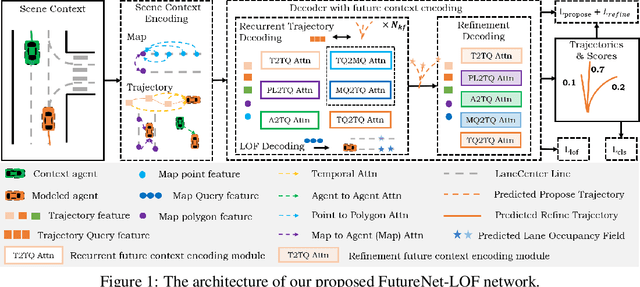
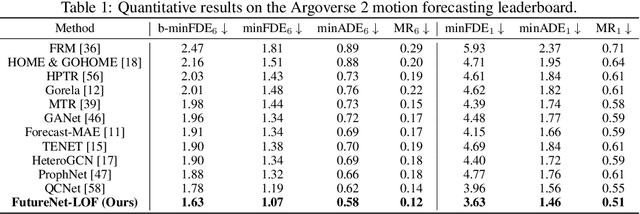
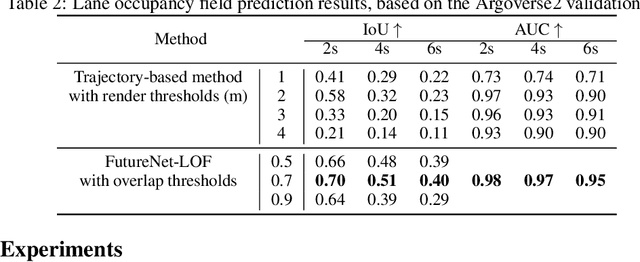
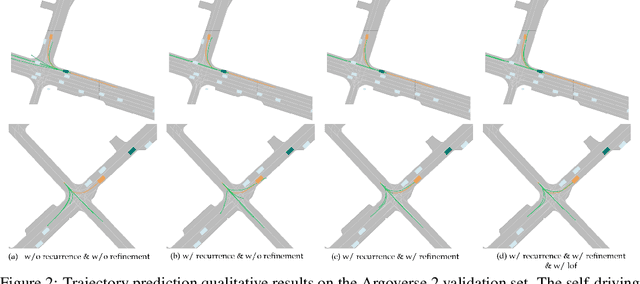
Most prior motion prediction endeavors in autonomous driving have inadequately encoded future scenarios, leading to predictions that may fail to accurately capture the diverse movements of agents (e.g., vehicles or pedestrians). To address this, we propose FutureNet, which explicitly integrates initially predicted trajectories into the future scenario and further encodes these future contexts to enhance subsequent forecasting. Additionally, most previous motion forecasting works have focused on predicting independent futures for each agent. However, safe and smooth autonomous driving requires accurately predicting the diverse future behaviors of numerous surrounding agents jointly in complex dynamic environments. Given that all agents occupy certain potential travel spaces and possess lane driving priority, we propose Lane Occupancy Field (LOF), a new representation with lane semantics for motion forecasting in autonomous driving. LOF can simultaneously capture the joint probability distribution of all road participants' future spatial-temporal positions. Due to the high compatibility between lane occupancy field prediction and trajectory prediction, we propose a novel network with future context encoding for the joint prediction of these two tasks. Our approach ranks 1st on two large-scale motion forecasting benchmarks: Argoverse 1 and Argoverse 2.
Dimba: Transformer-Mamba Diffusion Models
Jun 03, 2024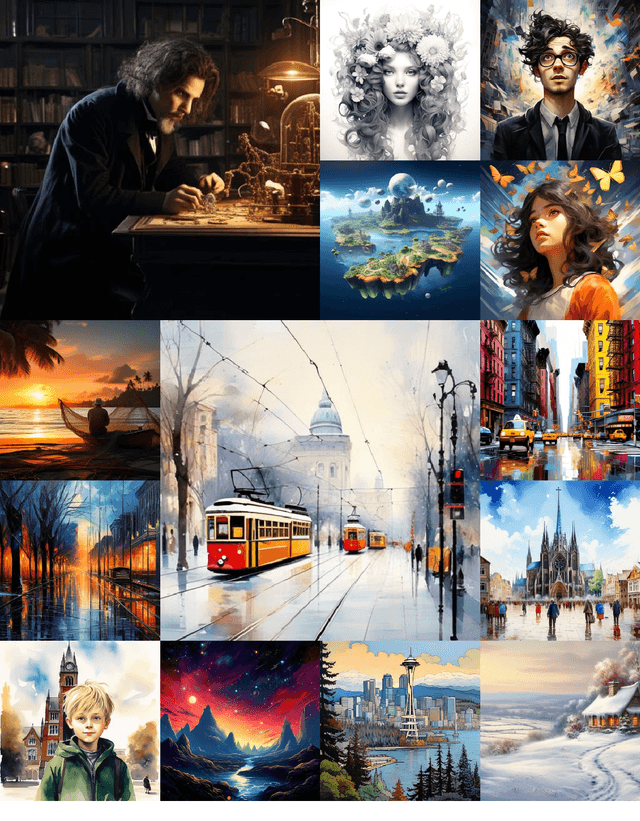
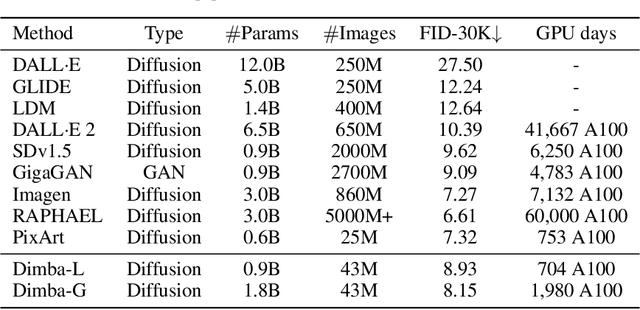
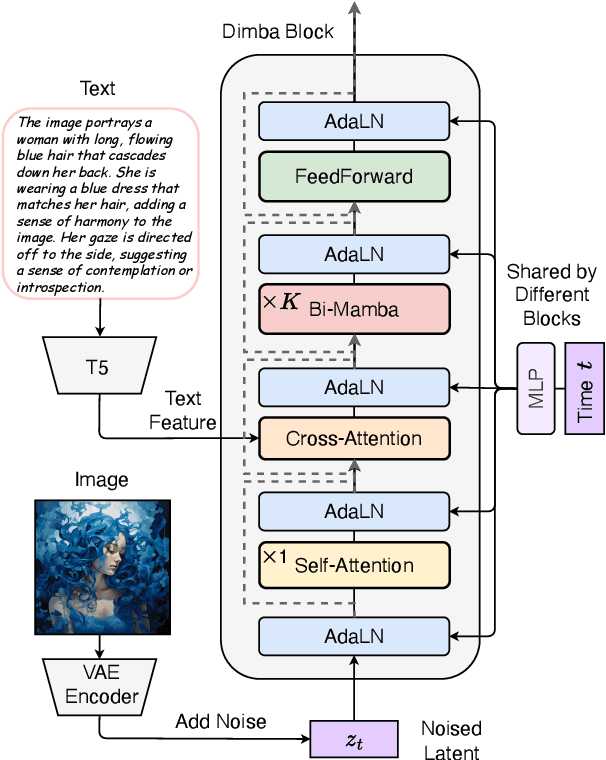
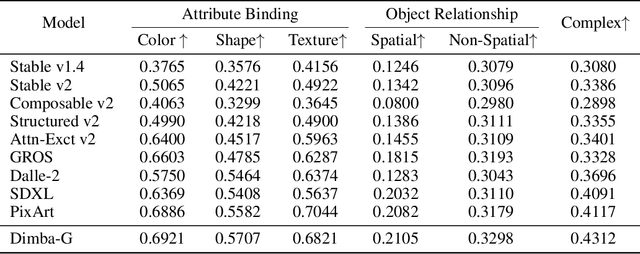
This paper unveils Dimba, a new text-to-image diffusion model that employs a distinctive hybrid architecture combining Transformer and Mamba elements. Specifically, Dimba sequentially stacked blocks alternate between Transformer and Mamba layers, and integrate conditional information through the cross-attention layer, thus capitalizing on the advantages of both architectural paradigms. We investigate several optimization strategies, including quality tuning, resolution adaption, and identify critical configurations necessary for large-scale image generation. The model's flexible design supports scenarios that cater to specific resource constraints and objectives. When scaled appropriately, Dimba offers substantial throughput and a reduced memory footprint relative to conventional pure Transformers-based benchmarks. Extensive experiments indicate that Dimba achieves comparable performance compared with benchmarks in terms of image quality, artistic rendering, and semantic control. We also report several intriguing properties of architecture discovered during evaluation and release checkpoints in experiments. Our findings emphasize the promise of large-scale hybrid Transformer-Mamba architectures in the foundational stage of diffusion models, suggesting a bright future for text-to-image generation.
Diffusion-RWKV: Scaling RWKV-Like Architectures for Diffusion Models
Apr 06, 2024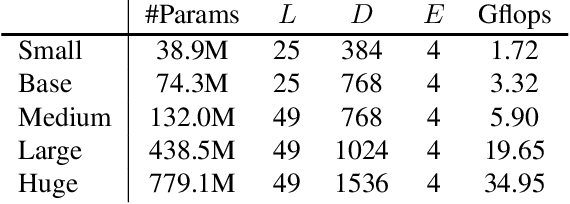
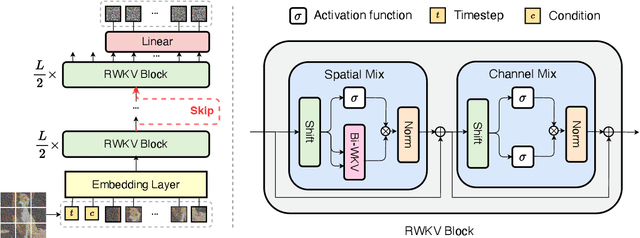


Transformers have catalyzed advancements in computer vision and natural language processing (NLP) fields. However, substantial computational complexity poses limitations for their application in long-context tasks, such as high-resolution image generation. This paper introduces a series of architectures adapted from the RWKV model used in the NLP, with requisite modifications tailored for diffusion model applied to image generation tasks, referred to as Diffusion-RWKV. Similar to the diffusion with Transformers, our model is designed to efficiently handle patchnified inputs in a sequence with extra conditions, while also scaling up effectively, accommodating both large-scale parameters and extensive datasets. Its distinctive advantage manifests in its reduced spatial aggregation complexity, rendering it exceptionally adept at processing high-resolution images, thereby eliminating the necessity for windowing or group cached operations. Experimental results on both condition and unconditional image generation tasks demonstrate that Diffison-RWKV achieves performance on par with or surpasses existing CNN or Transformer-based diffusion models in FID and IS metrics while significantly reducing total computation FLOP usage.