 Add to Chrome
 Add to Firefox
 Add to Edge
Factorized-Dreamer: Training A High-Quality Video Generator with Limited and Low-Quality Data
Aug 19, 2024

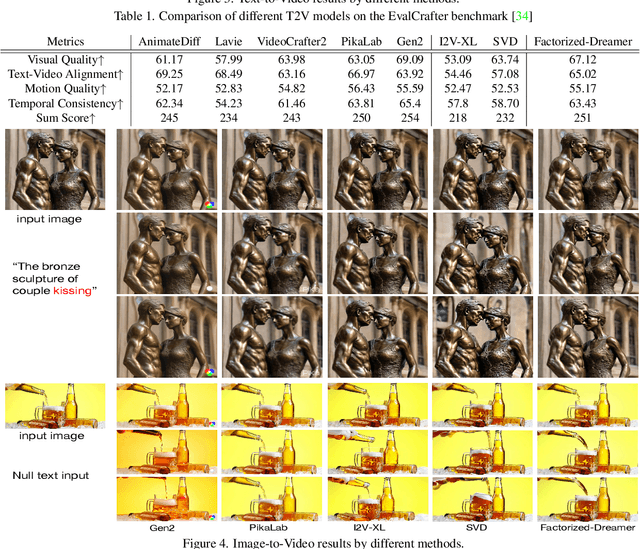
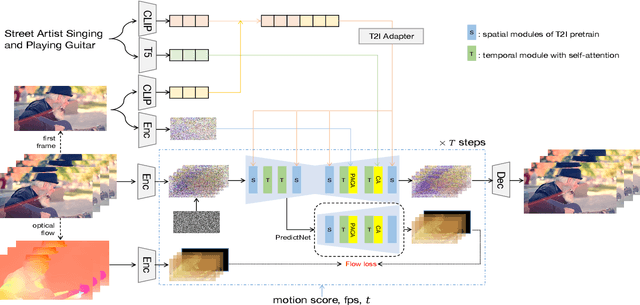
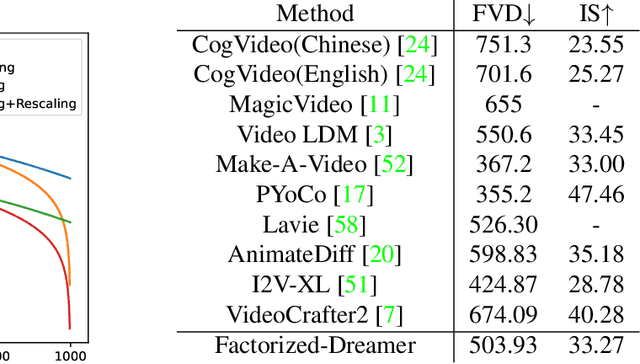
Text-to-video (T2V) generation has gained significant attention due to its wide applications to video generation, editing, enhancement and translation, \etc. However, high-quality (HQ) video synthesis is extremely challenging because of the diverse and complex motions existed in real world. Most existing works struggle to address this problem by collecting large-scale HQ videos, which are inaccessible to the community. In this work, we show that publicly available limited and low-quality (LQ) data are sufficient to train a HQ video generator without recaptioning or finetuning. We factorize the whole T2V generation process into two steps: generating an image conditioned on a highly descriptive caption, and synthesizing the video conditioned on the generated image and a concise caption of motion details. Specifically, we present \emph{Factorized-Dreamer}, a factorized spatiotemporal framework with several critical designs for T2V generation, including an adapter to combine text and image embeddings, a pixel-aware cross attention module to capture pixel-level image information, a T5 text encoder to better understand motion description, and a PredictNet to supervise optical flows. We further present a noise schedule, which plays a key role in ensuring the quality and stability of video generation. Our model lowers the requirements in detailed captions and HQ videos, and can be directly trained on limited LQ datasets with noisy and brief captions such as WebVid-10M, largely alleviating the cost to collect large-scale HQ video-text pairs. Extensive experiments in a variety of T2V and image-to-video generation tasks demonstrate the effectiveness of our proposed Factorized-Dreamer. Our source codes are available at \url{https://github.com/yangxy/Factorized-Dreamer/}.

HQOD: Harmonious Quantization for Object Detection
Aug 05, 2024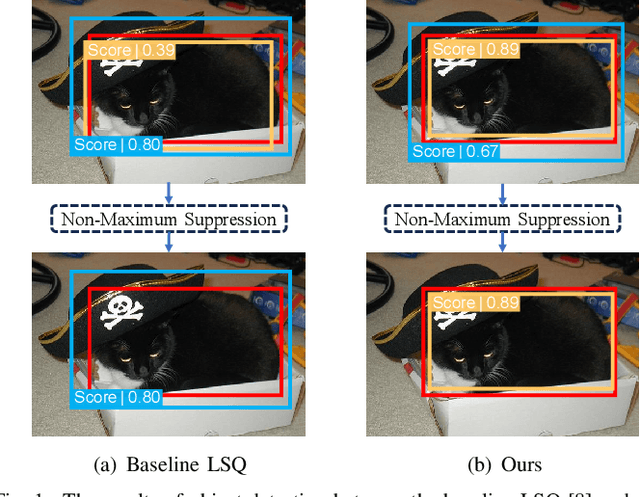
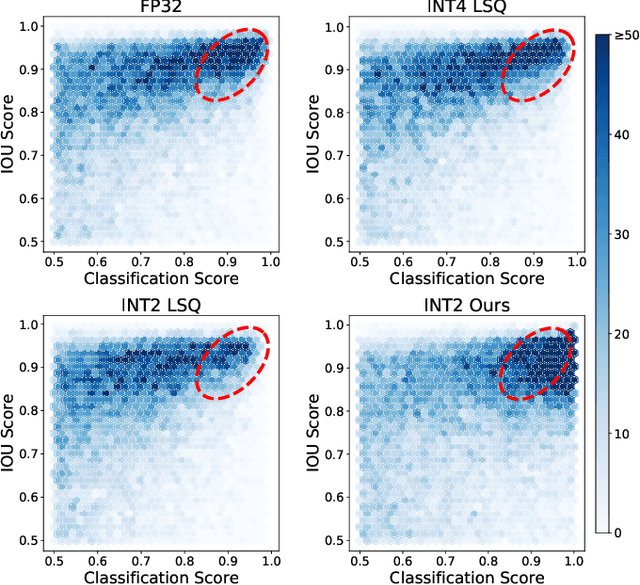
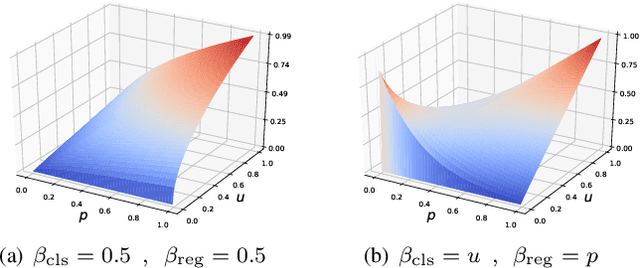
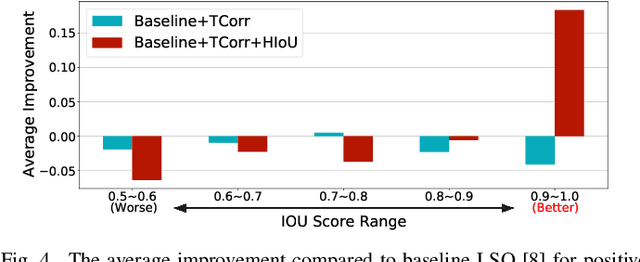
Task inharmony problem commonly occurs in modern object detectors, leading to inconsistent qualities between classification and regression tasks. The predicted boxes with high classification scores but poor localization positions or low classification scores but accurate localization positions will worsen the performance of detectors after Non-Maximum Suppression. Furthermore, when object detectors collaborate with Quantization-Aware Training (QAT), we observe that the task inharmony problem will be further exacerbated, which is considered one of the main causes of the performance degradation of quantized detectors. To tackle this issue, we propose the Harmonious Quantization for Object Detection (HQOD) framework, which consists of two components. Firstly, we propose a task-correlated loss to encourage detectors to focus on improving samples with lower task harmony quality during QAT. Secondly, a harmonious Intersection over Union (IoU) loss is incorporated to balance the optimization of the regression branch across different IoU levels. The proposed HQOD can be easily integrated into different QAT algorithms and detectors. Remarkably, on the MS COCO dataset, our 4-bit ATSS with ResNet-50 backbone achieves a state-of-the-art mAP of 39.6%, even surpassing the full-precision one.
InfiniMotion: Mamba Boosts Memory in Transformer for Arbitrary Long Motion Generation
Jul 14, 2024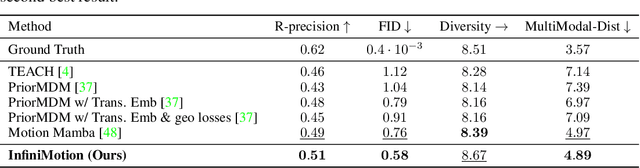
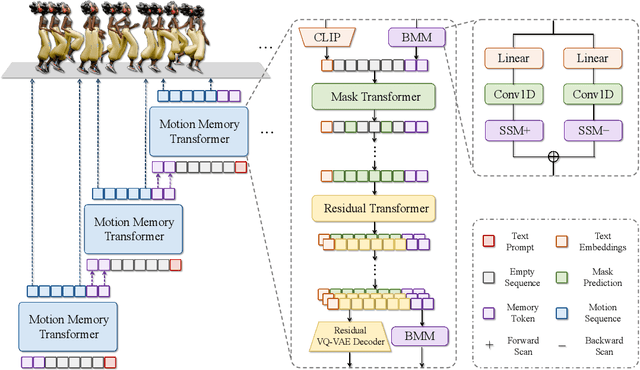
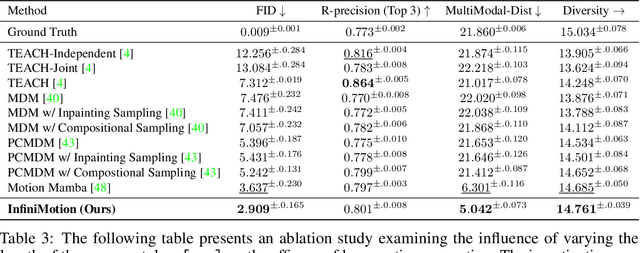
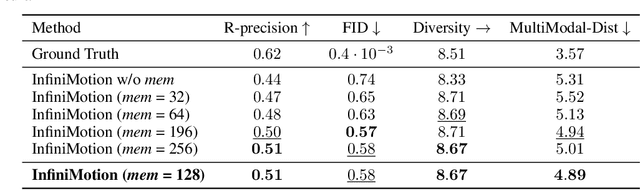
Text-to-motion generation holds potential for film, gaming, and robotics, yet current methods often prioritize short motion generation, making it challenging to produce long motion sequences effectively: (1) Current methods struggle to handle long motion sequences as a single input due to prohibitively high computational cost; (2) Breaking down the generation of long motion sequences into shorter segments can result in inconsistent transitions and requires interpolation or inpainting, which lacks entire sequence modeling. To solve these challenges, we propose InfiniMotion, a method that generates continuous motion sequences of arbitrary length within an autoregressive framework. We highlight its groundbreaking capability by generating a continuous 1-hour human motion with around 80,000 frames. Specifically, we introduce the Motion Memory Transformer with Bidirectional Mamba Memory, enhancing the transformer's memory to process long motion sequences effectively without overwhelming computational resources. Notably our method achieves over 30% improvement in FID and 6 times longer demonstration compared to previous state-of-the-art methods, showcasing significant advancements in long motion generation. See project webpage: https://steve-zeyu-zhang.github.io/InfiniMotion/
Can We Trust the Performance Evaluation of Uncertainty Estimation Methods in Text Summarization?
Jun 25, 2024Text summarization, a key natural language generation (NLG) task, is vital in various domains. However, the high cost of inaccurate summaries in risk-critical applications, particularly those involving human-in-the-loop decision-making, raises concerns about the reliability of uncertainty estimation on text summarization (UE-TS) evaluation methods. This concern stems from the dependency of uncertainty model metrics on diverse and potentially conflicting NLG metrics. To address this issue, we introduce a comprehensive UE-TS benchmark incorporating 31 NLG metrics across four dimensions. The benchmark evaluates the uncertainty estimation capabilities of two large language models and one pre-trained language model on three datasets, with human-annotation analysis incorporated where applicable. We also assess the performance of 14 common uncertainty estimation methods within this benchmark. Our findings emphasize the importance of considering multiple uncorrelated NLG metrics and diverse uncertainty estimation methods to ensure reliable and efficient evaluation of UE-TS techniques.
GMT: Guided Mask Transformer for Leaf Instance Segmentation
Jun 24, 2024


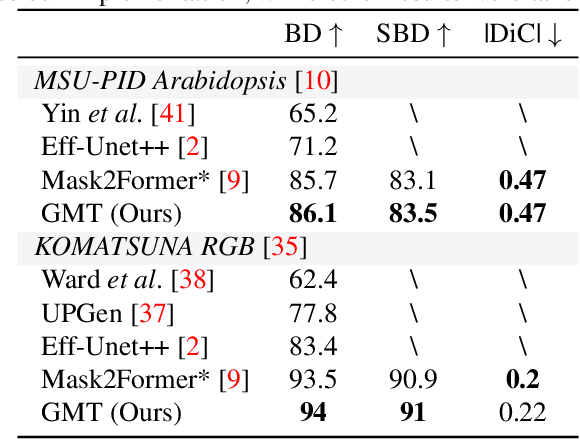
Leaf instance segmentation is a challenging multi-instance segmentation task, aiming to separate and delineate each leaf in an image of a plant. The delineation of each leaf is a necessary prerequisite task for several biology-related applications such as the fine-grained monitoring of plant growth, and crop yield estimation. The task is challenging because self-similarity of instances is high (similar shape and colour) and instances vary greatly in size under heavy occulusion. We believe that the key to overcoming the aforementioned challenges lies in the specific spatial patterns of leaf distribution. For example, leaves typically grow around the plant's center, with smaller leaves clustering and overlapped near this central point. In this paper, we propose a novel approach named Guided Mask Transformer (GMT), which contains three key components, namely Guided Positional Encoding (GPE), Guided Embedding Fusion Module (GEFM) and Guided Dynamic Positional Queries (GDPQ), to extend the meta-architecture of Mask2Former and incorporate with a set of harmonic guide functions. These guide functions are tailored to the pixel positions of instances and trained to separate distinct instances in an embedding space. The proposed GMT consistently outperforms State-of-the-Art models on three public plant datasets.
PCIE_EgoHandPose Solution for EgoExo4D Hand Pose Challenge
Jun 18, 2024This report presents our team's 'PCIE_EgoHandPose' solution for the EgoExo4D Hand Pose Challenge at CVPR2024. The main goal of the challenge is to accurately estimate hand poses, which involve 21 3D joints, using an RGB egocentric video image provided for the task. This task is particularly challenging due to the subtle movements and occlusions. To handle the complexity of the task, we propose the Hand Pose Vision Transformer (HP-ViT). The HP-ViT comprises a ViT backbone and transformer head to estimate joint positions in 3D, utilizing MPJPE and RLE loss function. Our approach achieved the 1st position in the Hand Pose challenge with 25.51 MPJPE and 8.49 PA-MPJPE. Code is available at https://github.com/KanokphanL/PCIE_EgoHandPose
PCIE_LAM Solution for Ego4D Looking At Me Challenge
Jun 18, 2024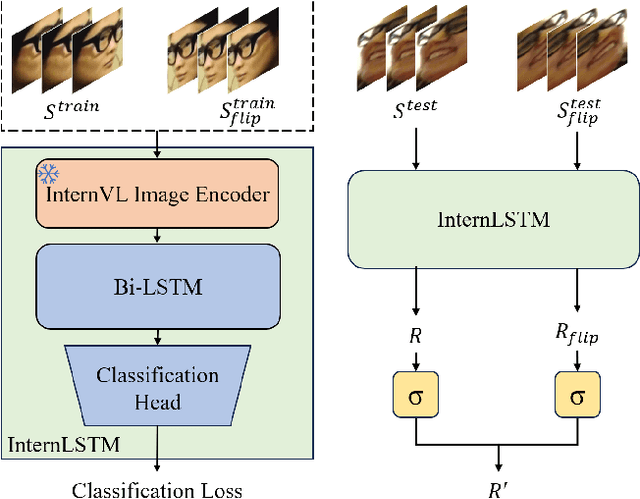


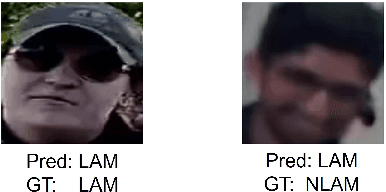
This report presents our team's 'PCIE_LAM' solution for the Ego4D Looking At Me Challenge at CVPR2024. The main goal of the challenge is to accurately determine if a person in the scene is looking at the camera wearer, based on a video where the faces of social partners have been localized. Our proposed solution, InternLSTM, consists of an InternVL image encoder and a Bi-LSTM network. The InternVL extracts spatial features, while the Bi-LSTM extracts temporal features. However, this task is highly challenging due to the distance between the person in the scene and the camera movement, which results in significant blurring in the face image. To address the complexity of the task, we implemented a Gaze Smoothing filter to eliminate noise or spikes from the output. Our approach achieved the 1st position in the looking at me challenge with 0.81 mAP and 0.93 accuracy rate. Code is available at https://github.com/KanokphanL/Ego4D_LAM_InternLSTM
Get rich quick: exact solutions reveal how unbalanced initializations promote rapid feature learning
Jun 10, 2024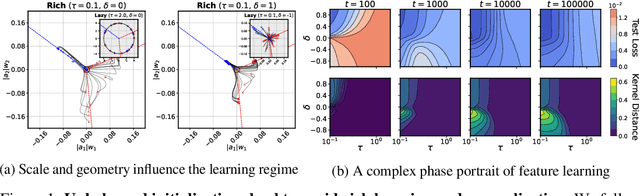

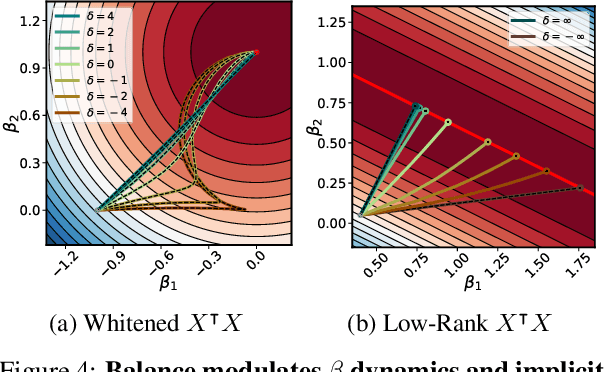
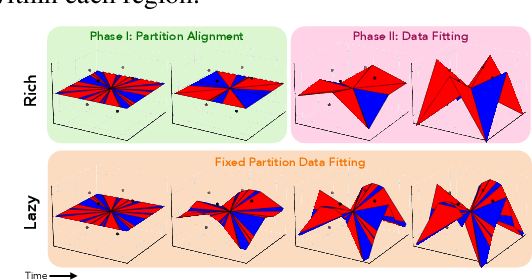
While the impressive performance of modern neural networks is often attributed to their capacity to efficiently extract task-relevant features from data, the mechanisms underlying this rich feature learning regime remain elusive, with much of our theoretical understanding stemming from the opposing lazy regime. In this work, we derive exact solutions to a minimal model that transitions between lazy and rich learning, precisely elucidating how unbalanced layer-specific initialization variances and learning rates determine the degree of feature learning. Our analysis reveals that they conspire to influence the learning regime through a set of conserved quantities that constrain and modify the geometry of learning trajectories in parameter and function space. We extend our analysis to more complex linear models with multiple neurons, outputs, and layers and to shallow nonlinear networks with piecewise linear activation functions. In linear networks, rapid feature learning only occurs with balanced initializations, where all layers learn at similar speeds. While in nonlinear networks, unbalanced initializations that promote faster learning in earlier layers can accelerate rich learning. Through a series of experiments, we provide evidence that this unbalanced rich regime drives feature learning in deep finite-width networks, promotes interpretability of early layers in CNNs, reduces the sample complexity of learning hierarchical data, and decreases the time to grokking in modular arithmetic. Our theory motivates further exploration of unbalanced initializations to enhance efficient feature learning.
Feature Contamination: Neural Networks Learn Uncorrelated Features and Fail to Generalize
Jun 06, 2024
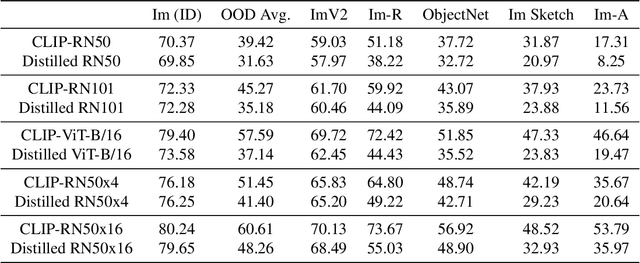

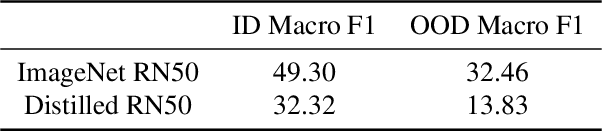
Learning representations that generalize under distribution shifts is critical for building robust machine learning models. However, despite significant efforts in recent years, algorithmic advances in this direction have been limited. In this work, we seek to understand the fundamental difficulty of out-of-distribution generalization with deep neural networks. We first empirically show that perhaps surprisingly, even allowing a neural network to explicitly fit the representations obtained from a teacher network that can generalize out-of-distribution is insufficient for the generalization of the student network. Then, by a theoretical study of two-layer ReLU networks optimized by stochastic gradient descent (SGD) under a structured feature model, we identify a fundamental yet unexplored feature learning proclivity of neural networks, feature contamination: neural networks can learn uncorrelated features together with predictive features, resulting in generalization failure under distribution shifts. Notably, this mechanism essentially differs from the prevailing narrative in the literature that attributes the generalization failure to spurious correlations. Overall, our results offer new insights into the non-linear feature learning dynamics of neural networks and highlight the necessity of considering inductive biases in out-of-distribution generalization.
Uncertainty Quantification for Bird's Eye View Semantic Segmentation: Methods and Benchmarks
May 31, 2024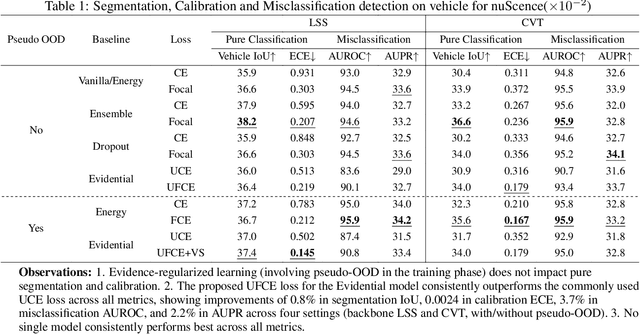
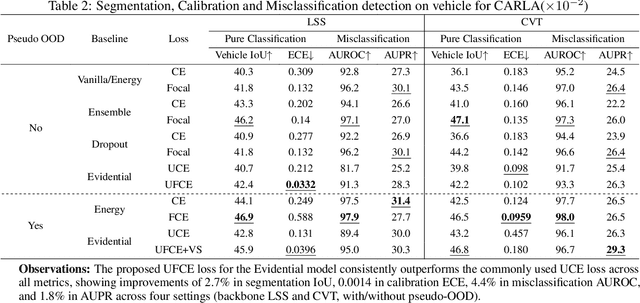

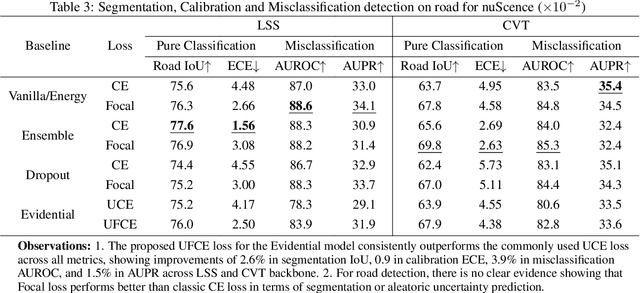
The fusion of raw features from multiple sensors on an autonomous vehicle to create a Bird's Eye View (BEV) representation is crucial for planning and control systems. There is growing interest in using deep learning models for BEV semantic segmentation. Anticipating segmentation errors and improving the explainability of DNNs is essential for autonomous driving, yet it is under-studied. This paper introduces a benchmark for predictive uncertainty quantification in BEV segmentation. The benchmark assesses various approaches across three popular datasets using two representative backbones and focuses on the effectiveness of predicted uncertainty in identifying misclassified and out-of-distribution (OOD) pixels, as well as calibration. Empirical findings highlight the challenges in uncertainty quantification. Our results find that evidential deep learning based approaches show the most promise by efficiently quantifying aleatoric and epistemic uncertainty. We propose the Uncertainty-Focal-Cross-Entropy (UFCE) loss, designed for highly imbalanced data, which consistently improves the segmentation quality and calibration. Additionally, we introduce a vacuity-scaled regularization term that enhances the model's focus on high uncertainty pixels, improving epistemic uncertainty quantification.