 Add to Chrome
 Add to Firefox
 Add to Edge
Optimal Representation Size: High-Dimensional Analysis of Pretraining and Linear Probing
May 19, 2026
Learning to generalise from limited data is a fundamental challenge for both artificial and biological systems. A common strategy is to extract reusable structure from abundant unlabelled data, enabling efficient adaptation to new tasks from limited labelled data. This two-stage paradigm is now standard in modern training pipelines, where pretraining is followed by fine-tuning or linear probing. We provide an analytical model of this process: structure extraction is formalized as principal component analysis on unlabelled data, and downstream learning as linear regression on a separate labelled dataset. In the high-dimensional regime, we derive exact expressions for training and generalisation error showcasing their dependence on representation dimensionality, unlabelled and labelled sample sizes, and task alignment. Our results show that pretrained representations strongly influence downstream generalisation, and we characterize the optimal representation size as a function of task parameters: with abundant pretraining data but scarce downstream data, maximally compressed representations are optimal, whereas with limited pretraining data, higher-dimensional representations generalise better. Furthermore, we establish an exact trade-off between pretraining and supervision, quantifying how much unlabelled data is required to replace a single labelled sample. Beyond our idealised model, we observe similar phenomenology in autoencoders and pretrained LLMs. Altogether, we highlight that optimising representation size is critical, giving conditions for when compression during pretraining improves generalisation.

Get rich quick: exact solutions reveal how unbalanced initializations promote rapid feature learning
Jun 10, 2024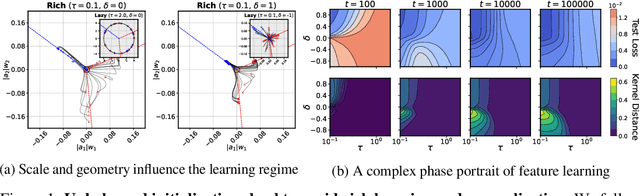

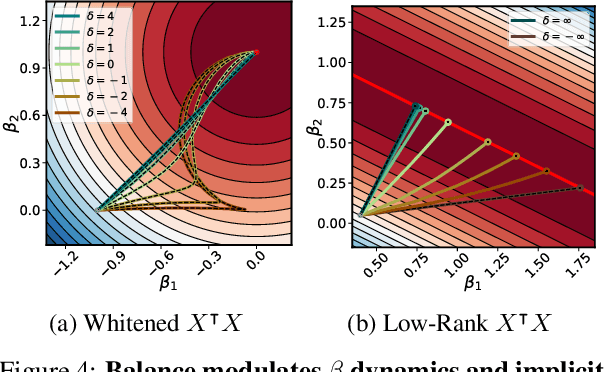
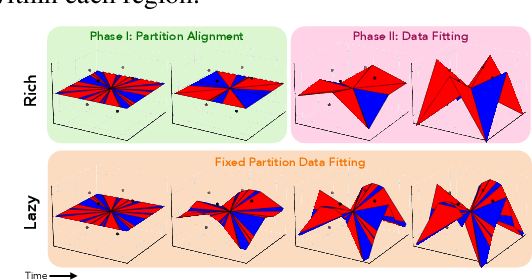
While the impressive performance of modern neural networks is often attributed to their capacity to efficiently extract task-relevant features from data, the mechanisms underlying this rich feature learning regime remain elusive, with much of our theoretical understanding stemming from the opposing lazy regime. In this work, we derive exact solutions to a minimal model that transitions between lazy and rich learning, precisely elucidating how unbalanced layer-specific initialization variances and learning rates determine the degree of feature learning. Our analysis reveals that they conspire to influence the learning regime through a set of conserved quantities that constrain and modify the geometry of learning trajectories in parameter and function space. We extend our analysis to more complex linear models with multiple neurons, outputs, and layers and to shallow nonlinear networks with piecewise linear activation functions. In linear networks, rapid feature learning only occurs with balanced initializations, where all layers learn at similar speeds. While in nonlinear networks, unbalanced initializations that promote faster learning in earlier layers can accelerate rich learning. Through a series of experiments, we provide evidence that this unbalanced rich regime drives feature learning in deep finite-width networks, promotes interpretability of early layers in CNNs, reduces the sample complexity of learning hierarchical data, and decreases the time to grokking in modular arithmetic. Our theory motivates further exploration of unbalanced initializations to enhance efficient feature learning.