 Add to Chrome
 Add to Firefox
 Add to Edge
Presentation, Not Mechanism: A Render Confound in Deprecation-Aware Memory Evaluation
Jul 17, 2026
AI systems increasingly retrieve from records that revise themselves: issue threads, encyclopedic histories, policy logs, and long conversations. The challenge is not only finding relevant evidence, but deciding which claims remain in force, which were superseded, and when to abstain. Structured memories promise to solve this with typed edges, temporal updates, and conflict status, yet evaluations often change mechanism and prompt presentation together. We study this as Evidence-State Revision, comparing flat retrieval, coarse edge invalidation, and fine-grained RevisionLedger on 2,907 high-agreement questions from GitHub, multi-repo issue histories, Wikipedia, and DyKnow-style temporal streams. A render-matched control (same layout, deprecation disabled) reveals the central confound: when a value is changed and later restored, RevisionLedger appears to beat a flat baseline by +0.182, but almost all the gain comes from easier presentation; the fine-grained mechanism residual is indistinguishable from zero (+0.021 to +0.025 across two judge families). After presentation is controlled, coarse invalidation is the only mechanism that pays for current-state queries, beating the fine ledger by 0.084; the same query-sufficiency principle says provenance mainly needs retained invalidated evidence, not richer typing. Memory evaluations should hold render fixed, and deprecation-aware systems should deploy the coarsest retained state that covers their queries.

Better Accuracies, Worse Reasoning: A Step-Level Audit of Medical Chain-of-Thought Distillation
May 27, 2026Chain-of-thought (CoT) distillation trains a smaller model to imitate a teacher's reasoning trace, but it is typically evaluated by final-answer metrics including accuracy. We ask whether gains in answer quality are accompanied by improvements in the trace. In medical QA, where short answer options can leave a richer clinical justification under-specified, a Qwen3-8B student distilled from a DeepSeek-V3-family teacher improves on MedQA-USMLE answer metrics (SC@64 74.7% to 84.4%; expected calibration error (ECE) 0.096 to 0.034). Yet under a Kimi-K2.6 style-blind LLM-judge audit, its error rate over non-abstained steps rises from 30.6% to 50.3%. In this primary medical setting, answer quality and trace factuality move in opposite directions. This before--after pattern persists across evaluators, teacher strengths, student scales and families, medical benchmarks, and style, segmentation, and answer-correctness controls. A 150-step blinded audit by a clinical expert reproduces the same ordering. Boundary checks narrow the scope of the claim: the risk appears when a compact answer under-constrains the rationale and a capable student can imitate expert-like form without reliably grounding each local claim. Standard answer metrics and aggregate hedging rates do not reveal the shift. When such traces are released or reused, answer-level metrics alone are insufficient.
A Regime Theory of Controller Class Selection for LLM Action Decisions
May 07, 2026Deployed language and vision-language models must decide, on each input, whether to answer directly, retrieve evidence, defer to a stronger model, or abstain. Contrary to the common monotonicity intuition, greater per-input expressivity is not uniformly beneficial in finite samples: under identical strict cross-validation, different benchmarks prefer different controller classes. This reflects a finite-sample limitation of instance-level uncertainty signals, which can be exhausted at a distribution-dependent scale. We organize controllers into a nested lattice of four classes: fixed actions, partition routers, instance-level controllers, and prior-gated controllers, ordered by complexity. We prove a regime theory that turns three data-estimable bottlenecks into a class choice: how much improvement is possible beyond the best fixed action, whether there are enough samples for instance-level controllers to make reliable decisions, and how much improvement a coarse partition router can recover when instance-level signal is unreliable. The resulting Bernstein-tight threshold has a matching information-theoretic lower bound, and strict nested cross-validation provably selects a near-best class. Across SMS-Spam, HallusionBench, A-OKVQA, and FOLIO, the predicted class matches the empirical winner; the prior-gated controller wins on TextVQA when OCR tokens supply a label-free prediction-time prior. Code is available at https://github.com/Anonymous-Awesome-Submissions/Regime-Theory.
Focus on the Whole Character: Discriminative Character Modeling for Scene Text Recognition
Jul 08, 2024Recently, scene text recognition (STR) models have shown significant performance improvements. However, existing models still encounter difficulties in recognizing challenging texts that involve factors such as severely distorted and perspective characters. These challenging texts mainly cause two problems: (1) Large Intra-Class Variance. (2) Small Inter-Class Variance. An extremely distorted character may prominently differ visually from other characters within the same category, while the variance between characters from different classes is relatively small. To address the above issues, we propose a novel method that enriches the character features to enhance the discriminability of characters. Firstly, we propose the Character-Aware Constraint Encoder (CACE) with multiple blocks stacked. CACE introduces a decay matrix in each block to explicitly guide the attention region for each token. By continuously employing the decay matrix, CACE enables tokens to perceive morphological information at the character level. Secondly, an Intra-Inter Consistency Loss (I^2CL) is introduced to consider intra-class compactness and inter-class separability at feature space. I^2CL improves the discriminative capability of features by learning a long-term memory unit for each character category. Trained with synthetic data, our model achieves state-of-the-art performance on common benchmarks (94.1% accuracy) and Union14M-Benchmark (61.6% accuracy). Code is available at https://github.com/bang123-box/CFE.
Pre-trained Token-replaced Detection Model as Few-shot Learner
Mar 07, 2022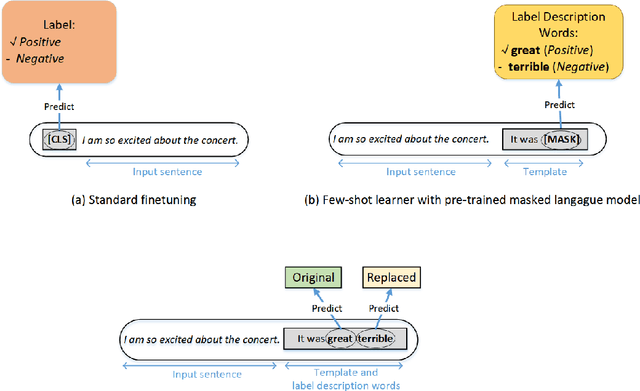
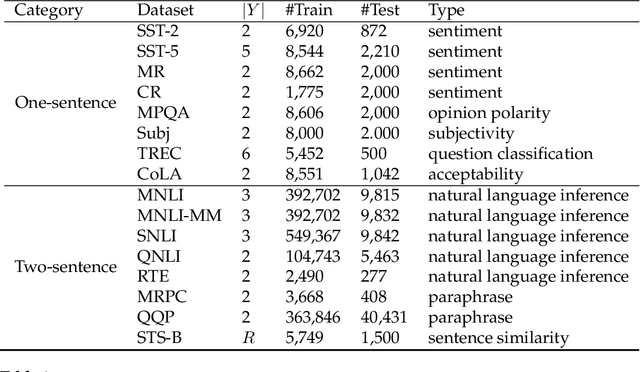
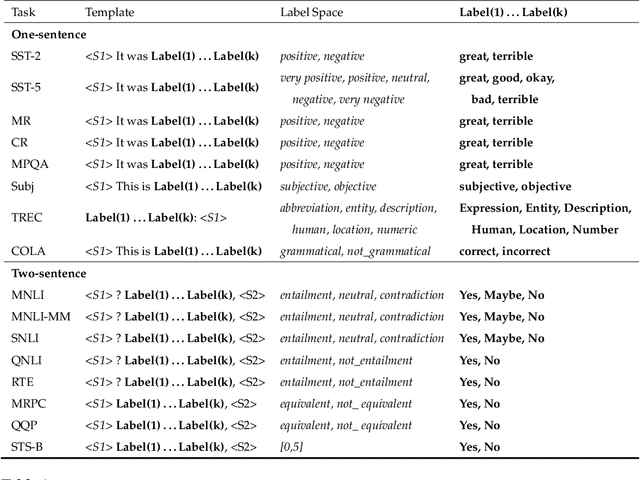
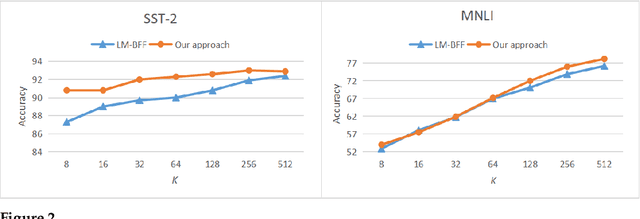
Pre-trained masked language models have demonstrated remarkable ability as few-shot learners. In this paper, as an alternative, we propose a novel approach to few-shot learning with pre-trained token-replaced detection models like ELECTRA. In this approach, we reformulate a classification or a regression task as a token-replaced detection problem. Specifically, we first define a template and label description words for each task and put them into the input to form a natural language prompt. Then, we employ the pre-trained token-replaced detection model to predict which label description word is the most original (i.e., least replaced) among all label description words in the prompt. A systematic evaluation on 16 datasets demonstrates that our approach outperforms few-shot learners with pre-trained masked language models in both one-sentence and two-sentence learning tasks.