 Add to Chrome
 Add to Firefox
 Add to Edge
Gaussians-to-Life: Text-Driven Animation of 3D Gaussian Splatting Scenes
Nov 28, 2024

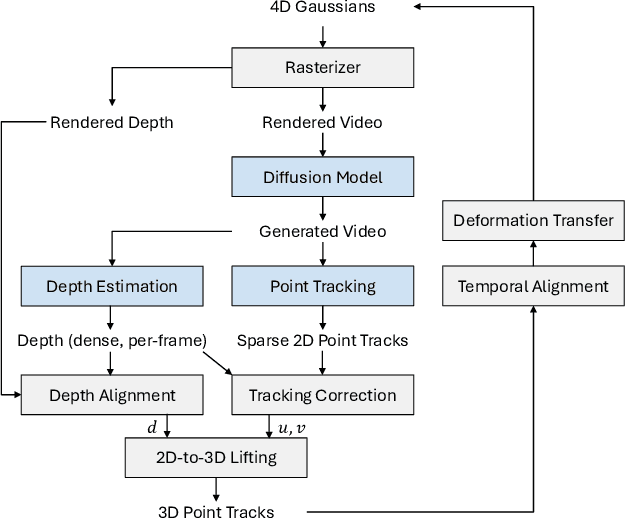
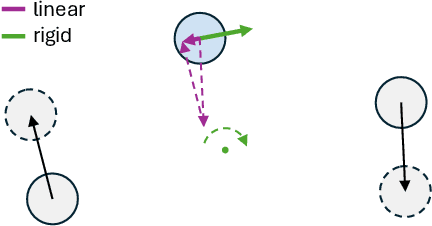
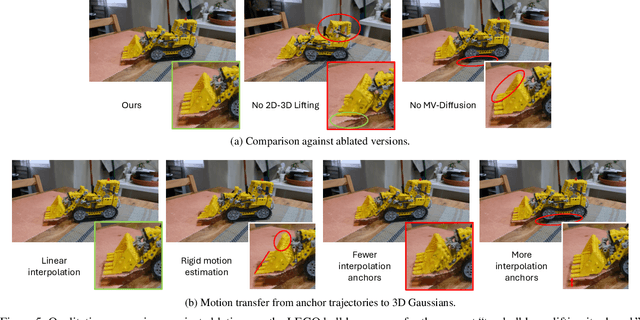
State-of-the-art novel view synthesis methods achieve impressive results for multi-view captures of static 3D scenes. However, the reconstructed scenes still lack "liveliness," a key component for creating engaging 3D experiences. Recently, novel video diffusion models generate realistic videos with complex motion and enable animations of 2D images, however they cannot naively be used to animate 3D scenes as they lack multi-view consistency. To breathe life into the static world, we propose Gaussians2Life, a method for animating parts of high-quality 3D scenes in a Gaussian Splatting representation. Our key idea is to leverage powerful video diffusion models as the generative component of our model and to combine these with a robust technique to lift 2D videos into meaningful 3D motion. We find that, in contrast to prior work, this enables realistic animations of complex, pre-existing 3D scenes and further enables the animation of a large variety of object classes, while related work is mostly focused on prior-based character animation, or single 3D objects. Our model enables the creation of consistent, immersive 3D experiences for arbitrary scenes.

Active Data Curation Effectively Distills Large-Scale Multimodal Models
Nov 27, 2024Knowledge distillation (KD) is the de facto standard for compressing large-scale models into smaller ones. Prior works have explored ever more complex KD strategies involving different objective functions, teacher-ensembles, and weight inheritance. In this work we explore an alternative, yet simple approach -- active data curation as effective distillation for contrastive multimodal pretraining. Our simple online batch selection method, ACID, outperforms strong KD baselines across various model-, data- and compute-configurations. Further, we find such an active data curation strategy to in fact be complementary to standard KD, and can be effectively combined to train highly performant inference-efficient models. Our simple and scalable pretraining framework, ACED, achieves state-of-the-art results across 27 zero-shot classification and retrieval tasks with upto 11% less inference FLOPs. We further demonstrate that our ACED models yield strong vision-encoders for training generative multimodal models in the LiT-Decoder setting, outperforming larger vision encoders for image-captioning and visual question-answering tasks.
SmileSplat: Generalizable Gaussian Splats for Unconstrained Sparse Images
Nov 27, 2024


Sparse Multi-view Images can be Learned to predict explicit radiance fields via Generalizable Gaussian Splatting approaches, which can achieve wider application prospects in real-life when ground-truth camera parameters are not required as inputs. In this paper, a novel generalizable Gaussian Splatting method, SmileSplat, is proposed to reconstruct pixel-aligned Gaussian surfels for diverse scenarios only requiring unconstrained sparse multi-view images. First, Gaussian surfels are predicted based on the multi-head Gaussian regression decoder, which can are represented with less degree-of-freedom but have better multi-view consistency. Furthermore, the normal vectors of Gaussian surfel are enhanced based on high-quality of normal priors. Second, the Gaussians and camera parameters (both extrinsic and intrinsic) are optimized to obtain high-quality Gaussian radiance fields for novel view synthesis tasks based on the proposed Bundle-Adjusting Gaussian Splatting module. Extensive experiments on novel view rendering and depth map prediction tasks are conducted on public datasets, demonstrating that the proposed method achieves state-of-the-art performance in various 3D vision tasks. More information can be found on our project page (https://yanyan-li.github.io/project/gs/smilesplat)
G2SDF: Surface Reconstruction from Explicit Gaussians with Implicit SDFs
Nov 25, 2024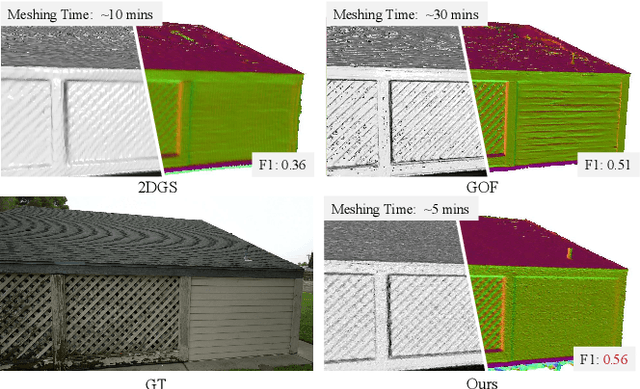
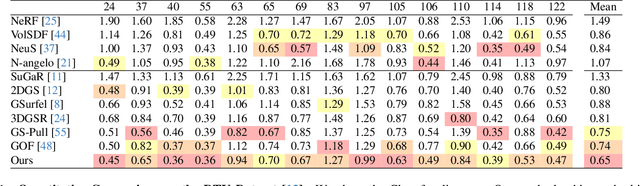
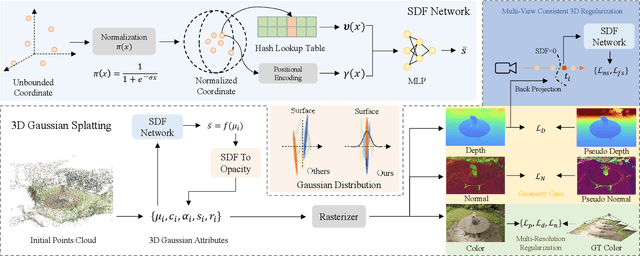
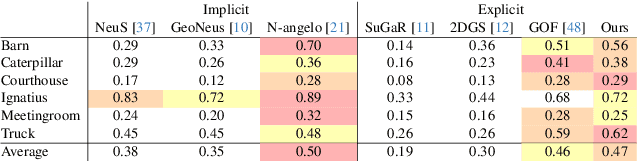
State-of-the-art novel view synthesis methods such as 3D Gaussian Splatting (3DGS) achieve remarkable visual quality. While 3DGS and its variants can be rendered efficiently using rasterization, many tasks require access to the underlying 3D surface, which remains challenging to extract due to the sparse and explicit nature of this representation. In this paper, we introduce G2SDF, a novel approach that addresses this limitation by integrating a neural implicit Signed Distance Field (SDF) into the Gaussian Splatting framework. Our method links the opacity values of Gaussians with their distances to the surface, ensuring a closer alignment of Gaussians with the scene surface. To extend this approach to unbounded scenes at varying scales, we propose a normalization function that maps any range to a fixed interval. To further enhance reconstruction quality, we leverage an off-the-shelf depth estimator as pseudo ground truth during Gaussian Splatting optimization. By establishing a differentiable connection between the explicit Gaussians and the implicit SDF, our approach enables high-quality surface reconstruction and rendering. Experimental results on several real-world datasets demonstrate that G2SDF achieves superior reconstruction quality than prior works while maintaining the efficiency of 3DGS.
UNOPose: Unseen Object Pose Estimation with an Unposed RGB-D Reference Image
Nov 25, 2024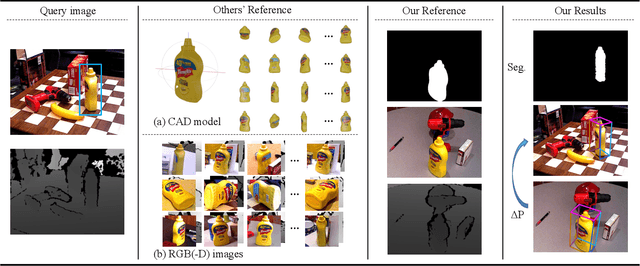
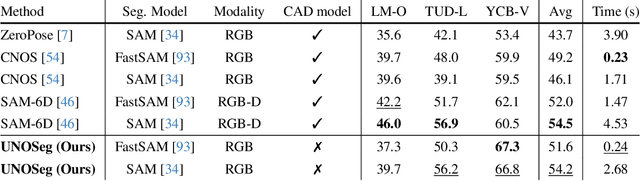
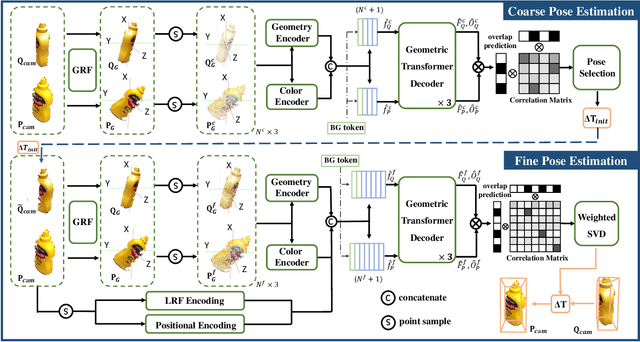
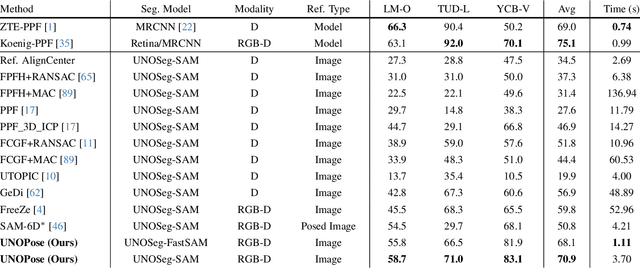
Unseen object pose estimation methods often rely on CAD models or multiple reference views, making the onboarding stage costly. To simplify reference acquisition, we aim to estimate the unseen object's pose through a single unposed RGB-D reference image. While previous works leverage reference images as pose anchors to limit the range of relative pose, our scenario presents significant challenges since the relative transformation could vary across the entire SE(3) space. Moreover, factors like occlusion, sensor noise, and extreme geometry could result in low viewpoint overlap. To address these challenges, we present a novel approach and benchmark, termed UNOPose, for unseen one-reference-based object pose estimation. Building upon a coarse-to-fine paradigm, UNOPose constructs an SE(3)-invariant reference frame to standardize object representation despite pose and size variations. To alleviate small overlap across viewpoints, we recalibrate the weight of each correspondence based on its predicted likelihood of being within the overlapping region. Evaluated on our proposed benchmark based on the BOP Challenge, UNOPose demonstrates superior performance, significantly outperforming traditional and learning-based methods in the one-reference setting and remaining competitive with CAD-model-based methods. The code and dataset will be available.
TokenFormer: Rethinking Transformer Scaling with Tokenized Model Parameters
Oct 30, 2024
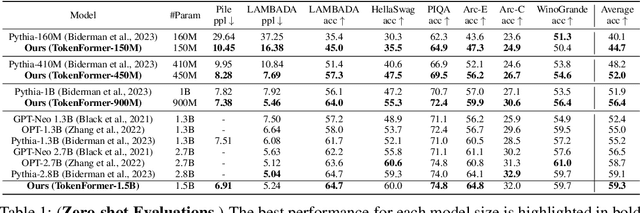
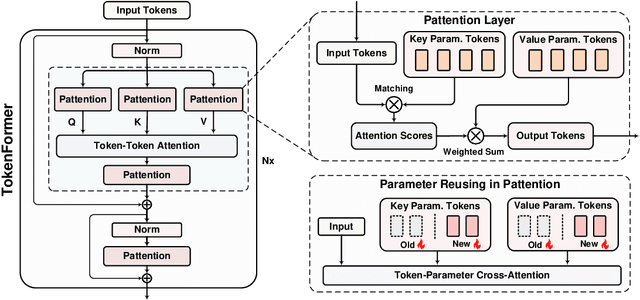
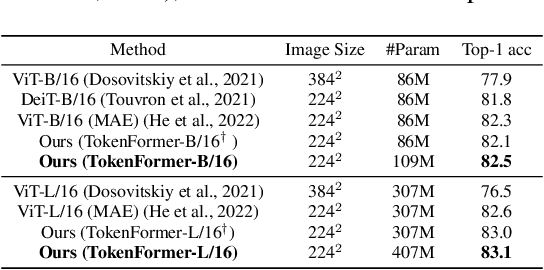
Transformers have become the predominant architecture in foundation models due to their excellent performance across various domains. However, the substantial cost of scaling these models remains a significant concern. This problem arises primarily from their dependence on a fixed number of parameters within linear projections. When architectural modifications (e.g., channel dimensions) are introduced, the entire model typically requires retraining from scratch. As model sizes continue growing, this strategy results in increasingly high computational costs and becomes unsustainable. To overcome this problem, we introduce TokenFormer, a natively scalable architecture that leverages the attention mechanism not only for computations among input tokens but also for interactions between tokens and model parameters, thereby enhancing architectural flexibility. By treating model parameters as tokens, we replace all the linear projections in Transformers with our token-parameter attention layer, where input tokens act as queries and model parameters as keys and values. This reformulation allows for progressive and efficient scaling without necessitating retraining from scratch. Our model scales from 124M to 1.4B parameters by incrementally adding new key-value parameter pairs, achieving performance comparable to Transformers trained from scratch while greatly reducing training costs. Code and models are available at \url{https://github.com/Haiyang-W/TokenFormer}.
Neural Semantic Map-Learning for Autonomous Vehicles
Oct 10, 2024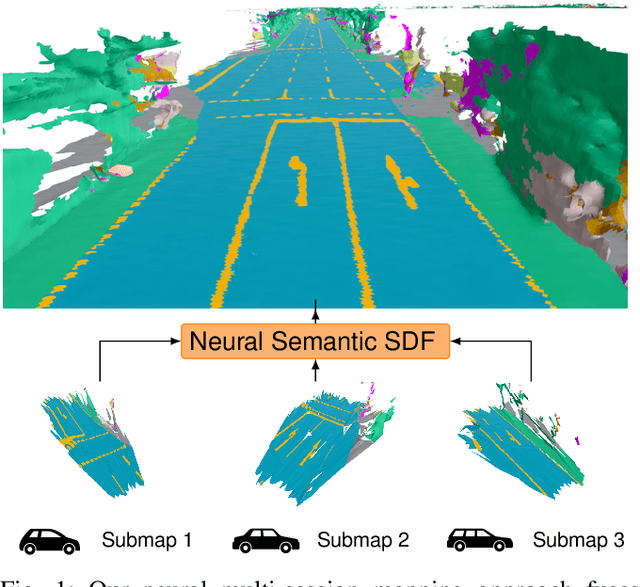
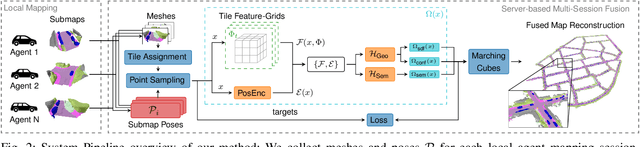
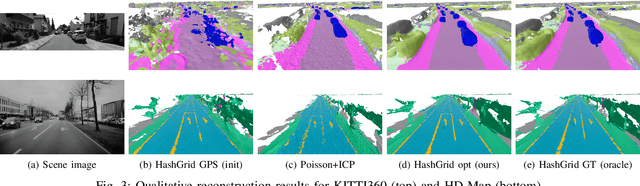
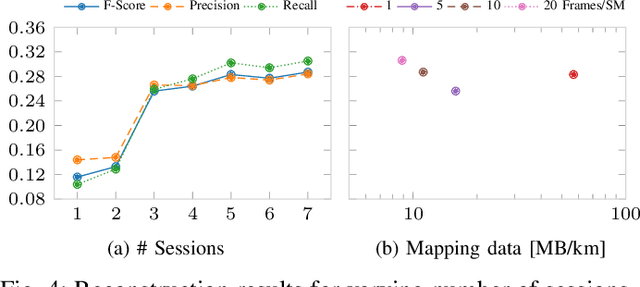
Autonomous vehicles demand detailed maps to maneuver reliably through traffic, which need to be kept up-to-date to ensure a safe operation. A promising way to adapt the maps to the ever-changing road-network is to use crowd-sourced data from a fleet of vehicles. In this work, we present a mapping system that fuses local submaps gathered from a fleet of vehicles at a central instance to produce a coherent map of the road environment including drivable area, lane markings, poles, obstacles and more as a 3D mesh. Each vehicle contributes locally reconstructed submaps as lightweight meshes, making our method applicable to a wide range of reconstruction methods and sensor modalities. Our method jointly aligns and merges the noisy and incomplete local submaps using a scene-specific Neural Signed Distance Field, which is supervised using the submap meshes to predict a fused environment representation. We leverage memory-efficient sparse feature-grids to scale to large areas and introduce a confidence score to model uncertainty in scene reconstruction. Our approach is evaluated on two datasets with different local mapping methods, showing improved pose alignment and reconstruction over existing methods. Additionally, we demonstrate the benefit of multi-session mapping and examine the required amount of data to enable high-fidelity map learning for autonomous vehicles.
Search3D: Hierarchical Open-Vocabulary 3D Segmentation
Sep 27, 2024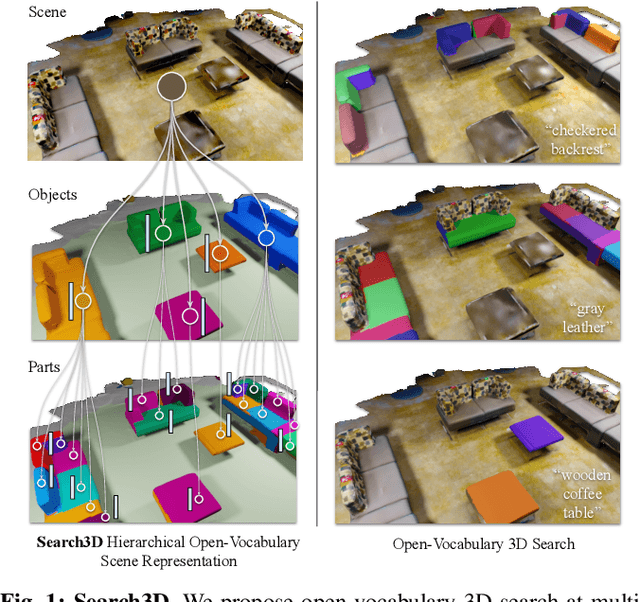

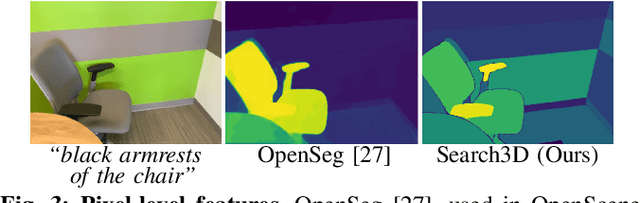

Open-vocabulary 3D segmentation enables the exploration of 3D spaces using free-form text descriptions. Existing methods for open-vocabulary 3D instance segmentation primarily focus on identifying object-level instances in a scene. However, they face challenges when it comes to understanding more fine-grained scene entities such as object parts, or regions described by generic attributes. In this work, we introduce Search3D, an approach that builds a hierarchical open-vocabulary 3D scene representation, enabling the search for entities at varying levels of granularity: fine-grained object parts, entire objects, or regions described by attributes like materials. Our method aims to expand the capabilities of open vocabulary instance-level 3D segmentation by shifting towards a more flexible open-vocabulary 3D search setting less anchored to explicit object-centric queries, compared to prior work. To ensure a systematic evaluation, we also contribute a scene-scale open-vocabulary 3D part segmentation benchmark based on MultiScan, along with a set of open-vocabulary fine-grained part annotations on ScanNet++. We verify the effectiveness of Search3D across several tasks, demonstrating that our approach outperforms baselines in scene-scale open-vocabulary 3D part segmentation, while maintaining strong performance in segmenting 3D objects and materials.
Self-supervised Shape Completion via Involution and Implicit Correspondences
Sep 24, 2024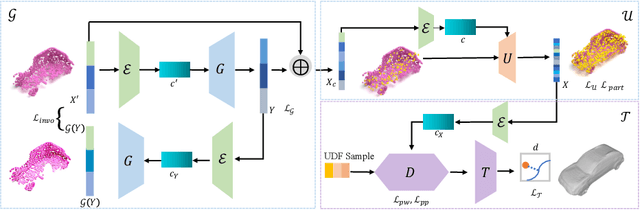
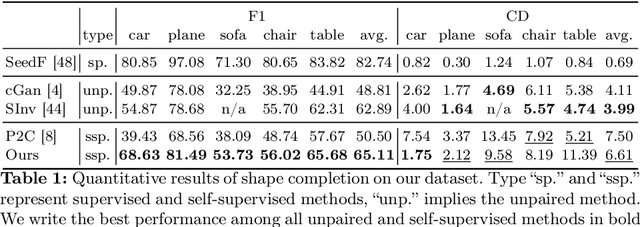
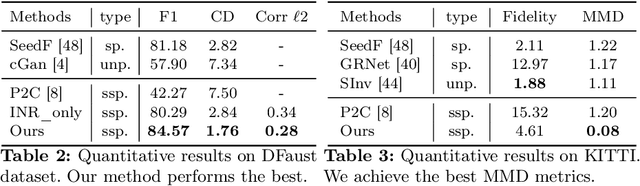
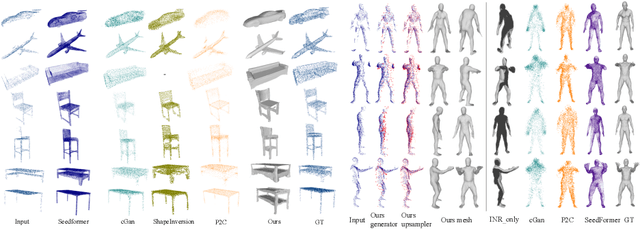
3D shape completion is traditionally solved using supervised training or by distribution learning on complete shape examples. Recently self-supervised learning approaches that do not require any complete 3D shape examples have gained more interests. In this paper, we propose a non-adversarial self-supervised approach for the shape completion task. Our first finding is that completion problems can be formulated as an involutory function trivially, which implies a special constraint on the completion function G, such that G(G(X)) = X. Our second constraint on self-supervised shape completion relies on the fact that shape completion becomes easier to solve with correspondences and similarly, completion can simplify the correspondences problem. We formulate a consistency measure in the canonical space in order to supervise the completion function. We efficiently optimize the completion and correspondence modules using "freeze and alternate" strategy. The overall approach performs well for rigid shapes in a category as well as dynamic non-rigid shapes. We ablate our design choices and compare our solution against state-of-the-art methods, showing remarkable accuracy approaching supervised accuracy in some cases.
LiLoc: Lifelong Localization using Adaptive Submap Joining and Egocentric Factor Graph
Sep 16, 2024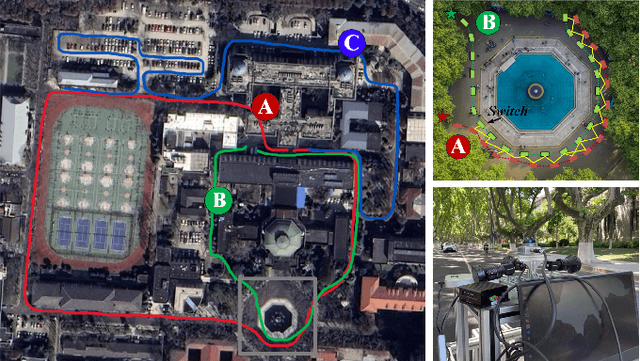
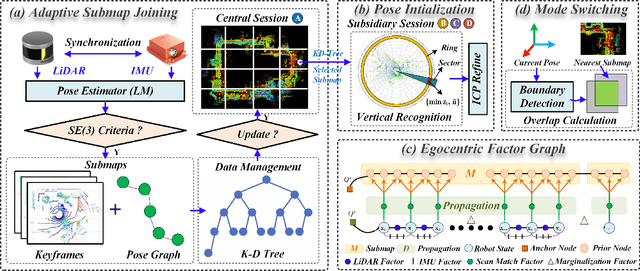

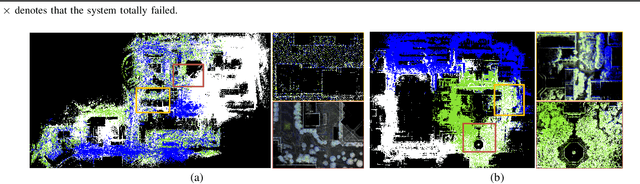
This paper proposes a versatile graph-based lifelong localization framework, LiLoc, which enhances its timeliness by maintaining a single central session while improves the accuracy through multi-modal factors between the central and subsidiary sessions. First, an adaptive submap joining strategy is employed to generate prior submaps (keyframes and poses) for the central session, and to provide priors for subsidiaries when constraints are needed for robust localization. Next, a coarse-to-fine pose initialization for subsidiary sessions is performed using vertical recognition and ICP refinement in the global coordinate frame. To elevate the accuracy of subsequent localization, we propose an egocentric factor graph (EFG) module that integrates the IMU preintegration, LiDAR odometry and scan match factors in a joint optimization manner. Specifically, the scan match factors are constructed by a novel propagation model that efficiently distributes the prior constrains as edges to the relevant prior pose nodes, weighted by noises based on keyframe registration errors. Additionally, the framework supports flexible switching between two modes: relocalization (RLM) and incremental localization (ILM) based on the proposed overlap-based mechanism to select or update the prior submaps from central session. The proposed LiLoc is tested on public and custom datasets, demonstrating accurate localization performance against state-of-the-art methods. Our codes will be publicly available on https://github.com/Yixin-F/LiLoc.