 Add to Chrome
 Add to Firefox
 Add to Edge
Knowledge Cascade: Reverse Knowledge Distillation on Nonparametric Multivariate Functional Estimation
Jun 24, 2026
As machine learning models and datasets continue to grow, developing complex models has become increasingly computationally demanding. Knowledge distillation reduces deployment cost by compressing a large, well-trained teacher model into a compact student model, but it does not address settings where constructing the teacher itself is the bottleneck. Motivated by this challenge, we introduce Knowledge Cascade (KCas), a reverse knowledge distillation framework that uses information from a small, inexpensive student model to guide the development of a more complex teacher model. Although this direction is counterintuitive because the teacher typically has greater representational capacity, we show that student-to-teacher transfer can be principled when supported by statistical scaling relationships. We first develop KCas for nonparametric multivariate functional estimation in reproducing kernel Hilbert spaces via smoothing splines, where selecting multiple smoothing parameters is a major computational bottleneck. KCas transfers student-selected smoothing parameters to the full-sample regime through asymptotic scaling laws, substantially reducing computational cost for high-dimensional and large-scale datasets while retaining theoretical guarantees. Beyond smoothing splines, we illustrate the same principle through kernel density estimation and deep learning hyperparameter transfer. Simulations and real-data experiments show that KCas achieves substantial computational savings while maintaining strong statistical performance, and can sometimes outperform the corresponding full-sample procedure.

Multi-Teacher Knowledge Distillation via Teacher-Informed Mixture Priors
May 27, 2026Knowledge distillation is a powerful method for model compression, enabling the efficient deployment of complex deep learning models (teachers), including large language models. However, its underlying statistical mechanisms remain unclear, and uncertainty evaluation is often overlooked, especially in real-world scenarios requiring diverse teacher expertise. To address these challenges, we introduce \textit{Multi-Teacher Bayesian Knowledge Distillation} (MT-BKD), where a distilled student model learns from multiple teachers within the Bayesian framework. Our approach leverages Bayesian inference to capture inherent uncertainty in the distillation process. We introduce a teacher-informed prior, integrating external knowledge from teacher models and task-specific training data, offering better generalization, robustness, and scalability. Additionally, an entropy-based weighting mechanism adaptively adjusts each teacher's influence, allowing the student to combine multiple sources of expertise effectively. MT-BKD enhances the interpretability of the student model's learning process, improves predictive accuracy, and provides uncertainty quantification. We validate MT-BKD on both synthetic and real-world tasks, including protein subcellular location prediction and image classification. Our experiments show improved performance and robust uncertainty quantification, highlighting the strengths of our MT-BKD framework.
Wahkon: A Statistically Principled Deep RKHS Superposition Network
May 13, 2026Deep learning excels at prediction but often lacks finite-sample guarantees and calibrated uncertainty; RKHS (Reproducing Kernel Hilbert Space)-based methods provide those guarantees but struggle to adapt in high dimensions. We propose Wahkon, a deep RKHS superposition network that unifies Kolmogorov's superposition principle with RKHS regularization in the smoothing-spline tradition of Wahba. This yields a finite-dimensional deep representer theorem that makes training tractable and provides explicit layerwise complexity control. We show the penalized estimator is exactly the MAP (maximum a posteriori) estimate under a hierarchical Gaussian-process prior, extending the spline/GP duality to deep compositions. Using metric-entropy arguments, we establish minimax-optimal convergence rates under mild smoothness and clarify how depth and width trade off with regularity. Empirically, Wahkon outperforms multilayer perceptrons, Neural Tangent Kernels, and Kolmogorov--Arnold Networks across simulation benchmarks and a single-cell CITE-seq study. By unifying Kolmogorov's superposition principle with RKHS regularization, Wahkon delivers accuracy, interpretability, and statistical rigor in a single framework.
Classifying Metamorphic versus Single-Fold Proteins with Statistical Learning and AlphaFold2
Dec 10, 2025The remarkable success of AlphaFold2 in providing accurate atomic-level prediction of protein structures from their amino acid sequence has transformed approaches to the protein folding problem. However, its core paradigm of mapping one sequence to one structure may only be appropriate for single-fold proteins with one stable conformation. Metamorphic proteins, which can adopt multiple distinct conformations, have conformational diversity that cannot be adequately modeled by AlphaFold2. Hence, classifying whether a given protein is metamorphic or single-fold remains a critical challenge for both laboratory experiments and computational methods. To address this challenge, we developed a novel classification framework by re-purposing AlphaFold2 to generate conformational ensembles via a multiple sequence alignment sampling method. From these ensembles, we extract a comprehensive set of features characterizing the conformational ensemble's modality and structural dispersion. A random forest classifier trained on a carefully curated benchmark dataset of known metamorphic and single-fold proteins achieves a mean AUC of 0.869 with cross-validation, demonstrating the effectiveness of our integrated approach. Furthermore, by applying our classifier to 600 randomly sampled proteins from the Protein Data Bank, we identified several potential metamorphic protein candidates -- including the 40S ribosomal protein S30, whose conformational change is crucial for its secondary function in antimicrobial defense. By combining AI-driven protein structure prediction with statistical learning, our work provides a powerful new approach for discovering metamorphic proteins and deepens our understanding of their role in their molecular function.
S2MNet: Speckle-To-Mesh Net for Three-Dimensional Cardiac Morphology Reconstruction via Echocardiogram
May 09, 2025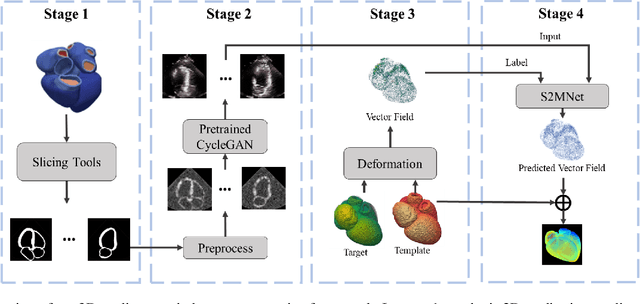
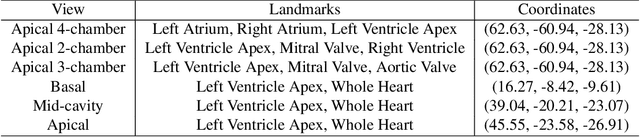
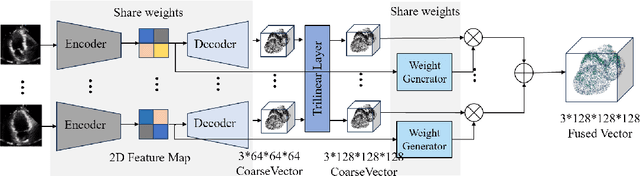
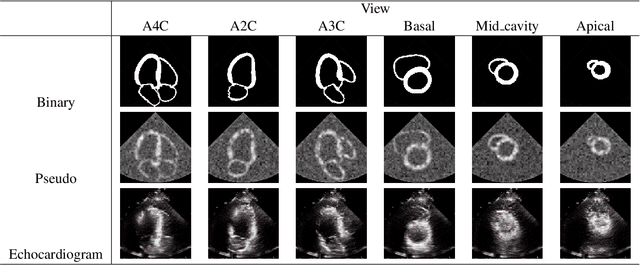
Echocardiogram is the most commonly used imaging modality in cardiac assessment duo to its non-invasive nature, real-time capability, and cost-effectiveness. Despite its advantages, most clinical echocardiograms provide only two-dimensional views, limiting the ability to fully assess cardiac anatomy and function in three dimensions. While three-dimensional echocardiography exists, it often suffers from reduced resolution, limited availability, and higher acquisition costs. To overcome these challenges, we propose a deep learning framework S2MNet that reconstructs continuous and high-fidelity 3D heart models by integrating six slices of routinely acquired 2D echocardiogram views. Our method has three advantages. First, our method avoid the difficulties on training data acquasition by simulate six of 2D echocardiogram images from corresponding slices of a given 3D heart mesh. Second, we introduce a deformation field-based method, which avoid spatial discontinuities or structural artifacts in 3D echocardiogram reconstructions. We validate our method using clinically collected echocardiogram and demonstrate that our estimated left ventricular volume, a key clinical indicator of cardiac function, is strongly correlated with the doctor measured GLPS, a clinical measurement that should demonstrate a negative correlation with LVE in medical theory. This association confirms the reliability of our proposed 3D construction method.
Knowledge Distillation and Dataset Distillation of Large Language Models: Emerging Trends, Challenges, and Future Directions
Apr 20, 2025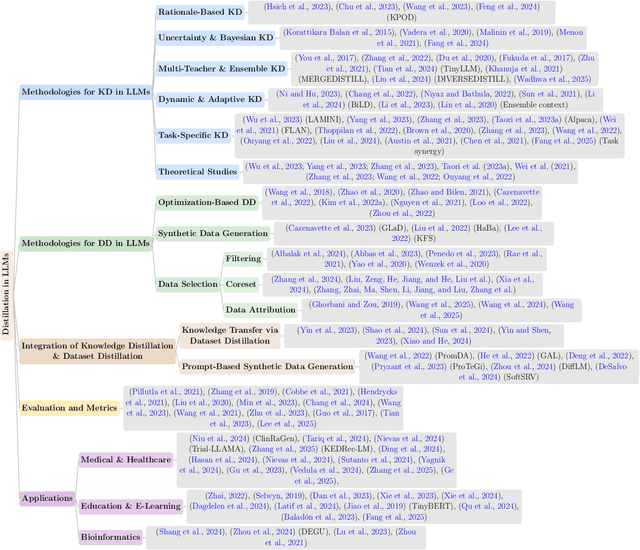

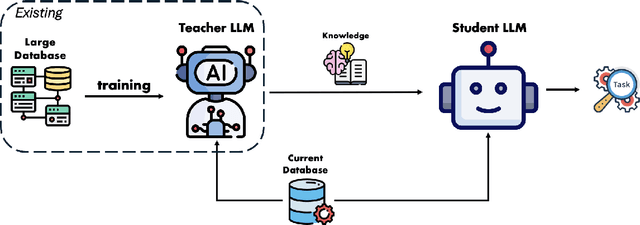
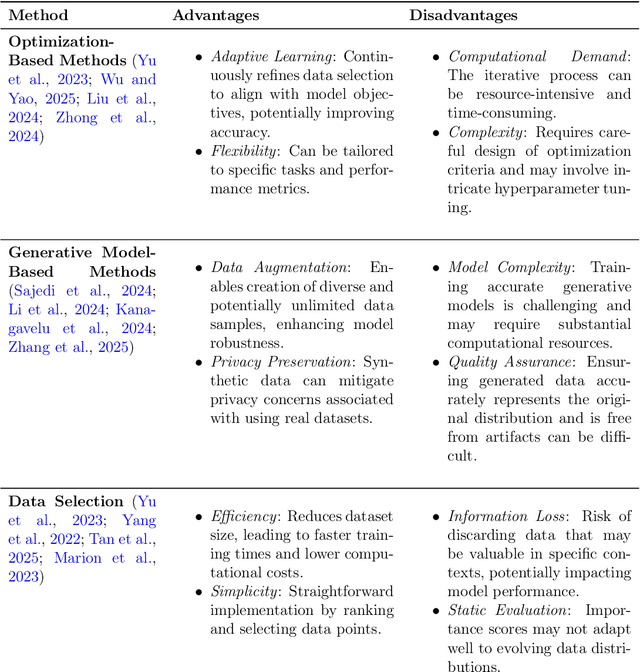
The exponential growth of Large Language Models (LLMs) continues to highlight the need for efficient strategies to meet ever-expanding computational and data demands. This survey provides a comprehensive analysis of two complementary paradigms: Knowledge Distillation (KD) and Dataset Distillation (DD), both aimed at compressing LLMs while preserving their advanced reasoning capabilities and linguistic diversity. We first examine key methodologies in KD, such as task-specific alignment, rationale-based training, and multi-teacher frameworks, alongside DD techniques that synthesize compact, high-impact datasets through optimization-based gradient matching, latent space regularization, and generative synthesis. Building on these foundations, we explore how integrating KD and DD can produce more effective and scalable compression strategies. Together, these approaches address persistent challenges in model scalability, architectural heterogeneity, and the preservation of emergent LLM abilities. We further highlight applications across domains such as healthcare and education, where distillation enables efficient deployment without sacrificing performance. Despite substantial progress, open challenges remain in preserving emergent reasoning and linguistic diversity, enabling efficient adaptation to continually evolving teacher models and datasets, and establishing comprehensive evaluation protocols. By synthesizing methodological innovations, theoretical foundations, and practical insights, our survey charts a path toward sustainable, resource-efficient LLMs through the tighter integration of KD and DD principles.
Ensemble machine learning approach for screening of coronary heart disease based on echocardiography and risk factors
May 20, 2021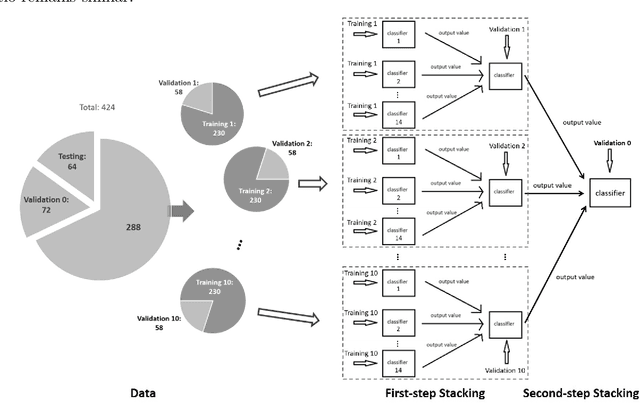
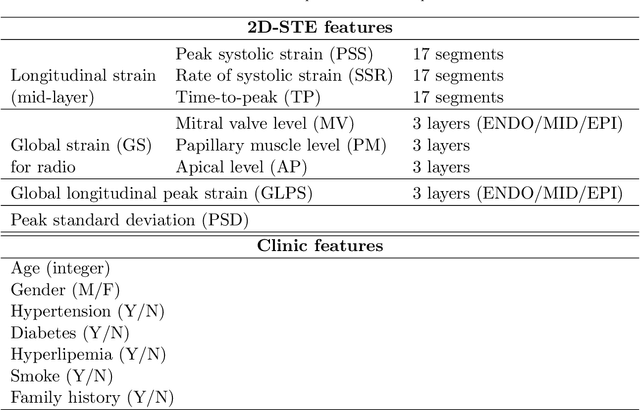
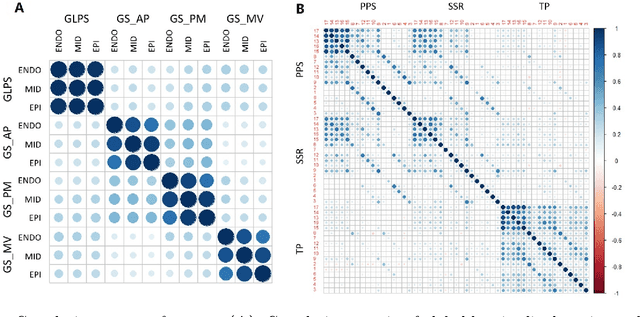
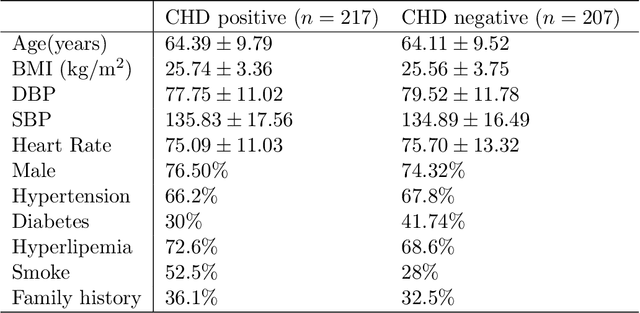
Background: Extensive clinical evidence suggests that a preventive screening of coronary heart disease (CHD) at an earlier stage can greatly reduce the mortality rate. We use 64 two-dimensional speckle tracking echocardiography (2D-STE) features and seven clinical features to predict whether one has CHD. Methods: We develop a machine learning approach that integrates a number of popular classification methods together by model stacking, and generalize the traditional stacking method to a two-step stacking method to improve the diagnostic performance. Results: By borrowing strengths from multiple classification models through the proposed method, we improve the CHD classification accuracy from around 70% to 87.7% on the testing set. The sensitivity of the proposed method is 0.903 and the specificity is 0.843, with an AUC of 0.904, which is significantly higher than those of the individual classification models. Conclusions: Our work lays a foundation for the deployment of speckle tracking echocardiography-based screening tools for coronary heart disease.