 Add to Chrome
 Add to Firefox
 Add to Edge
When Correct Decisions Hide Internal Stress: Decision-State Probing in Multimodal Language Models
Jun 07, 2026
Multimodal language models are typically evaluated through external behavior: selecting the correct image--text match, rejecting unsupported captions, or answering visual queries correctly. However, correct behavior alone does not show that the model's internal decision state remains stable under controlled semantic stress. We study this gap through S$^3$E (Structured Semantic Stress Evaluation), a framework for analyzing behavior-internal decoupling in multimodal language models. S$^3$E uses a positive-anchored A/B forced-choice setup in which an image-supported caption is contrasted against semantic stress candidates under both original and swapped option orders, while hidden states are extracted at the pre-answer decision state. We focus on strict-correct trials, where the model consistently selects the correct caption across both orders. Rather than treating arbitrary hidden-state variation as evidence of instability, we measure whether semantic-conflict candidates induce excess decision-state displacement relative to meaning-preserving controls. Across Qwen3VL, Gemma3, and InternVL3, semantic stress consistently produces positive selected-layer excess displacement over lexical controls despite correct forced-choice behavior, while comparisons against random negatives are model-dependent. We interpret this as a scoped decision-state stress-sensitivity signal rather than evidence of downstream failure or hallucination. Our results suggest that forced-choice correctness alone is not a sufficient certificate of invariant internal decision geometry.

CommonMorph: Participatory Morphological Documentation Platform
Apr 06, 2026Collecting and annotating morphological data present significant challenges, requiring linguistic expertise, methodological rigour, and substantial resources. These barriers are particularly acute for low-resource languages and varieties. To accelerate this process, we introduce \texttt{CommonMorph}, a comprehensive platform that streamlines morphological data collection development through a three-tiered approach: expert linguistic definition, contributor elicitation, and community validation. The platform minimises manual work by incorporating active learning, annotation suggestions, and tools to import and adapt materials from related languages. It accommodates diverse morphological systems, including fusional, agglutinative, and root-and-pattern morphologies. Its open-source design and UniMorph-compatible outputs ensure accessibility and interoperability with NLP tools. Our platform is accessible at https://common-morph.com, offering a replicable model for preserving linguistic diversity through collaborative technology.
Article and Comment Frames Shape the Quality of Online Comments
Mar 29, 2026Framing theory posits that how information is presented shapes audience responses, but computational work has largely ignored audience reactions. While recent work showed that article framing systematically shapes the content of reader responses, this paper asks: Does framing also affect response quality? Analyzing 1M comments across 2.7K news articles, we operationalize quality as comment health (constructive, good-faith contributions). We find that article frames significantly predict comment health while controlling for topic, and that comments that adopt the article frame are healthier than those that depart from it. Further, unhealthy top-level comments tend to generate more unhealthy responses, independent of the frame being used in the comment. Our results establish a link between framing theory and discourse quality, laying the groundwork for downstream applications. We illustrate this potential with a proactive frame-aware LLM- based system to mitigate unhealthy discourse
EvoTool: Self-Evolving Tool-Use Policy Optimization in LLM Agents via Blame-Aware Mutation and Diversity-Aware Selection
Mar 05, 2026LLM-based agents depend on effective tool-use policies to solve complex tasks, yet optimizing these policies remains challenging due to delayed supervision and the difficulty of credit assignment in long-horizon trajectories. Existing optimization approaches tend to be either monolithic, which are prone to entangling behaviors, or single-aspect, which ignore cross-module error propagation. To address these limitations, we propose EvoTool, a self-evolving framework that optimizes a modular tool-use policy via a gradient-free evolutionary paradigm. EvoTool decomposes agent's tool-use policy into four modules, including Planner, Selector, Caller, and Synthesizer, and iteratively improves them in a self-improving loop through three novel mechanisms. Trajectory-Grounded Blame Attribution uses diagnostic traces to localize failures to a specific module. Feedback-Guided Targeted Mutation then edits only that module via natural-language critique. Diversity-Aware Population Selection preserves complementary candidates to ensure solution diversity. Across four benchmarks, EvoTool outperforms strong baselines by over 5 points on both GPT-4.1 and Qwen3-8B, while achieving superior efficiency and transferability. The code will be released once paper is accepted.
Triggered: A Statistical Analysis of Environmental Influences on Extremist Groups
Feb 10, 2026Online extremist communities operate within a wider information ecosystem shaped by real-world events, news coverage, and cross-community interaction. We adopt a systems perspective to examine these influences using seven years of data from two ideologically distinct extremist forums (Stormfront and Incels) and a mainstream reference community (r/News). We ask three questions: how extremist violence impacts community behaviour; whether news coverage of political entities predicts shifts in conversation dynamics; and whether linguistic diffusion occurs between mainstream and extremist spaces and across extremist ideologies. Methodologically, we combine counterfactual synthesis to estimate event-level impacts with vector autoregression and Granger causality analyses to model ongoing relationships among news signals, behavioural outcomes, and cross-community language change. Across analyses, our results indicate that Stormfront and r/News appear to be more reactive to external stimuli, while Incels demonstrates less cross-community linguistic influence and less responsiveness to news and violent events. These findings underscore that extremist communities are not homogeneous, but differ in how tightly they are coupled to the surrounding information ecosystem.
When Is Rank-1 Enough? Geometry-Guided Initialization for Parameter-Efficient Fine-Tuning
Feb 02, 2026Parameter-efficient fine-tuning (PEFT) is a standard way to adapt multimodal large language models, yet extremely low-rank settings -- especially rank-1 LoRA -- are often unstable. We show that this instability is not solely due to limited capacity: in the rank-1 regime, optimization is highly sensitive to the update direction. Concretely, pretrained vision and text features form mismatched anisotropic regions, yielding a dominant "gap" direction that acts like a translation component and disproportionately steers early gradients under rank-1 constraints. Analyzing pretrained representations, we identify a modality-gap axis that dominates early gradient flow, while a random rank-1 initialization is unlikely to align with it, leading to weak gradients and training collapse. We propose Gap-Init, a geometry-aware initialization that aligns the rank-1 LoRA direction with an estimated modality-gap vector from a small calibration set, while keeping the initial LoRA update zero. Across multiple vision-language tasks and backbones, Gap-Init consistently stabilizes rank-1 training and can match or outperform strong rank-8 baselines. Our results suggest that at the extreme low-rank limit, initial alignment can matter as much as rank itself.
LLMs for Argument Mining: Detection, Extraction, and Relationship Classification of pre-defined Arguments in Online Comments
May 29, 2025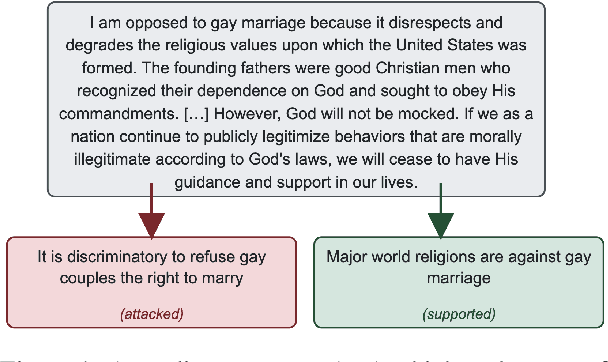
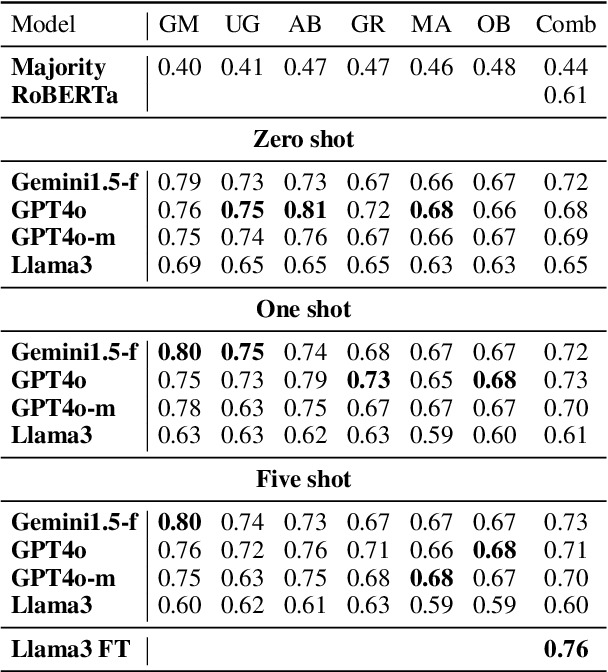
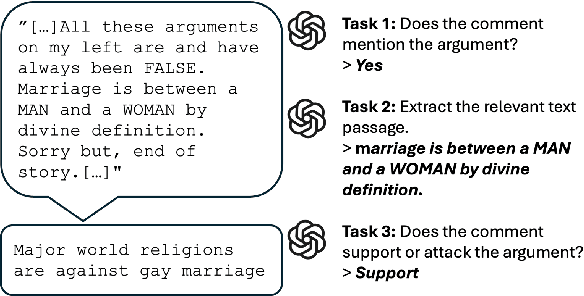
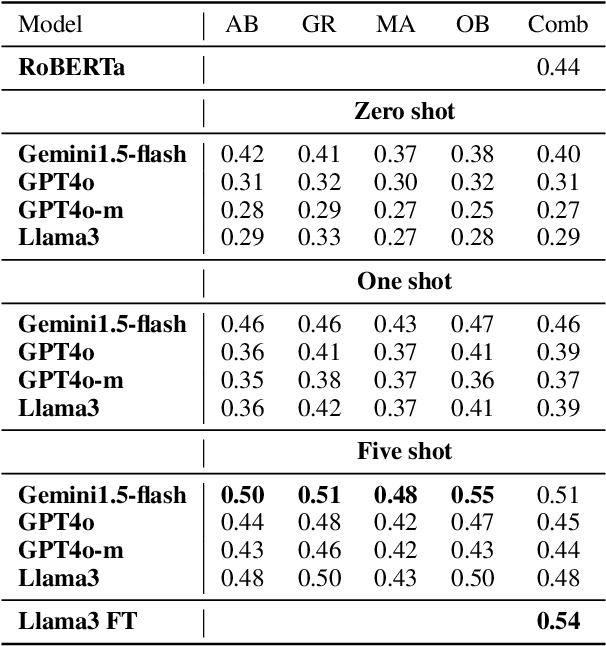
Automated large-scale analysis of public discussions around contested issues like abortion requires detecting and understanding the use of arguments. While Large Language Models (LLMs) have shown promise in language processing tasks, their performance in mining topic-specific, pre-defined arguments in online comments remains underexplored. We evaluate four state-of-the-art LLMs on three argument mining tasks using datasets comprising over 2,000 opinion comments across six polarizing topics. Quantitative evaluation suggests an overall strong performance across the three tasks, especially for large and fine-tuned LLMs, albeit at a significant environmental cost. However, a detailed error analysis revealed systematic shortcomings on long and nuanced comments and emotionally charged language, raising concerns for downstream applications like content moderation or opinion analysis. Our results highlight both the promise and current limitations of LLMs for automated argument analysis in online comments.
Community Moderation and the New Epistemology of Fact Checking on Social Media
May 26, 2025Social media platforms have traditionally relied on internal moderation teams and partnerships with independent fact-checking organizations to identify and flag misleading content. Recently, however, platforms including X (formerly Twitter) and Meta have shifted towards community-driven content moderation by launching their own versions of crowd-sourced fact-checking -- Community Notes. If effectively scaled and governed, such crowd-checking initiatives have the potential to combat misinformation with increased scale and speed as successfully as community-driven efforts once did with spam. Nevertheless, general content moderation, especially for misinformation, is inherently more complex. Public perceptions of truth are often shaped by personal biases, political leanings, and cultural contexts, complicating consensus on what constitutes misleading content. This suggests that community efforts, while valuable, cannot replace the indispensable role of professional fact-checkers. Here we systemically examine the current approaches to misinformation detection across major platforms, explore the emerging role of community-driven moderation, and critically evaluate both the promises and challenges of crowd-checking at scale.
FaceID-6M: A Large-Scale, Open-Source FaceID Customization Dataset
Mar 11, 2025Due to the data-driven nature of current face identity (FaceID) customization methods, all state-of-the-art models rely on large-scale datasets containing millions of high-quality text-image pairs for training. However, none of these datasets are publicly available, which restricts transparency and hinders further advancements in the field. To address this issue, in this paper, we collect and release FaceID-6M, the first large-scale, open-source FaceID dataset containing 6 million high-quality text-image pairs. Filtered from LAION-5B \cite{schuhmann2022laion}, FaceID-6M undergoes a rigorous image and text filtering steps to ensure dataset quality, including resolution filtering to maintain high-quality images and faces, face filtering to remove images that lack human faces, and keyword-based strategy to retain descriptions containing human-related terms (e.g., nationality, professions and names). Through these cleaning processes, FaceID-6M provides a high-quality dataset optimized for training powerful FaceID customization models, facilitating advancements in the field by offering an open resource for research and development. We conduct extensive experiments to show the effectiveness of our FaceID-6M, demonstrating that models trained on our FaceID-6M dataset achieve performance that is comparable to, and slightly better than currently available industrial models. Additionally, to support and advance research in the FaceID customization community, we make our code, datasets, and models fully publicly available. Our codes, models, and datasets are available at: https://github.com/ShuheSH/FaceID-6M.
Control Illusion: The Failure of Instruction Hierarchies in Large Language Models
Feb 21, 2025Large language models (LLMs) are increasingly deployed with hierarchical instruction schemes, where certain instructions (e.g., system-level directives) are expected to take precedence over others (e.g., user messages). Yet, we lack a systematic understanding of how effectively these hierarchical control mechanisms work. We introduce a systematic evaluation framework based on constraint prioritization to assess how well LLMs enforce instruction hierarchies. Our experiments across six state-of-the-art LLMs reveal that models struggle with consistent instruction prioritization, even for simple formatting conflicts. We find that the widely-adopted system/user prompt separation fails to establish a reliable instruction hierarchy, and models exhibit strong inherent biases toward certain constraint types regardless of their priority designation. While controlled prompt engineering and model fine-tuning show modest improvements, our results indicate that instruction hierarchy enforcement is not robustly realized, calling for deeper architectural innovations beyond surface-level modifications.