 Add to Chrome
 Add to Firefox
 Add to Edge
Cognitive Kernel: An Open-source Agent System towards Generalist Autopilots
Sep 16, 2024

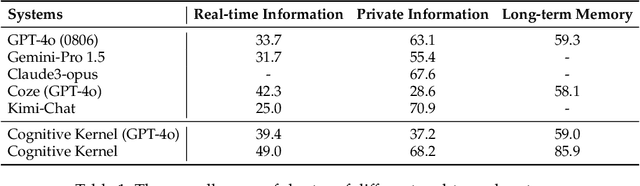


We introduce Cognitive Kernel, an open-source agent system towards the goal of generalist autopilots. Unlike copilot systems, which primarily rely on users to provide essential state information (e.g., task descriptions) and assist users by answering questions or auto-completing contents, autopilot systems must complete tasks from start to finish independently, which requires the system to acquire the state information from the environments actively. To achieve this, an autopilot system should be capable of understanding user intents, actively gathering necessary information from various real-world sources, and making wise decisions. Cognitive Kernel adopts a model-centric design. In our implementation, the central policy model (a fine-tuned LLM) initiates interactions with the environment using a combination of atomic actions, such as opening files, clicking buttons, saving intermediate results to memory, or calling the LLM itself. This differs from the widely used environment-centric design, where a task-specific environment with predefined actions is fixed, and the policy model is limited to selecting the correct action from a given set of options. Our design facilitates seamless information flow across various sources and provides greater flexibility. We evaluate our system in three use cases: real-time information management, private information management, and long-term memory management. The results demonstrate that Cognitive Kernel achieves better or comparable performance to other closed-source systems in these scenarios. Cognitive Kernel is fully dockerized, ensuring everyone can deploy it privately and securely. We open-source the system and the backbone model to encourage further research on LLM-driven autopilot systems.

Towards Diverse and Efficient Audio Captioning via Diffusion Models
Sep 14, 2024We introduce Diffusion-based Audio Captioning (DAC), a non-autoregressive diffusion model tailored for diverse and efficient audio captioning. Although existing captioning models relying on language backbones have achieved remarkable success in various captioning tasks, their insufficient performance in terms of generation speed and diversity impede progress in audio understanding and multimedia applications. Our diffusion-based framework offers unique advantages stemming from its inherent stochasticity and holistic context modeling in captioning. Through rigorous evaluation, we demonstrate that DAC not only achieves SOTA performance levels compared to existing benchmarks in the caption quality, but also significantly outperforms them in terms of generation speed and diversity. The success of DAC illustrates that text generation can also be seamlessly integrated with audio and visual generation tasks using a diffusion backbone, paving the way for a unified, audio-related generative model across different modalities.
STA-V2A: Video-to-Audio Generation with Semantic and Temporal Alignment
Sep 13, 2024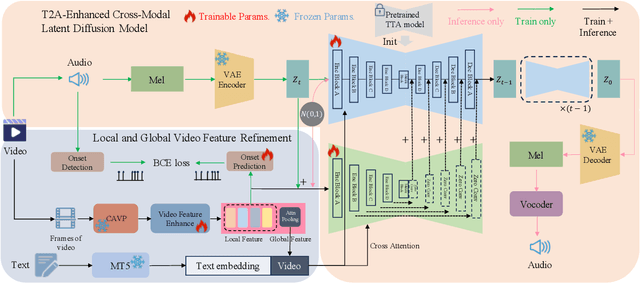
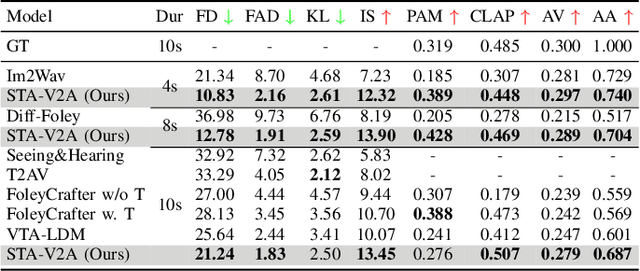
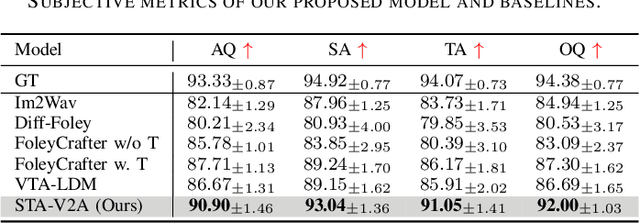
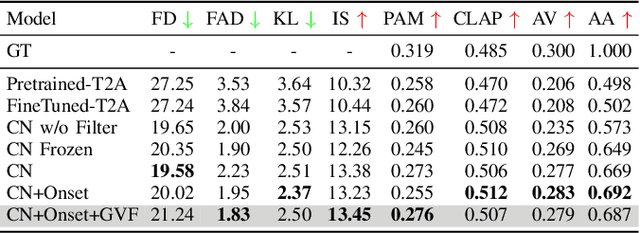
Visual and auditory perception are two crucial ways humans experience the world. Text-to-video generation has made remarkable progress over the past year, but the absence of harmonious audio in generated video limits its broader applications. In this paper, we propose Semantic and Temporal Aligned Video-to-Audio (STA-V2A), an approach that enhances audio generation from videos by extracting both local temporal and global semantic video features and combining these refined video features with text as cross-modal guidance. To address the issue of information redundancy in videos, we propose an onset prediction pretext task for local temporal feature extraction and an attentive pooling module for global semantic feature extraction. To supplement the insufficient semantic information in videos, we propose a Latent Diffusion Model with Text-to-Audio priors initialization and cross-modal guidance. We also introduce Audio-Audio Align, a new metric to assess audio-temporal alignment. Subjective and objective metrics demonstrate that our method surpasses existing Video-to-Audio models in generating audio with better quality, semantic consistency, and temporal alignment. The ablation experiment validated the effectiveness of each module. Audio samples are available at https://y-ren16.github.io/STAV2A.
DSBench: How Far Are Data Science Agents to Becoming Data Science Experts?
Sep 12, 2024


Large Language Models (LLMs) and Large Vision-Language Models (LVLMs) have demonstrated impressive language/vision reasoning abilities, igniting the recent trend of building agents for targeted applications such as shopping assistants or AI software engineers. Recently, many data science benchmarks have been proposed to investigate their performance in the data science domain. However, existing data science benchmarks still fall short when compared to real-world data science applications due to their simplified settings. To bridge this gap, we introduce DSBench, a comprehensive benchmark designed to evaluate data science agents with realistic tasks. This benchmark includes 466 data analysis tasks and 74 data modeling tasks, sourced from Eloquence and Kaggle competitions. DSBench offers a realistic setting by encompassing long contexts, multimodal task backgrounds, reasoning with large data files and multi-table structures, and performing end-to-end data modeling tasks. Our evaluation of state-of-the-art LLMs, LVLMs, and agents shows that they struggle with most tasks, with the best agent solving only 34.12% of data analysis tasks and achieving a 34.74% Relative Performance Gap (RPG). These findings underscore the need for further advancements in developing more practical, intelligent, and autonomous data science agents.
SSR-Speech: Towards Stable, Safe and Robust Zero-shot Text-based Speech Editing and Synthesis
Sep 11, 2024


In this paper, we introduce SSR-Speech, a neural codec autoregressive model designed for stable, safe, and robust zero-shot text-based speech editing and text-to-speech synthesis. SSR-Speech is built on a Transformer decoder and incorporates classifier-free guidance to enhance the stability of the generation process. A watermark Encodec is proposed to embed frame-level watermarks into the edited regions of the speech so that which parts were edited can be detected. In addition, the waveform reconstruction leverages the original unedited speech segments, providing superior recovery compared to the Encodec model. Our approach achieves the state-of-the-art performance in the RealEdit speech editing task and the LibriTTS text-to-speech task, surpassing previous methods. Furthermore, SSR-Speech excels in multi-span speech editing and also demonstrates remarkable robustness to background sounds. Source code and demos are released.
Neural Ambisonic Encoding For Multi-Speaker Scenarios Using A Circular Microphone Array
Sep 11, 2024Spatial audio formats like Ambisonics are playback device layout-agnostic and well-suited for applications such as teleconferencing and virtual reality. Conventional Ambisonic encoding methods often rely on spherical microphone arrays for efficient sound field capture, which limits their flexibility in practical scenarios. We propose a deep learning (DL)-based approach, leveraging a two-stage network architecture for encoding circular microphone array signals into second-order Ambisonics (SOA) in multi-speaker environments. In addition, we introduce: (i) a novel loss function based on spatial power maps to regularize inter-channel correlations of the Ambisonic signals, and (ii) a channel permutation technique to resolve the ambiguity of encoding vertical information using a horizontal circular array. Evaluation on simulated speech and noise datasets shows that our approach consistently outperforms traditional signal processing (SP) and DL-based methods, providing significantly better timbral and spatial quality and higher source localization accuracy. Binaural audio demos with visualizations are available at https://bridgoon97.github.io/NeuralAmbisonicEncoding/.
Comparing Discrete and Continuous Space LLMs for Speech Recognition
Sep 01, 2024


This paper investigates discrete and continuous speech representations in Large Language Model (LLM)-based Automatic Speech Recognition (ASR), organizing them by feature continuity and training approach into four categories: supervised and unsupervised for both discrete and continuous types. We further classify LLMs based on their input and autoregressive feedback into continuous and discrete-space models. Using specialized encoders and comparative analysis with a Joint-Training-From-Scratch Language Model (JTFS LM) and pre-trained LLaMA2-7b, we provide a detailed examination of their effectiveness. Our work marks the first extensive comparison of speech representations in LLM-based ASR and explores various modeling techniques. We present an open-sourced achievement of a state-of-the-art Word Error Rate (WER) of 1.69\% on LibriSpeech using a HuBERT encoder, offering valuable insights for advancing ASR and natural language processing (NLP) research.
Advancing Multi-talker ASR Performance with Large Language Models
Aug 30, 2024
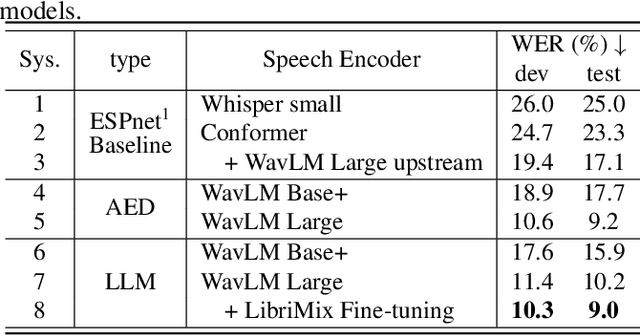

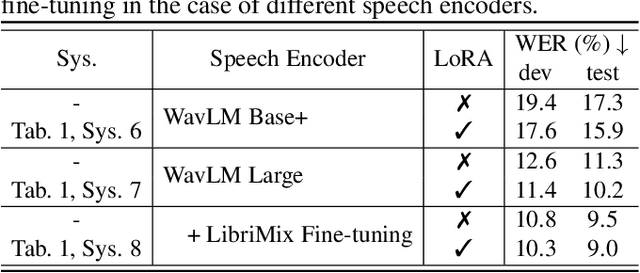
Recognizing overlapping speech from multiple speakers in conversational scenarios is one of the most challenging problem for automatic speech recognition (ASR). Serialized output training (SOT) is a classic method to address multi-talker ASR, with the idea of concatenating transcriptions from multiple speakers according to the emission times of their speech for training. However, SOT-style transcriptions, derived from concatenating multiple related utterances in a conversation, depend significantly on modeling long contexts. Therefore, compared to traditional methods that primarily emphasize encoder performance in attention-based encoder-decoder (AED) architectures, a novel approach utilizing large language models (LLMs) that leverages the capabilities of pre-trained decoders may be better suited for such complex and challenging scenarios. In this paper, we propose an LLM-based SOT approach for multi-talker ASR, leveraging pre-trained speech encoder and LLM, fine-tuning them on multi-talker dataset using appropriate strategies. Experimental results demonstrate that our approach surpasses traditional AED-based methods on the simulated dataset LibriMix and achieves state-of-the-art performance on the evaluation set of the real-world dataset AMI, outperforming the AED model trained with 1000 times more supervised data in previous works.
SIaM: Self-Improving Code-Assisted Mathematical Reasoning of Large Language Models
Aug 28, 2024


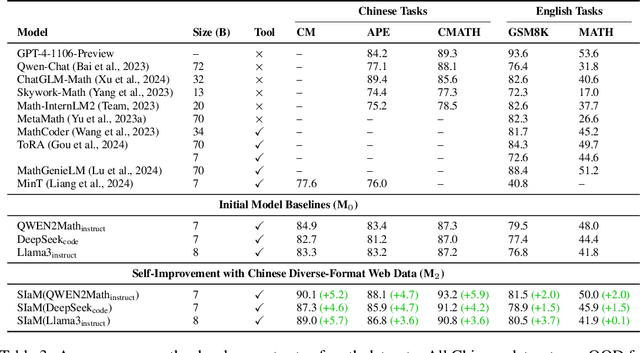
There is a growing trend of teaching large language models (LLMs) to solve mathematical problems through coding. Existing studies primarily focus on prompting powerful, closed-source models to generate seed training data followed by in-domain data augmentation, equipping LLMs with considerable capabilities for code-aided mathematical reasoning. However, continually training these models on augmented data derived from a few datasets such as GSM8K may impair their generalization abilities and restrict their effectiveness to a narrow range of question types. Conversely, the potential of improving such LLMs by leveraging large-scale, expert-written, diverse math question-answer pairs remains unexplored. To utilize these resources and tackle unique challenges such as code response assessment, we propose a novel paradigm that uses a code-based critic model to guide steps including question-code data construction, quality control, and complementary evaluation. We also explore different alignment algorithms with self-generated instruction/preference data to foster continuous improvement. Experiments across both in-domain (up to +5.7%) and out-of-domain (+4.4%) benchmarks in English and Chinese demonstrate the effectiveness of the proposed paradigm.
DOCBENCH: A Benchmark for Evaluating LLM-based Document Reading Systems
Jul 15, 2024


Recently, there has been a growing interest among large language model (LLM) developers in LLM-based document reading systems, which enable users to upload their own documents and pose questions related to the document contents, going beyond simple reading comprehension tasks. Consequently, these systems have been carefully designed to tackle challenges such as file parsing, metadata extraction, multi-modal information understanding and long-context reading. However, no current benchmark exists to evaluate their performance in such scenarios, where a raw file and questions are provided as input, and a corresponding response is expected as output. In this paper, we introduce DocBench, a new benchmark designed to evaluate LLM-based document reading systems. Our benchmark involves a meticulously crafted process, including the recruitment of human annotators and the generation of synthetic questions. It includes 229 real documents and 1,102 questions, spanning across five different domains and four major types of questions. We evaluate both proprietary LLM-based systems accessible via web interfaces or APIs, and a parse-then-read pipeline employing open-source LLMs. Our evaluations reveal noticeable gaps between existing LLM-based document reading systems and human performance, underscoring the challenges of developing proficient systems. To summarize, DocBench aims to establish a standardized benchmark for evaluating LLM-based document reading systems under diverse real-world scenarios, thereby guiding future advancements in this research area.