 Add to Chrome
 Add to Firefox
 Add to Edge
A Stitch in Time Saves Nine: Detecting and Mitigating Hallucinations of LLMs by Validating Low-Confidence Generation
Jul 08, 2023
Recently developed large language models have achieved remarkable success in generating fluent and coherent text. However, these models often tend to 'hallucinate' which critically hampers their reliability. In this work, we address this crucial problem and propose an approach that actively detects and mitigates hallucinations during the generation process. Specifically, we first identify the candidates of potential hallucination leveraging the model's logit output values, check their correctness through a validation procedure, mitigate the detected hallucinations, and then continue with the generation process. Through extensive experiments with the 'article generation task', we first demonstrate the individual efficacy of our detection and mitigation techniques. Specifically, the detection technique achieves a recall of 88% and the mitigation technique successfully mitigates 57.6% of the correctly detected hallucinations. Importantly, our mitigation technique does not introduce new hallucinations even in the case of incorrectly detected hallucinations, i.e., false positives. Then, we show that the proposed active detection and mitigation approach successfully reduces the hallucinations of the GPT-3 model from 47.5% to 14.5% on average. In summary, our work contributes to improving the reliability and trustworthiness of large language models, a crucial step en route to enabling their widespread adoption in real-world applications.

Make-A-Voice: Unified Voice Synthesis With Discrete Representation
May 30, 2023Various applications of voice synthesis have been developed independently despite the fact that they generate "voice" as output in common. In addition, the majority of voice synthesis models currently rely on annotated audio data, but it is crucial to scale them to self-supervised datasets in order to effectively capture the wide range of acoustic variations present in human voice, including speaker identity, emotion, and prosody. In this work, we propose Make-A-Voice, a unified framework for synthesizing and manipulating voice signals from discrete representations. Make-A-Voice leverages a "coarse-to-fine" approach to model the human voice, which involves three stages: 1) semantic stage: model high-level transformation between linguistic content and self-supervised semantic tokens, 2) acoustic stage: introduce varying control signals as acoustic conditions for semantic-to-acoustic modeling, and 3) generation stage: synthesize high-fidelity waveforms from acoustic tokens. Make-A-Voice offers notable benefits as a unified voice synthesis framework: 1) Data scalability: the major backbone (i.e., acoustic and generation stage) does not require any annotations, and thus the training data could be scaled up. 2) Controllability and conditioning flexibility: we investigate different conditioning mechanisms and effectively handle three voice synthesis applications, including text-to-speech (TTS), voice conversion (VC), and singing voice synthesis (SVS) by re-synthesizing the discrete voice representations with prompt guidance. Experimental results demonstrate that Make-A-Voice exhibits superior audio quality and style similarity compared with competitive baseline models. Audio samples are available at https://Make-A-Voice.github.io
PIVOINE: Instruction Tuning for Open-world Information Extraction
May 24, 2023We consider the problem of Open-world Information Extraction (Open-world IE), which extracts comprehensive entity profiles from unstructured texts. Different from the conventional closed-world setting of Information Extraction (IE), Open-world IE considers a more general situation where entities and relations could be beyond a predefined ontology. More importantly, we seek to develop a large language model (LLM) that is able to perform Open-world IE to extract desirable entity profiles characterized by (possibly fine-grained) natural language instructions. We achieve this by finetuning LLMs using instruction tuning. In particular, we construct INSTRUCTOPENWIKI, a substantial instruction tuning dataset for Open-world IE enriched with a comprehensive corpus, extensive annotations, and diverse instructions. We finetune the pretrained BLOOM models on INSTRUCTOPENWIKI and obtain PIVOINE, an LLM for Open-world IE with strong instruction-following capabilities. Our experiments demonstrate that PIVOINE significantly outperforms traditional closed-world methods and other LLM baselines, displaying impressive generalization capabilities on both unseen instructions and out-of-ontology cases. Consequently, PIVOINE emerges as a promising solution to tackle the open-world challenge in IE effectively.
Bridging Continuous and Discrete Spaces: Interpretable Sentence Representation Learning via Compositional Operations
May 24, 2023Traditional sentence embedding models encode sentences into vector representations to capture useful properties such as the semantic similarity between sentences. However, in addition to similarity, sentence semantics can also be interpreted via compositional operations such as sentence fusion or difference. It is unclear whether the compositional semantics of sentences can be directly reflected as compositional operations in the embedding space. To more effectively bridge the continuous embedding and discrete text spaces, we explore the plausibility of incorporating various compositional properties into the sentence embedding space that allows us to interpret embedding transformations as compositional sentence operations. We propose InterSent, an end-to-end framework for learning interpretable sentence embeddings that supports compositional sentence operations in the embedding space. Our method optimizes operator networks and a bottleneck encoder-decoder model to produce meaningful and interpretable sentence embeddings. Experimental results demonstrate that our method significantly improves the interpretability of sentence embeddings on four textual generation tasks over existing approaches while maintaining strong performance on traditional semantic similarity tasks.
Open-Domain Event Graph Induction for Mitigating Framing Bias
May 22, 2023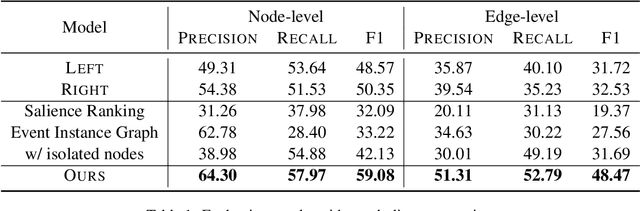
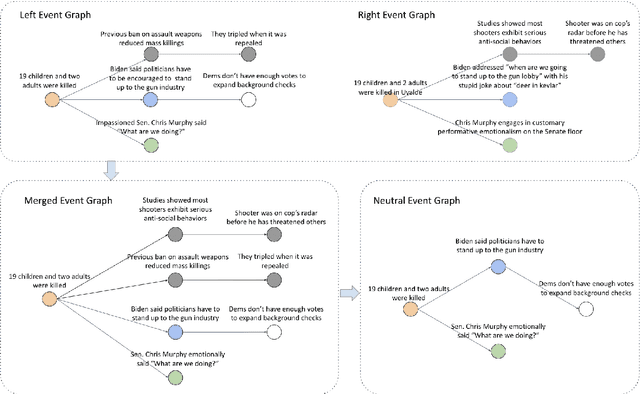
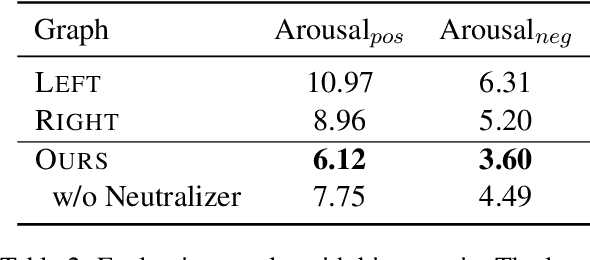

Researchers have proposed various information extraction (IE) techniques to convert news articles into structured knowledge for news understanding. However, none of the existing methods have explicitly addressed the issue of framing bias that is inherent in news articles. We argue that studying and identifying framing bias is a crucial step towards trustworthy event understanding. We propose a novel task, neutral event graph induction, to address this problem. An event graph is a network of events and their temporal relations. Our task aims to induce such structural knowledge with minimal framing bias in an open domain. We propose a three-step framework to induce a neutral event graph from multiple input sources. The process starts by inducing an event graph from each input source, then merging them into one merged event graph, and lastly using a Graph Convolutional Network to remove event nodes with biased connotations. We demonstrate the effectiveness of our framework through the use of graph prediction metrics and bias-focused metrics.
Deep Learning for Joint Acoustic Echo and Acoustic Howling Suppression in Hybrid Meetings
May 04, 2023Hybrid meetings have become increasingly necessary during the post-COVID period and also brought new challenges for solving audio-related problems. In particular, the interplay between acoustic echo and acoustic howling in a hybrid meeting makes the joint suppression of them difficult. This paper proposes a deep learning approach to tackle this problem by formulating a recurrent feedback suppression process as an instantaneous speech separation task using the teacher-forced training strategy. Specifically, a self-attentive recurrent neural network is utilized to extract the target speech from microphone recordings with accessible and learned reference signals, thus suppressing acoustic echo and acoustic howling simultaneously. Different combinations of input signals and loss functions have been investigated for performance improvement. Experimental results demonstrate the effectiveness of the proposed method for suppressing echo and howling jointly in hybrid meetings.
Faithful Question Answering with Monte-Carlo Planning
May 04, 2023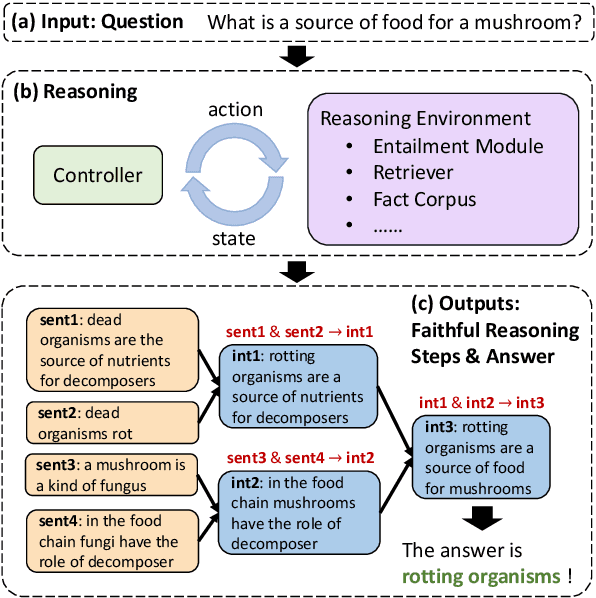

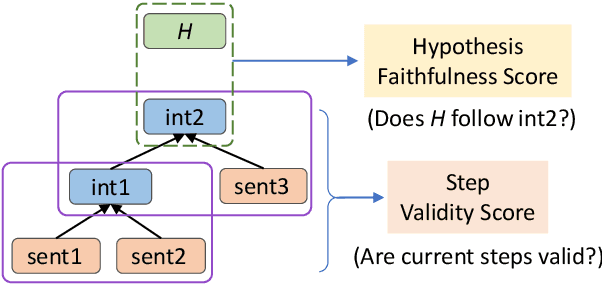
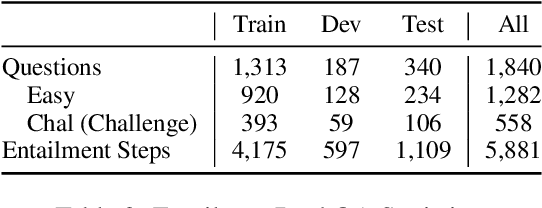
Although large language models demonstrate remarkable question-answering performances, revealing the intermediate reasoning steps that the models faithfully follow remains challenging. In this paper, we propose FAME (FAithful question answering with MontE-carlo planning) to answer questions based on faithful reasoning steps. The reasoning steps are organized as a structured entailment tree, which shows how premises are used to produce intermediate conclusions that can prove the correctness of the answer. We formulate the task as a discrete decision-making problem and solve it through the interaction of a reasoning environment and a controller. The environment is modular and contains several basic task-oriented modules, while the controller proposes actions to assemble the modules. Since the search space could be large, we introduce a Monte-Carlo planning algorithm to do a look-ahead search and select actions that will eventually lead to high-quality steps. FAME achieves state-of-the-art performance on the standard benchmark. It can produce valid and faithful reasoning steps compared with large language models with a much smaller model size.
Hybrid AHS: A Hybrid of Kalman Filter and Deep Learning for Acoustic Howling Suppression
May 04, 2023Deep learning has been recently introduced for efficient acoustic howling suppression (AHS). However, the recurrent nature of howling creates a mismatch between offline training and streaming inference, limiting the quality of enhanced speech. To address this limitation, we propose a hybrid method that combines a Kalman filter with a self-attentive recurrent neural network (SARNN) to leverage their respective advantages for robust AHS. During offline training, a pre-processed signal obtained from the Kalman filter and an ideal microphone signal generated via teacher-forced training strategy are used to train the deep neural network (DNN). During streaming inference, the DNN's parameters are fixed while its output serves as a reference signal for updating the Kalman filter. Evaluation in both offline and streaming inference scenarios using simulated and real-recorded data shows that the proposed method efficiently suppresses howling and consistently outperforms baselines.
3D Neural Beamforming for Multi-channel Speech Separation Against Location Uncertainty
Feb 27, 2023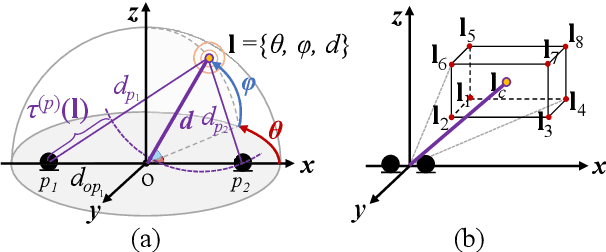
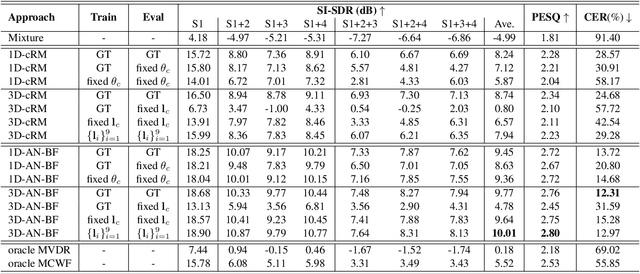
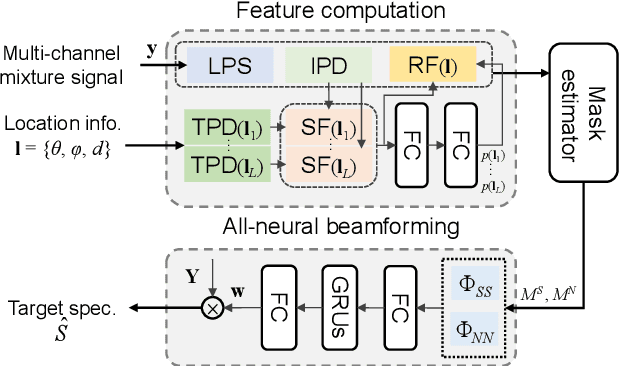
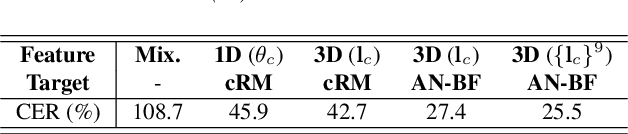
Multi-channel speech separation using speaker's directional information has demonstrated significant gains over blind speech separation. However, it has two limitations. First, substantial performance degradation is observed when the coming directions of two sounds are close. Second, the result highly relies on the precise estimation of the speaker's direction. To overcome these issues, this paper proposes 3D features and an associated 3D neural beamformer for multi-channel speech separation. Previous works in this area are extended in two important directions. First, the traditional 1D directional beam patterns are generalized to 3D. This enables the model to extract speech from any target region in the 3D space. Thus, speakers with similar directions but different elevations or distances become separable. Second, to handle the speaker location uncertainty, previously proposed spatial feature is extended to a new 3D region feature. The proposed 3D region feature and 3D neural beamformer are evaluated under an in-car scenario. Experimental results demonstrated that the combination of 3D feature and 3D beamformer can achieve comparable performance to the separation model with ground truth speaker location as input.
Deep AHS: A Deep Learning Approach to Acoustic Howling Suppression
Feb 18, 2023In this paper, we formulate acoustic howling suppression (AHS) as a supervised learning problem and propose a deep learning approach, called Deep AHS, to address it. Deep AHS is trained in a teacher forcing way which converts the recurrent howling suppression process into an instantaneous speech separation process to simplify the problem and accelerate the model training. The proposed method utilizes properly designed features and trains an attention based recurrent neural network (RNN) to extract the target signal from the microphone recording, thus attenuating the playback signal that may lead to howling. Different training strategies are investigated and a streaming inference method implemented in a recurrent mode used to evaluate the performance of the proposed method for real-time howling suppression. Deep AHS avoids howling detection and intrinsically prohibits howling from happening, allowing for more flexibility in the design of audio systems. Experimental results show the effectiveness of the proposed method for howling suppression under different scenarios.