 Add to Chrome
 Add to Firefox
 Add to Edge
Attenuation-Resilient Alternating Optimization for Laparoscopic Liver Landmark Detection
May 26, 2026
Liver surface landmark detection is a fundamental prerequisite for anatomical guidance in laparoscopic liver surgery. However, it remains unreliable in practice due to two pervasive challenges: illumination attenuation in underexposed regions and the structural mismatch between pixel-wise localization and continuous curvilinear geometry. To address these limitations, we propose A2ONet, an attenuation-resilient alternating optimization network for robust liver landmark detection. To mitigate illumination attenuation, A2ONet embraces an illumination field compensation (IFC) block that adaptively enhances dark regions while preserving structural consistency. Meanwhile, we introduce a lightweight frequency-orientation selective filter (FOSF) to suppress repetitive texture interference and preserve salient curvilinear cues. Building upon these resilient representations, we design an alternating seg-curve optimization (ASCO) decoder that iteratively couples dense segmentation with explicit curve modeling, enabling mutual guidance to optimize both structural continuity and endpoint localization. Extensive evaluations on L3D-2K, L3D, and P2ILF demonstrate consistent improvements over competitive methods, establishing a more reliable foundation for intraoperative anatomy guidance. Our code will be available at https://github.com/hyperiondk115/A2ONet.

Preoperative-to-intraoperative Liver Registration for Laparoscopic Surgery via Latent-Grounded Correspondence Constraints
Mar 02, 2026In laparoscopic liver surgery, augmented reality technology enhances intraoperative anatomical guidance by overlaying 3D liver models from preoperative CT/MRI onto laparoscopic 2D views. However, existing registration methods lack explicit modeling of reliable 2D-3D geometric correspondences supported by latent evidence, leading to limited interpretability and potentially unstable alignment in clinical scenarios. In this work, we introduce Land-Reg, a correspondence-driven deformable registration framework that explicitly learns latent-grounded 2D-3D landmark correspondences as an interpretable intermediate representation to bridge cross-modal alignment. For rigid registration, Land-Reg embraces a Cross-modal Latent Alignment module to map multi-modal features into a unified latent space. Further, an Uncertainty-enhanced Overlap Landmark Detector with similarity matching is proposed to robustly estimate explicit 2D-3D landmark correspondences. For non-rigid registration, we design a novel shape-constrained supervision strategy that anchors shape deformation to matched landmarks through reprojection consistency and incorporates local-isometric regularization to alleviate inherent 2D-3D depth ambiguity, while a rendered-mask alignment enforces global shape consistency. Experimental results on the P2ILF dataset demonstrate the superiority of our method on both rigid pose estimation and non-rigid deformation. Our code will be available at https://github.com/cuiruize/Land-Reg.
Depth-Driven Geometric Prompt Learning for Laparoscopic Liver Landmark Detection
Jun 27, 2024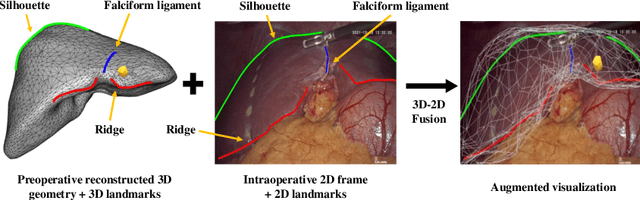


Laparoscopic liver surgery poses a complex intraoperative dynamic environment for surgeons, where remains a significant challenge to distinguish critical or even hidden structures inside the liver. Liver anatomical landmarks, e.g., ridge and ligament, serve as important markers for 2D-3D alignment, which can significantly enhance the spatial perception of surgeons for precise surgery. To facilitate the detection of laparoscopic liver landmarks, we collect a novel dataset called L3D, which comprises 1,152 frames with elaborated landmark annotations from surgical videos of 39 patients across two medical sites. For benchmarking purposes, 12 mainstream detection methods are selected and comprehensively evaluated on L3D. Further, we propose a depth-driven geometric prompt learning network, namely D2GPLand. Specifically, we design a Depth-aware Prompt Embedding (DPE) module that is guided by self-supervised prompts and generates semantically relevant geometric information with the benefit of global depth cues extracted from SAM-based features. Additionally, a Semantic-specific Geometric Augmentation (SGA) scheme is introduced to efficiently merge RGB-D spatial and geometric information through reverse anatomic perception. The experimental results indicate that D2GPLand obtains state-of-the-art performance on L3D, with 63.52% DICE and 48.68% IoU scores. Together with 2D-3D fusion technology, our method can directly provide the surgeon with intuitive guidance information in laparoscopic scenarios.