 Add to Chrome
 Add to Firefox
 Add to Edge
When Convenience Becomes Risk: A Semantic View of Under-Specification in Host-Acting Agents
Mar 22, 2026
Host-acting agents promise a convenient interaction model in which users specify goals and the system determines how to realize them. We argue that this convenience introduces a distinct security problem: semantic under-specification in goal specification. User instructions are typically goal-oriented, yet they often leave process constraints, safety boundaries, persistence, and exposure insufficiently specified. As a result, the agent must complete missing execution semantics before acting, and this completion can produce risky host-side plans even when the user-stated goal is benign. In this paper, we develop a semantic threat model, present a taxonomy of semantic-induced risky completion patterns, and study the phenomenon through an OpenClaw-centered case study and execution-trace analysis. We further derive defense design principles for making execution boundaries explicit and constraining risky completion. These findings suggest that securing host-acting agents requires governing not only which actions are allowed at execution time, but also how goal-only instructions are translated into executable plans.

Differentially Private Subspace Fine-Tuning for Large Language Models
Jan 16, 2026Fine-tuning large language models on downstream tasks is crucial for realizing their cross-domain potential but often relies on sensitive data, raising privacy concerns. Differential privacy (DP) offers rigorous privacy guarantees and has been widely adopted in fine-tuning; however, naively injecting noise across the high-dimensional parameter space creates perturbations with large norms, degrading performance and destabilizing training. To address this issue, we propose DP-SFT, a two-stage subspace fine-tuning method that substantially reduces noise magnitude while preserving formal DP guarantees. Our intuition is that, during fine-tuning, significant parameter updates lie within a low-dimensional, task-specific subspace, while other directions change minimally. Hence, we only inject DP noise into this subspace to protect privacy without perturbing irrelevant parameters. In phase one, we identify the subspace by analyzing principal gradient directions to capture task-specific update signals. In phase two, we project full gradients onto this subspace, add DP noise, and map the perturbed gradients back to the original parameter space for model updates, markedly lowering noise impact. Experiments on multiple datasets demonstrate that DP-SFT enhances accuracy and stability under rigorous DP constraints, accelerates convergence, and achieves substantial gains over DP fine-tuning baselines.
Privacy in Fine-tuning Large Language Models: Attacks, Defenses, and Future Directions
Dec 21, 2024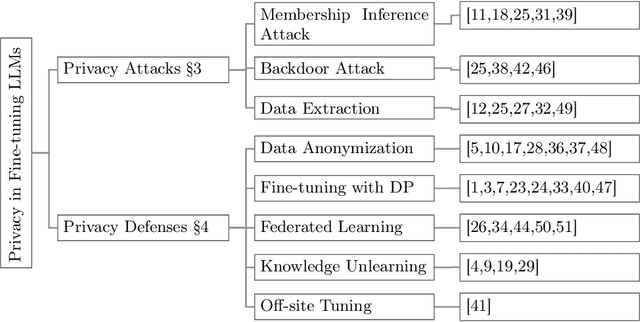
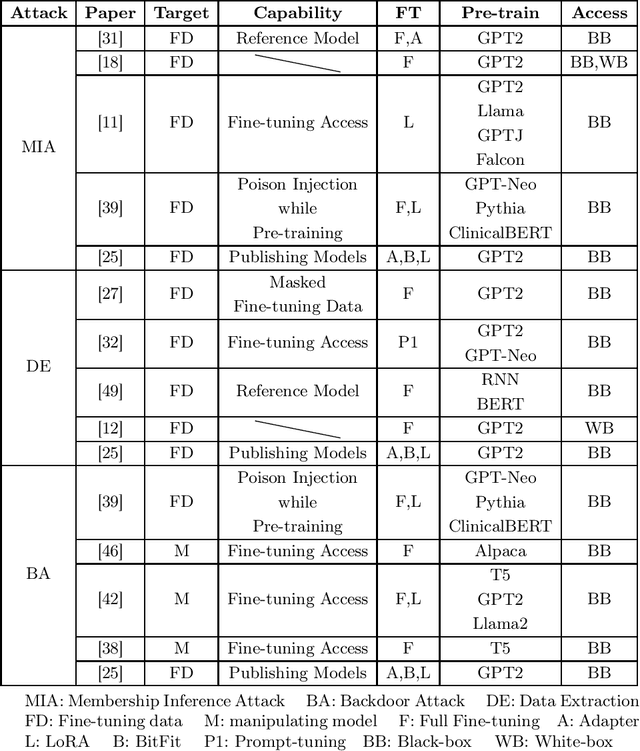
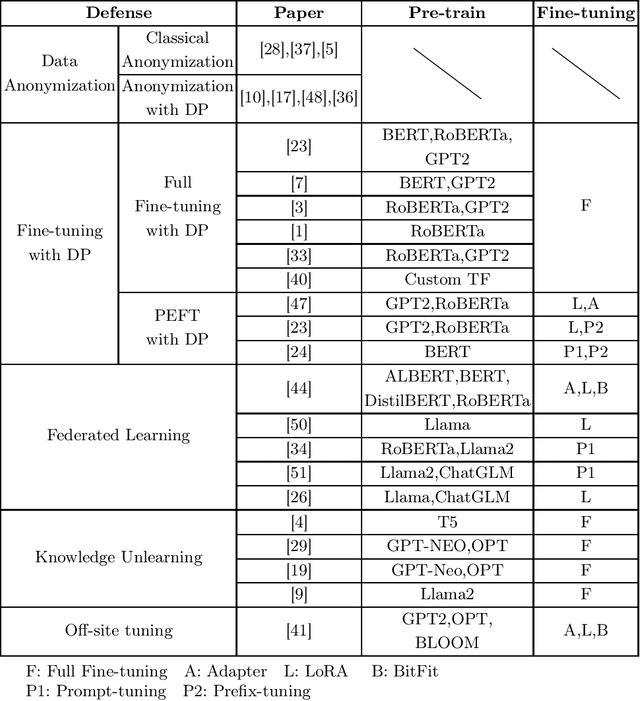
Fine-tuning has emerged as a critical process in leveraging Large Language Models (LLMs) for specific downstream tasks, enabling these models to achieve state-of-the-art performance across various domains. However, the fine-tuning process often involves sensitive datasets, introducing privacy risks that exploit the unique characteristics of this stage. In this paper, we provide a comprehensive survey of privacy challenges associated with fine-tuning LLMs, highlighting vulnerabilities to various privacy attacks, including membership inference, data extraction, and backdoor attacks. We further review defense mechanisms designed to mitigate privacy risks in the fine-tuning phase, such as differential privacy, federated learning, and knowledge unlearning, discussing their effectiveness and limitations in addressing privacy risks and maintaining model utility. By identifying key gaps in existing research, we highlight challenges and propose directions to advance the development of privacy-preserving methods for fine-tuning LLMs, promoting their responsible use in diverse applications.
Extracting Spatiotemporal Data from Gradients with Large Language Models
Oct 21, 2024
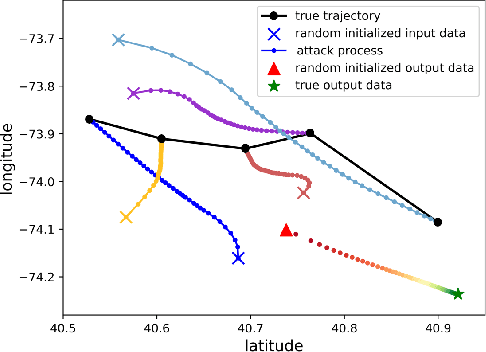
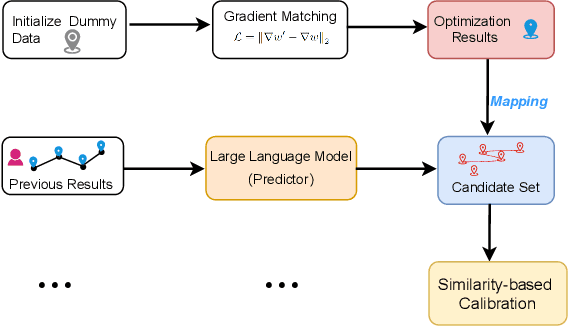

Recent works show that sensitive user data can be reconstructed from gradient updates, breaking the key privacy promise of federated learning. While success was demonstrated primarily on image data, these methods do not directly transfer to other domains, such as spatiotemporal data. To understand privacy risks in spatiotemporal federated learning, we first propose Spatiotemporal Gradient Inversion Attack (ST-GIA), a gradient attack algorithm tailored to spatiotemporal data that successfully reconstructs the original location from gradients. Furthermore, the absence of priors in attacks on spatiotemporal data has hindered the accurate reconstruction of real client data. To address this limitation, we propose ST-GIA+, which utilizes an auxiliary language model to guide the search for potential locations, thereby successfully reconstructing the original data from gradients. In addition, we design an adaptive defense strategy to mitigate gradient inversion attacks in spatiotemporal federated learning. By dynamically adjusting the perturbation levels, we can offer tailored protection for varying rounds of training data, thereby achieving a better trade-off between privacy and utility than current state-of-the-art methods. Through intensive experimental analysis on three real-world datasets, we reveal that the proposed defense strategy can well preserve the utility of spatiotemporal federated learning with effective security protection.