 Add to Chrome
 Add to Firefox
 Add to Edge
RAVEN: Retrieval-Augmented Vulnerability Exploration Network for Memory Corruption Analysis in User Code and Binary Programs
Apr 20, 2026
Large Language Models (LLMs) have demonstrated remarkable capabilities across various cybersecurity tasks, including vulnerability classification, detection, and patching. However, their potential in automated vulnerability report documentation and analysis remains underexplored. We present RAVEN (Retrieval Augmented Vulnerability Exploration Network), a framework leveraging LLM agents and Retrieval Augmented Generation (RAG) to synthesize comprehensive vulnerability analysis reports. Given vulnerable source code, RAVEN generates reports following the Google Project Zero Root Cause Analysis template. The framework uses four modules: an Explorer agent for vulnerability identification, a RAG engine retrieving relevant knowledge from curated databases including Google Project Zero reports and CWE entries, an Analyst agent for impact and exploitation assessment, and a Reporter agent for structured report generation. To ensure quality, RAVEN includes a task specific LLM Judge evaluating reports across structural integrity, ground truth alignment, code reasoning quality, and remediation quality. We evaluate RAVEN on 105 vulnerable code samples covering 15 CWE types from the NIST-SARD dataset. Results show an average quality score of 54.21%, supporting the effectiveness of our approach for automated vulnerability documentation.

MARVEL: Multimodal Adaptive Reasoning-intensiVe Expand-rerank and retrievaL
Apr 08, 2026Multimodal retrieval over text corpora remains a fundamental challenge: the best vision-language encoder achieves only 27.6 nDCG@10 on MM-BRIGHT, a reasoning-intensive multimodal retrieval benchmark, underperforming strong text-only systems. We argue that effective multimodal retrieval requires three tightly integrated capabilities that existing approaches address only in isolation: expanding the query's latent intent, retrieving with a model trained for complex reasoning, and reranking via explicit step-by-step reasoning over candidates. We introduce \textbf{MARVEL} (\textbf{M}ultimodal \textbf{A}daptive \textbf{R}easoning-intensi\textbf{V}e \textbf{E}xpand-rerank and retrieva\textbf{L}), a unified pipeline that combines LLM-driven query expansion, \textbf{MARVEL-Retriever} -- a reasoning-enhanced dense retriever fine-tuned for complex multimodal queries -- and GPT-4o-based chain-of-thought reranking with optional multi-pass reciprocal rank fusion. Evaluated on MM-BRIGHT across 29 technical domains, MARVEL achieves \textbf{37.9} nDCG@10, surpassing the best multimodal encoder by \textbf{+10.3 points} and outperforming all single-stage baselines in 27 of 29 domains and matching or approaching the best baseline in the remaining two highly-specialized domains (Crypto, Quantum Computing), demonstrating that reasoning-intensive multimodal retrieval is best addressed through a unified expand-retrieve-rerank framework. https://github.com/mm-bright/multimodal-reasoning-retrieval
BRIDGE: Multimodal-to-Text Retrieval via Reinforcement-Learned Query Alignment
Apr 08, 2026Multimodal retrieval systems struggle to resolve image-text queries against text-only corpora: the best vision-language encoder achieves only 27.6 nDCG@10 on MM-BRIGHT, underperforming strong text-only retrievers. We argue the bottleneck is not the retriever but the query -- raw multimodal queries entangle visual descriptions, conversational noise, and retrieval intent in ways that systematically degrade embedding similarity. We present \textbf{BRIDGE}, a two-component system that resolves this mismatch without multimodal encoders. \textbf{FORGE} (\textbf{F}ocused Retrieval Query Generato\textbf{r}) is a query alignment model trained via reinforcement learning, which distills noisy multimodal queries into compact, retrieval-optimized search strings. \textbf{LENS} (\textbf{L}anguage-\textbf{E}nhanced \textbf{N}eural \textbf{S}earch) is a reasoning-enhanced dense retriever fine-tuned on reasoning-intensive retrieval data to handle the intent-rich queries FORGE produces. Evaluated on MM-BRIGHT (2,803 queries, 29 domains), BRIDGE achieves \textbf{29.7} nDCG@10, surpassing all multimodal encoder baselines including Nomic-Vision (27.6). When FORGE is applied as a plug-and-play aligner on top of Nomic-Vision, the combined system reaches \textbf{33.3} nDCG@10 -- exceeding the best text-only retriever (32.2) -- demonstrating that \textit{query alignment} is the key bottleneck in multimodal-to-text retrieval. https://github.com/mm-bright/multimodal-reasoning-retrieval
HIVE: Query, Hypothesize, Verify An LLM Framework for Multimodal Reasoning-Intensive Retrieval
Apr 08, 2026Multimodal retrieval models fail on reasoning-intensive queries where images (diagrams, charts, screenshots) must be deeply integrated with text to identify relevant documents -- the best multimodal model achieves only 27.6 nDCG@10 on MM-BRIGHT, underperforming even strong text-only retrievers (32.2). We introduce \textbf{HIVE} (\textbf{H}ypothesis-driven \textbf{I}terative \textbf{V}isual \textbf{E}vidence Retrieval), a plug-and-play framework that injects explicit visual-text reasoning into a retriever via LLMs. HIVE operates in four stages: (1) initial retrieval over the corpus, (2) LLM-based compensatory query synthesis that explicitly articulates visual and logical gaps observed in top-$k$ candidates, (3) secondary retrieval with the refined query, and (4) LLM verification and reranking over the union of candidates. Evaluated on the multimodal-to-text track of MM-BRIGHT (2,803 real-world queries across 29 technical domains), HIVE achieves a new state-of-the-art aggregated nDCG@10 of \textbf{41.7} -- a \textbf{+9.5} point gain over the best text-only model (DiVeR: 32.2) and \textbf{+14.1} over the best multimodal model (Nomic-Vision: 27.6), where our reasoning-enhanced base retriever contributes 33.2 and the HIVE framework adds a further \textbf{+8.5} points -- with particularly strong results in visually demanding domains (Gaming: 68.2, Chemistry: 42.5, Sustainability: 49.4). Compatible with both standard and reasoning-enhanced retrievers, HIVE demonstrates that LLM-mediated visual hypothesis generation and verification can substantially close the multimodal reasoning gap in retrieval. https://github.com/mm-bright/multimodal-reasoning-retrieval
Representation-Level Adversarial Regularization for Clinically Aligned Multitask Thyroid Ultrasound Assessment
Mar 22, 2026Thyroid ultrasound is the first-line exam for assessing thyroid nodules and determining whether biopsy is warranted. In routine reporting, radiologists produce two coupled outputs: a nodule contour for measurement and a TI-RADS risk category based on sonographic criteria. Yet both contouring style and risk grading vary across readers, creating inconsistent supervision that can degrade standard learning pipelines. In this paper, we address this workflow with a clinically guided multitask framework that jointly predicts the nodule mask and TI-RADS category within a single model. To ground risk prediction in clinically meaningful evidence, we guide the classification embedding using a compact TI-RADS aligned radiomics target during training, while preserving complementary deep features for discriminative performance. However, under annotator variability, naive multitask optimization often fails not because the tasks are unrelated, but because their gradients compete within the shared representation. To make this competition explicit and controllable, we introduce RLAR, a representation-level adversarial gradient regularizer. Rather than performing parameter-level gradient surgery, RLAR uses each task's normalized adversarial direction in latent space as a geometric probe of task sensitivity and penalizes excessive angular alignment between task-specific adversarial directions. On a public TI-RADS dataset, our clinically guided multitask model with RLAR consistently improves risk stratification while maintaining segmentation quality compared to single-task training and conventional multitask baselines. Code and pretrained models will be released.
MM-BRIGHT: A Multi-Task Multimodal Benchmark for Reasoning-Intensive Retrieval
Jan 15, 2026Existing retrieval benchmarks primarily consist of text-based queries where keyword or semantic matching is usually sufficient. Many real-world queries contain multimodal elements, particularly, images such as diagrams, charts, and screenshots that require intensive reasoning to identify relevant documents. To address this gap, we introduce MM-BRIGHT, the first multimodal benchmark for reasoning-intensive retrieval. Our dataset consists of 2,803 real-world queries spanning 29 diverse technical domains, with four tasks of increasing complexity: text-to-text, multimodal-to-text, multimodal-to-image, and multimodal-to-multimodal retrieval. Extensive evaluation reveals that state-of-the-art models struggle across all tasks: BM25 achieves only 8.5 nDCG@10 on text-only retrieval, while the best multimodal model Nomic-Vision reaches just 27.6 nDCG@10 on multimodal-to-text retrieval actually underperforming the best text-only model (DiVeR: 32.2). These results highlight substantial headroom and position MM-BRIGHT as a testbed for next-generation retrieval models that better integrate visual reasoning. Our code and data are available at https://github.com/mm-bright/MM-BRIGHT. See also our official website: https://mm-bright.github.io/.
CORU: Comprehensive Post-OCR Parsing and Receipt Understanding Dataset
Jun 06, 2024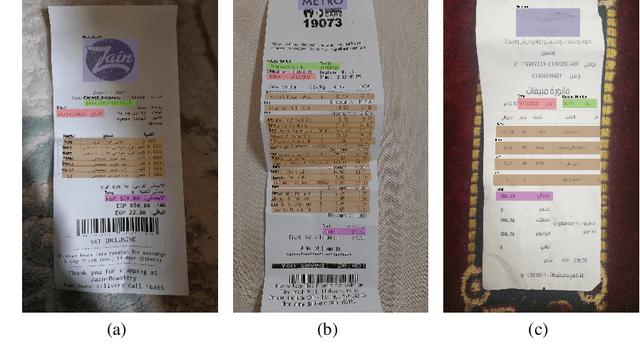
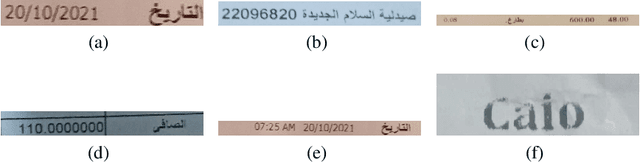
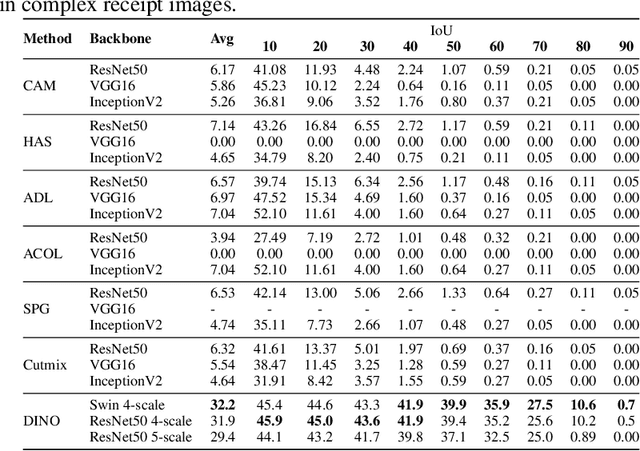
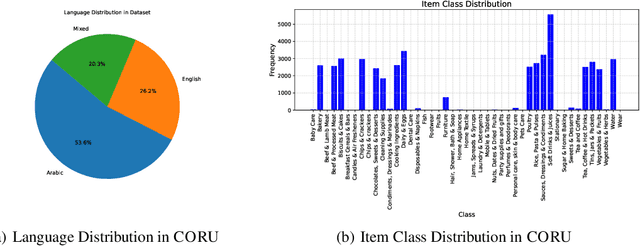
In the fields of Optical Character Recognition (OCR) and Natural Language Processing (NLP), integrating multilingual capabilities remains a critical challenge, especially when considering languages with complex scripts such as Arabic. This paper introduces the Comprehensive Post-OCR Parsing and Receipt Understanding Dataset (CORU), a novel dataset specifically designed to enhance OCR and information extraction from receipts in multilingual contexts involving Arabic and English. CORU consists of over 20,000 annotated receipts from diverse retail settings, including supermarkets and clothing stores, alongside 30,000 annotated images for OCR that were utilized to recognize each detected line, and 10,000 items annotated for detailed information extraction. These annotations capture essential details such as merchant names, item descriptions, total prices, receipt numbers, and dates. They are structured to support three primary computational tasks: object detection, OCR, and information extraction. We establish the baseline performance for a range of models on CORU to evaluate the effectiveness of traditional methods, like Tesseract OCR, and more advanced neural network-based approaches. These baselines are crucial for processing the complex and noisy document layouts typical of real-world receipts and for advancing the state of automated multilingual document processing. Our datasets are publicly accessible (https://github.com/Update-For-Integrated-Business-AI/CORU).
A Comprehensive Survey of Masked Faces: Recognition, Detection, and Unmasking
May 09, 2024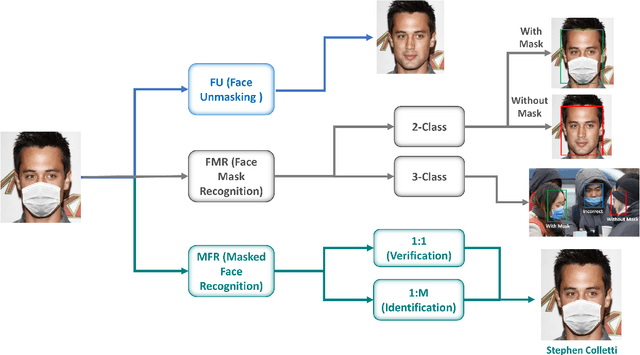


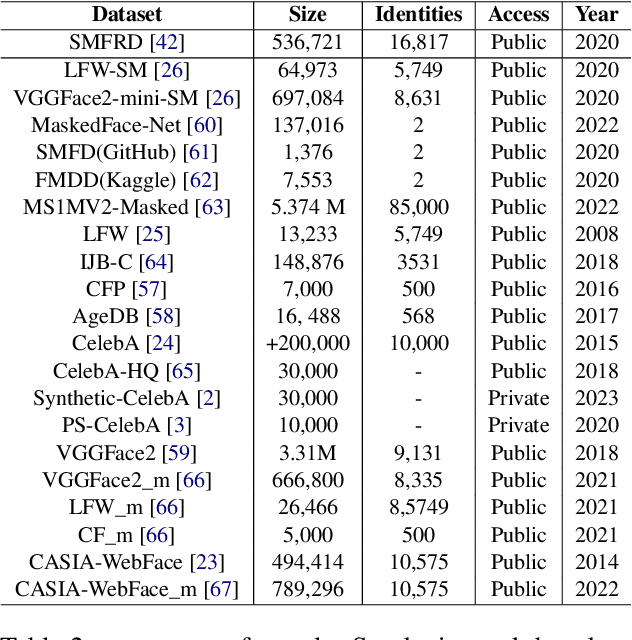
Masked face recognition (MFR) has emerged as a critical domain in biometric identification, especially by the global COVID-19 pandemic, which introduced widespread face masks. This survey paper presents a comprehensive analysis of the challenges and advancements in recognising and detecting individuals with masked faces, which has seen innovative shifts due to the necessity of adapting to new societal norms. Advanced through deep learning techniques, MFR, along with Face Mask Recognition (FMR) and Face Unmasking (FU), represent significant areas of focus. These methods address unique challenges posed by obscured facial features, from fully to partially covered faces. Our comprehensive review delves into the various deep learning-based methodologies developed for MFR, FMR, and FU, highlighting their distinctive challenges and the solutions proposed to overcome them. Additionally, we explore benchmark datasets and evaluation metrics specifically tailored for assessing performance in MFR research. The survey also discusses the substantial obstacles still facing researchers in this field and proposes future directions for the ongoing development of more robust and effective masked face recognition systems. This paper serves as an invaluable resource for researchers and practitioners, offering insights into the evolving landscape of face recognition technologies in the face of global health crises and beyond.
ArabicaQA: A Comprehensive Dataset for Arabic Question Answering
Mar 26, 2024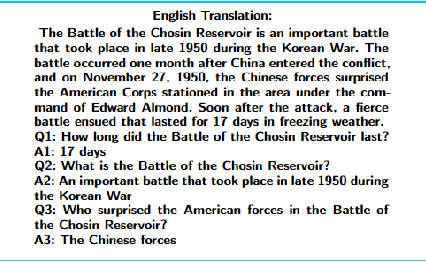
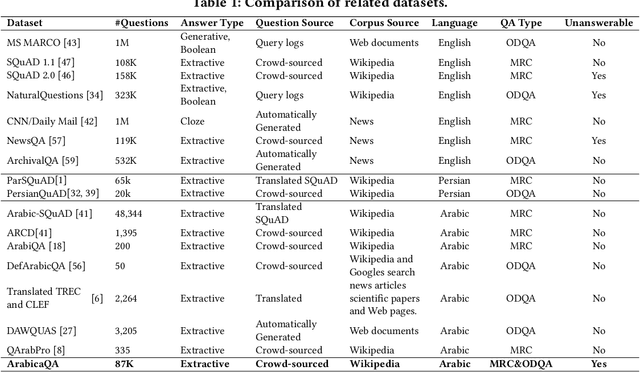
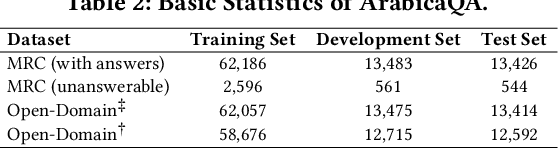
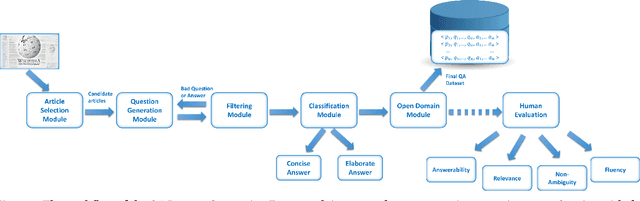
In this paper, we address the significant gap in Arabic natural language processing (NLP) resources by introducing ArabicaQA, the first large-scale dataset for machine reading comprehension and open-domain question answering in Arabic. This comprehensive dataset, consisting of 89,095 answerable and 3,701 unanswerable questions created by crowdworkers to look similar to answerable ones, along with additional labels of open-domain questions marks a crucial advancement in Arabic NLP resources. We also present AraDPR, the first dense passage retrieval model trained on the Arabic Wikipedia corpus, specifically designed to tackle the unique challenges of Arabic text retrieval. Furthermore, our study includes extensive benchmarking of large language models (LLMs) for Arabic question answering, critically evaluating their performance in the Arabic language context. In conclusion, ArabicaQA, AraDPR, and the benchmarking of LLMs in Arabic question answering offer significant advancements in the field of Arabic NLP. The dataset and code are publicly accessible for further research https://github.com/DataScienceUIBK/ArabicaQA.
Advancements and Challenges in Arabic Optical Character Recognition: A Comprehensive Survey
Dec 19, 2023Optical character recognition (OCR) is a vital process that involves the extraction of handwritten or printed text from scanned or printed images, converting it into a format that can be understood and processed by machines. This enables further data processing activities such as searching and editing. The automatic extraction of text through OCR plays a crucial role in digitizing documents, enhancing productivity, improving accessibility, and preserving historical records. This paper seeks to offer an exhaustive review of contemporary applications, methodologies, and challenges associated with Arabic Optical Character Recognition (OCR). A thorough analysis is conducted on prevailing techniques utilized throughout the OCR process, with a dedicated effort to discern the most efficacious approaches that demonstrate enhanced outcomes. To ensure a thorough evaluation, a meticulous keyword-search methodology is adopted, encompassing a comprehensive analysis of articles relevant to Arabic OCR, including both backward and forward citation reviews. In addition to presenting cutting-edge techniques and methods, this paper critically identifies research gaps within the realm of Arabic OCR. By highlighting these gaps, we shed light on potential areas for future exploration and development, thereby guiding researchers toward promising avenues in the field of Arabic OCR. The outcomes of this study provide valuable insights for researchers, practitioners, and stakeholders involved in Arabic OCR, ultimately fostering advancements in the field and facilitating the creation of more accurate and efficient OCR systems for the Arabic language.