 Add to Chrome
 Add to Firefox
 Add to Edge
Generating Synthetic Doctor-Patient Conversations for Long-form Audio Summarization
Apr 07, 2026
Long-context audio reasoning is underserved in both training data and evaluation. Existing benchmarks target short-context tasks, and the open-ended generation tasks most relevant to long-context reasoning pose well-known challenges for automatic evaluation. We propose a synthetic data generation pipeline designed to serve both as a training resource and as a controlled evaluation environment, and instantiate it for first-visit doctor-patient conversations with SOAP note generation as the task. The pipeline has three stages, persona-driven dialogue generation, multi-speaker audio synthesis with overlap/pause modeling, room acoustics, and sound events, and LLM-based reference SOAP note production, built entirely on open-weight models. We release 8,800 synthetic conversations with 1.3k hours of corresponding audio and reference notes. Evaluating current open-weight systems, we find that cascaded approaches still substantially outperform end-to-end models.

On the Use of Self-Supervised Representation Learning for Speaker Diarization and Separation
Dec 17, 2025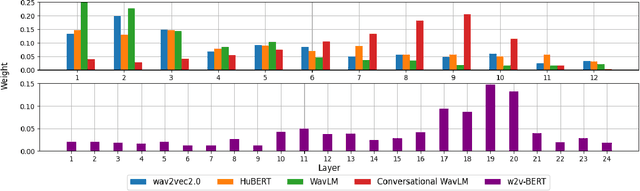
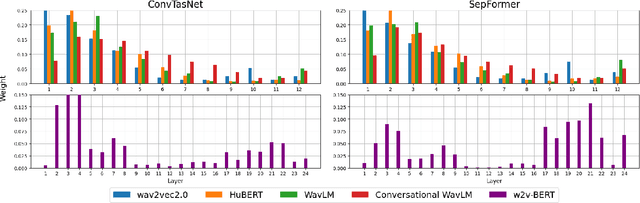
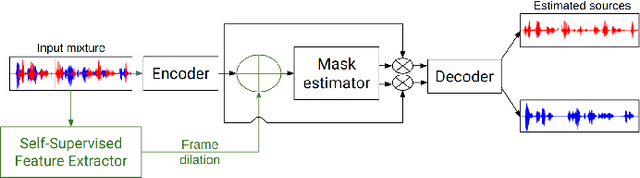
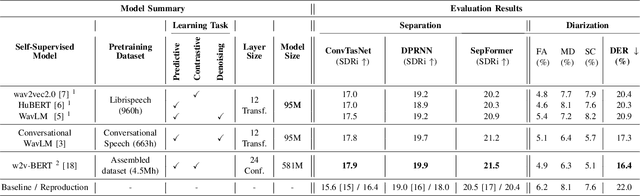
Self-supervised speech models such as wav2vec2.0 and WavLM have been shown to significantly improve the performance of many downstream speech tasks, especially in low-resource settings, over the past few years. Despite this, evaluations on tasks such as Speaker Diarization and Speech Separation remain limited. This paper investigates the quality of recent self-supervised speech representations on these two speaker identity-related tasks, highlighting gaps in the current literature that stem from limitations in the existing benchmarks, particularly the lack of diversity in evaluation datasets and variety in downstream systems associated to both diarization and separation.
SDialog: A Python Toolkit for End-to-End Agent Building, User Simulation, Dialog Generation, and Evaluation
Dec 12, 2025We present SDialog, an MIT-licensed open-source Python toolkit that unifies dialog generation, evaluation and mechanistic interpretability into a single end-to-end framework for building and analyzing LLM-based conversational agents. Built around a standardized \texttt{Dialog} representation, SDialog provides: (1) persona-driven multi-agent simulation with composable orchestration for controlled, synthetic dialog generation, (2) comprehensive evaluation combining linguistic metrics, LLM-as-a-judge and functional correctness validators, (3) mechanistic interpretability tools for activation inspection and steering via feature ablation and induction, and (4) audio generation with full acoustic simulation including 3D room modeling and microphone effects. The toolkit integrates with all major LLM backends, enabling mixed-backend experiments under a unified API. By coupling generation, evaluation, and interpretability in a dialog-centric architecture, SDialog enables researchers to build, benchmark and understand conversational systems more systematically.
TalTech-IRIT-LIS Speaker and Language Diarization Systems for DISPLACE 2024
Jul 17, 2024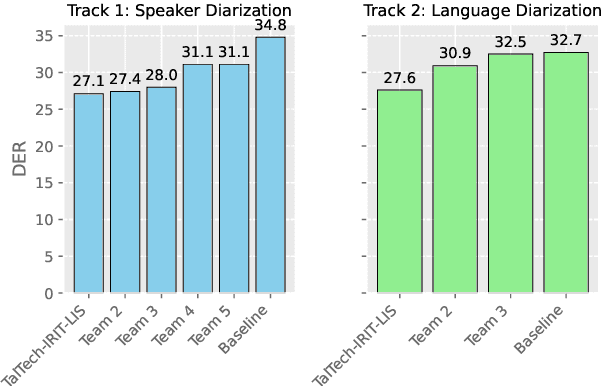
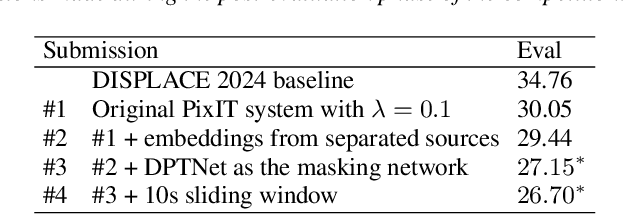
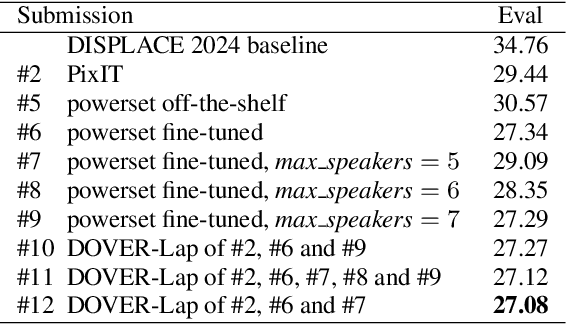

This paper describes the submissions of team TalTech-IRIT-LIS to the DISPLACE 2024 challenge. Our team participated in the speaker diarization and language diarization tracks of the challenge. In the speaker diarization track, our best submission was an ensemble of systems based on the pyannote.audio speaker diarization pipeline utilizing powerset training and our recently proposed PixIT method that performs joint diarization and speech separation. We improve upon PixIT by using the separation outputs for speaker embedding extraction. Our ensemble achieved a diarization error rate of 27.1% on the evaluation dataset. In the language diarization track, we fine-tuned a pre-trained Wav2Vec2-BERT language embedding model on in-domain data, and clustered short segments using AHC and VBx, based on similarity scores from LDA/PLDA. This led to a language diarization error rate of 27.6% on the evaluation data. Both results were ranked first in their respective challenge tracks.