 Add to Chrome
 Add to Firefox
 Add to Edge
XTinyU-Net: Training-Free U-Net Scaling via Initialization-Time Sensitivity
May 10, 2026
While U-Net architectures remain the gold standard for medical image segmentation, their deployment in resource-constrained environments demands aggressive model compression. However, finding an optimally efficient configuration is computationally prohibitive, typically requiring exhaustive train-and-evaluate cycles to find the smallest model that maintains peak performance. In this paper, we introduce a training-free selection framework to automatically identify ultralightweight, dataset-specific U-Net configurations directly at initialization. We observe that systematically scaling down U-Net channel width induces a sharp transition from a stable performance plateau to representational capacity collapse. To pinpoint this boundary without training, we propose a Jacobian-based sensitivity metric that scores discrete, width-capped U-Net variants using a small set of unlabeled images. By analyzing the total variation of this sensitivity curve, we isolate the smallest stable configuration, which we denote as XTinyU-Net. Evaluated across six diverse medical datasets within the nnU-Net framework, XTinyU-Net achieves segmentation accuracy comparable to the heavy nnU-Net baseline with 400x-1600x fewer parameters, and outperforms contemporary lightweight architectures while utilizing 5x-72x fewer parameters. Code is publicly accessible on https://github.com/alvinkimbowa/nntinyunet.git.

MonoUNet: A Robust Tiny Neural Network for Automated Knee Cartilage Segmentation on Point-of-Care Ultrasound Devices
Apr 09, 2026Objective: To develop a robust and compact deep learning model for automated knee cartilage segmentation on point-of-care ultrasound (POCUS) devices. Methods: We propose MonoUNet, an ultra-compact U-Net consisting of (i) an aggressively reduced backbone with an asymmetric decoder, (ii) a trainable monogenic block that extracts multi-scale local phase features, and (iii) a gated feature injection mechanism that integrates these features into the encoder stages to reduce sensitivity to variations in ultrasound image appearance and improve robustness across devices. MonoUNet was evaluated on a multi-site, multi-device knee cartilage ultrasound dataset acquired using cart-based, portable, and handheld POCUS devices. Results: Overall, MonoUNet outperformed existing lightweight segmentation models, with average Dice scores ranging from 92.62% to 94.82% and mean average surface distance (MASD) values between 0.133 mm and 0.254 mm. MonoUNet reduces the number of parameters by 10x--700x and computational cost by 14x--2000x relative to existing lightweight models. MonoUNet cartilage outcomes showed excellent reliability and agreement with the manual outcomes: intraclass correlation coefficients (ICC$_{2,k})$=0.96 and bias=2.00% (0.047 mm) for average thickness, and ICC$_{2,k}$=0.99 and bias=0.80% (0.328 a.u.) for echo intensity. Conclusion: Incorporating trainable local phase features improves the robustness of highly compact neural networks for knee cartilage segmentation across varying acquisition settings and could support scalable ultrasound-based assessment and monitoring of knee osteoarthritis using POCUS devices. The code is publicly available at https://github.com/alvinkimbowa/monounet.
Mono2D: A Trainable Monogenic Layer for Robust Knee Cartilage Segmentation on Out-of-Distribution 2D Ultrasound Data
Mar 12, 2025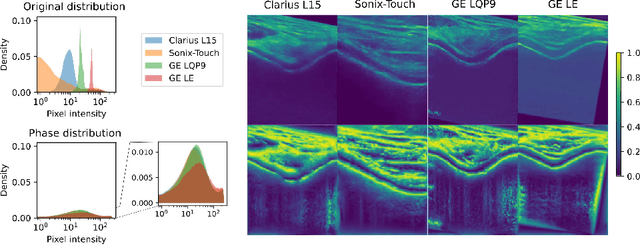
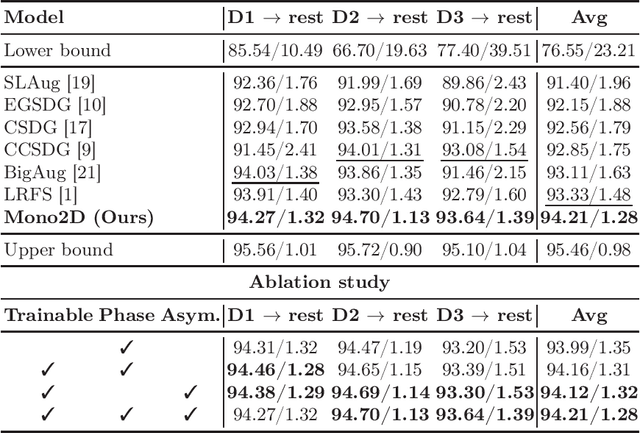
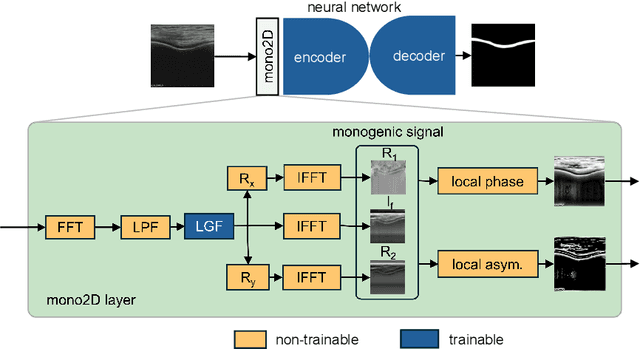
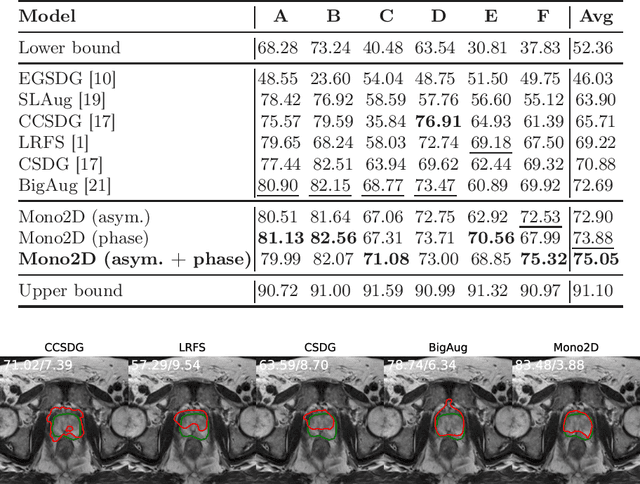
Automated knee cartilage segmentation using point-of-care ultrasound devices and deep-learning networks has the potential to enhance the management of knee osteoarthritis. However, segmentation algorithms often struggle with domain shifts caused by variations in ultrasound devices and acquisition parameters, limiting their generalizability. In this paper, we propose Mono2D, a monogenic layer that extracts multi-scale, contrast- and intensity-invariant local phase features using trainable bandpass quadrature filters. This layer mitigates domain shifts, improving generalization to out-of-distribution domains. Mono2D is integrated before the first layer of a segmentation network, and its parameters jointly trained alongside the network's parameters. We evaluated Mono2D on a multi-domain 2D ultrasound knee cartilage dataset for single-source domain generalization (SSDG). Our results demonstrate that Mono2D outperforms other SSDG methods in terms of Dice score and mean average surface distance. To further assess its generalizability, we evaluate Mono2D on a multi-site prostate MRI dataset, where it continues to outperform other SSDG methods, highlighting its potential to improve domain generalization in medical imaging. Nevertheless, further evaluation on diverse datasets is still necessary to assess its clinical utility.