 Add to Chrome
 Add to Firefox
 Add to Edge
Zero-Shot Sharpness-Aware Quantization for Pre-trained Language Models
Oct 20, 2023


Quantization is a promising approach for reducing memory overhead and accelerating inference, especially in large pre-trained language model (PLM) scenarios. While having no access to original training data due to security and privacy concerns has emerged the demand for zero-shot quantization. Most of the cutting-edge zero-shot quantization methods primarily 1) apply to computer vision tasks, and 2) neglect of overfitting problem in the generative adversarial learning process, leading to sub-optimal performance. Motivated by this, we propose a novel zero-shot sharpness-aware quantization (ZSAQ) framework for the zero-shot quantization of various PLMs. The key algorithm in solving ZSAQ is the SAM-SGA optimization, which aims to improve the quantization accuracy and model generalization via optimizing a minimax problem. We theoretically prove the convergence rate for the minimax optimization problem and this result can be applied to other nonconvex-PL minimax optimization frameworks. Extensive experiments on 11 tasks demonstrate that our method brings consistent and significant performance gains on both discriminative and generative PLMs, i.e., up to +6.98 average score. Furthermore, we empirically validate that our method can effectively improve the model generalization.

Stochastic Optimization for Non-convex Problem with Inexact Hessian Matrix, Gradient, and Function
Oct 18, 2023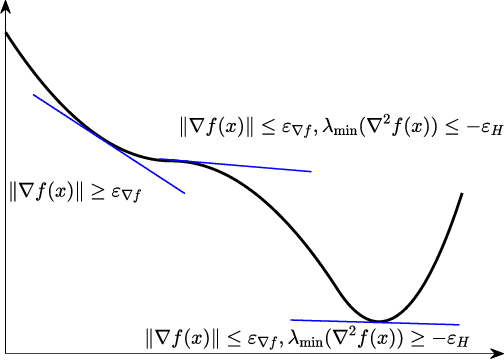
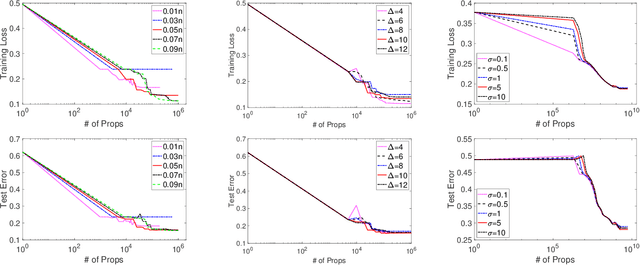
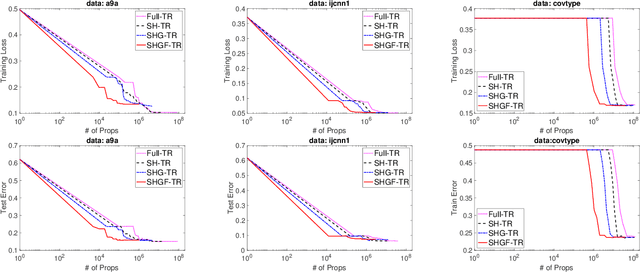
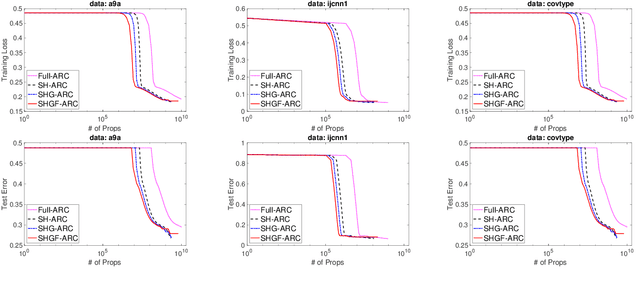
Trust-region (TR) and adaptive regularization using cubics (ARC) have proven to have some very appealing theoretical properties for non-convex optimization by concurrently computing function value, gradient, and Hessian matrix to obtain the next search direction and the adjusted parameters. Although stochastic approximations help largely reduce the computational cost, it is challenging to theoretically guarantee the convergence rate. In this paper, we explore a family of stochastic TR and ARC methods that can simultaneously provide inexact computations of the Hessian matrix, gradient, and function values. Our algorithms require much fewer propagations overhead per iteration than TR and ARC. We prove that the iteration complexity to achieve $\epsilon$-approximate second-order optimality is of the same order as the exact computations demonstrated in previous studies. Additionally, the mild conditions on inexactness can be met by leveraging a random sampling technology in the finite-sum minimization problem. Numerical experiments with a non-convex problem support these findings and demonstrate that, with the same or a similar number of iterations, our algorithms require less computational overhead per iteration than current second-order methods.
Diversifying the Mixture-of-Experts Representation for Language Models with Orthogonal Optimizer
Oct 15, 2023The Mixture of Experts (MoE) has emerged as a highly successful technique in deep learning, based on the principle of divide-and-conquer to maximize model capacity without significant additional computational cost. Even in the era of large-scale language models (LLMs), MoE continues to play a crucial role, as some researchers have indicated that GPT-4 adopts the MoE structure to ensure diverse inference results. However, MoE is susceptible to performance degeneracy, particularly evident in the issues of imbalance and homogeneous representation among experts. While previous studies have extensively addressed the problem of imbalance, the challenge of homogeneous representation remains unresolved. In this study, we shed light on the homogeneous representation problem, wherein experts in the MoE fail to specialize and lack diversity, leading to frustratingly high similarities in their representations (up to 99% in a well-performed MoE model). This problem restricts the expressive power of the MoE and, we argue, contradicts its original intention. To tackle this issue, we propose a straightforward yet highly effective solution: OMoE, an orthogonal expert optimizer. Additionally, we introduce an alternating training strategy that encourages each expert to update in a direction orthogonal to the subspace spanned by other experts. Our algorithm facilitates MoE training in two key ways: firstly, it explicitly enhances representation diversity, and secondly, it implicitly fosters interaction between experts during orthogonal weights computation. Through extensive experiments, we demonstrate that our proposed optimization algorithm significantly improves the performance of fine-tuning the MoE model on the GLUE benchmark, SuperGLUE benchmark, question-answering task, and name entity recognition tasks.
Learn From Model Beyond Fine-Tuning: A Survey
Oct 12, 2023Foundation models (FM) have demonstrated remarkable performance across a wide range of tasks (especially in the fields of natural language processing and computer vision), primarily attributed to their ability to comprehend instructions and access extensive, high-quality data. This not only showcases their current effectiveness but also sets a promising trajectory towards the development of artificial general intelligence. Unfortunately, due to multiple constraints, the raw data of the model used for large model training are often inaccessible, so the use of end-to-end models for downstream tasks has become a new research trend, which we call Learn From Model (LFM) in this article. LFM focuses on the research, modification, and design of FM based on the model interface, so as to better understand the model structure and weights (in a black box environment), and to generalize the model to downstream tasks. The study of LFM techniques can be broadly categorized into five major areas: model tuning, model distillation, model reuse, meta learning and model editing. Each category encompasses a repertoire of methods and strategies that aim to enhance the capabilities and performance of FM. This paper gives a comprehensive review of the current methods based on FM from the perspective of LFM, in order to help readers better understand the current research status and ideas. To conclude, we summarize the survey by highlighting several critical areas for future exploration and addressing open issues that require further attention from the research community. The relevant papers we investigated in this article can be accessed at <https://github.com/ruthless-man/Awesome-Learn-from-Model>.
PointHR: Exploring High-Resolution Architectures for 3D Point Cloud Segmentation
Oct 11, 2023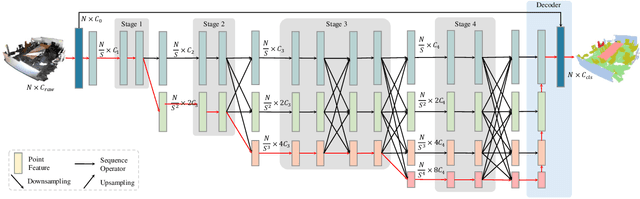


Significant progress has been made recently in point cloud segmentation utilizing an encoder-decoder framework, which initially encodes point clouds into low-resolution representations and subsequently decodes high-resolution predictions. Inspired by the success of high-resolution architectures in image dense prediction, which always maintains a high-resolution representation throughout the entire learning process, we consider it also highly important for 3D dense point cloud analysis. Therefore, in this paper, we explore high-resolution architectures for 3D point cloud segmentation. Specifically, we generalize high-resolution architectures using a unified pipeline named PointHR, which includes a knn-based sequence operator for feature extraction and a differential resampling operator to efficiently communicate different resolutions. Additionally, we propose to avoid numerous on-the-fly computations of high-resolution architectures by pre-computing the indices for both sequence and resampling operators. By doing so, we deliver highly competitive high-resolution architectures while capitalizing on the benefits of well-designed point cloud blocks without additional effort. To evaluate these architectures for dense point cloud analysis, we conduct thorough experiments using S3DIS and ScanNetV2 datasets, where the proposed PointHR outperforms recent state-of-the-art methods without any bells and whistles. The source code is available at \url{https://github.com/haibo-qiu/PointHR}.
Revisiting Plasticity in Visual Reinforcement Learning: Data, Modules and Training Stages
Oct 11, 2023
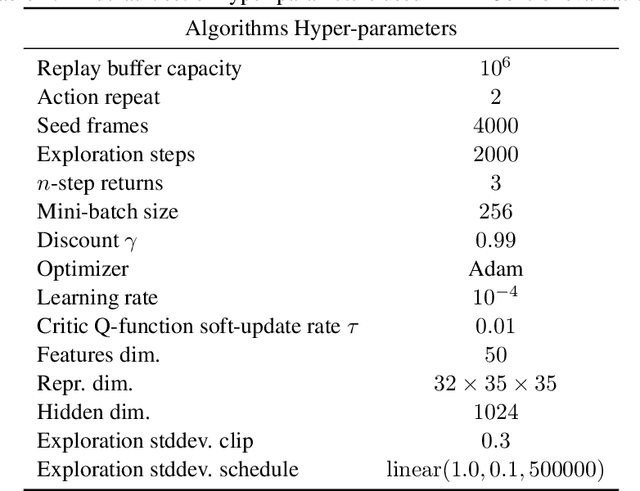


Plasticity, the ability of a neural network to evolve with new data, is crucial for high-performance and sample-efficient visual reinforcement learning (VRL). Although methods like resetting and regularization can potentially mitigate plasticity loss, the influences of various components within the VRL framework on the agent's plasticity are still poorly understood. In this work, we conduct a systematic empirical exploration focusing on three primary underexplored facets and derive the following insightful conclusions: (1) data augmentation is essential in maintaining plasticity; (2) the critic's plasticity loss serves as the principal bottleneck impeding efficient training; and (3) without timely intervention to recover critic's plasticity in the early stages, its loss becomes catastrophic. These insights suggest a novel strategy to address the high replay ratio (RR) dilemma, where exacerbated plasticity loss hinders the potential improvements of sample efficiency brought by increased reuse frequency. Rather than setting a static RR for the entire training process, we propose Adaptive RR, which dynamically adjusts the RR based on the critic's plasticity level. Extensive evaluations indicate that Adaptive RR not only avoids catastrophic plasticity loss in the early stages but also benefits from more frequent reuse in later phases, resulting in superior sample efficiency.
Parameter Efficient Multi-task Model Fusion with Partial Linearization
Oct 10, 2023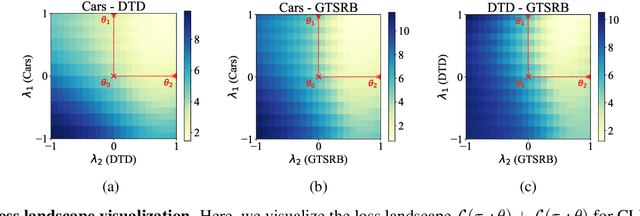
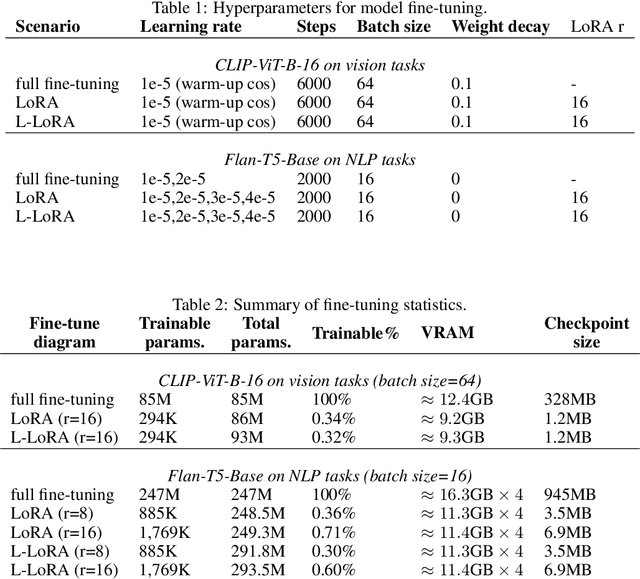
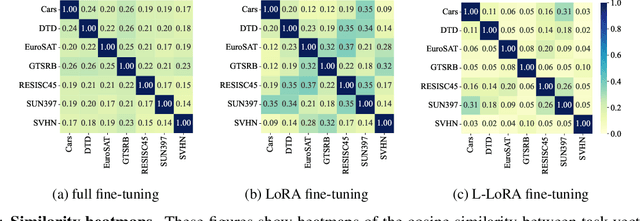
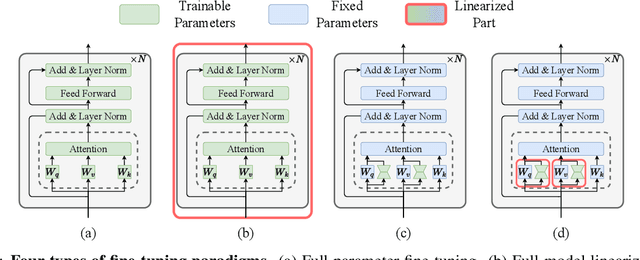
Large pre-trained models have enabled significant advances in machine learning and served as foundation components. Model fusion methods, such as task arithmetic, have been proven to be powerful and scalable to incorporate fine-tuned weights from different tasks into a multi-task model. However, efficiently fine-tuning large pre-trained models on multiple downstream tasks remains challenging, leading to inefficient multi-task model fusion. In this work, we propose a novel method to improve multi-task fusion for parameter-efficient fine-tuning techniques like LoRA fine-tuning. Specifically, our approach partially linearizes only the adapter modules and applies task arithmetic over the linearized adapters. This allows us to leverage the the advantages of model fusion over linearized fine-tuning, while still performing fine-tuning and inference efficiently. We demonstrate that our partial linearization technique enables a more effective fusion of multiple tasks into a single model, outperforming standard adapter tuning and task arithmetic alone. Experimental results demonstrate the capabilities of our proposed partial linearization technique to effectively construct unified multi-task models via the fusion of fine-tuned task vectors. We evaluate performance over an increasing number of tasks and find that our approach outperforms standard parameter-efficient fine-tuning techniques. The results highlight the benefits of partial linearization for scalable and efficient multi-task model fusion.
Which mode is better for federated learning? Centralized or Decentralized
Oct 05, 2023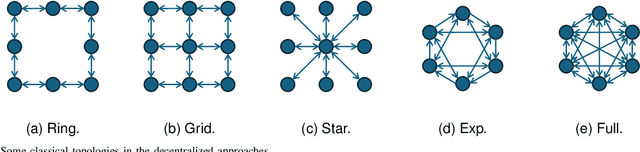

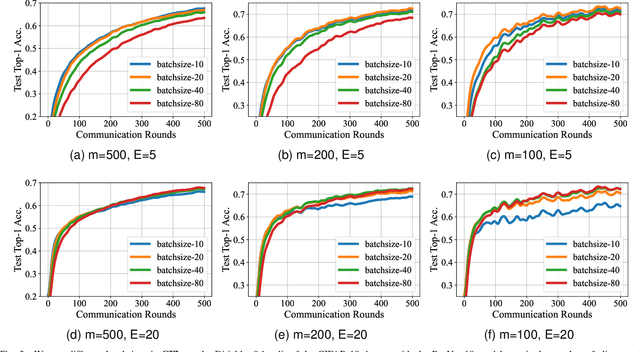
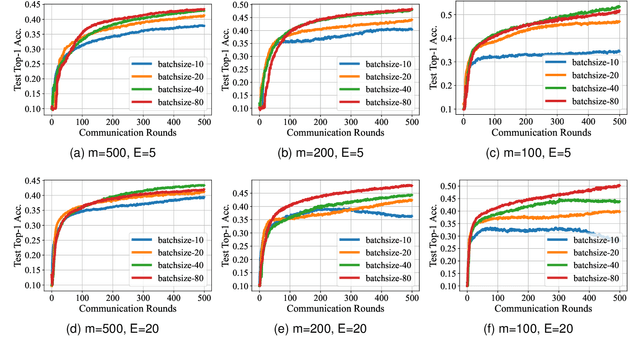
Both centralized and decentralized approaches have shown excellent performance and great application value in federated learning (FL). However, current studies do not provide sufficient evidence to show which one performs better. Although from the optimization perspective, decentralized methods can approach the comparable convergence of centralized methods with less communication, its test performance has always been inefficient in empirical studies. To comprehensively explore their behaviors in FL, we study their excess risks, including the joint analysis of both optimization and generalization. We prove that on smooth non-convex objectives, 1) centralized FL (CFL) always generalizes better than decentralized FL (DFL); 2) from perspectives of the excess risk and test error in CFL, adopting partial participation is superior to full participation; and, 3) there is a necessary requirement for the topology in DFL to avoid performance collapse as the training scale increases. Based on some simple hardware metrics, we could evaluate which framework is better in practice. Extensive experiments are conducted on common setups in FL to validate that our theoretical analysis is contextually valid in practical scenarios.
AdaMerging: Adaptive Model Merging for Multi-Task Learning
Oct 04, 2023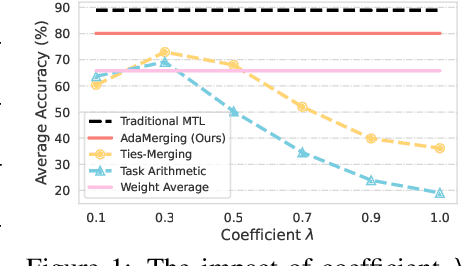
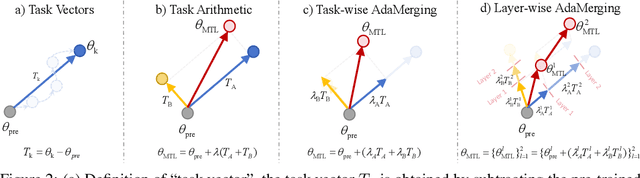
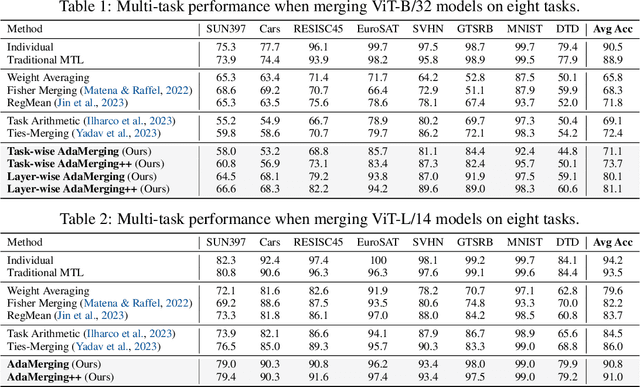
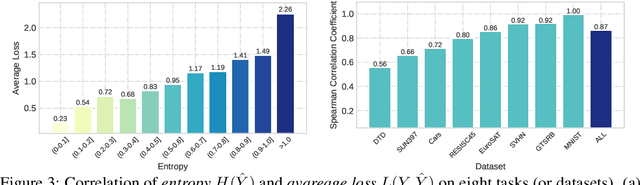
Multi-task learning (MTL) aims to empower a model to tackle multiple tasks simultaneously. A recent development known as task arithmetic has revealed that several models, each fine-tuned for distinct tasks, can be directly merged into a single model to execute MTL without necessitating a retraining process using the initial training data. Nevertheless, this direct addition of models often leads to a significant deterioration in the overall performance of the merged model. This decline occurs due to potential conflicts and intricate correlations among the multiple tasks. Consequently, the challenge emerges of how to merge pre-trained models more effectively without using their original training data. This paper introduces an innovative technique called Adaptive Model Merging (AdaMerging). This approach aims to autonomously learn the coefficients for model merging, either in a task-wise or layer-wise manner, without relying on the original training data. Specifically, our AdaMerging method operates as an automatic, unsupervised task arithmetic scheme. It leverages entropy minimization on unlabeled test samples from the multi-task setup as a surrogate objective function to iteratively refine the merging coefficients of the multiple models. Our experimental findings across eight tasks demonstrate the efficacy of the AdaMerging scheme we put forth. Compared to the current state-of-the-art task arithmetic merging scheme, AdaMerging showcases a remarkable 11\% improvement in performance. Notably, AdaMerging also exhibits superior generalization capabilities when applied to unseen downstream tasks. Furthermore, it displays a significantly enhanced robustness to data distribution shifts that may occur during the testing phase.
Efficient Federated Prompt Tuning for Black-box Large Pre-trained Models
Oct 04, 2023


With the blowout development of pre-trained models (PTMs), the efficient tuning of these models for diverse downstream applications has emerged as a pivotal research concern. Although recent investigations into prompt tuning have provided promising avenues, three salient challenges persist: (1) memory constraint: the continuous growth in the size of open-source PTMs renders fine-tuning, even a fraction of their parameters, challenging for many practitioners. (2) model privacy: existing PTMs often function as public API services, with their parameters inaccessible for effective or tailored fine-tuning. (3) data privacy: the fine-tuning of PTMs necessitates high-quality datasets, which are typically localized and not shared to public. To optimally harness each local dataset while navigating memory constraints and preserving privacy, we propose Federated Black-Box Prompt Tuning (Fed-BBPT). This innovative approach eschews reliance on parameter architectures and private dataset access, instead capitalizing on a central server that aids local users in collaboratively training a prompt generator through regular aggregation. Local users leverage API-driven learning via a zero-order optimizer, obviating the need for PTM deployment. Relative to extensive fine-tuning, Fed-BBPT proficiently sidesteps memory challenges tied to PTM storage and fine-tuning on local machines, tapping into comprehensive, high-quality, yet private training datasets. A thorough evaluation across 40 datasets spanning CV and NLP tasks underscores the robustness of our proposed model.