 Add to Chrome
 Add to Firefox
 Add to Edge
Enhancing Protein Representation Learning via Manifold Restore Mixing
Jun 21, 2026
Data augmentation (DA) has been proven to be an effective means for improving protein representation learning (PRL) by generating additional training samples. Although mainstream perturbation- and sampling-based augmentation methods can produce data containing sufficient variations, they carry the risk of disrupting the protein structure and function. Some crafted protein homology modeling tools can generate conformations, but reduce structural diversity. The above dilemmas lead us to a question: Can we restore the disrupted structure caused by DA operations, providing data with both the original structure and diverse variations? In this work, we first analyze and empirically reveal the structure defect and performance degradation issues of existing DA methods. Based on the findings, we propose a simple yet effective DA method, Manifold Restore Mixing (MRM), for protein representation learning. Specifically, inspired by manifold mixup, we mix the hidden representations of original and augmented protein data to generate new samples that restore structural information lost in DA while introducing diverse variations. Furthermore, we develop a sample difficulty scheduler that adjusts the beta distribution in mixup to provide models with progressively challenging mixed samples during training, which improves the final performance. Comprehensive experiments on various PRL backbones and downstream tasks demonstrate the effectiveness and generalization of our method. The complete code and weights will be released upon acceptance. We provide a implementation at https://github.com/KingGugu/MRM.

Learning How Much to Think: Difficulty-Aware Dynamic MoEs for Graph Node Classification
Apr 13, 2026Mixture-of-Experts (MoE) architectures offer a scalable path for Graph Neural Networks (GNNs) in node classification tasks but typically rely on static and rigid routing strategies that enforce a uniform expert budget or coarse-grained expert toggles on all nodes. This limitation overlooks the varying discriminative difficulty of nodes and leads to under-fitting for hard nodes and redundant computation for easy ones. To resolve this issue, we propose D2MoE, a novel framework that shifts the focus from static expert selection to node-wise expert resource allocation. By using predictive entropy as a real-time proxy for difficulty, D2MoE employs a difficulty-driven top-p routing mechanism to adaptively concentrate expert resources on hard nodes while reducing overhead for easy ones, achieving continuous and fine-grained expert budget scaling for node classification. Experiments on 13 benchmarks demonstrate that D2MoE achieves consistent state-of-the-art performance, surpassing leading baselines by up to 7.92% in accuracy on heterophilous graphs. Notably, on large-scale graphs, it reduces memory consumption by up to 73.07% and training time by 46.53% compared to the best-performing Graph MoE, thereby validating its superior efficiency.
From Exposure to Internalization: Dual-Stream Calibration for In-context Clinical Reasoning
Apr 07, 2026Contextual clinical reasoning demands robust inference grounded in complex, heterogeneous clinical records. While state-of-the-art fine-tuning, in-context learning (ICL), and retrieval-augmented generation (RAG) enable knowledge exposure, they often fall short of genuine contextual internalization: dynamically adjusting a model's internal representations to the subtle nuances of individual cases at inference time. To address this, we propose Dual-Stream Calibration (DSC), a test-time training framework that transcends superficial knowledge exposure to achieve deep internalization during inference. DSC facilitates input internalization by synergistically aligning two calibration streams. Unlike passive context exposure, the Semantic Calibration Stream enforces a deliberative reflection on core evidence, internalizing semantic anchors by minimizing entropy to stabilize generative trajectories. Simultaneously, the Structural Calibration Stream assimilates latent inferential dependencies through an iterative meta-learning objective. By training on specialized support sets at test-time, this stream enables the model to bridge the gap between external evidence and internal logic, synthesizing fragmented data into a coherent response. Our approach shifts the reasoning paradigm from passive attention-based matching to an active refinement of the latent inferential space. Validated against thirteen clinical datasets, DSC demonstrates superiority across three distinct task paradigms, consistently outstripping state-of-the-art baselines ranging from training-dependent models to test-time learning frameworks.
Pay Attention to Sequence Split: Uncovering the Impacts of Sub-Sequence Splitting on Sequential Recommendation Models
Apr 07, 2026Sub-sequence splitting (SSS) has been demonstrated as an effective approach to mitigate data sparsity in sequential recommendation (SR) by splitting a raw user interaction sequence into multiple sub-sequences. Previous studies have demonstrated its ability to enhance the performance of SR models significantly. However, in this work, we discover that \textbf{(i). SSS may interfere with the evaluation of the model's actual performance.} We observed that many recent state-of-the-art SR models employ SSS during the data reading stage (not mentioned in the papers). When we removed this operation, performance significantly declined, even falling below that of earlier classical SR models. The varying improvements achieved by SSS and different splitting methods across different models prompt us to analyze further when SSS proves effective. We find that \textbf{(ii). SSS demonstrates strong capabilities only when specific splitting methods, target strategies, and loss functions are used together.} Inappropriate combinations may even harm performance. Furthermore, we analyze why sub-sequence splitting yields such remarkable performance gains and find that \textbf{(iii). it evens out the distribution of training data while increasing the likelihood that different items are targeted.} Finally, we provide suggestions for overcoming SSS interference, along with a discussion on data augmentation methods and future directions. We hope this work will prompt the broader community to re-examine the impact of data splitting on SR and promote fairer, more rigorous model evaluation. All analysis code and data will be made available upon acceptance. We provide a simple, anonymous implementation at https://github.com/KingGugu/SSS4SR.
Fusion and Alignment Enhancement with Large Language Models for Tail-item Sequential Recommendation
Apr 04, 2026Sequential Recommendation (SR) learns user preferences from their historical interaction sequences and provides personalized suggestions. In real-world scenarios, most items exhibit sparse interactions, known as the tail-item problem. This issue limits the model's ability to accurately capture item transition patterns. To tackle this, large language models (LLMs) offer a promising solution by capturing semantic relationships between items. Despite previous efforts to leverage LLM-derived embeddings for enriching tail items, they still face the following limitations: 1) They struggle to effectively fuse collaborative signals with semantic knowledge, leading to suboptimal item embedding quality. 2) Existing methods overlook the structural inconsistency between the ID and LLM embedding spaces, causing conflicting signals that degrade recommendation accuracy. In this work, we propose a Fusion and Alignment Enhancement framework with LLMs for Tail-item Sequential Recommendation (FAERec), which improves item representations by generating coherently-fused and structurally consistent embeddings. For the information fusion challenge, we design an adaptive gating mechanism that dynamically fuses ID and LLM embeddings. Then, we propose a dual-level alignment approach to mitigate structural inconsistency. The item-level alignment establishes correspondences between ID and LLM embeddings of the same item through contrastive learning, while the feature-level alignment constrains the correlation patterns between corresponding dimensions across the two embedding spaces. Furthermore, the weights of the two alignments are adjusted by a curriculum learning scheduler to avoid premature optimization of the complex feature-level objective. Extensive experiments across three widely used datasets with multiple representative SR backbones demonstrate the effectiveness and generalizability of our framework.
NeuroSymActive: Differentiable Neural-Symbolic Reasoning with Active Exploration for Knowledge Graph Question Answering
Feb 17, 2026Large pretrained language models and neural reasoning systems have advanced many natural language tasks, yet they remain challenged by knowledge-intensive queries that require precise, structured multi-hop inference. Knowledge graphs provide a compact symbolic substrate for factual grounding, but integrating graph structure with neural models is nontrivial: naively embedding graph facts into prompts leads to inefficiency and fragility, while purely symbolic or search-heavy approaches can be costly in retrievals and lack gradient-based refinement. We introduce NeuroSymActive, a modular framework that combines a differentiable neural-symbolic reasoning layer with an active, value-guided exploration controller for Knowledge Graph Question Answering. The method couples soft-unification style symbolic modules with a neural path evaluator and a Monte-Carlo style exploration policy that prioritizes high-value path expansions. Empirical results on standard KGQA benchmarks show that NeuroSymActive attains strong answer accuracy while reducing the number of expensive graph lookups and model calls compared to common retrieval-augmented baselines.
Grounded by Experience: Generative Healthcare Prediction Augmented with Hierarchical Agentic Retrieval
Nov 17, 2025Accurate healthcare prediction is critical for improving patient outcomes and reducing operational costs. Bolstered by growing reasoning capabilities, large language models (LLMs) offer a promising path to enhance healthcare predictions by drawing on their rich parametric knowledge. However, LLMs are prone to factual inaccuracies due to limitations in the reliability and coverage of their embedded knowledge. While retrieval-augmented generation (RAG) frameworks, such as GraphRAG and its variants, have been proposed to mitigate these issues by incorporating external knowledge, they face two key challenges in the healthcare scenario: (1) identifying the clinical necessity to activate the retrieval mechanism, and (2) achieving synergy between the retriever and the generator to craft contextually appropriate retrievals. To address these challenges, we propose GHAR, a \underline{g}enerative \underline{h}ierarchical \underline{a}gentic \underline{R}AG framework that simultaneously resolves when to retrieve and how to optimize the collaboration between submodules in healthcare. Specifically, for the first challenge, we design a dual-agent architecture comprising Agent-Top and Agent-Low. Agent-Top acts as the primary physician, iteratively deciding whether to rely on parametric knowledge or to initiate retrieval, while Agent-Low acts as the consulting service, summarising all task-relevant knowledge once retrieval was triggered. To tackle the second challenge, we innovatively unify the optimization of both agents within a formal Markov Decision Process, designing diverse rewards to align their shared goal of accurate prediction while preserving their distinct roles. Extensive experiments on three benchmark datasets across three popular tasks demonstrate our superiority over state-of-the-art baselines, highlighting the potential of hierarchical agentic RAG in advancing healthcare systems.
Diffmv: A Unified Diffusion Framework for Healthcare Predictions with Random Missing Views and View Laziness
May 17, 2025Advanced healthcare predictions offer significant improvements in patient outcomes by leveraging predictive analytics. Existing works primarily utilize various views of Electronic Health Record (EHR) data, such as diagnoses, lab tests, or clinical notes, for model training. These methods typically assume the availability of complete EHR views and that the designed model could fully leverage the potential of each view. However, in practice, random missing views and view laziness present two significant challenges that hinder further improvements in multi-view utilization. To address these challenges, we introduce Diffmv, an innovative diffusion-based generative framework designed to advance the exploitation of multiple views of EHR data. Specifically, to address random missing views, we integrate various views of EHR data into a unified diffusion-denoising framework, enriched with diverse contextual conditions to facilitate progressive alignment and view transformation. To mitigate view laziness, we propose a novel reweighting strategy that assesses the relative advantages of each view, promoting a balanced utilization of various data views within the model. Our proposed strategy achieves superior performance across multiple health prediction tasks derived from three popular datasets, including multi-view and multi-modality scenarios.
Instruct-of-Reflection: Enhancing Large Language Models Iterative Reflection Capabilities via Dynamic-Meta Instruction
Mar 02, 2025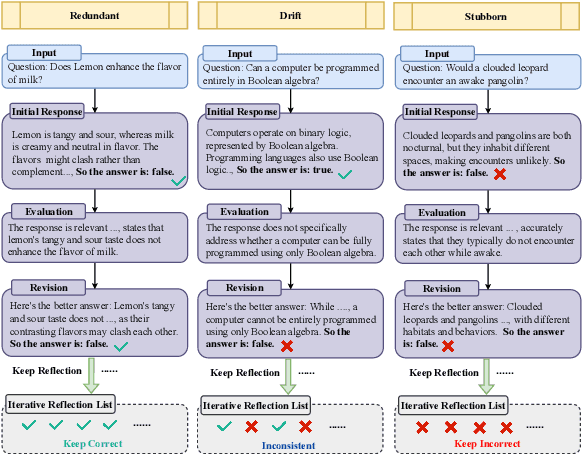
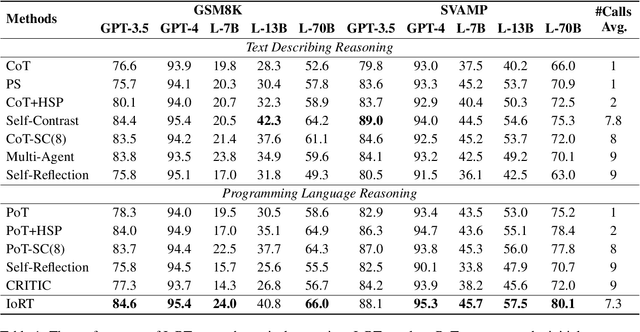
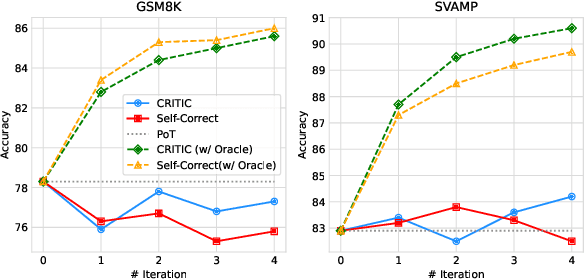
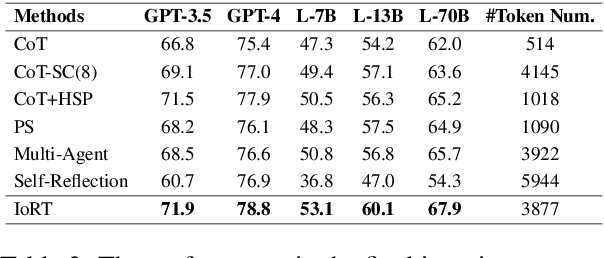
Self-reflection for Large Language Models (LLMs) has gained significant attention. Existing approaches involve models iterating and improving their previous responses based on LLMs' internal reflection ability or external feedback. However, recent research has raised doubts about whether intrinsic self-correction without external feedback may even degrade performance. Based on our empirical evidence, we find that current static reflection methods may lead to redundant, drift, and stubborn issues. To mitigate this, we introduce Instruct-of-Reflection (IoRT), a novel and general reflection framework that leverages dynamic-meta instruction to enhance the iterative reflection capability of LLMs. Specifically, we propose the instructor driven by the meta-thoughts and self-consistency classifier, generates various instructions, including refresh, stop, and select, to guide the next reflection iteration. Our experiments demonstrate that IoRT achieves an average improvement of 10.1% over established baselines in mathematical and commonsense reasoning tasks, highlighting its efficacy and applicability.
Collaborative Knowledge Fusion: A Novel Approach for Multi-task Recommender Systems via LLMs
Oct 28, 2024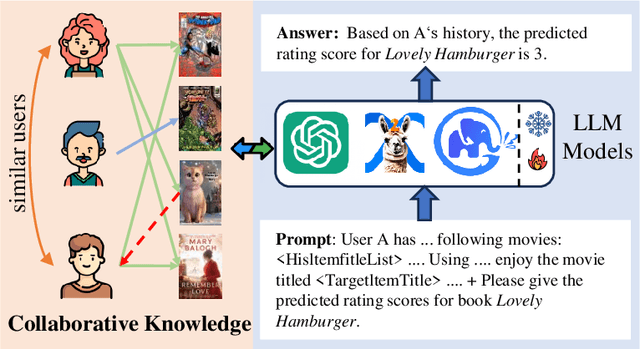


Owing to the impressive general intelligence of large language models (LLMs), there has been a growing trend to integrate them into recommender systems to gain a more profound insight into human interests and intentions. Existing LLMs-based recommender systems primarily leverage item attributes and user interaction histories in textual format, improving the single task like rating prediction or explainable recommendation. Nevertheless, these approaches overlook the crucial contribution of traditional collaborative signals in discerning users' profound intentions and disregard the interrelatedness among tasks. To address these limitations, we introduce a novel framework known as CKF, specifically developed to boost multi-task recommendations via personalized collaborative knowledge fusion into LLMs. Specifically, our method synergizes traditional collaborative filtering models to produce collaborative embeddings, subsequently employing the meta-network to construct personalized mapping bridges tailored for each user. Upon mapped, the embeddings are incorporated into meticulously designed prompt templates and then fed into an advanced LLM to represent user interests. To investigate the intrinsic relationship among diverse recommendation tasks, we develop Multi-Lora, a new parameter-efficient approach for multi-task optimization, adept at distinctly segregating task-shared and task-specific information. This method forges a connection between LLMs and recommendation scenarios, while simultaneously enriching the supervisory signal through mutual knowledge transfer among various tasks. Extensive experiments and in-depth robustness analyses across four common recommendation tasks on four large public data sets substantiate the effectiveness and superiority of our framework.