 Add to Chrome
 Add to Firefox
 Add to Edge
AIS: Adaptive Importance Sampling for Quantized RL
May 13, 2026
Reinforcement learning (RL) for large language models (LLMs) is dominated by the cost of rollout generation, which has motivated the use of low-precision rollouts (e.g., FP8) paired with a BF16 trainer to improve throughput and reduce memory pressure. This introduces a rollout-training mismatch that biases the policy gradient and can cause training to collapse outright on reasoning benchmarks. We show that the mismatch is non-stationary and acts as a double-edged sword: early in training it provides a stochastic exploration bonus, exposing the gradient to trajectories the trainer would otherwise under-sample, but the same perturbation transitions into a destabilizing source of bias as the policy concentrates. To solve this, we propose Adaptive Importance Sampling (AIS), a correction framework that adjusts the strength of its intervention on a per-batch basis. AIS combines three real-time diagnostics, namely weight reliability, divergence severity, and variance amplification, into a single mixing coefficient that interpolates between the uncorrected and fully importance-weighted gradients, suppressing the destabilizing component of the mismatch while preserving its exploratory benefit. We integrate AIS into GRPO and evaluate it on the diffusion-based LLaDA-8B-Instruct and the autoregressive Qwen3-8B and Qwen3.5-9B across mathematical reasoning and planning benchmarks. AIS matches the BF16 baseline on most tasks while retaining the 1.5 to 2.76x rollout speedup of FP8.

Learning How Much to Think: Difficulty-Aware Dynamic MoEs for Graph Node Classification
Apr 13, 2026Mixture-of-Experts (MoE) architectures offer a scalable path for Graph Neural Networks (GNNs) in node classification tasks but typically rely on static and rigid routing strategies that enforce a uniform expert budget or coarse-grained expert toggles on all nodes. This limitation overlooks the varying discriminative difficulty of nodes and leads to under-fitting for hard nodes and redundant computation for easy ones. To resolve this issue, we propose D2MoE, a novel framework that shifts the focus from static expert selection to node-wise expert resource allocation. By using predictive entropy as a real-time proxy for difficulty, D2MoE employs a difficulty-driven top-p routing mechanism to adaptively concentrate expert resources on hard nodes while reducing overhead for easy ones, achieving continuous and fine-grained expert budget scaling for node classification. Experiments on 13 benchmarks demonstrate that D2MoE achieves consistent state-of-the-art performance, surpassing leading baselines by up to 7.92% in accuracy on heterophilous graphs. Notably, on large-scale graphs, it reduces memory consumption by up to 73.07% and training time by 46.53% compared to the best-performing Graph MoE, thereby validating its superior efficiency.
CrossHGL: A Text-Free Foundation Model for Cross-Domain Heterogeneous Graph Learning
Mar 29, 2026Heterogeneous graph representation learning (HGRL) is essential for modeling complex systems with diverse node and edge types. However, most existing methods are limited to closed-world settings with shared schemas and feature spaces, hindering cross-domain generalization. While recent graph foundation models improve transferability, they often target homogeneous graphs, rely on domain-specific schemas, or require rich textual attributes. Consequently, text-free and few-shot cross-domain HGRL remains underexplored. To address this, we propose CrossHGL, a foundation framework that preserves and transfers multi-relational structural semantics without external textual supervision. Specifically, a semantic-preserving transformation strategy homogenizes heterogeneous graphs while encoding interaction semantics into edge features. Based on this, a prompt-aware multi-domain pre-training framework with a Tri-Prompt mechanism captures transferable knowledge across feature, edge, and structure perspectives via self-supervised contrastive learning. For target-domain adaptation, we develop a parameter-efficient fine-tuning strategy that freezes the pre-trained backbone and performs few-shot classification via prompt composition and prototypical learning. Experiments on node-level and graph-level tasks show that CrossHGL consistently outperforms state-of-the-art baselines, yielding average relative improvements of 25.1% and 7.6% in Micro-F1 for node and graph classification, respectively, while remaining competitive in challenging feature-degenerated settings.
Unveiling Latent Information in Transaction Hashes: Hypergraph Learning for Ethereum Ponzi Scheme Detection
Mar 27, 2025With the widespread adoption of Ethereum, financial frauds such as Ponzi schemes have become increasingly rampant in the blockchain ecosystem, posing significant threats to the security of account assets. Existing Ethereum fraud detection methods typically model account transactions as graphs, but this approach primarily focuses on binary transactional relationships between accounts, failing to adequately capture the complex multi-party interaction patterns inherent in Ethereum. To address this, we propose a hypergraph modeling method for the Ponzi scheme detection method in Ethereum, called HyperDet. Specifically, we treat transaction hashes as hyperedges that connect all the relevant accounts involved in a transaction. Additionally, we design a two-step hypergraph sampling strategy to significantly reduce computational complexity. Furthermore, we introduce a dual-channel detection module, including the hypergraph detection channel and the hyper-homo graph detection channel, to be compatible with existing detection methods. Experimental results show that, compared to traditional homogeneous graph-based methods, the hyper-homo graph detection channel achieves significant performance improvements, demonstrating the superiority of hypergraph in Ponzi scheme detection. This research offers innovations for modeling complex relationships in blockchain data.
Pushing DSP-Free Coherent Interconnect to the Last Inch by Optically Analog Signal Processing
Mar 14, 2025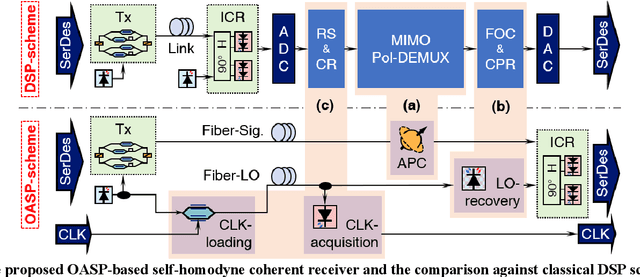
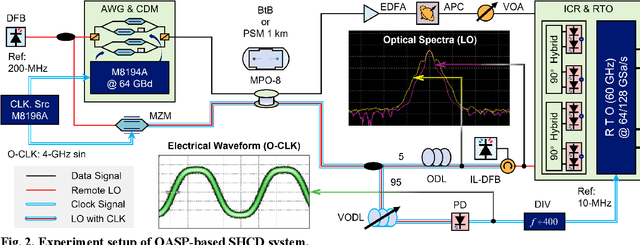
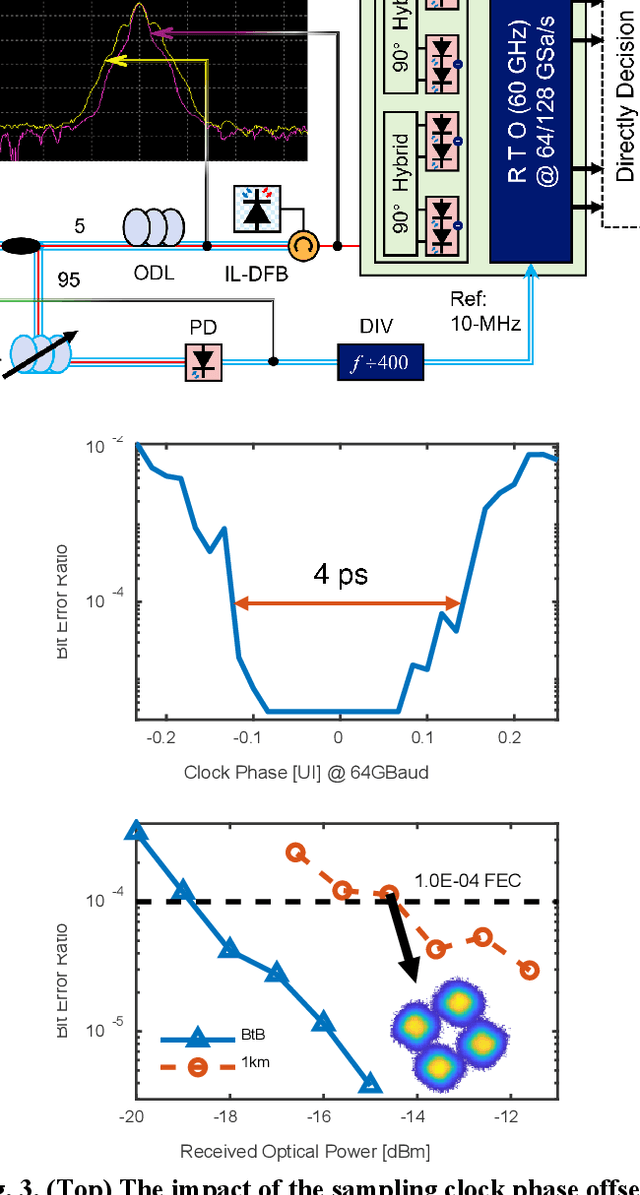
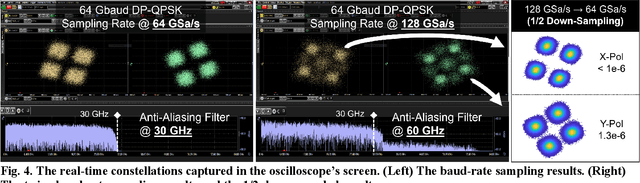
To support the boosting interconnect capacity of the AI-related data centers, novel techniques enabled high-speed and low-cost optics are continuously emerging. When the baud rate approaches 200 GBaud per lane, the bottle-neck of traditional intensity modulation direct detection (IM-DD) architectures becomes increasingly evident. The simplified coherent solutions are widely discussed and considered as one of the most promising candidates. In this paper, a novel coherent architecture based on self-homodyne coherent detection and optically analog signal processing (OASP) is demonstrated. Proved by experiment, the first DSP-free baud-rate sampled 64-GBaud QPSK/16-QAM receptions are achieved, with BERs of 1e-6 and 2e-2, respectively. Even with 1-km fiber link propagation, the BER for QPSK reception remains at 3.6e-6. When an ultra-simple 1-sps SISO filter is utilized, the performance degradation of the proposed scheme is less than 1 dB compared to legacy DSP-based coherent reception. The proposed results pave the way for the ultra-high-speed coherent optical interconnections, offering high power and cost efficiency.
QuZO: Quantized Zeroth-Order Fine-Tuning for Large Language Models
Feb 17, 2025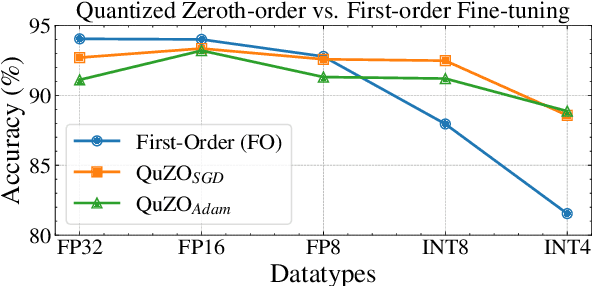
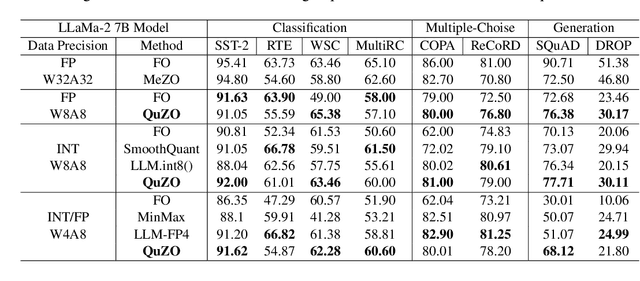

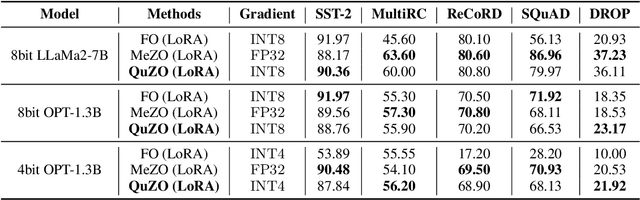
Language Models (LLMs) are often quantized to lower precision to reduce the memory cost and latency in inference. However, quantization often degrades model performance, thus fine-tuning is required for various down-stream tasks. Traditional fine-tuning methods such as stochastic gradient descent and Adam optimization require backpropagation, which are error-prone in the low-precision settings. To overcome these limitations, we propose the Quantized Zeroth-Order (QuZO) framework, specifically designed for fine-tuning LLMs through low-precision (e.g., 4- or 8-bit) forward passes. Our method can avoid the error-prone low-precision straight-through estimator, and utilizes optimized stochastic rounding to mitigate the increased bias. QuZO simplifies the training process, while achieving results comparable to first-order methods in ${\rm FP}8$ and superior accuracy in ${\rm INT}8$ and ${\rm INT}4$ training. Experiments demonstrate that low-bit training QuZO achieves performance comparable to MeZO optimization on GLUE, Multi-Choice, and Generation tasks, while reducing memory cost by $2.94 \times$ in LLaMA2-7B fine-tuning compared to quantized first-order methods.
Mixture of Decoupled Message Passing Experts with Entropy Constraint for General Node Classification
Feb 12, 2025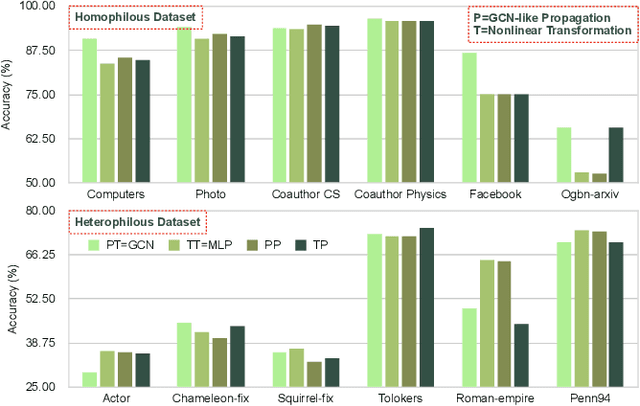
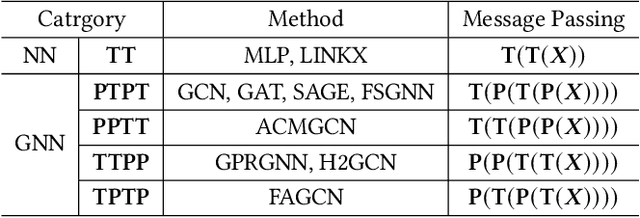
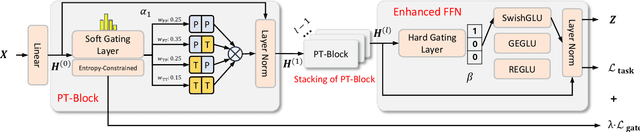
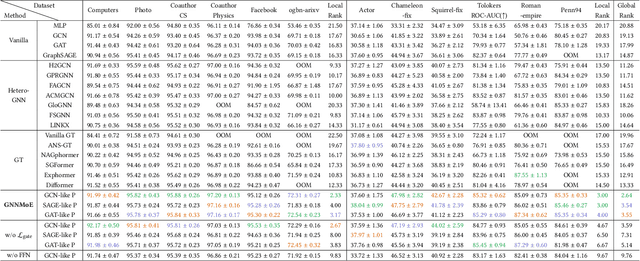
The varying degrees of homophily and heterophily in real-world graphs persistently constrain the universality of graph neural networks (GNNs) for node classification. Adopting a data-centric perspective, this work reveals an inherent preference of different graphs towards distinct message encoding schemes: homophilous graphs favor local propagation, while heterophilous graphs exhibit preference for flexible combinations of propagation and transformation. To address this, we propose GNNMoE, a universal node classification framework based on the Mixture-of-Experts (MoE) mechanism. The framework first constructs diverse message-passing experts through recombination of fine-grained encoding operators, then designs soft and hard gating layers to allocate the most suitable expert networks for each node's representation learning, thereby enhancing both model expressiveness and adaptability to diverse graphs. Furthermore, considering that soft gating might introduce encoding noise in homophilous scenarios, we introduce an entropy constraint to guide sharpening of soft gates, achieving organic integration of weighted combination and Top-K selection. Extensive experiments demonstrate that GNNMoE significantly outperforms mainstream GNNs, heterophilous GNNs, and graph transformers in both node classification performance and universality across diverse graph datasets.
Mixture of Experts Meets Decoupled Message Passing: Towards General and Adaptive Node Classification
Dec 11, 2024
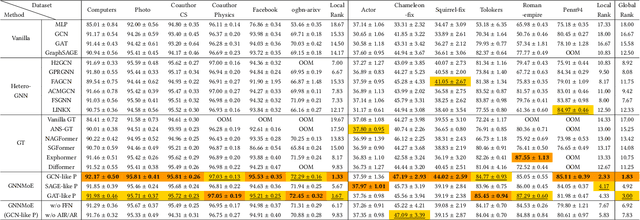
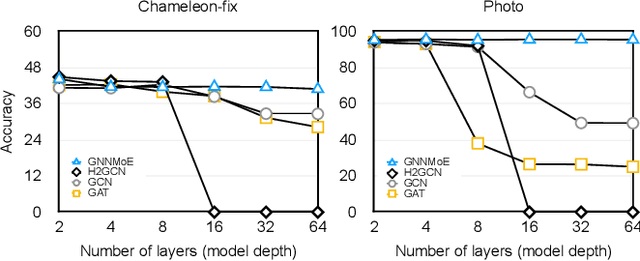
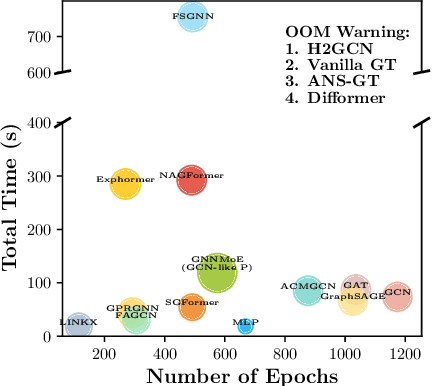
Graph neural networks excel at graph representation learning but struggle with heterophilous data and long-range dependencies. And graph transformers address these issues through self-attention, yet face scalability and noise challenges on large-scale graphs. To overcome these limitations, we propose GNNMoE, a universal model architecture for node classification. This architecture flexibly combines fine-grained message-passing operations with a mixture-of-experts mechanism to build feature encoding blocks. Furthermore, by incorporating soft and hard gating layers to assign the most suitable expert networks to each node, we enhance the model's expressive power and adaptability to different graph types. In addition, we introduce adaptive residual connections and an enhanced FFN module into GNNMoE, further improving the expressiveness of node representation. Extensive experimental results demonstrate that GNNMoE performs exceptionally well across various types of graph data, effectively alleviating the over-smoothing issue and global noise, enhancing model robustness and adaptability, while also ensuring computational efficiency on large-scale graphs.
Lateral Movement Detection via Time-aware Subgraph Classification on Authentication Logs
Nov 15, 2024Lateral movement is a crucial component of advanced persistent threat (APT) attacks in networks. Attackers exploit security vulnerabilities in internal networks or IoT devices, expanding their control after initial infiltration to steal sensitive data or carry out other malicious activities, posing a serious threat to system security. Existing research suggests that attackers generally employ seemingly unrelated operations to mask their malicious intentions, thereby evading existing lateral movement detection methods and hiding their intrusion traces. In this regard, we analyze host authentication log data from a graph perspective and propose a multi-scale lateral movement detection framework called LMDetect. The main workflow of this framework proceeds as follows: 1) Construct a heterogeneous multigraph from host authentication log data to strengthen the correlations among internal system entities; 2) Design a time-aware subgraph generator to extract subgraphs centered on authentication events from the heterogeneous authentication multigraph; 3) Design a multi-scale attention encoder that leverages both local and global attention to capture hidden anomalous behavior patterns in the authentication subgraphs, thereby achieving lateral movement detection. Extensive experiments on two real-world authentication log datasets demonstrate the effectiveness and superiority of our framework in detecting lateral movement behaviors.
Rethinking Graph Transformer Architecture Design for Node Classification
Oct 15, 2024


Graph Transformer (GT), as a special type of Graph Neural Networks (GNNs), utilizes multi-head attention to facilitate high-order message passing. However, this also imposes several limitations in node classification applications: 1) nodes are susceptible to global noise; 2) self-attention computation cannot scale well to large graphs. In this work, we conduct extensive observational experiments to explore the adaptability of the GT architecture in node classification tasks and draw several conclusions: the current multi-head self-attention module in GT can be completely replaceable, while the feed-forward neural network module proves to be valuable. Based on this, we decouple the propagation (P) and transformation (T) of GNNs and explore a powerful GT architecture, named GNNFormer, which is based on the P/T combination message passing and adapted for node classification in both homophilous and heterophilous scenarios. Extensive experiments on 12 benchmark datasets demonstrate that our proposed GT architecture can effectively adapt to node classification tasks without being affected by global noise and computational efficiency limitations.