 Add to Chrome
 Add to Firefox
 Add to Edge
Optimised Grouped-Query Attention Mechanism for Transformers
Jun 21, 2024
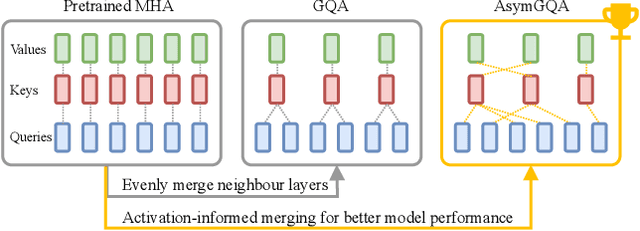
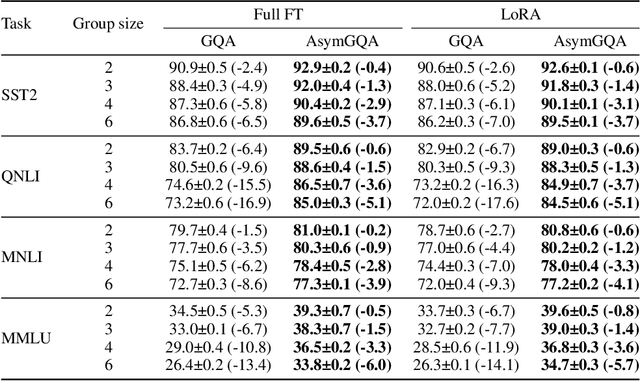
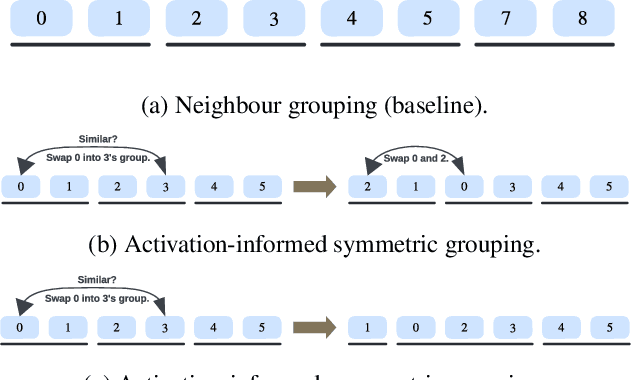
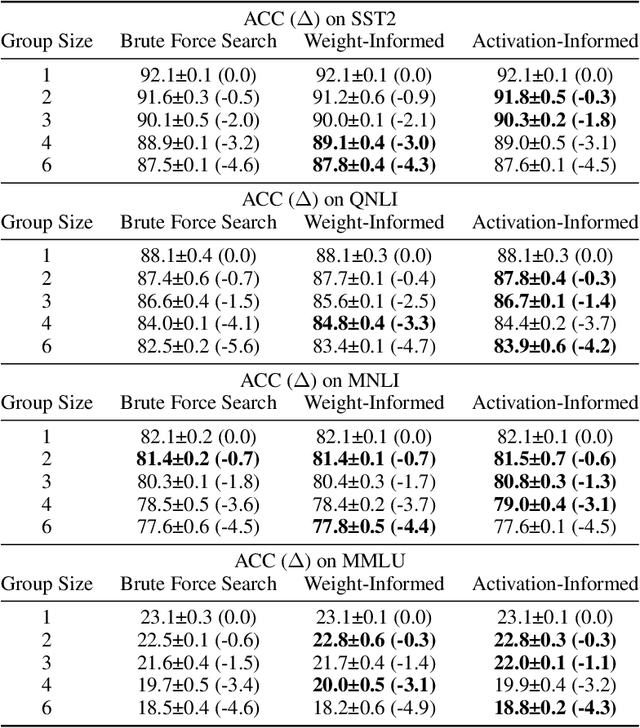
Grouped-query attention (GQA) has been widely adopted in LLMs to mitigate the complexity of multi-head attention (MHA). To transform an MHA to a GQA, neighbour queries in MHA are evenly split into groups where each group shares the value and key layers. In this work, we propose AsymGQA, an activation-informed approach to asymmetrically grouping an MHA to a GQA for better model performance. Our AsymGQA outperforms the GQA within the same model size budget. For example, AsymGQA LLaMA-2-7B has an accuracy increase of 7.5% on MMLU compared to neighbour grouping. Our approach addresses the GQA's trade-off problem between model performance and hardware efficiency.

Fusion of Movement and Naive Predictions for Point Forecasting in Univariate Random Walks
Jun 20, 2024Traditional methods for point forecasting in univariate random walks often fail to surpass naive benchmarks due to data unpredictability. This study introduces a novel forecasting method that fuses movement prediction (binary classification) with naive forecasts for accurate one-step-ahead point forecasting. The method's efficacy is demonstrated through theoretical analysis, simulations, and real-world data experiments. It reliably exceeds naive forecasts with movement prediction accuracies as low as 0.55, outperforming baseline models like ARIMA, linear regression, MLP, and LSTM networks in forecasting the S\&P 500 index and Bitcoin prices. This method is particularly advantageous when accurate point predictions are challenging but accurate movement predictions are attainable, translating movement predictions into point forecasts in random walk contexts.
SeamPose: Repurposing Seams as Capacitive Sensors in a Shirt for Upper-Body Pose Tracking
Jun 17, 2024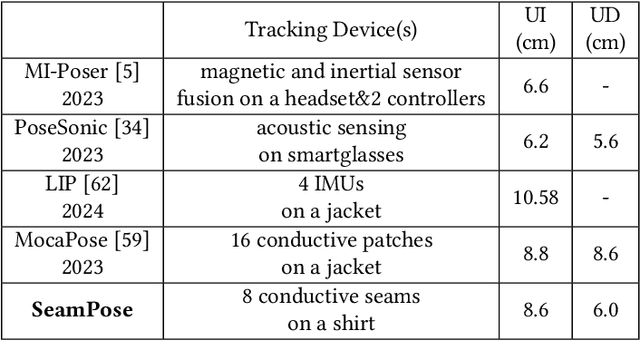
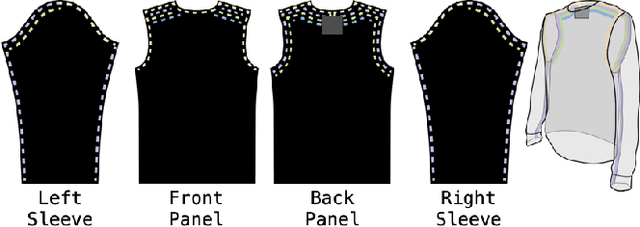
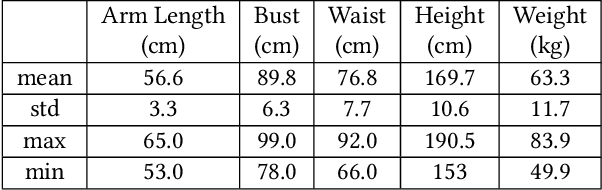
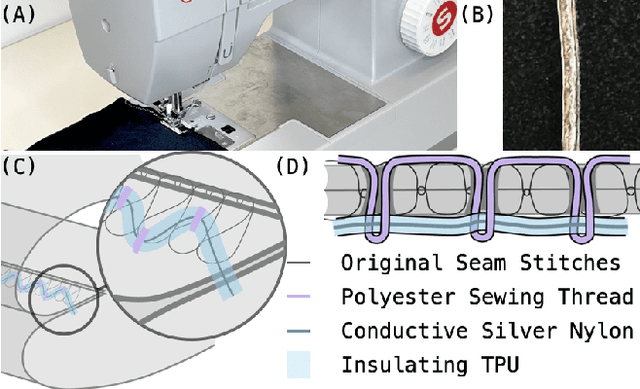
Seams are areas of overlapping fabric formed by stitching two or more pieces of fabric together in the cut-and-sew apparel manufacturing process. In SeamPose, we repurposed seams as capacitive sensors in a shirt for continuous upper-body pose estimation. Compared to previous all-textile motion-capturing garments that place the electrodes on the surface of clothing, our solution leverages existing seams inside of a shirt by machine-sewing insulated conductive threads over the seams. The unique invisibilities and placements of the seams afford the sensing shirt to look and wear the same as a conventional shirt while providing exciting pose-tracking capabilities. To validate this approach, we implemented a proof-of-concept untethered shirt. With eight capacitive sensing seams, our customized deep-learning pipeline accurately estimates the upper-body 3D joint positions relative to the pelvis. With a 12-participant user study, we demonstrated promising cross-user and cross-session tracking performance. SeamPose represents a step towards unobtrusive integration of smart clothing for everyday pose estimation.
Causality for Tabular Data Synthesis: A High-Order Structure Causal Benchmark Framework
Jun 12, 2024Tabular synthesis models remain ineffective at capturing complex dependencies, and the quality of synthetic data is still insufficient for comprehensive downstream tasks, such as prediction under distribution shifts, automated decision-making, and cross-table understanding. A major challenge is the lack of prior knowledge about underlying structures and high-order relationships in tabular data. We argue that a systematic evaluation on high-order structural information for tabular data synthesis is the first step towards solving the problem. In this paper, we introduce high-order structural causal information as natural prior knowledge and provide a benchmark framework for the evaluation of tabular synthesis models. The framework allows us to generate benchmark datasets with a flexible range of data generation processes and to train tabular synthesis models using these datasets for further evaluation. We propose multiple benchmark tasks, high-order metrics, and causal inference tasks as downstream tasks for evaluating the quality of synthetic data generated by the trained models. Our experiments demonstrate to leverage the benchmark framework for evaluating the model capability of capturing high-order structural causal information. Furthermore, our benchmarking results provide an initial assessment of state-of-the-art tabular synthesis models. They have clearly revealed significant gaps between ideal and actual performance and how baseline methods differ. Our benchmark framework is available at URL https://github.com/TURuibo/CauTabBench.
HASS: Hardware-Aware Sparsity Search for Dataflow DNN Accelerator
Jun 05, 2024


Deep Neural Networks (DNNs) excel in learning hierarchical representations from raw data, such as images, audio, and text. To compute these DNN models with high performance and energy efficiency, these models are usually deployed onto customized hardware accelerators. Among various accelerator designs, dataflow architecture has shown promising performance due to its layer-pipelined structure and its scalability in data parallelism. Exploiting weights and activations sparsity can further enhance memory storage and computation efficiency. However, existing approaches focus on exploiting sparsity in non-dataflow accelerators, which cannot be applied onto dataflow accelerators because of the large hardware design space introduced. As such, this could miss opportunities to find an optimal combination of sparsity features and hardware designs. In this paper, we propose a novel approach to exploit unstructured weights and activations sparsity for dataflow accelerators, using software and hardware co-optimization. We propose a Hardware-Aware Sparsity Search (HASS) to systematically determine an efficient sparsity solution for dataflow accelerators. Over a set of models, we achieve an efficiency improvement ranging from 1.3$\times$ to 4.2$\times$ compared to existing sparse designs, which are either non-dataflow or non-hardware-aware. Particularly, the throughput of MobileNetV3 can be optimized to 4895 images per second. HASS is open-source: \url{https://github.com/Yu-Zhewen/HASS}
Training of Physical Neural Networks
Jun 05, 2024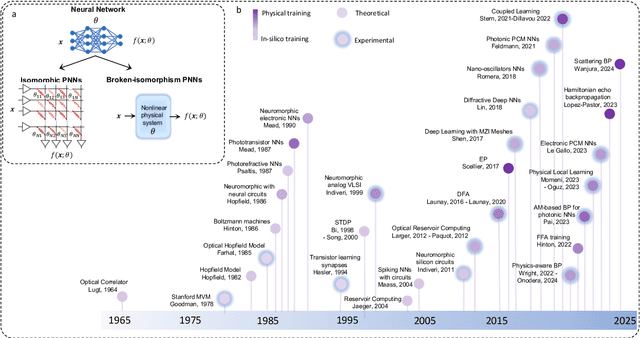
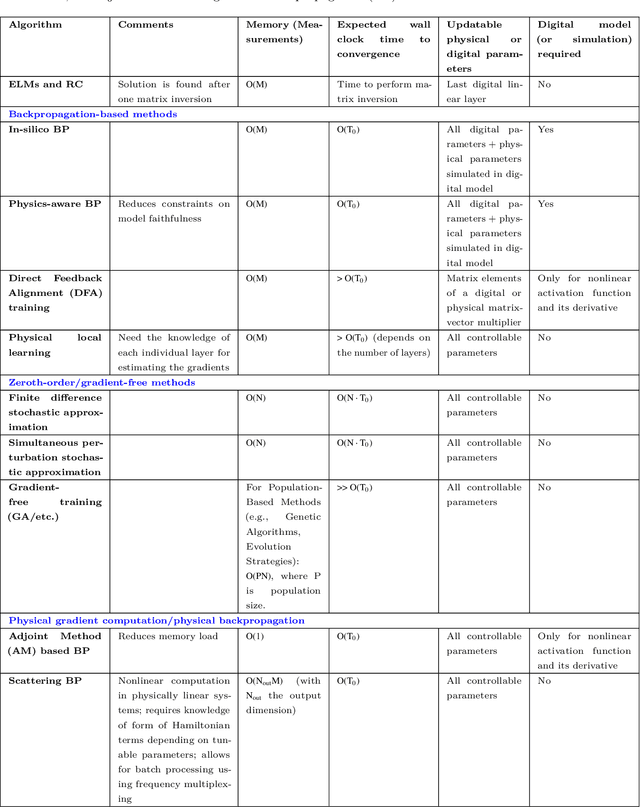
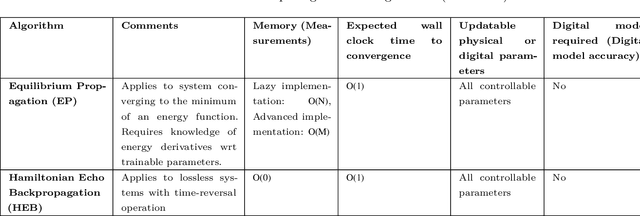
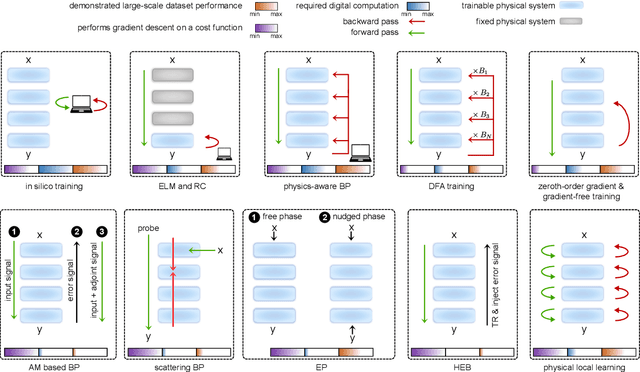
Physical neural networks (PNNs) are a class of neural-like networks that leverage the properties of physical systems to perform computation. While PNNs are so far a niche research area with small-scale laboratory demonstrations, they are arguably one of the most underappreciated important opportunities in modern AI. Could we train AI models 1000x larger than current ones? Could we do this and also have them perform inference locally and privately on edge devices, such as smartphones or sensors? Research over the past few years has shown that the answer to all these questions is likely "yes, with enough research": PNNs could one day radically change what is possible and practical for AI systems. To do this will however require rethinking both how AI models work, and how they are trained - primarily by considering the problems through the constraints of the underlying hardware physics. To train PNNs at large scale, many methods including backpropagation-based and backpropagation-free approaches are now being explored. These methods have various trade-offs, and so far no method has been shown to scale to the same scale and performance as the backpropagation algorithm widely used in deep learning today. However, this is rapidly changing, and a diverse ecosystem of training techniques provides clues for how PNNs may one day be utilized to create both more efficient realizations of current-scale AI models, and to enable unprecedented-scale models.
Learning Adaptive Fusion Bank for Multi-modal Salient Object Detection
Jun 03, 2024Multi-modal salient object detection (MSOD) aims to boost saliency detection performance by integrating visible sources with depth or thermal infrared ones. Existing methods generally design different fusion schemes to handle certain issues or challenges. Although these fusion schemes are effective at addressing specific issues or challenges, they may struggle to handle multiple complex challenges simultaneously. To solve this problem, we propose a novel adaptive fusion bank that makes full use of the complementary benefits from a set of basic fusion schemes to handle different challenges simultaneously for robust MSOD. We focus on handling five major challenges in MSOD, namely center bias, scale variation, image clutter, low illumination, and thermal crossover or depth ambiguity. The fusion bank proposed consists of five representative fusion schemes, which are specifically designed based on the characteristics of each challenge, respectively. The bank is scalable, and more fusion schemes could be incorporated into the bank for more challenges. To adaptively select the appropriate fusion scheme for multi-modal input, we introduce an adaptive ensemble module that forms the adaptive fusion bank, which is embedded into hierarchical layers for sufficient fusion of different source data. Moreover, we design an indirect interactive guidance module to accurately detect salient hollow objects via the skip integration of high-level semantic information and low-level spatial details. Extensive experiments on three RGBT datasets and seven RGBD datasets demonstrate that the proposed method achieves the outstanding performance compared to the state-of-the-art methods. The code and results are available at https://github.com/Angknpng/LAFB.
Locking Machine Learning Models into Hardware
May 31, 2024Modern Machine Learning models are expensive IP and business competitiveness often depends on keeping this IP confidential. This in turn restricts how these models are deployed -- for example it is unclear how to deploy a model on-device without inevitably leaking the underlying model. At the same time, confidential computing technologies such as Multi-Party Computation or Homomorphic encryption remain impractical for wide adoption. In this paper we take a different approach and investigate feasibility of ML-specific mechanisms that deter unauthorized model use by restricting the model to only be usable on specific hardware, making adoption on unauthorized hardware inconvenient. That way, even if IP is compromised, it cannot be trivially used without specialised hardware or major model adjustment. In a sense, we seek to enable cheap locking of machine learning models into specific hardware. We demonstrate that locking mechanisms are feasible by either targeting efficiency of model representations, such making models incompatible with quantisation, or tie the model's operation on specific characteristics of hardware, such as number of cycles for arithmetic operations. We demonstrate that locking comes with negligible work and latency overheads, while significantly restricting usability of the resultant model on unauthorized hardware.
Kernel Semi-Implicit Variational Inference
May 29, 2024Semi-implicit variational inference (SIVI) extends traditional variational families with semi-implicit distributions defined in a hierarchical manner. Due to the intractable densities of semi-implicit distributions, classical SIVI often resorts to surrogates of evidence lower bound (ELBO) that would introduce biases for training. A recent advancement in SIVI, named SIVI-SM, utilizes an alternative score matching objective made tractable via a minimax formulation, albeit requiring an additional lower-level optimization. In this paper, we propose kernel SIVI (KSIVI), a variant of SIVI-SM that eliminates the need for lower-level optimization through kernel tricks. Specifically, we show that when optimizing over a reproducing kernel Hilbert space (RKHS), the lower-level problem has an explicit solution. This way, the upper-level objective becomes the kernel Stein discrepancy (KSD), which is readily computable for stochastic gradient descent due to the hierarchical structure of semi-implicit variational distributions. An upper bound for the variance of the Monte Carlo gradient estimators of the KSD objective is derived, which allows us to establish novel convergence guarantees of KSIVI. We demonstrate the effectiveness and efficiency of KSIVI on both synthetic distributions and a variety of real data Bayesian inference tasks.
Reflected Flow Matching
May 26, 2024Continuous normalizing flows (CNFs) learn an ordinary differential equation to transform prior samples into data. Flow matching (FM) has recently emerged as a simulation-free approach for training CNFs by regressing a velocity model towards the conditional velocity field. However, on constrained domains, the learned velocity model may lead to undesirable flows that result in highly unnatural samples, e.g., oversaturated images, due to both flow matching error and simulation error. To address this, we add a boundary constraint term to CNFs, which leads to reflected CNFs that keep trajectories within the constrained domains. We propose reflected flow matching (RFM) to train the velocity model in reflected CNFs by matching the conditional velocity fields in a simulation-free manner, similar to the vanilla FM. Moreover, the analytical form of conditional velocity fields in RFM avoids potentially biased approximations, making it superior to existing score-based generative models on constrained domains. We demonstrate that RFM achieves comparable or better results on standard image benchmarks and produces high-quality class-conditioned samples under high guidance weight.