 Add to Chrome
 Add to Firefox
 Add to Edge
Multi-Mask Diffusion Language Models for Few-Step Generation
Jul 24, 2026
Masked diffusion models (MDMs) are a promising family of language generators, but achieving high-quality few-step generation remains challenging. In MDMs, all forward trajectories collapse to a single fully masked state, leaving no terminal entropy for consistency-style few-step generation. While recent few-step alternatives based on uniform-state diffusion avoid this degeneracy, it becomes harder to distinguish clean tokens from noise than MDMs, which usually harms modeling quality and training efficiency. In this work, we propose a multi-mask diffusion model (MultiMDM) that preserves the masking structure towards few-step generation. In the forward process, each clean token is first pushed towards a designated mask and then gradually mixes over the mask set. As a result, the backward process has a drafting capability by predicting a designated mask before refining to a clean token. We derive a closed-form ELBO training objective for MultiMDM that supports continual training from pretrained MDMs. In addition, we formulate a purely discrete-state consistency distillation scheme, with a shared-Gumbel coupling to reduce pathwise entropy. Experiments on pretraining and distillation show that MultiMDM provides an effective foundation for principled few-step generation.

Actor-Critic Learning for Extended Mean Field Control with Deterministic Policies
Jul 13, 2026This paper develops a model-free reinforcement learning framework for continuous--time extended mean field control problems, where both the dynamics and reward may depend on the joint distribution of states and controls. We adopt deterministic feedback policies, under which the state--action distribution is induced directly as a push--forward of the state law. This avoids optimization over stochastic kernels and bypasses key limitations of existing approaches in extended mean field settings. We first establish a model--free sensitivity formula for parameterized McKean--Vlasov dynamics and use it to derive a deterministic policy gradient formula expressed through an advantage--rate function on the Wasserstein space. We then refine this formula by introducing local value and advantage--rate representations that depend on the state, action, and joint state--action distribution, yielding a policy gradient that includes both action derivatives and measure--derivative terms with respect to the control distribution. These characterizations lead to a martingale--based learning principle and motivate a continuous--time deep deterministic policy gradient algorithm combining particle approximations, measure--dependent neural networks, temporal--difference learning, and exploration in either action or parameter space. Numerical experiments on stochastic Cucker--Smale consensus control and optimal liquidation with trade crowding demonstrate the efficiency, stability, and robustness of the proposed method, including problems with explicit dependence on the control distribution.
Multi-Objective Learning for Diffusion Models: A Statistical Theory under Semi-Supervised Learning
May 24, 2026Diffusion models are increasingly used as powerful conditional generators, yet real deployments often involve multiple target distributions arising from different tasks, e.g., diverse prompt domains in text-to-image generation, or multiple environments in robotics with diffusion policies. This naturally leads to a multi-objective learning (MOL) problem. A key challenge is that achieving good Pareto trade-offs can require a generalist model class with substantially larger capacity than what suffices for solving any individual task, thereby increasing statistical cost since sample complexity typically scales with the model complexity. To reconcile this, we develop a principled MOL framework for diffusion models with limited data: a semi-supervised regime where paired (labeled) samples are scarce, but (unlabeled) condition data are abundant. We propose a two-stage training procedure that first fits lightweight specialist models from limited paired data, and then distills them into a generalist model by generating pseudo-samples. We establish generalization bounds showing that the required number of paired samples only depends on the complexity of the specialist model classes. We further extend the theory to diffusion policies for sequential decision making to account for distribution shift in on-policy rollouts. Extensive experiments on robotic control and image restoration tasks are conducted to verify our theoretical results.
A Kernel Approach for Semi-implicit Variational Inference
Jan 17, 2026Semi-implicit variational inference (SIVI) enhances the expressiveness of variational families through hierarchical semi-implicit distributions, but the intractability of their densities makes standard ELBO-based optimization biased. Recent score-matching approaches to SIVI (SIVI-SM) address this issue via a minimax formulation, at the expense of an additional lower-level optimization problem. In this paper, we propose kernel semi-implicit variational inference (KSIVI), a principled and tractable alternative that eliminates the lower-level optimization by leveraging kernel methods. We show that when optimizing over a reproducing kernel Hilbert space, the lower-level problem admits an explicit solution, reducing the objective to the kernel Stein discrepancy (KSD). Exploiting the hierarchical structure of semi-implicit distributions, the resulting KSD objective can be efficiently optimized using stochastic gradient methods. We establish optimization guarantees via variance bounds on Monte Carlo gradient estimators and derive statistical generalization bounds of order $\tilde{\mathcal{O}}(1/\sqrt{n})$. We further introduce a multi-layer hierarchical extension that improves expressiveness while preserving tractability. Empirical results on synthetic and real-world Bayesian inference tasks demonstrate the effectiveness of KSIVI.
OVERT: A Benchmark for Over-Refusal Evaluation on Text-to-Image Models
May 28, 2025Text-to-Image (T2I) models have achieved remarkable success in generating visual content from text inputs. Although multiple safety alignment strategies have been proposed to prevent harmful outputs, they often lead to overly cautious behavior -- rejecting even benign prompts -- a phenomenon known as $\textit{over-refusal}$ that reduces the practical utility of T2I models. Despite over-refusal having been observed in practice, there is no large-scale benchmark that systematically evaluates this phenomenon for T2I models. In this paper, we present an automatic workflow to construct synthetic evaluation data, resulting in OVERT ($\textbf{OVE}$r-$\textbf{R}$efusal evaluation on $\textbf{T}$ext-to-image models), the first large-scale benchmark for assessing over-refusal behaviors in T2I models. OVERT includes 4,600 seemingly harmful but benign prompts across nine safety-related categories, along with 1,785 genuinely harmful prompts (OVERT-unsafe) to evaluate the safety-utility trade-off. Using OVERT, we evaluate several leading T2I models and find that over-refusal is a widespread issue across various categories (Figure 1), underscoring the need for further research to enhance the safety alignment of T2I models without compromising their functionality. As a preliminary attempt to reduce over-refusal, we explore prompt rewriting; however, we find it often compromises faithfulness to the meaning of the original prompts. Finally, we demonstrate the flexibility of our generation framework in accommodating diverse safety requirements by generating customized evaluation data adapting to user-defined policies.
Provable Sample-Efficient Transfer Learning Conditional Diffusion Models via Representation Learning
Feb 06, 2025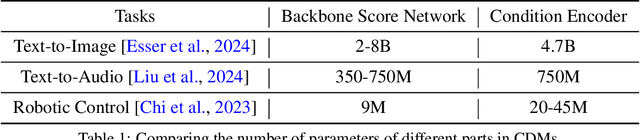


While conditional diffusion models have achieved remarkable success in various applications, they require abundant data to train from scratch, which is often infeasible in practice. To address this issue, transfer learning has emerged as an essential paradigm in small data regimes. Despite its empirical success, the theoretical underpinnings of transfer learning conditional diffusion models remain unexplored. In this paper, we take the first step towards understanding the sample efficiency of transfer learning conditional diffusion models through the lens of representation learning. Inspired by practical training procedures, we assume that there exists a low-dimensional representation of conditions shared across all tasks. Our analysis shows that with a well-learned representation from source tasks, the samplecomplexity of target tasks can be reduced substantially. In addition, we investigate the practical implications of our theoretical results in several real-world applications of conditional diffusion models. Numerical experiments are also conducted to verify our results.
Functional Gradient Flows for Constrained Sampling
Oct 30, 2024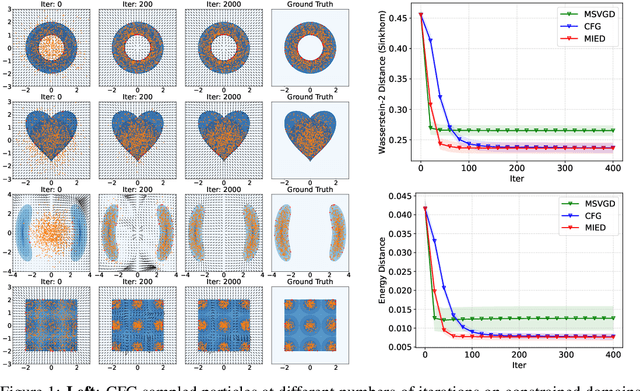

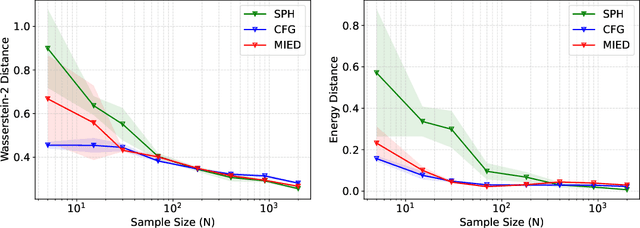

Recently, through a unified gradient flow perspective of Markov chain Monte Carlo (MCMC) and variational inference (VI), particle-based variational inference methods (ParVIs) have been proposed that tend to combine the best of both worlds. While typical ParVIs such as Stein Variational Gradient Descent (SVGD) approximate the gradient flow within a reproducing kernel Hilbert space (RKHS), many attempts have been made recently to replace RKHS with more expressive function spaces, such as neural networks. While successful, these methods are mainly designed for sampling from unconstrained domains. In this paper, we offer a general solution to constrained sampling by introducing a boundary condition for the gradient flow which would confine the particles within the specific domain. This allows us to propose a new functional gradient ParVI method for constrained sampling, called constrained functional gradient flow (CFG), with provable continuous-time convergence in total variation (TV). We also present novel numerical strategies to handle the boundary integral term arising from the domain constraints. Our theory and experiments demonstrate the effectiveness of the proposed framework.
Semi-Implicit Functional Gradient Flow
Oct 23, 2024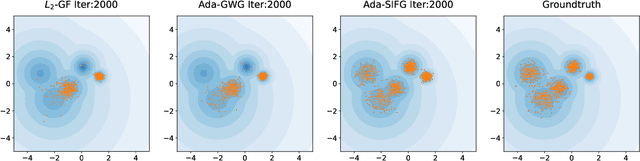

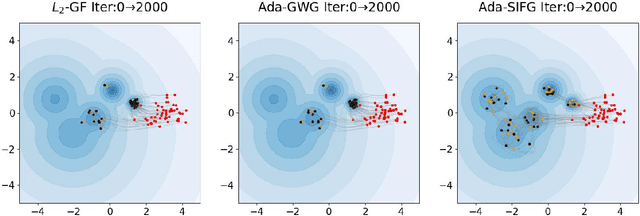
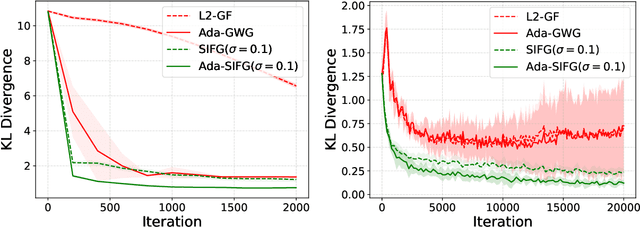
Particle-based variational inference methods (ParVIs) use non-parametric variational families represented by particles to approximate the target distribution according to the kernelized Wasserstein gradient flow for the Kullback-Leibler (KL) divergence. Recent works introduce functional gradient flows to substitute the kernel for better flexibility. However, the deterministic updating mechanism may suffer from limited exploration and require expensive repetitive runs for new samples. In this paper, we propose Semi-Implicit Functional Gradient flow (SIFG), a functional gradient ParVI method that uses perturbed particles as the approximation family. The corresponding functional gradient flow, which can be estimated via denoising score matching, exhibits strong theoretical convergence guarantee. We also present an adaptive version of our method to automatically choose the suitable noise magnitude. Extensive experiments demonstrate the effectiveness and efficiency of the proposed framework on both simulated and real data problems.
Kernel Semi-Implicit Variational Inference
May 29, 2024Semi-implicit variational inference (SIVI) extends traditional variational families with semi-implicit distributions defined in a hierarchical manner. Due to the intractable densities of semi-implicit distributions, classical SIVI often resorts to surrogates of evidence lower bound (ELBO) that would introduce biases for training. A recent advancement in SIVI, named SIVI-SM, utilizes an alternative score matching objective made tractable via a minimax formulation, albeit requiring an additional lower-level optimization. In this paper, we propose kernel SIVI (KSIVI), a variant of SIVI-SM that eliminates the need for lower-level optimization through kernel tricks. Specifically, we show that when optimizing over a reproducing kernel Hilbert space (RKHS), the lower-level problem has an explicit solution. This way, the upper-level objective becomes the kernel Stein discrepancy (KSD), which is readily computable for stochastic gradient descent due to the hierarchical structure of semi-implicit variational distributions. An upper bound for the variance of the Monte Carlo gradient estimators of the KSD objective is derived, which allows us to establish novel convergence guarantees of KSIVI. We demonstrate the effectiveness and efficiency of KSIVI on both synthetic distributions and a variety of real data Bayesian inference tasks.
Reflected Flow Matching
May 26, 2024Continuous normalizing flows (CNFs) learn an ordinary differential equation to transform prior samples into data. Flow matching (FM) has recently emerged as a simulation-free approach for training CNFs by regressing a velocity model towards the conditional velocity field. However, on constrained domains, the learned velocity model may lead to undesirable flows that result in highly unnatural samples, e.g., oversaturated images, due to both flow matching error and simulation error. To address this, we add a boundary constraint term to CNFs, which leads to reflected CNFs that keep trajectories within the constrained domains. We propose reflected flow matching (RFM) to train the velocity model in reflected CNFs by matching the conditional velocity fields in a simulation-free manner, similar to the vanilla FM. Moreover, the analytical form of conditional velocity fields in RFM avoids potentially biased approximations, making it superior to existing score-based generative models on constrained domains. We demonstrate that RFM achieves comparable or better results on standard image benchmarks and produces high-quality class-conditioned samples under high guidance weight.