 Add to Chrome
 Add to Firefox
 Add to Edge
NLOS Dies Twice: Challenges and Solutions of V2X for Cooperative Perception
Jul 13, 2023
Multi-agent multi-lidar sensor fusion between connected vehicles for cooperative perception has recently been recognized as the best technique for minimizing the blind zone of individual vehicular perception systems and further enhancing the overall safety of autonomous driving systems. This technique relies heavily on the reliability and availability of vehicle-to-everything (V2X) communication. In practical sensor fusion application scenarios, the non-line-of-sight (NLOS) issue causes blind zones for not only the perception system but also V2X direct communication. To counteract underlying communication issues, we introduce an abstract perception matrix matching method for quick sensor fusion matching procedures and mobility-height hybrid relay determination procedures, proactively improving the efficiency and performance of V2X communication to serve the upper layer application fusion requirements. To demonstrate the effectiveness of our solution, we design a new simulation framework to consider autonomous driving, sensor fusion and V2X communication in general, paving the way for end-to-end performance evaluation and further solution derivation.

Goal-Conditioned Predictive Coding as an Implicit Planner for Offline Reinforcement Learning
Jul 07, 2023Recent work has demonstrated the effectiveness of formulating decision making as a supervised learning problem on offline-collected trajectories. However, the benefits of performing sequence modeling on trajectory data is not yet clear. In this work we investigate if sequence modeling has the capability to condense trajectories into useful representations that can contribute to policy learning. To achieve this, we adopt a two-stage framework that first summarizes trajectories with sequence modeling techniques, and then employs these representations to learn a policy along with a desired goal. This design allows many existing supervised offline RL methods to be considered as specific instances of our framework. Within this framework, we introduce Goal-Conditioned Predicitve Coding (GCPC), an approach that brings powerful trajectory representations and leads to performant policies. We conduct extensive empirical evaluations on AntMaze, FrankaKitchen and Locomotion environments, and observe that sequence modeling has a significant impact on some decision making tasks. In addition, we demonstrate that GCPC learns a goal-conditioned latent representation about the future, which serves as an "implicit planner", and enables competitive performance on all three benchmarks.
Federated Learning over a Wireless Network: Distributed User Selection through Random Access
Jul 07, 2023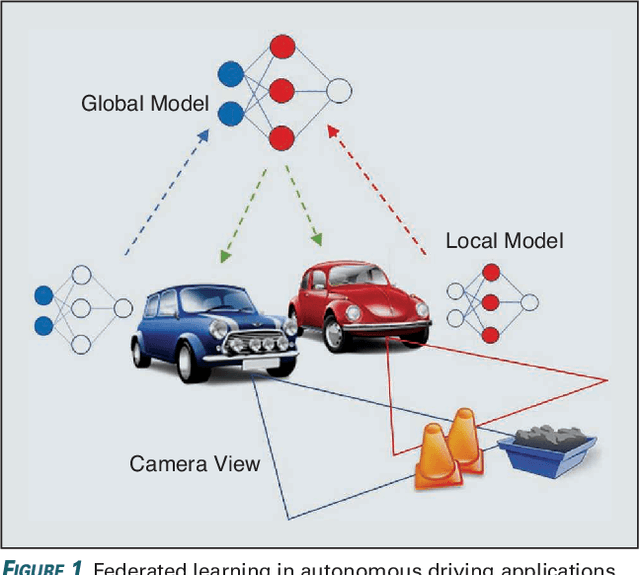
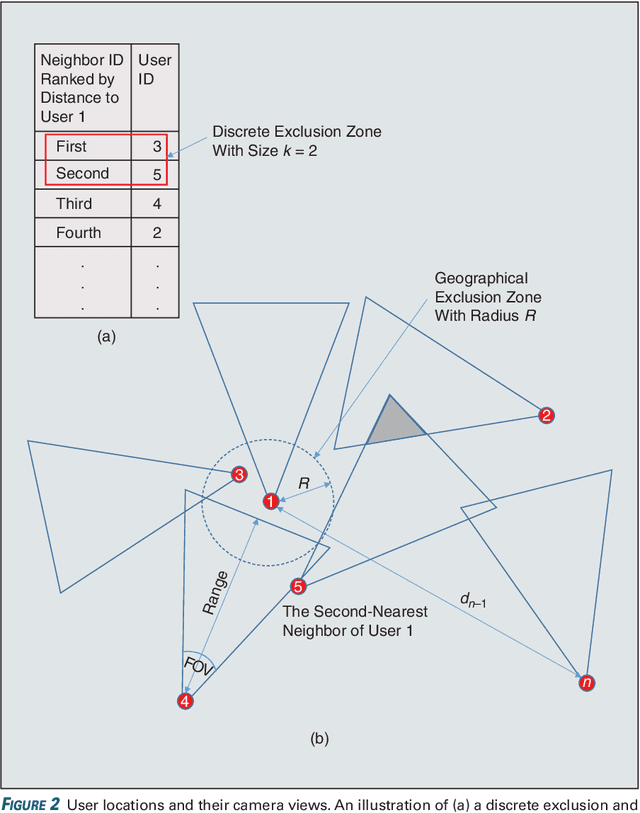
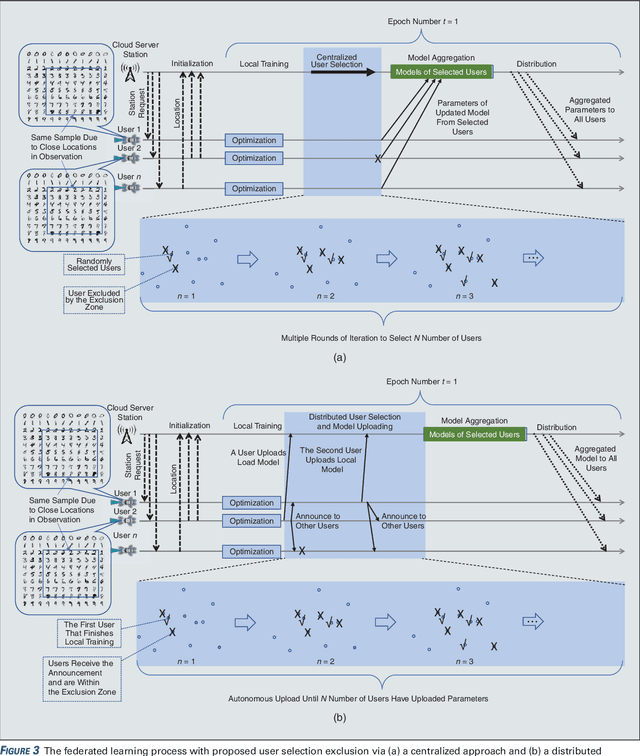
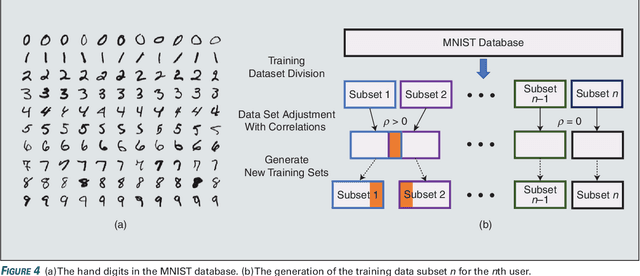
User selection has become crucial for decreasing the communication costs of federated learning (FL) over wireless networks. However, centralized user selection causes additional system complexity. This study proposes a network intrinsic approach of distributed user selection that leverages the radio resource competition mechanism in random access. Taking the carrier sensing multiple access (CSMA) mechanism as an example of random access, we manipulate the contention window (CW) size to prioritize certain users for obtaining radio resources in each round of training. Training data bias is used as a target scenario for FL with user selection. Prioritization is based on the distance between the newly trained local model and the global model of the previous round. To avoid excessive contribution by certain users, a counting mechanism is used to ensure fairness. Simulations with various datasets demonstrate that this method can rapidly achieve convergence similar to that of the centralized user selection approach.
Dense Video Object Captioning from Disjoint Supervision
Jun 20, 2023We propose a new task and model for dense video object captioning -- detecting, tracking, and captioning trajectories of all objects in a video. This task unifies spatial and temporal understanding of the video, and requires fine-grained language description. Our model for dense video object captioning is trained end-to-end and consists of different modules for spatial localization, tracking, and captioning. As such, we can train our model with a mixture of disjoint tasks, and leverage diverse, large-scale datasets which supervise different parts of our model. This results in noteworthy zero-shot performance. Moreover, by finetuning a model from this initialization, we can further improve our performance, surpassing strong image-based baselines by a significant margin. Although we are not aware of other work performing this task, we are able to repurpose existing video grounding datasets for our task, namely VidSTG and VLN. We show our task is more general than grounding, and models trained on our task can directly be applied to grounding by finding the bounding box with the maximum likelihood of generating the query sentence. Our model outperforms dedicated, state-of-the-art models for spatial grounding on both VidSTG and VLN.
How can objects help action recognition?
Jun 20, 2023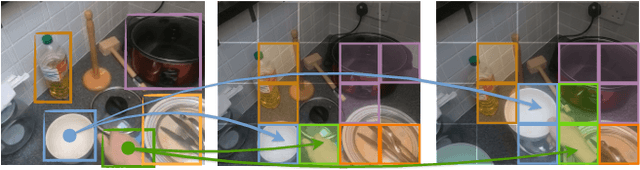
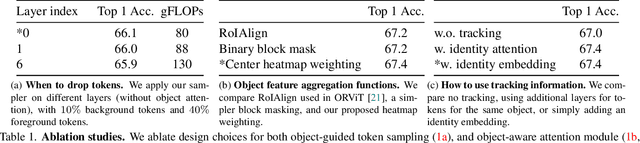
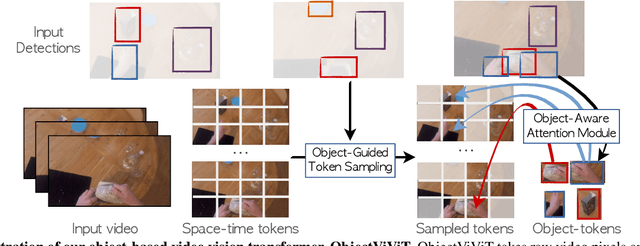
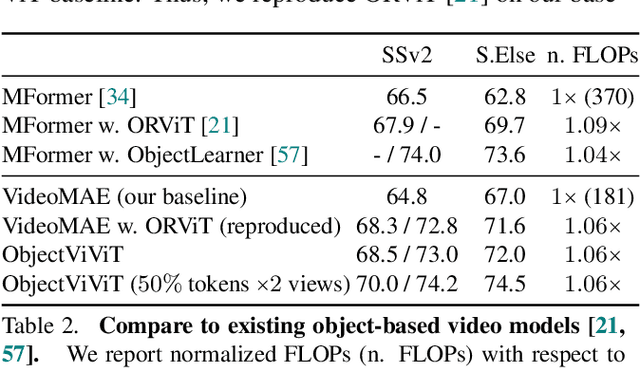
Current state-of-the-art video models process a video clip as a long sequence of spatio-temporal tokens. However, they do not explicitly model objects, their interactions across the video, and instead process all the tokens in the video. In this paper, we investigate how we can use knowledge of objects to design better video models, namely to process fewer tokens and to improve recognition accuracy. This is in contrast to prior works which either drop tokens at the cost of accuracy, or increase accuracy whilst also increasing the computation required. First, we propose an object-guided token sampling strategy that enables us to retain a small fraction of the input tokens with minimal impact on accuracy. And second, we propose an object-aware attention module that enriches our feature representation with object information and improves overall accuracy. Our resulting framework achieves better performance when using fewer tokens than strong baselines. In particular, we match our baseline with 30%, 40%, and 60% of the input tokens on SomethingElse, Something-something v2, and Epic-Kitchens, respectively. When we use our model to process the same number of tokens as our baseline, we improve by 0.6 to 4.2 points on these datasets.
Winning Solution for the CVPR2023 Visual Anomaly and Novelty Detection Challenge: Multimodal Prompting for Data-centric Anomaly Detection
Jun 15, 2023This technical report introduces the winning solution of the team \textit{Segment Any Anomaly} for the CVPR2023 Visual Anomaly and Novelty Detection (VAND) challenge. Going beyond uni-modal prompt, \textit{e.g.}, language prompt, we present a novel framework, \textit{i.e.}, Segment Any Anomaly + (SAA$+$), for zero-shot anomaly segmentation with multi-modal prompts for the regularization of cascaded modern foundation models. Inspired by the great zero-shot generalization ability of foundation models like Segment Anything, we first explore their assembly (SAA) to leverage diverse multi-modal prior knowledge for anomaly localization. Subsequently, we further introduce multimodal prompts (SAA$+$) derived from domain expert knowledge and target image context to enable the non-parameter adaptation of foundation models to anomaly segmentation. The proposed SAA$+$ model achieves state-of-the-art performance on several anomaly segmentation benchmarks, including VisA and MVTec-AD, in the zero-shot setting. We will release the code of our winning solution for the CVPR2023 VAND challenge at \href{Segment-Any-Anomaly}{https://github.com/caoyunkang/Segment-Any-Anomaly} \footnote{The extended-version paper with more details is available at ~\cite{cao2023segment}.}
AVIS: Autonomous Visual Information Seeking with Large Language Models
Jun 13, 2023In this paper, we propose an autonomous information seeking visual question answering framework, AVIS. Our method leverages a Large Language Model (LLM) to dynamically strategize the utilization of external tools and to investigate their outputs, thereby acquiring the indispensable knowledge needed to provide answers to the posed questions. Responding to visual questions that necessitate external knowledge, such as "What event is commemorated by the building depicted in this image?", is a complex task. This task presents a combinatorial search space that demands a sequence of actions, including invoking APIs, analyzing their responses, and making informed decisions. We conduct a user study to collect a variety of instances of human decision-making when faced with this task. This data is then used to design a system comprised of three components: an LLM-powered planner that dynamically determines which tool to use next, an LLM-powered reasoner that analyzes and extracts key information from the tool outputs, and a working memory component that retains the acquired information throughout the process. The collected user behavior serves as a guide for our system in two key ways. First, we create a transition graph by analyzing the sequence of decisions made by users. This graph delineates distinct states and confines the set of actions available at each state. Second, we use examples of user decision-making to provide our LLM-powered planner and reasoner with relevant contextual instances, enhancing their capacity to make informed decisions. We show that AVIS achieves state-of-the-art results on knowledge-intensive visual question answering benchmarks such as Infoseek and OK-VQA.
Segment Any Anomaly without Training via Hybrid Prompt Regularization
May 18, 2023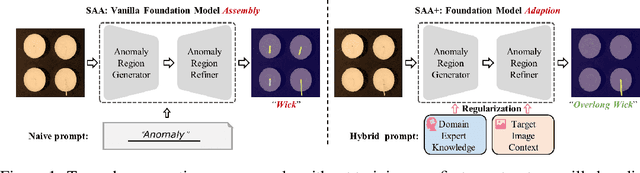
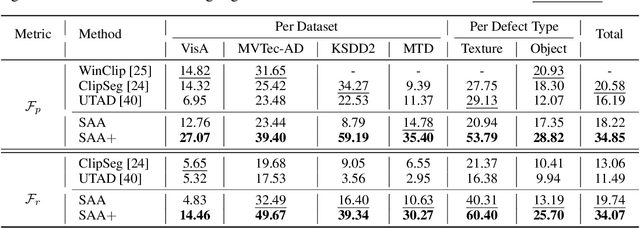
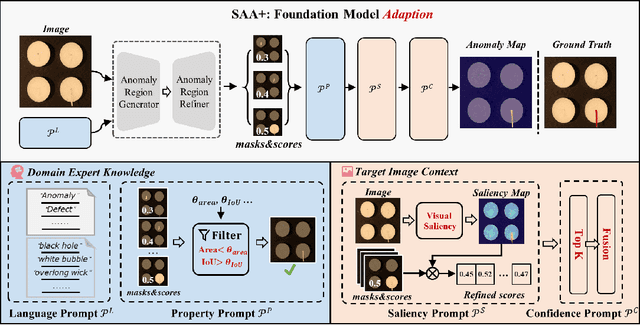
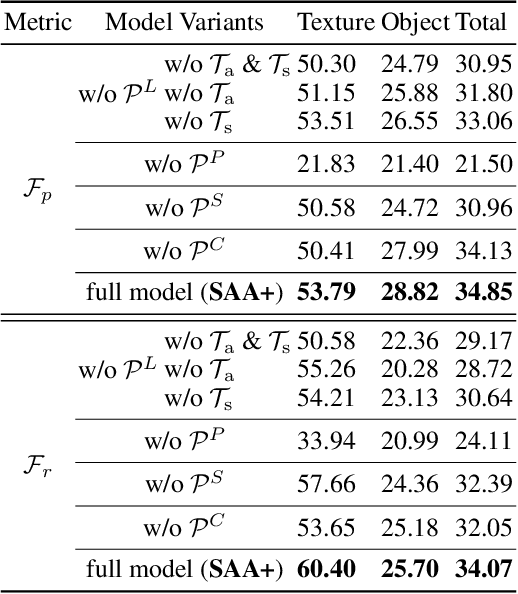
We present a novel framework, i.e., Segment Any Anomaly + (SAA+), for zero-shot anomaly segmentation with hybrid prompt regularization to improve the adaptability of modern foundation models. Existing anomaly segmentation models typically rely on domain-specific fine-tuning, limiting their generalization across countless anomaly patterns. In this work, inspired by the great zero-shot generalization ability of foundation models like Segment Anything, we first explore their assembly to leverage diverse multi-modal prior knowledge for anomaly localization. For non-parameter foundation model adaptation to anomaly segmentation, we further introduce hybrid prompts derived from domain expert knowledge and target image context as regularization. Our proposed SAA+ model achieves state-of-the-art performance on several anomaly segmentation benchmarks, including VisA, MVTec-AD, MTD, and KSDD2, in the zero-shot setting. We will release the code at \href{https://github.com/caoyunkang/Segment-Any-Anomaly}{https://github.com/caoyunkang/Segment-Any-Anomaly}.
End-to-End Spatio-Temporal Action Localisation with Video Transformers
Apr 24, 2023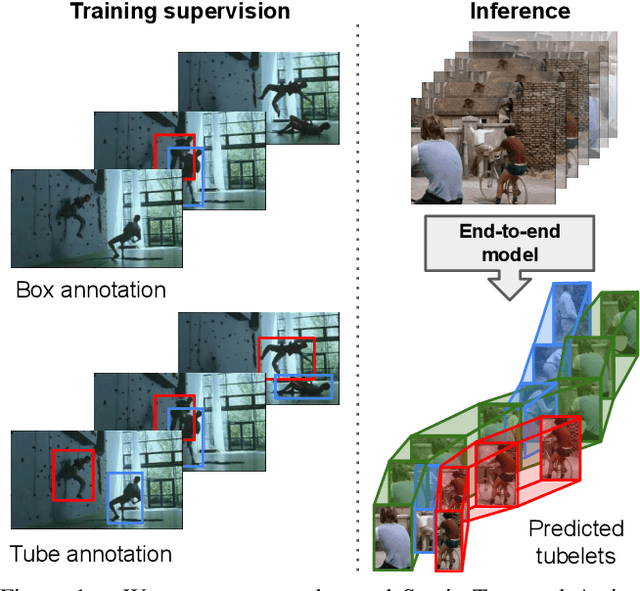
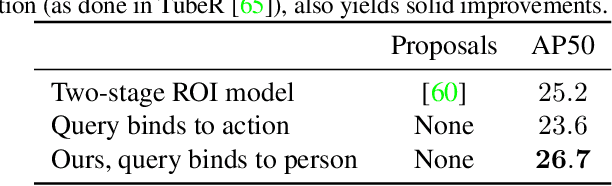
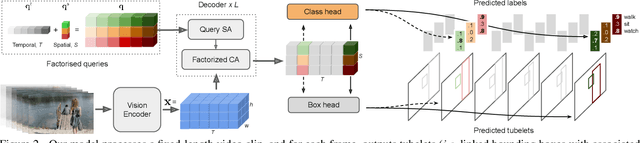
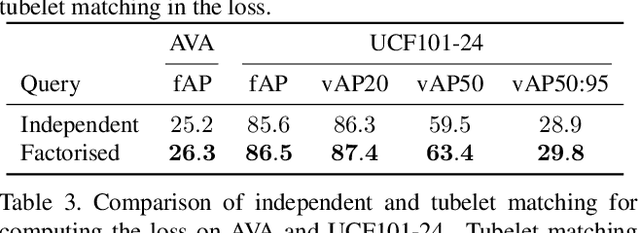
The most performant spatio-temporal action localisation models use external person proposals and complex external memory banks. We propose a fully end-to-end, purely-transformer based model that directly ingests an input video, and outputs tubelets -- a sequence of bounding boxes and the action classes at each frame. Our flexible model can be trained with either sparse bounding-box supervision on individual frames, or full tubelet annotations. And in both cases, it predicts coherent tubelets as the output. Moreover, our end-to-end model requires no additional pre-processing in the form of proposals, or post-processing in terms of non-maximal suppression. We perform extensive ablation experiments, and significantly advance the state-of-the-art results on four different spatio-temporal action localisation benchmarks with both sparse keyframes and full tubelet annotations.
Steerable Equivariant Representation Learning
Feb 22, 2023Pre-trained deep image representations are useful for post-training tasks such as classification through transfer learning, image retrieval, and object detection. Data augmentations are a crucial aspect of pre-training robust representations in both supervised and self-supervised settings. Data augmentations explicitly or implicitly promote invariance in the embedding space to the input image transformations. This invariance reduces generalization to those downstream tasks which rely on sensitivity to these particular data augmentations. In this paper, we propose a method of learning representations that are instead equivariant to data augmentations. We achieve this equivariance through the use of steerable representations. Our representations can be manipulated directly in embedding space via learned linear maps. We demonstrate that our resulting steerable and equivariant representations lead to better performance on transfer learning and robustness: e.g. we improve linear probe top-1 accuracy by between 1% to 3% for transfer; and ImageNet-C accuracy by upto 3.4%. We further show that the steerability of our representations provides significant speedup (nearly 50x) for test-time augmentations; by applying a large number of augmentations for out-of-distribution detection, we significantly improve OOD AUC on the ImageNet-C dataset over an invariant representation.