 Add to Chrome
 Add to Firefox
 Add to Edge
Have We Really Understood Collaborative Information? An Empirical Investigation
Nov 10, 2025
Collaborative information serves as the cornerstone of recommender systems which typically focus on capturing it from user-item interactions to deliver personalized services. However, current understanding of this crucial resource remains limited. Specifically, a quantitative definition of collaborative information is missing, its manifestation within user-item interactions remains unclear, and its impact on recommendation performance is largely unknown. To bridge this gap, this work conducts a systematic investigation of collaborative information. We begin by clarifying collaborative information in terms of item co-occurrence patterns, identifying its main characteristics, and presenting a quantitative definition. We then estimate the distribution of collaborative information from several aspects, shedding light on how collaborative information is structured in practice. Furthermore, we evaluate the impact of collaborative information on the performance of various recommendation algorithms. Finally, we highlight challenges in effectively capturing collaborative information and outlook promising directions for future research. By establishing an empirical framework, we uncover many insightful observations that advance our understanding of collaborative information and offer valuable guidelines for developing more effective recommender systems.

S$^2$Drug: Bridging Protein Sequence and 3D Structure in Contrastive Representation Learning for Virtual Screening
Nov 10, 2025Virtual screening (VS) is an essential task in drug discovery, focusing on the identification of small-molecule ligands that bind to specific protein pockets. Existing deep learning methods, from early regression models to recent contrastive learning approaches, primarily rely on structural data while overlooking protein sequences, which are more accessible and can enhance generalizability. However, directly integrating protein sequences poses challenges due to the redundancy and noise in large-scale protein-ligand datasets. To address these limitations, we propose \textbf{S$^2$Drug}, a two-stage framework that explicitly incorporates protein \textbf{S}equence information and 3D \textbf{S}tructure context in protein-ligand contrastive representation learning. In the first stage, we perform protein sequence pretraining on ChemBL using an ESM2-based backbone, combined with a tailored data sampling strategy to reduce redundancy and noise on both protein and ligand sides. In the second stage, we fine-tune on PDBBind by fusing sequence and structure information through a residue-level gating module, while introducing an auxiliary binding site prediction task. This auxiliary task guides the model to accurately localize binding residues within the protein sequence and capture their 3D spatial arrangement, thereby refining protein-ligand matching. Across multiple benchmarks, S$^2$Drug consistently improves virtual screening performance and achieves strong results on binding site prediction, demonstrating the value of bridging sequence and structure in contrastive learning.
TinyUSFM: Towards Compact and Efficient Ultrasound Foundation Models
Oct 22, 2025Foundation models for medical imaging demonstrate superior generalization capabilities across diverse anatomical structures and clinical applications. Their outstanding performance relies on substantial computational resources, limiting deployment in resource-constrained clinical environments. This paper presents TinyUSFM, the first lightweight ultrasound foundation model that maintains superior organ versatility and task adaptability of our large-scale Ultrasound Foundation Model (USFM) through knowledge distillation with strategically curated small datasets, delivering significant computational efficiency without sacrificing performance. Considering the limited capacity and representation ability of lightweight models, we propose a feature-gradient driven coreset selection strategy to curate high-quality compact training data, avoiding training degradation from low-quality redundant images. To preserve the essential spatial and frequency domain characteristics during knowledge transfer, we develop domain-separated masked image modeling assisted consistency-driven dynamic distillation. This novel framework adaptively transfers knowledge from large foundation models by leveraging teacher model consistency across different domain masks, specifically tailored for ultrasound interpretation. For evaluation, we establish the UniUS-Bench, the largest publicly available ultrasound benchmark comprising 8 classification and 10 segmentation datasets across 15 organs. Using only 200K images in distillation, TinyUSFM matches USFM's performance with just 6.36% of parameters and 6.40% of GFLOPs. TinyUSFM significantly outperforms the vanilla model by 9.45% in classification and 7.72% in segmentation, surpassing all state-of-the-art lightweight models, and achieving 84.91% average classification accuracy and 85.78% average segmentation Dice score across diverse medical devices and centers.
Enhanced Pre-training of Graph Neural Networks for Million-Scale Heterogeneous Graphs
Oct 14, 2025In recent years, graph neural networks (GNNs) have facilitated the development of graph data mining. However, training GNNs requires sufficient labeled task-specific data, which is expensive and sometimes unavailable. To be less dependent on labeled data, recent studies propose to pre-train GNNs in a self-supervised manner and then apply the pre-trained GNNs to downstream tasks with limited labeled data. However, most existing methods are designed solely for homogeneous graphs (real-world graphs are mostly heterogeneous) and do not consider semantic mismatch (the semantic difference between the original data and the ideal data containing more transferable semantic information). In this paper, we propose an effective framework to pre-train GNNs on the large-scale heterogeneous graph. We first design a structure-aware pre-training task, which aims to capture structural properties in heterogeneous graphs. Then, we design a semantic-aware pre-training task to tackle the mismatch. Specifically, we construct a perturbation subspace composed of semantic neighbors to help deal with the semantic mismatch. Semantic neighbors make the model focus more on the general knowledge in the semantic space, which in turn assists the model in learning knowledge with better transferability. Finally, extensive experiments are conducted on real-world large-scale heterogeneous graphs to demonstrate the superiority of the proposed method over state-of-the-art baselines. Code available at https://github.com/sunshy-1/PHE.
Causality-aware Graph Aggregation Weight Estimator for Popularity Debiasing in Top-K Recommendation
Oct 06, 2025Graph-based recommender systems leverage neighborhood aggregation to generate node representations, which is highly sensitive to popularity bias, resulting in an echo effect during information propagation. Existing graph-based debiasing solutions refine the aggregation process with attempts such as edge reconstruction or weight adjustment. However, these methods remain inadequate in fully alleviating popularity bias. Specifically, this is because 1) they provide no insights into graph aggregation rationality, thus lacking an optimality guarantee; 2) they fail to well balance the training and debiasing process, which undermines the effectiveness. In this paper, we propose a novel approach to mitigate popularity bias through rational modeling of the graph aggregation process. We reveal that graph aggregation is a special form of backdoor adjustment in causal inference, where the aggregation weight corresponds to the historical interaction likelihood distribution. Based on this insight, we devise an encoder-decoder architecture, namely Causality-aware Graph Aggregation Weight Estimator for Debiasing (CAGED), to approximate the unbiased aggregation weight by optimizing the evidence lower bound of the interaction likelihood. In order to enhance the debiasing effectiveness during early training stages, we further design a momentum update strategy that incrementally refines the aggregation weight matrix. Extensive experiments on three datasets demonstrate that CAGED outperforms existing graph-based debiasing methods. Our implementation is available at https://github.com/QueYork/CAGED.
Revisiting Adversarial Patch Defenses on Object Detectors: Unified Evaluation, Large-Scale Dataset, and New Insights
Aug 01, 2025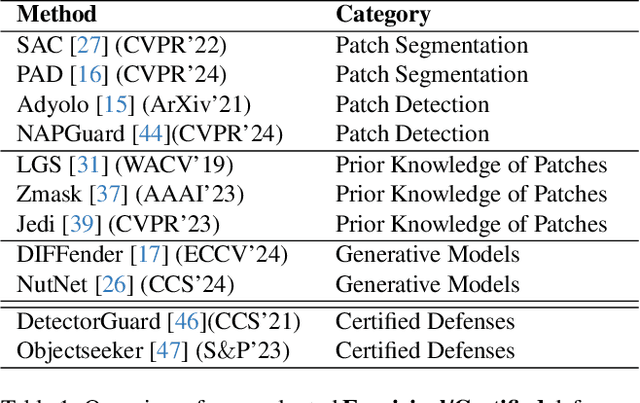
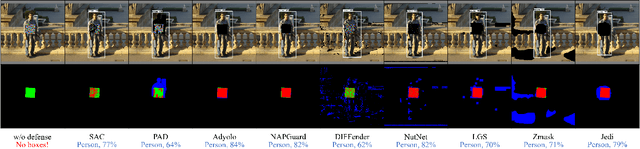
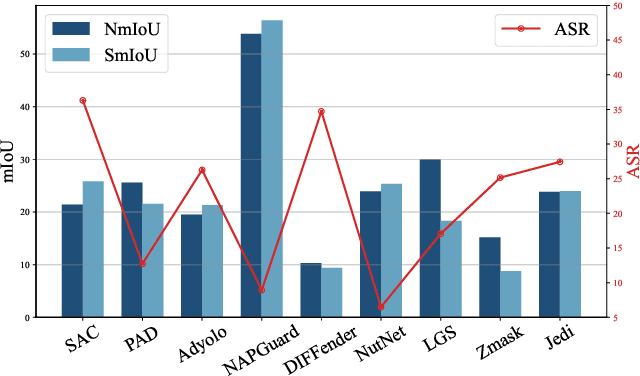
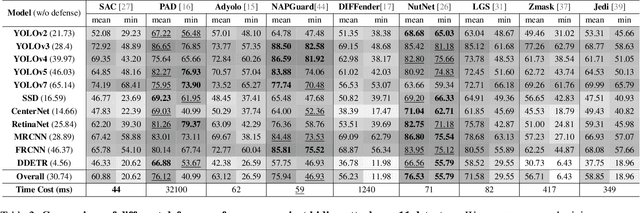
Developing reliable defenses against patch attacks on object detectors has attracted increasing interest. However, we identify that existing defense evaluations lack a unified and comprehensive framework, resulting in inconsistent and incomplete assessments of current methods. To address this issue, we revisit 11 representative defenses and present the first patch defense benchmark, involving 2 attack goals, 13 patch attacks, 11 object detectors, and 4 diverse metrics. This leads to the large-scale adversarial patch dataset with 94 types of patches and 94,000 images. Our comprehensive analyses reveal new insights: (1) The difficulty in defending against naturalistic patches lies in the data distribution, rather than the commonly believed high frequencies. Our new dataset with diverse patch distributions can be used to improve existing defenses by 15.09% AP@0.5. (2) The average precision of the attacked object, rather than the commonly pursued patch detection accuracy, shows high consistency with defense performance. (3) Adaptive attacks can substantially bypass existing defenses, and defenses with complex/stochastic models or universal patch properties are relatively robust. We hope that our analyses will serve as guidance on properly evaluating patch attacks/defenses and advancing their design. Code and dataset are available at https://github.com/Gandolfczjh/APDE, where we will keep integrating new attacks/defenses.
Boosting Ray Search Procedure of Hard-label Attacks with Transfer-based Priors
Jul 23, 2025One of the most practical and challenging types of black-box adversarial attacks is the hard-label attack, where only the top-1 predicted label is available. One effective approach is to search for the optimal ray direction from the benign image that minimizes the $\ell_p$-norm distance to the adversarial region. The unique advantage of this approach is that it transforms the hard-label attack into a continuous optimization problem. The objective function value is the ray's radius, which can be obtained via binary search at a high query cost. Existing methods use a "sign trick" in gradient estimation to reduce the number of queries. In this paper, we theoretically analyze the quality of this gradient estimation and propose a novel prior-guided approach to improve ray search efficiency both theoretically and empirically. Specifically, we utilize the transfer-based priors from surrogate models, and our gradient estimators appropriately integrate them by approximating the projection of the true gradient onto the subspace spanned by these priors and random directions, in a query-efficient manner. We theoretically derive the expected cosine similarities between the obtained gradient estimators and the true gradient, and demonstrate the improvement achieved by incorporating priors. Extensive experiments on the ImageNet and CIFAR-10 datasets show that our approach significantly outperforms 11 state-of-the-art methods in terms of query efficiency.
Defurnishing with X-Ray Vision: Joint Removal of Furniture from Panoramas and Mesh
Jun 06, 2025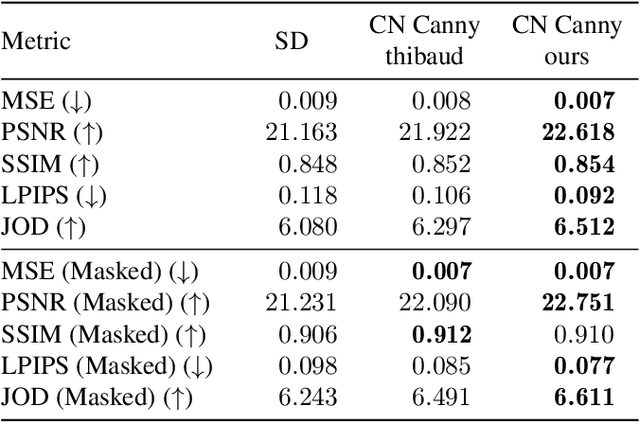
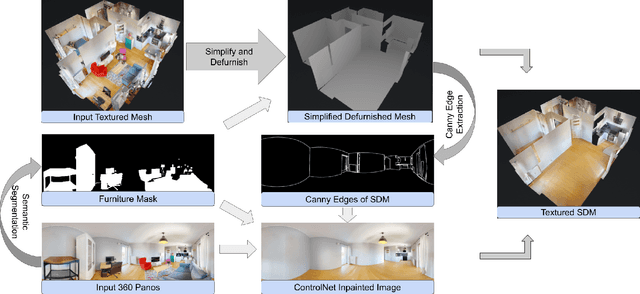
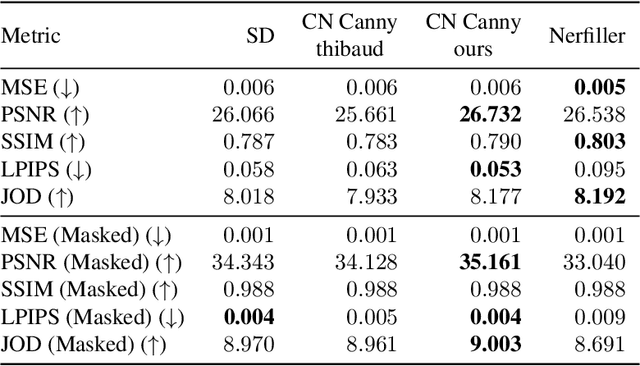

We present a pipeline for generating defurnished replicas of indoor spaces represented as textured meshes and corresponding multi-view panoramic images. To achieve this, we first segment and remove furniture from the mesh representation, extend planes, and fill holes, obtaining a simplified defurnished mesh (SDM). This SDM acts as an ``X-ray'' of the scene's underlying structure, guiding the defurnishing process. We extract Canny edges from depth and normal images rendered from the SDM. We then use these as a guide to remove the furniture from panorama images via ControlNet inpainting. This control signal ensures the availability of global geometric information that may be hidden from a particular panoramic view by the furniture being removed. The inpainted panoramas are used to texture the mesh. We show that our approach produces higher quality assets than methods that rely on neural radiance fields, which tend to produce blurry low-resolution images, or RGB-D inpainting, which is highly susceptible to hallucinations.
Shapley Value-driven Data Pruning for Recommender Systems
May 28, 2025Recommender systems often suffer from noisy interactions like accidental clicks or popularity bias. Existing denoising methods typically identify users' intent in their interactions, and filter out noisy interactions that deviate from the assumed intent. However, they ignore that interactions deemed noisy could still aid model training, while some ``clean'' interactions offer little learning value. To bridge this gap, we propose Shapley Value-driven Valuation (SVV), a framework that evaluates interactions based on their objective impact on model training rather than subjective intent assumptions. In SVV, a real-time Shapley value estimation method is devised to quantify each interaction's value based on its contribution to reducing training loss. Afterward, SVV highlights the interactions with high values while downplaying low ones to achieve effective data pruning for recommender systems. In addition, we develop a simulated noise protocol to examine the performance of various denoising approaches systematically. Experiments on four real-world datasets show that SVV outperforms existing denoising methods in both accuracy and robustness. Further analysis also demonstrates that our SVV can preserve training-critical interactions and offer interpretable noise assessment. This work shifts denoising from heuristic filtering to principled, model-driven interaction valuation.
Counterfactual Multi-player Bandits for Explainable Recommendation Diversification
May 27, 2025Existing recommender systems tend to prioritize items closely aligned with users' historical interactions, inevitably trapping users in the dilemma of ``filter bubble''. Recent efforts are dedicated to improving the diversity of recommendations. However, they mainly suffer from two major issues: 1) a lack of explainability, making it difficult for the system designers to understand how diverse recommendations are generated, and 2) limitations to specific metrics, with difficulty in enhancing non-differentiable diversity metrics. To this end, we propose a \textbf{C}ounterfactual \textbf{M}ulti-player \textbf{B}andits (CMB) method to deliver explainable recommendation diversification across a wide range of diversity metrics. Leveraging a counterfactual framework, our method identifies the factors influencing diversity outcomes. Meanwhile, we adopt the multi-player bandits to optimize the counterfactual optimization objective, making it adaptable to both differentiable and non-differentiable diversity metrics. Extensive experiments conducted on three real-world datasets demonstrate the applicability, effectiveness, and explainability of the proposed CMB.