 Add to Chrome
 Add to Firefox
 Add to Edge
UniNav: A Unified World-Action Diffusion Model for Visual Navigation
Aug 04, 2026
Image-goal visual navigation is a fundamental capability for embodied agents. Existing navigation policies efficiently predict waypoint trajectories but lack visual foresight, while navigation world models can anticipate future observations but often require costly planning rollouts. We present UniNav, a unified world-action model that generates future visual observations and continuous waypoint trajectories through a single diffusion process. Given history frames and a goal image, UniNav jointly denoises visual and waypoint tokens within a single transformer, unifying future prediction and action generation in a shared framework. To improve spatial grounding, we incorporate geometry-aware camera tokens. We also train on both trajectory-labeled navigation data and video-only data, enabling the model to benefit from diverse videos without waypoint annotations. Based on this unified framework, we introduce two variants: UniNav-Full jointly predicts interpretable future observations and their corresponding trajectories, while UniNav-Fast removes future-image tokens at inference for efficient trajectory prediction. Experiments on navigation benchmarks show that UniNav outperforms the strongest baseline in ATE across all datasets. With one-step inference, UniNav-Fast achieves a latency of 0.1s without a substantial accuracy drop. Code will be released.

Reasoning to Regulate: Chain-of-Thought for Traffic Rule Understanding
Jul 27, 2026Understanding and complying with traffic regulations is a safety-critical requirement for autonomous driving, yet remains challenging due to the diversity and context dependence of traffic signage. Importantly, regulation understanding is not a simple recognition task, but a reasoning problem: whether a rule applies depends on interpreting the sign in relation to the spatial layout of lanes and scene context. To support such reasoning, MapDR provide fine-grained annotations that link each traffic sign's regulatory rules to the specific lanes they govern. Existing methods, however, largely treat this as direct sequence prediction, ignoring the underlying reasoning that connects sign semantics and map structure. To address this limitation, we explicitly incorporate reasoning into this task and propose a framework that equips vision-language models (VLMs) with chain-of-thought (CoT) capabilities. We first design a scalable CoT curation pipeline that bootstraps rationales from a strong LLM through a two-round strategy and employs a VLM-based verifier to filter out incorrect cases, yielding a high-quality set of (CoT, answer) pairs. Building on this foundation, we adopt a two-stage training scheme: supervised fine-tuning (SFT) to teach rationale-to-answer generation, followed by GRPO reinforcement learning with answer-grounded, fine-grained rewards to further improve final answer accuracy. Extensive experiments on MapDR show that our approach significantly improves both interpretability and accuracy, establishing the first reasoning-based framework for regulation-aware autonomous driving.
GPOcc++: Unified Sparse Gaussian Occupancy Prediction with Visual Geometry Priors
Jul 15, 2026Accurate 3D scene understanding is fundamental to embodied intelligence and autonomous driving, where 3D occupancy provides a unified representation of objects, structures, and free space. However, recovering such a complete volumetric representation from visual observations remains challenging, particularly in occluded and unobserved regions. Visual geometry priors offer strong and generalizable geometric cues for addressing this challenge, but their outputs are inherently surface-centric, whereas occupancy prediction requires reasoning about volumetric interiors and free space. To bridge this gap, we introduce GPOcc, which transforms visual geometry priors into occupancy-aware sparse Gaussian representations for efficient and expressive volumetric scene modeling. Building on GPOcc, GPOcc++ models multi-view observations and temporal sequences within a unified framework, allowing spatial and temporal evidence to be handled through the same representation. We further extend GPOcc++ from indoor scenes to outdoor occupancy prediction. Extensive experiments on both indoor and outdoor benchmarks demonstrate consistently strong performance across both multi-view and temporal settings, together with favorable efficiency and generalization. Code will be released at https://github.com/JuIvyy/GPOcc.
Monocular Open Vocabulary Occupancy Prediction for Indoor Scenes
Feb 26, 2026Open-vocabulary 3D occupancy is vital for embodied agents, which need to understand complex indoor environments where semantic categories are abundant and evolve beyond fixed taxonomies. While recent work has explored open-vocabulary occupancy in outdoor driving scenarios, such methods transfer poorly indoors, where geometry is denser, layouts are more intricate, and semantics are far more fine-grained. To address these challenges, we adopt a geometry-only supervision paradigm that uses only binary occupancy labels (occupied vs free). Our framework builds upon 3D Language-Embedded Gaussians, which serve as a unified intermediate representation coupling fine-grained 3D geometry with a language-aligned semantic embedding. On the geometry side, we find that existing Gaussian-to-Occupancy operators fail to converge under such weak supervision, and we introduce an opacity-aware, Poisson-based approach that stabilizes volumetric aggregation. On the semantic side, direct alignment between rendered features and open-vocabulary segmentation features suffers from feature mixing; we therefore propose a Progressive Temperature Decay schedule that gradually sharpens opacities during splatting, strengthening Gaussian-language alignment. On Occ-ScanNet, our framework achieves 59.50 IoU and 21.05 mIoU in the open-vocabulary setting, surpassing all existing occupancy methods in IoU and outperforming prior open-vocabulary approaches by a large margin in mIoU. Code will be released at https://github.com/JuIvyy/LegoOcc.
Generalizing Visual Geometry Priors to Sparse Gaussian Occupancy Prediction
Feb 25, 2026Accurate 3D scene understanding is essential for embodied intelligence, with occupancy prediction emerging as a key task for reasoning about both objects and free space. Existing approaches largely rely on depth priors (e.g., DepthAnything) but make only limited use of 3D cues, restricting performance and generalization. Recently, visual geometry models such as VGGT have shown strong capability in providing rich 3D priors, but similar to monocular depth foundation models, they still operate at the level of visible surfaces rather than volumetric interiors, motivating us to explore how to more effectively leverage these increasingly powerful geometry priors for 3D occupancy prediction. We present GPOcc, a framework that leverages generalizable visual geometry priors (GPs) for monocular occupancy prediction. Our method extends surface points inward along camera rays to generate volumetric samples, which are represented as Gaussian primitives for probabilistic occupancy inference. To handle streaming input, we further design a training-free incremental update strategy that fuses per-frame Gaussians into a unified global representation. Experiments on Occ-ScanNet and EmbodiedOcc-ScanNet demonstrate significant gains: GPOcc improves mIoU by +9.99 in the monocular setting and +11.79 in the streaming setting over prior state of the art. Under the same depth prior, it achieves +6.73 mIoU while running 2.65$\times$ faster. These results highlight that GPOcc leverages geometry priors more effectively and efficiently. Code will be released at https://github.com/JuIvyy/GPOcc.
RelTopo: Enhancing Relational Modeling for Driving Scene Topology Reasoning
Jun 16, 2025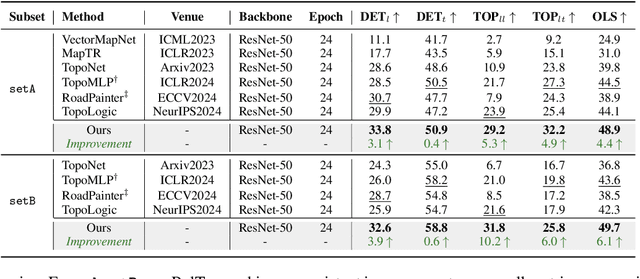
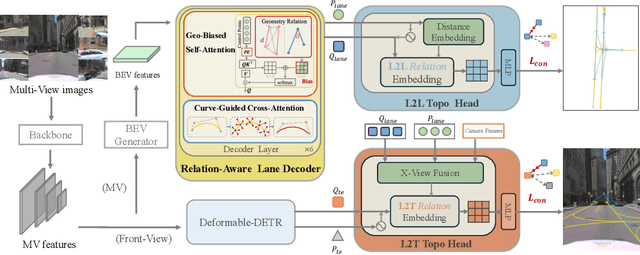
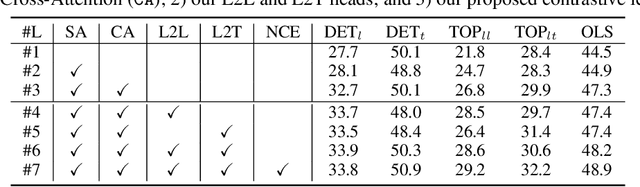
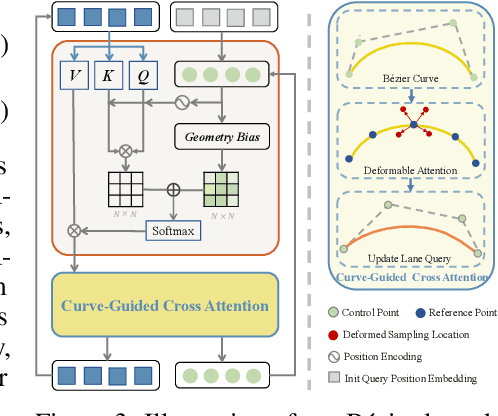
Accurate road topology reasoning is critical for autonomous driving, enabling effective navigation and adherence to traffic regulations. Central to this task are lane perception and topology reasoning. However, existing methods typically focus on either lane detection or Lane-to-Lane (L2L) topology reasoning, often \textit{neglecting} Lane-to-Traffic-element (L2T) relationships or \textit{failing} to optimize these tasks jointly. Furthermore, most approaches either overlook relational modeling or apply it in a limited scope, despite the inherent spatial relationships among road elements. We argue that relational modeling is beneficial for both perception and reasoning, as humans naturally leverage contextual relationships for road element recognition and their connectivity inference. To this end, we introduce relational modeling into both perception and reasoning, \textit{jointly} enhancing structural understanding. Specifically, we propose: 1) a relation-aware lane detector, where our geometry-biased self-attention and \curve\ cross-attention refine lane representations by capturing relational dependencies; 2) relation-enhanced topology heads, including a geometry-enhanced L2L head and a cross-view L2T head, boosting reasoning with relational cues; and 3) a contrastive learning strategy with InfoNCE loss to regularize relationship embeddings. Extensive experiments on OpenLane-V2 demonstrate that our approach significantly improves both detection and topology reasoning metrics, achieving +3.1 in DET$_l$, +5.3 in TOP$_{ll}$, +4.9 in TOP$_{lt}$, and an overall +4.4 in OLS, setting a new state-of-the-art. Code will be released.
Modeling Continuous Motion for 3D Point Cloud Object Tracking
Mar 14, 2023The task of 3D single object tracking (SOT) with LiDAR point clouds is crucial for various applications, such as autonomous driving and robotics. However, existing approaches have primarily relied on appearance matching or motion modeling within only two successive frames, thereby overlooking the long-range continuous motion property of objects in 3D space. To address this issue, this paper presents a novel approach that views each tracklet as a continuous stream: at each timestamp, only the current frame is fed into the network to interact with multi-frame historical features stored in a memory bank, enabling efficient exploitation of sequential information. To achieve effective cross-frame message passing, a hybrid attention mechanism is designed to account for both long-range relation modeling and local geometric feature extraction. Furthermore, to enhance the utilization of multi-frame features for robust tracking, a contrastive sequence enhancement strategy is designed, which uses ground truth tracklets to augment training sequences and promote discrimination against false positives in a contrastive manner. Extensive experiments demonstrate that the proposed method outperforms the state-of-the-art method by significant margins (approximately 8%, 6%, and 12% improvements in the success performance on KITTI, nuScenes, and Waymo, respectively).
DETR4D: Direct Multi-View 3D Object Detection with Sparse Attention
Dec 15, 20223D object detection with surround-view images is an essential task for autonomous driving. In this work, we propose DETR4D, a Transformer-based framework that explores sparse attention and direct feature query for 3D object detection in multi-view images. We design a novel projective cross-attention mechanism for query-image interaction to address the limitations of existing methods in terms of geometric cue exploitation and information loss for cross-view objects. In addition, we introduce a heatmap generation technique that bridges 3D and 2D spaces efficiently via query initialization. Furthermore, unlike the common practice of fusing intermediate spatial features for temporal aggregation, we provide a new perspective by introducing a novel hybrid approach that performs cross-frame fusion over past object queries and image features, enabling efficient and robust modeling of temporal information. Extensive experiments on the nuScenes dataset demonstrate the effectiveness and efficiency of the proposed DETR4D.
Exploring Point-BEV Fusion for 3D Point Cloud Object Tracking with Transformer
Aug 10, 2022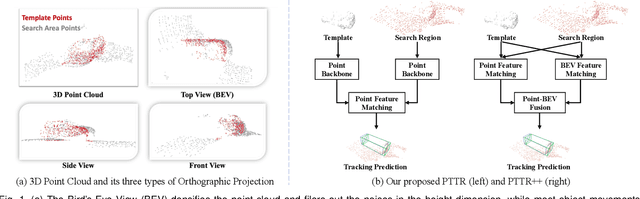
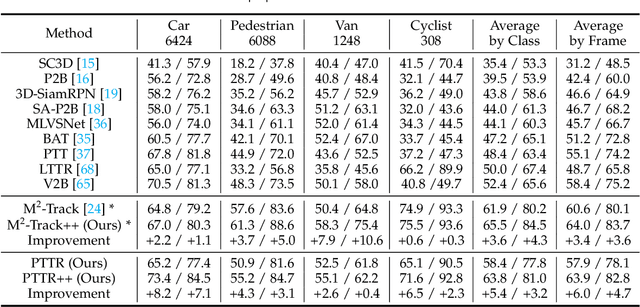
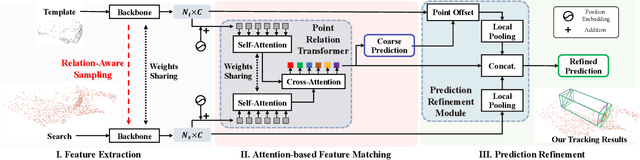
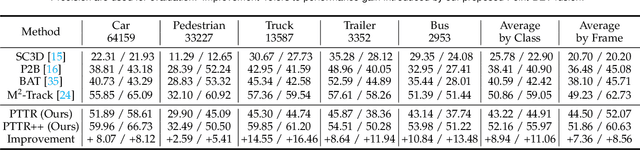
With the prevalence of LiDAR sensors in autonomous driving, 3D object tracking has received increasing attention. In a point cloud sequence, 3D object tracking aims to predict the location and orientation of an object in consecutive frames given an object template. Motivated by the success of transformers, we propose Point Tracking TRansformer (PTTR), which efficiently predicts high-quality 3D tracking results in a coarse-to-fine manner with the help of transformer operations. PTTR consists of three novel designs. 1) Instead of random sampling, we design Relation-Aware Sampling to preserve relevant points to the given template during subsampling. 2) We propose a Point Relation Transformer for effective feature aggregation and feature matching between the template and search region. 3) Based on the coarse tracking results, we employ a novel Prediction Refinement Module to obtain the final refined prediction through local feature pooling. In addition, motivated by the favorable properties of the Bird's-Eye View (BEV) of point clouds in capturing object motion, we further design a more advanced framework named PTTR++, which incorporates both the point-wise view and BEV representation to exploit their complementary effect in generating high-quality tracking results. PTTR++ substantially boosts the tracking performance on top of PTTR with low computational overhead. Extensive experiments over multiple datasets show that our proposed approaches achieve superior 3D tracking accuracy and efficiency.
TransPillars: Coarse-to-Fine Aggregation for Multi-Frame 3D Object Detection
Aug 04, 2022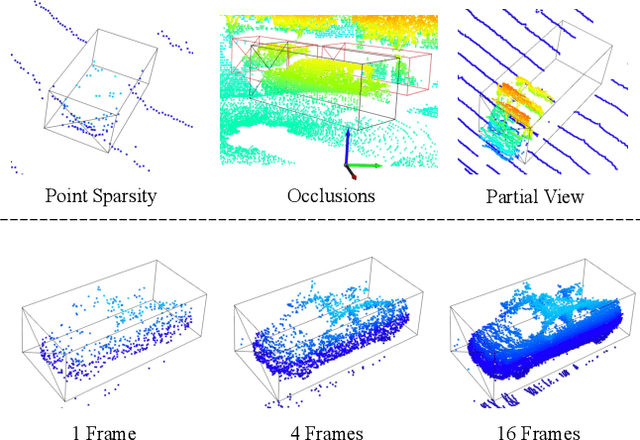

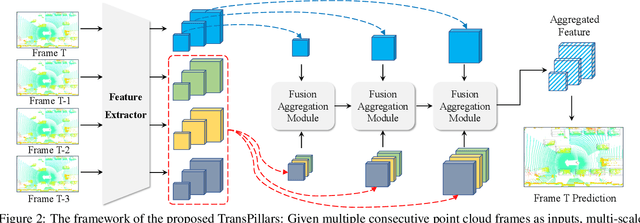
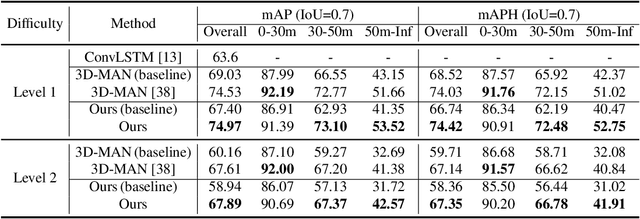
3D object detection using point clouds has attracted increasing attention due to its wide applications in autonomous driving and robotics. However, most existing studies focus on single point cloud frames without harnessing the temporal information in point cloud sequences. In this paper, we design TransPillars, a novel transformer-based feature aggregation technique that exploits temporal features of consecutive point cloud frames for multi-frame 3D object detection. TransPillars aggregates spatial-temporal point cloud features from two perspectives. First, it fuses voxel-level features directly from multi-frame feature maps instead of pooled instance features to preserve instance details with contextual information that are essential to accurate object localization. Second, it introduces a hierarchical coarse-to-fine strategy to fuse multi-scale features progressively to effectively capture the motion of moving objects and guide the aggregation of fine features. Besides, a variant of deformable transformer is introduced to improve the effectiveness of cross-frame feature matching. Extensive experiments show that our proposed TransPillars achieves state-of-art performance as compared to existing multi-frame detection approaches. Code will be released.