 Add to Chrome
 Add to Firefox
 Add to Edge
WISE: A Long-Horizon Agent in Minecraft with Why-Which Reasoning
Jun 11, 2026
Rapid advances have been made in developing general-purpose embodied agent in environments like Minecraft through the adoption of LLM-augmented hierarchical approaches. Despite their promise, low-level controllers often become performance bottlenecks due to repeated execution failures. We argue that a key limitation is not only the lack of episodic memory, but also the decoupling of \textit{what-where-when} memory from \textit{which-why} reasoning. To address this, we propose \textbf{WISE} (Which-Why Informed Semantic Explorer), a long-horizon agent framework with an enhanced low-level controller equipped with a Causal Event Graph that augments episodic memory with explicit causal structure linking observations to task relevance. Unlike prior work such as MrSteve, which relies on feature similarity for retrieval, WISE enables robust recall under viewpoint changes and supports opportunistic task reordering through causal reasoning. Building on this memory, we propose an Opportunistic Task Scheduler that dynamically re-prioritizes subtasks when causally relevant opportunities are detected. We further equip WISE with a multi-scale progressive exploration strategy to provide spatially comprehensive observations for downstream reasoning. Experiments show that WISE largely improves task success and efficiency on long-horizon sparse tasks, particularly in settings requiring adaptive decision-making.

REAL: Robust Extreme Agility via Spatio-Temporal Policy Learning and Physics-Guided Filtering
Mar 18, 2026Extreme legged parkour demands rapid terrain assessment and precise foot placement under highly dynamic conditions. While recent learning-based systems achieve impressive agility, they remain fundamentally fragile to perceptual degradation, where even brief visual noise or latency can cause catastrophic failure. To overcome this, we propose Robust Extreme Agility Learning (REAL), an end-to-end framework for reliable parkour under sensory corruption. Instead of relying on perfectly clean perception, REAL tightly couples vision, proprioceptive history, and temporal memory. We distill a cross-modal teacher policy into a deployable student equipped with a FiLM-modulated Mamba backbone to actively filter visual noise and build short-term terrain memory actively. Furthermore, a physics-guided Bayesian state estimator enforces rigid-body consistency during high-impact maneuvers. Validated on a Unitree Go2 quadruped, REAL successfully traverses extreme obstacles even with a 1-meter visual blind zone, while strictly satisfying real-time control constraints with a bounded 13.1 ms inference time.
SaferPath: Hierarchical Visual Navigation with Learned Guidance and Safety-Constrained Control
Mar 02, 2026Visual navigation is a core capability for mobile robots, yet end-to-end learning-based methods often struggle with generalization and safety in unseen, cluttered, or narrow environments. These limitations are especially pronounced in dense indoor settings, where collisions are likely and end-to-end models frequently fail. To address this, we propose SaferPath, a hierarchical visual navigation framework that leverages learned guidance from existing end-to-end models and refines it through a safety-constrained optimization-control module. SaferPath transforms visual observations into a traversable-area map and refines guidance trajectories using Model Predictive Stein Variational Evolution Strategy (MP-SVES), efficiently generating safe trajectories in only a few iterations. The refined trajectories are tracked by an MPC controller, ensuring robust navigation in complex environments. Extensive experiments in scenarios with unseen obstacles, dense unstructured spaces, and narrow corridors demonstrate that SaferPath consistently improves success rates and reduces collisions, outperforming representative baselines such as ViNT and NoMaD, and enabling safe navigation in challenging real-world settings.
Monocular Open Vocabulary Occupancy Prediction for Indoor Scenes
Feb 26, 2026Open-vocabulary 3D occupancy is vital for embodied agents, which need to understand complex indoor environments where semantic categories are abundant and evolve beyond fixed taxonomies. While recent work has explored open-vocabulary occupancy in outdoor driving scenarios, such methods transfer poorly indoors, where geometry is denser, layouts are more intricate, and semantics are far more fine-grained. To address these challenges, we adopt a geometry-only supervision paradigm that uses only binary occupancy labels (occupied vs free). Our framework builds upon 3D Language-Embedded Gaussians, which serve as a unified intermediate representation coupling fine-grained 3D geometry with a language-aligned semantic embedding. On the geometry side, we find that existing Gaussian-to-Occupancy operators fail to converge under such weak supervision, and we introduce an opacity-aware, Poisson-based approach that stabilizes volumetric aggregation. On the semantic side, direct alignment between rendered features and open-vocabulary segmentation features suffers from feature mixing; we therefore propose a Progressive Temperature Decay schedule that gradually sharpens opacities during splatting, strengthening Gaussian-language alignment. On Occ-ScanNet, our framework achieves 59.50 IoU and 21.05 mIoU in the open-vocabulary setting, surpassing all existing occupancy methods in IoU and outperforming prior open-vocabulary approaches by a large margin in mIoU. Code will be released at https://github.com/JuIvyy/LegoOcc.
Generalizing Visual Geometry Priors to Sparse Gaussian Occupancy Prediction
Feb 25, 2026Accurate 3D scene understanding is essential for embodied intelligence, with occupancy prediction emerging as a key task for reasoning about both objects and free space. Existing approaches largely rely on depth priors (e.g., DepthAnything) but make only limited use of 3D cues, restricting performance and generalization. Recently, visual geometry models such as VGGT have shown strong capability in providing rich 3D priors, but similar to monocular depth foundation models, they still operate at the level of visible surfaces rather than volumetric interiors, motivating us to explore how to more effectively leverage these increasingly powerful geometry priors for 3D occupancy prediction. We present GPOcc, a framework that leverages generalizable visual geometry priors (GPs) for monocular occupancy prediction. Our method extends surface points inward along camera rays to generate volumetric samples, which are represented as Gaussian primitives for probabilistic occupancy inference. To handle streaming input, we further design a training-free incremental update strategy that fuses per-frame Gaussians into a unified global representation. Experiments on Occ-ScanNet and EmbodiedOcc-ScanNet demonstrate significant gains: GPOcc improves mIoU by +9.99 in the monocular setting and +11.79 in the streaming setting over prior state of the art. Under the same depth prior, it achieves +6.73 mIoU while running 2.65$\times$ faster. These results highlight that GPOcc leverages geometry priors more effectively and efficiently. Code will be released at https://github.com/JuIvyy/GPOcc.
LST-SLAM: A Stereo Thermal SLAM System for Kilometer-Scale Dynamic Environments
Feb 24, 2026Thermal cameras offer strong potential for robot perception under challenging illumination and weather conditions. However, thermal Simultaneous Localization and Mapping (SLAM) remains difficult due to unreliable feature extraction, unstable motion tracking, and inconsistent global pose and map construction, particularly in dynamic large-scale outdoor environments. To address these challenges, we propose LST-SLAM, a novel large-scale stereo thermal SLAM system that achieves robust performance in complex, dynamic scenes. Our approach combines self-supervised thermal feature learning, stereo dual-level motion tracking, and geometric pose optimization. We also introduce a semantic-geometric hybrid constraint that suppresses potentially dynamic features lacking strong inter-frame geometric consistency. Furthermore, we develop an online incremental bag-of-words model for loop closure detection, coupled with global pose optimization to mitigate accumulated drift. Extensive experiments on kilometer-scale dynamic thermal datasets show that LST-SLAM significantly outperforms recent representative SLAM systems, including AirSLAM and DROID-SLAM, in both robustness and accuracy.
X-IONet: Cross-Platform Inertial Odometry Network with Dual-Stage Attention
Nov 11, 2025Learning-based inertial odometry has achieved remarkable progress in pedestrian navigation. However, extending these methods to quadruped robots remains challenging due to their distinct and highly dynamic motion patterns. Models that perform well on pedestrian data often experience severe degradation when deployed on legged platforms. To tackle this challenge, we introduce X-IONet, a cross-platform inertial odometry framework that operates solely using a single Inertial Measurement Unit (IMU). X-IONet incorporates a rule-based expert selection module to classify motion platforms and route IMU sequences to platform-specific expert networks. The displacement prediction network features a dual-stage attention architecture that jointly models long-range temporal dependencies and inter-axis correlations, enabling accurate motion representation. It outputs both displacement and associated uncertainty, which are further fused through an Extended Kalman Filter (EKF) for robust state estimation. Extensive experiments on public pedestrian datasets and a self-collected quadruped robot dataset demonstrate that X-IONet achieves state-of-the-art performance, reducing Absolute Trajectory Error (ATE) by 14.3% and Relative Trajectory Error (RTE) by 11.4% on pedestrian data, and by 52.8% and 41.3% on quadruped robot data. These results highlight the effectiveness of X-IONet in advancing accurate and robust inertial navigation across both human and legged robot platforms.
PanoNav: Mapless Zero-Shot Object Navigation with Panoramic Scene Parsing and Dynamic Memory
Nov 10, 2025Zero-shot object navigation (ZSON) in unseen environments remains a challenging problem for household robots, requiring strong perceptual understanding and decision-making capabilities. While recent methods leverage metric maps and Large Language Models (LLMs), they often depend on depth sensors or prebuilt maps, limiting the spatial reasoning ability of Multimodal Large Language Models (MLLMs). Mapless ZSON approaches have emerged to address this, but they typically make short-sighted decisions, leading to local deadlocks due to a lack of historical context. We propose PanoNav, a fully RGB-only, mapless ZSON framework that integrates a Panoramic Scene Parsing module to unlock the spatial parsing potential of MLLMs from panoramic RGB inputs, and a Memory-guided Decision-Making mechanism enhanced by a Dynamic Bounded Memory Queue to incorporate exploration history and avoid local deadlocks. Experiments on the public navigation benchmark show that PanoNav significantly outperforms representative baselines in both SR and SPL metrics.
DynaNav: Dynamic Feature and Layer Selection for Efficient Visual Navigation
Sep 26, 2025Visual navigation is essential for robotics and embodied AI. However, existing foundation models, particularly those with transformer decoders, suffer from high computational overhead and lack interpretability, limiting their deployment in resource-tight scenarios. To address this, we propose DynaNav, a Dynamic Visual Navigation framework that adapts feature and layer selection based on scene complexity. It employs a trainable hard feature selector for sparse operations, enhancing efficiency and interpretability. Additionally, we integrate feature selection into an early-exit mechanism, with Bayesian Optimization determining optimal exit thresholds to reduce computational cost. Extensive experiments in real-world-based datasets and simulated environments demonstrate the effectiveness of DynaNav. Compared to ViNT, DynaNav achieves a 2.26x reduction in FLOPs, 42.3% lower inference time, and 32.8% lower memory usage, while improving navigation performance across four public datasets.
SLAM in the Dark: Self-Supervised Learning of Pose, Depth and Loop-Closure from Thermal Images
Feb 26, 2025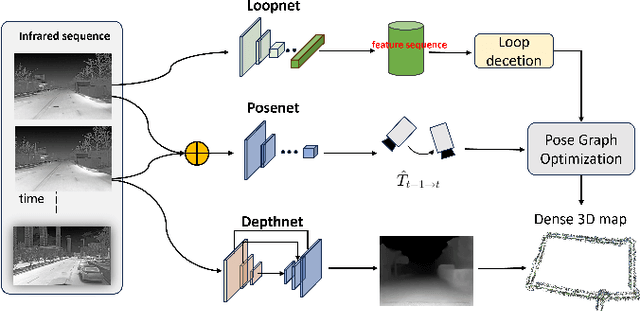

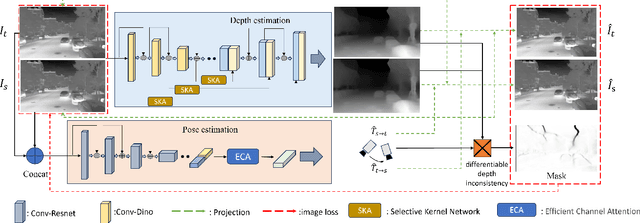
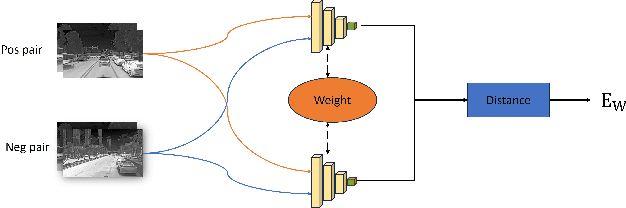
Visual SLAM is essential for mobile robots, drone navigation, and VR/AR, but traditional RGB camera systems struggle in low-light conditions, driving interest in thermal SLAM, which excels in such environments. However, thermal imaging faces challenges like low contrast, high noise, and limited large-scale annotated datasets, restricting the use of deep learning in outdoor scenarios. We present DarkSLAM, a noval deep learning-based monocular thermal SLAM system designed for large-scale localization and reconstruction in complex lighting conditions.Our approach incorporates the Efficient Channel Attention (ECA) mechanism in visual odometry and the Selective Kernel Attention (SKA) mechanism in depth estimation to enhance pose accuracy and mitigate thermal depth degradation. Additionally, the system includes thermal depth-based loop closure detection and pose optimization, ensuring robust performance in low-texture thermal scenes. Extensive outdoor experiments demonstrate that DarkSLAM significantly outperforms existing methods like SC-Sfm-Learner and Shin et al., delivering precise localization and 3D dense mapping even in challenging nighttime environments.