 Add to Chrome
 Add to Firefox
 Add to Edge
Fingerprints of Generative Models in the Frequency Domain
Jul 29, 2023
It is verified in existing works that CNN-based generative models leave unique fingerprints on generated images. There is a lack of analysis about how they are formed in generative models. Interpreting network components in the frequency domain, we derive sources for frequency distribution and grid-like pattern discrepancies exhibited on the spectrum. These insights are leveraged to develop low-cost synthetic models, which generate images emulating the frequency patterns observed in real generative models. The resulting fingerprint extractor pre-trained on synthetic data shows superior transferability in verifying, identifying, and analyzing the relationship of real CNN-based generative models such as GAN, VAE, Flow, and diffusion.

Re-mine, Learn and Reason: Exploring the Cross-modal Semantic Correlations for Language-guided HOI detection
Jul 25, 2023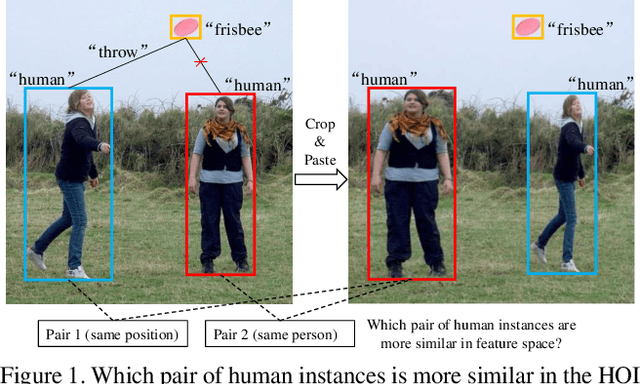
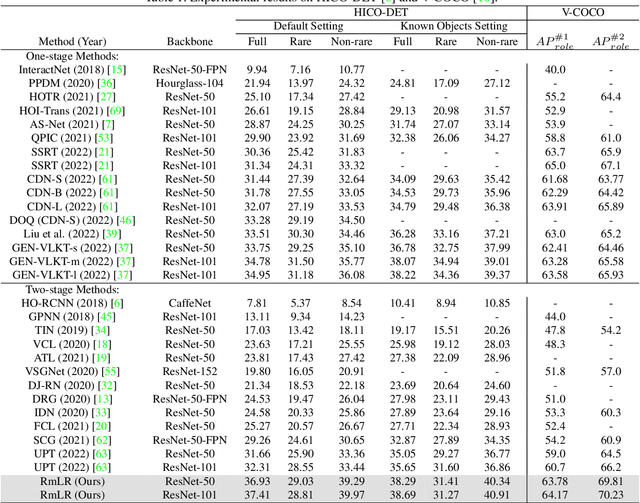
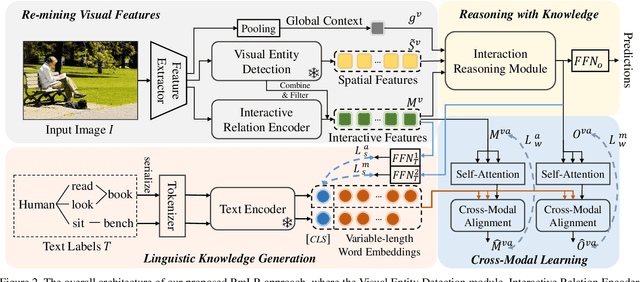
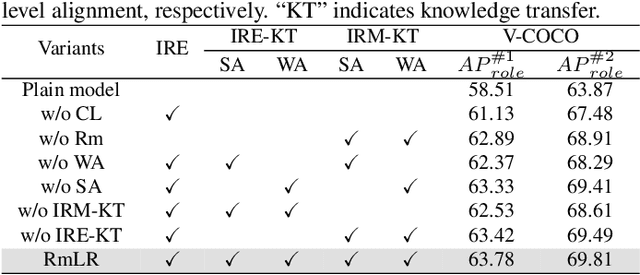
Human-Object Interaction (HOI) detection is a challenging computer vision task that requires visual models to address the complex interactive relationship between humans and objects and predict HOI triplets. Despite the challenges posed by the numerous interaction combinations, they also offer opportunities for multimodal learning of visual texts. In this paper, we present a systematic and unified framework (RmLR) that enhances HOI detection by incorporating structured text knowledge. Firstly, we qualitatively and quantitatively analyze the loss of interaction information in the two-stage HOI detector and propose a re-mining strategy to generate more comprehensive visual representation.Secondly, we design more fine-grained sentence- and word-level alignment and knowledge transfer strategies to effectively address the many-to-many matching problem between multiple interactions and multiple texts.These strategies alleviate the matching confusion problem that arises when multiple interactions occur simultaneously, thereby improving the effectiveness of the alignment process. Finally, HOI reasoning by visual features augmented with textual knowledge substantially improves the understanding of interactions. Experimental results illustrate the effectiveness of our approach, where state-of-the-art performance is achieved on public benchmarks. We further analyze the effects of different components of our approach to provide insights into its efficacy.
What Can Simple Arithmetic Operations Do for Temporal Modeling?
Jul 18, 2023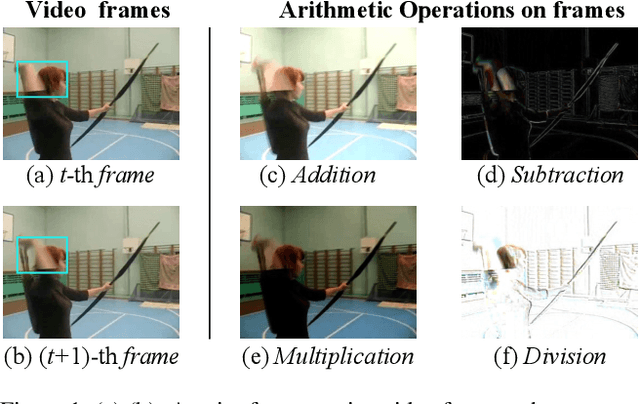
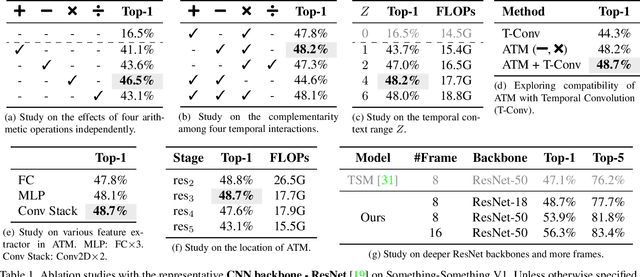
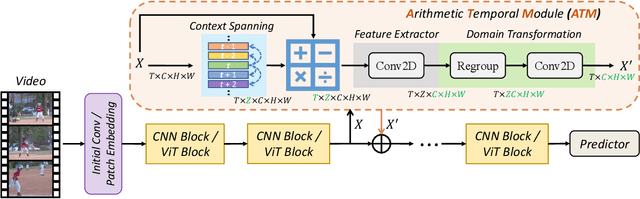
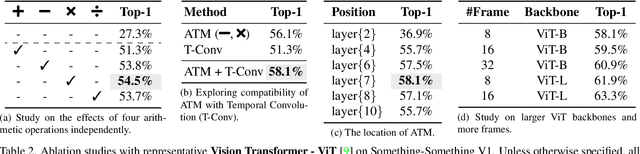
Temporal modeling plays a crucial role in understanding video content. To tackle this problem, previous studies built complicated temporal relations through time sequence thanks to the development of computationally powerful devices. In this work, we explore the potential of four simple arithmetic operations for temporal modeling. Specifically, we first capture auxiliary temporal cues by computing addition, subtraction, multiplication, and division between pairs of extracted frame features. Then, we extract corresponding features from these cues to benefit the original temporal-irrespective domain. We term such a simple pipeline as an Arithmetic Temporal Module (ATM), which operates on the stem of a visual backbone with a plug-andplay style. We conduct comprehensive ablation studies on the instantiation of ATMs and demonstrate that this module provides powerful temporal modeling capability at a low computational cost. Moreover, the ATM is compatible with both CNNs- and ViTs-based architectures. Our results show that ATM achieves superior performance over several popular video benchmarks. Specifically, on Something-Something V1, V2 and Kinetics-400, we reach top-1 accuracy of 65.6%, 74.6%, and 89.4% respectively. The code is available at https://github.com/whwu95/ATM.
Neural Architecture Retrieval
Jul 16, 2023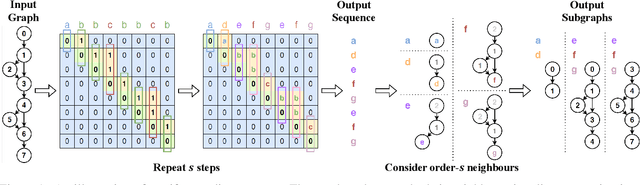
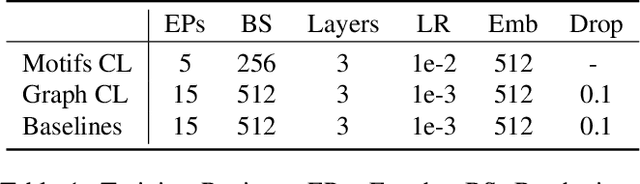
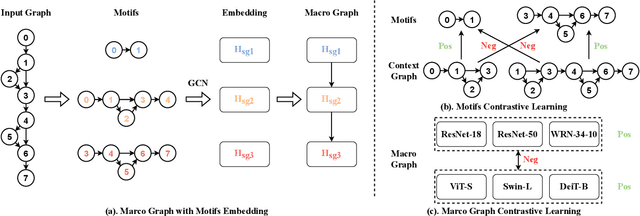
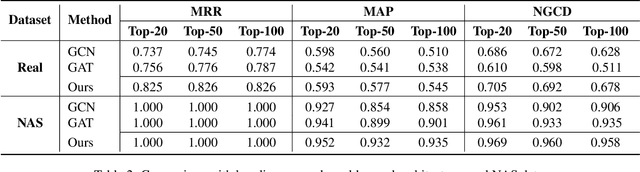
With the increasing number of new neural architecture designs and substantial existing neural architectures, it becomes difficult for the researchers to situate their contributions compared with existing neural architectures or establish the connections between their designs and other relevant ones. To discover similar neural architectures in an efficient and automatic manner, we define a new problem Neural Architecture Retrieval which retrieves a set of existing neural architectures which have similar designs to the query neural architecture. Existing graph pre-training strategies cannot address the computational graph in neural architectures due to the graph size and motifs. To fulfill this potential, we propose to divide the graph into motifs which are used to rebuild the macro graph to tackle these issues, and introduce multi-level contrastive learning to achieve accurate graph representation learning. Extensive evaluations on both human-designed and synthesized neural architectures demonstrate the superiority of our algorithm. Such a dataset which contains 12k real-world network architectures, as well as their embedding, is built for neural architecture retrieval.
Learning Structure-Guided Diffusion Model for 2D Human Pose Estimation
Jun 29, 2023One of the mainstream schemes for 2D human pose estimation (HPE) is learning keypoints heatmaps by a neural network. Existing methods typically improve the quality of heatmaps by customized architectures, such as high-resolution representation and vision Transformers. In this paper, we propose \textbf{DiffusionPose}, a new scheme that formulates 2D HPE as a keypoints heatmaps generation problem from noised heatmaps. During training, the keypoints are diffused to random distribution by adding noises and the diffusion model learns to recover ground-truth heatmaps from noised heatmaps with respect to conditions constructed by image feature. During inference, the diffusion model generates heatmaps from initialized heatmaps in a progressive denoising way. Moreover, we further explore improving the performance of DiffusionPose with conditions from human structural information. Extensive experiments show the prowess of our DiffusionPose, with improvements of 1.6, 1.2, and 1.2 mAP on widely-used COCO, CrowdPose, and AI Challenge datasets, respectively.
GPT Self-Supervision for a Better Data Annotator
Jun 08, 2023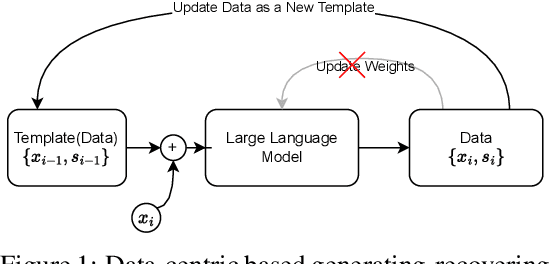
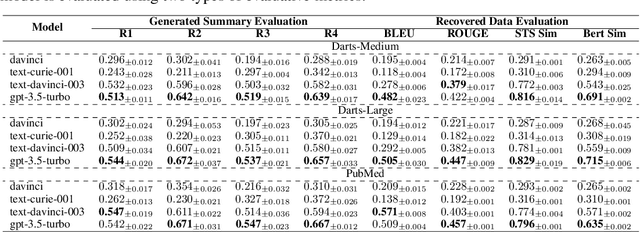
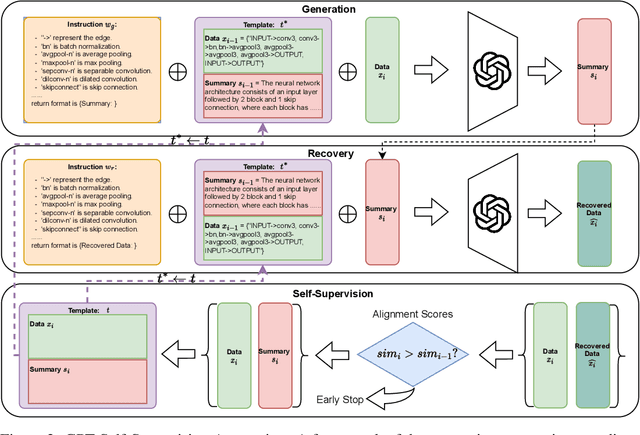
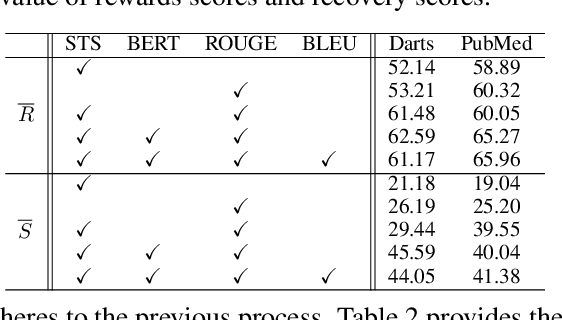
The task of annotating data into concise summaries poses a significant challenge across various domains, frequently requiring the allocation of significant time and specialized knowledge by human experts. Despite existing efforts to use large language models for annotation tasks, significant problems such as limited applicability to unlabeled data, the absence of self-supervised methods, and the lack of focus on complex structured data still persist. In this work, we propose a GPT self-supervision annotation method, which embodies a generating-recovering paradigm that leverages the one-shot learning capabilities of the Generative Pretrained Transformer (GPT). The proposed approach comprises a one-shot tuning phase followed by a generation phase. In the one-shot tuning phase, we sample a data from the support set as part of the prompt for GPT to generate a textual summary, which is then used to recover the original data. The alignment score between the recovered and original data serves as a self-supervision navigator to refine the process. In the generation stage, the optimally selected one-shot sample serves as a template in the prompt and is applied to generating summaries from challenging datasets. The annotation performance is evaluated by tuning several human feedback reward networks and by calculating alignment scores between original and recovered data at both sentence and structure levels. Our self-supervised annotation method consistently achieves competitive scores, convincingly demonstrating its robust strength in various data-to-summary annotation tasks.
Stable Diffusion is Unstable
Jun 06, 2023Recently, text-to-image models have been thriving. Despite their powerful generative capacity, our research has uncovered a lack of robustness in this generation process. Specifically, the introduction of small perturbations to the text prompts can result in the blending of primary subjects with other categories or their complete disappearance in the generated images. In this paper, we propose Auto-attack on Text-to-image Models (ATM), a gradient-based approach, to effectively and efficiently generate such perturbations. By learning a Gumbel Softmax distribution, we can make the discrete process of word replacement or extension continuous, thus ensuring the differentiability of the perturbation generation. Once the distribution is learned, ATM can sample multiple attack samples simultaneously. These attack samples can prevent the generative model from generating the desired subjects without compromising image quality. ATM has achieved a 91.1% success rate in short-text attacks and an 81.2% success rate in long-text attacks. Further empirical analysis revealed four attack patterns based on: 1) the variability in generation speed, 2) the similarity of coarse-grained characteristics, 3) the polysemy of words, and 4) the positioning of words.
Knowledge Diffusion for Distillation
May 25, 2023The representation gap between teacher and student is an emerging topic in knowledge distillation (KD). To reduce the gap and improve the performance, current methods often resort to complicated training schemes, loss functions, and feature alignments, which are task-specific and feature-specific. In this paper, we state that the essence of these methods is to discard the noisy information and distill the valuable information in the feature, and propose a novel KD method dubbed DiffKD, to explicitly denoise and match features using diffusion models. Our approach is based on the observation that student features typically contain more noises than teacher features due to the smaller capacity of student model. To address this, we propose to denoise student features using a diffusion model trained by teacher features. This allows us to perform better distillation between the refined clean feature and teacher feature. Additionally, we introduce a light-weight diffusion model with a linear autoencoder to reduce the computation cost and an adpative noise matching module to improve the denoising performance. Extensive experiments demonstrate that DiffKD is effective across various types of features and achieves state-of-the-art performance consistently on image classification, object detection, and semantic segmentation tasks. Code will be available at https://github.com/hunto/DiffKD.
VanillaKD: Revisit the Power of Vanilla Knowledge Distillation from Small Scale to Large Scale
May 25, 2023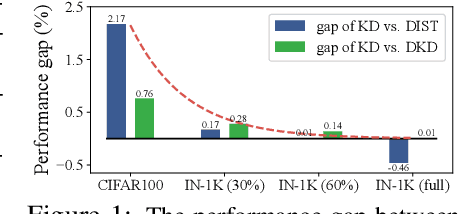

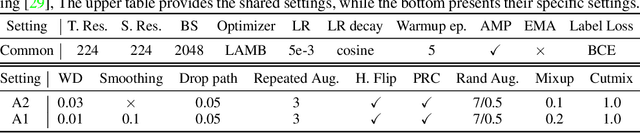
The tremendous success of large models trained on extensive datasets demonstrates that scale is a key ingredient in achieving superior results. Therefore, the reflection on the rationality of designing knowledge distillation (KD) approaches for limited-capacity architectures solely based on small-scale datasets is now deemed imperative. In this paper, we identify the \emph{small data pitfall} that presents in previous KD methods, which results in the underestimation of the power of vanilla KD framework on large-scale datasets such as ImageNet-1K. Specifically, we show that employing stronger data augmentation techniques and using larger datasets can directly decrease the gap between vanilla KD and other meticulously designed KD variants. This highlights the necessity of designing and evaluating KD approaches in the context of practical scenarios, casting off the limitations of small-scale datasets. Our investigation of the vanilla KD and its variants in more complex schemes, including stronger training strategies and different model capacities, demonstrates that vanilla KD is elegantly simple but astonishingly effective in large-scale scenarios. Without bells and whistles, we obtain state-of-the-art ResNet-50, ViT-S, and ConvNeXtV2-T models for ImageNet, which achieve 83.1\%, 84.3\%, and 85.0\% top-1 accuracy, respectively. PyTorch code and checkpoints can be found at https://github.com/Hao840/vanillaKD.
Dual Focal Loss for Calibration
May 23, 2023The use of deep neural networks in real-world applications require well-calibrated networks with confidence scores that accurately reflect the actual probability. However, it has been found that these networks often provide over-confident predictions, which leads to poor calibration. Recent efforts have sought to address this issue by focal loss to reduce over-confidence, but this approach can also lead to under-confident predictions. While different variants of focal loss have been explored, it is difficult to find a balance between over-confidence and under-confidence. In our work, we propose a new loss function by focusing on dual logits. Our method not only considers the ground truth logit, but also take into account the highest logit ranked after the ground truth logit. By maximizing the gap between these two logits, our proposed dual focal loss can achieve a better balance between over-confidence and under-confidence. We provide theoretical evidence to support our approach and demonstrate its effectiveness through evaluations on multiple models and datasets, where it achieves state-of-the-art performance. Code is available at https://github.com/Linwei94/DualFocalLoss