 Add to Chrome
 Add to Firefox
 Add to Edge
Seeing Realism from Simulation: Efficient Video Transfer for Vision-Language-Action Data Augmentation
May 04, 2026
Vision-language-action (VLA) models typically rely on large-scale real-world videos, whereas simulated data, despite being inexpensive and highly parallelizable to collect, often suffers from a substantial visual domain gap and limited environmental diversity, resulting in weak real-world generalization. We present an efficient video augmentation framework that converts simulated VLA videos into realistic training videos while preserving task semantics and action trajectories. Our pipeline extracts structured conditions from simulation via video semantic segmentation and video captioning, rewrites captions to diversify environments, and uses a conditional video transfer model to synthesize realistic videos. To make augmentation practical at scale, we introduce a diffusion feature-reuse mechanism that reuses video tokens across adjacent timesteps to accelerate generation, and a coreset sampling strategy that identifies a compact, non-redundant subset for augmentation under limited computation. Extensive experiments on Robotwin 2.0, LIBERO, LIBERO-Plus, and a real robotic platform demonstrate consistent improvements. For example, our method improves RDT-1B by 8% on Robotwin 2.0, and boosts $π_0$ by 5.1% on the more challenging LIBERO-Plus benchmark. Code is available at: https://github.com/nanfangxiansheng/Seeing-Realism-from-Simulation.

LEGATO: Good Identity Unlearning Is Continuous
Jan 07, 2026Machine unlearning has become a crucial role in enabling generative models trained on large datasets to remove sensitive, private, or copyright-protected data. However, existing machine unlearning methods face three challenges in learning to forget identity of generative models: 1) inefficient, where identity erasure requires fine-tuning all the model's parameters; 2) limited controllability, where forgetting intensity cannot be controlled and explainability is lacking; 3) catastrophic collapse, where the model's retention capability undergoes drastic degradation as forgetting progresses. Forgetting has typically been handled through discrete and unstable updates, often requiring full-model fine-tuning and leading to catastrophic collapse. In this work, we argue that identity forgetting should be modeled as a continuous trajectory, and introduce LEGATO - Learn to ForgEt Identity in GenerAtive Models via Trajectory-consistent Neural Ordinary Differential Equations. LEGATO augments pre-trained generators with fine-tunable lightweight Neural ODE adapters, enabling smooth, controllable forgetting while keeping the original model weights frozen. This formulation allows forgetting intensity to be precisely modulated via ODE step size, offering interpretability and robustness. To further ensure stability, we introduce trajectory consistency constraints that explicitly prevent catastrophic collapse during unlearning. Extensive experiments across in-domain and out-of-domain identity unlearning benchmarks show that LEGATO achieves state-of-the-art forgetting performance, avoids catastrophic collapse and reduces fine-tuned parameters.
Learning to Expand Images for Efficient Visual Autoregressive Modeling
Nov 19, 2025Autoregressive models have recently shown great promise in visual generation by leveraging discrete token sequences akin to language modeling. However, existing approaches often suffer from inefficiency, either due to token-by-token decoding or the complexity of multi-scale representations. In this work, we introduce Expanding Autoregressive Representation (EAR), a novel generation paradigm that emulates the human visual system's center-outward perception pattern. EAR unfolds image tokens in a spiral order from the center and progressively expands outward, preserving spatial continuity and enabling efficient parallel decoding. To further enhance flexibility and speed, we propose a length-adaptive decoding strategy that dynamically adjusts the number of tokens predicted at each step. This biologically inspired design not only reduces computational cost but also improves generation quality by aligning the generation order with perceptual relevance. Extensive experiments on ImageNet demonstrate that EAR achieves state-of-the-art trade-offs between fidelity and efficiency on single-scale autoregressive models, setting a new direction for scalable and cognitively aligned autoregressive image generation.
ActVAR: Activating Mixtures of Weights and Tokens for Efficient Visual Autoregressive Generation
Nov 17, 2025Visual Autoregressive (VAR) models enable efficient image generation via next-scale prediction but face escalating computational costs as sequence length grows. Existing static pruning methods degrade performance by permanently removing weights or tokens, disrupting pretrained dependencies. To address this, we propose ActVAR, a dynamic activation framework that introduces dual sparsity across model weights and token sequences to enhance efficiency without sacrificing capacity. ActVAR decomposes feedforward networks (FFNs) into lightweight expert sub-networks and employs a learnable router to dynamically select token-specific expert subsets based on content. Simultaneously, a gated token selector identifies high-update-potential tokens for computation while reconstructing unselected tokens to preserve global context and sequence alignment. Training employs a two-stage knowledge distillation strategy, where the original VAR model supervises the learning of routing and gating policies to align with pretrained knowledge. Experiments on the ImageNet $256\times 256$ benchmark demonstrate that ActVAR achieves up to $21.2\%$ FLOPs reduction with minimal performance degradation.
DeCoP: Enhancing Self-Supervised Time Series Representation with Dependency Controlled Pre-training
Sep 18, 2025Modeling dynamic temporal dependencies is a critical challenge in time series pre-training, which evolve due to distribution shifts and multi-scale patterns. This temporal variability severely impairs the generalization of pre-trained models to downstream tasks. Existing frameworks fail to capture the complex interactions of short- and long-term dependencies, making them susceptible to spurious correlations that degrade generalization. To address these limitations, we propose DeCoP, a Dependency Controlled Pre-training framework that explicitly models dynamic, multi-scale dependencies by simulating evolving inter-patch dependencies. At the input level, DeCoP introduces Instance-wise Patch Normalization (IPN) to mitigate distributional shifts while preserving the unique characteristics of each patch, creating a robust foundation for representation learning. At the latent level, a hierarchical Dependency Controlled Learning (DCL) strategy explicitly models inter-patch dependencies across multiple temporal scales, with an Instance-level Contrastive Module (ICM) enhances global generalization by learning instance-discriminative representations from time-invariant positive pairs. DeCoP achieves state-of-the-art results on ten datasets with lower computing resources, improving MSE by 3% on ETTh1 over PatchTST using only 37% of the FLOPs.
Learning Mask Invariant Mutual Information for Masked Image Modeling
Feb 27, 2025Masked autoencoders (MAEs) represent a prominent self-supervised learning paradigm in computer vision. Despite their empirical success, the underlying mechanisms of MAEs remain insufficiently understood. Recent studies have attempted to elucidate the functioning of MAEs through contrastive learning and feature representation analysis, yet these approaches often provide only implicit insights. In this paper, we propose a new perspective for understanding MAEs by leveraging the information bottleneck principle in information theory. Our theoretical analyses reveal that optimizing the latent features to balance relevant and irrelevant information is key to improving MAE performance. Building upon our proofs, we introduce MI-MAE, a novel method that optimizes MAEs through mutual information maximization and minimization. By enhancing latent features to retain maximal relevant information between them and the output, and minimizing irrelevant information between them and the input, our approach achieves better performance. Extensive experiments on standard benchmarks show that MI-MAE significantly outperforms MAE models in tasks such as image classification, object detection, and semantic segmentation. Our findings validate the theoretical framework and highlight the practical advantages of applying the information bottleneck principle to MAEs, offering deeper insights for developing more powerful self-supervised learning models.
MetaDD: Boosting Dataset Distillation with Neural Network Architecture-Invariant Generalization
Oct 07, 2024
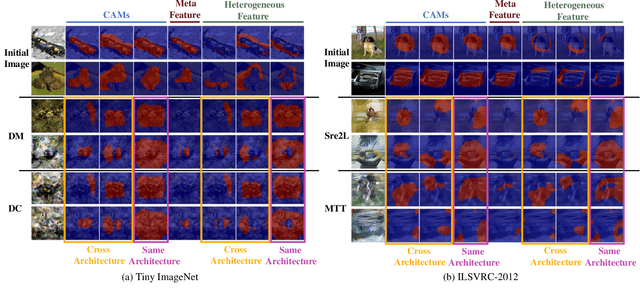

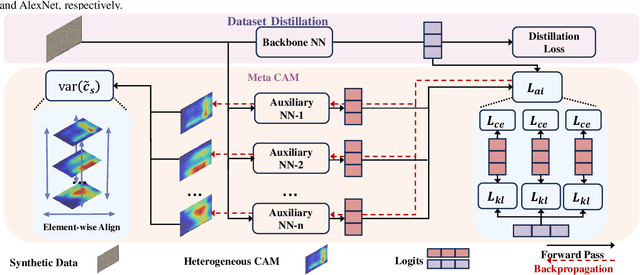
Dataset distillation (DD) entails creating a refined, compact distilled dataset from a large-scale dataset to facilitate efficient training. A significant challenge in DD is the dependency between the distilled dataset and the neural network (NN) architecture used. Training a different NN architecture with a distilled dataset distilled using a specific architecture often results in diminished trainning performance for other architectures. This paper introduces MetaDD, designed to enhance the generalizability of DD across various NN architectures. Specifically, MetaDD partitions distilled data into meta features (i.e., the data's common characteristics that remain consistent across different NN architectures) and heterogeneous features (i.e., the data's unique feature to each NN architecture). Then, MetaDD employs an architecture-invariant loss function for multi-architecture feature alignment, which increases meta features and reduces heterogeneous features in distilled data. As a low-memory consumption component, MetaDD can be seamlessly integrated into any DD methodology. Experimental results demonstrate that MetaDD significantly improves performance across various DD methods. On the Distilled Tiny-Imagenet with Sre2L (50 IPC), MetaDD achieves cross-architecture NN accuracy of up to 30.1\%, surpassing the second-best method (GLaD) by 1.7\%.
Training-free Long Video Generation with Chain of Diffusion Model Experts
Aug 27, 2024Video generation models hold substantial potential in areas such as filmmaking. However, current video diffusion models need high computational costs and produce suboptimal results due to high complexity of video generation task. In this paper, we propose \textbf{ConFiner}, an efficient high-quality video generation framework that decouples video generation into easier subtasks: structure \textbf{con}trol and spatial-temporal re\textbf{fine}ment. It can generate high-quality videos with chain of off-the-shelf diffusion model experts, each expert responsible for a decoupled subtask. During the refinement, we introduce coordinated denoising, which can merge multiple diffusion experts' capabilities into a single sampling. Furthermore, we design ConFiner-Long framework, which can generate long coherent video with three constraint strategies on ConFiner. Experimental results indicate that with only 10\% of the inference cost, our ConFiner surpasses representative models like Lavie and Modelscope across all objective and subjective metrics. And ConFiner-Long can generate high-quality and coherent videos with up to 600 frames.
LocalMamba: Visual State Space Model with Windowed Selective Scan
Mar 14, 2024


Recent advancements in state space models, notably Mamba, have demonstrated significant progress in modeling long sequences for tasks like language understanding. Yet, their application in vision tasks has not markedly surpassed the performance of traditional Convolutional Neural Networks (CNNs) and Vision Transformers (ViTs). This paper posits that the key to enhancing Vision Mamba (ViM) lies in optimizing scan directions for sequence modeling. Traditional ViM approaches, which flatten spatial tokens, overlook the preservation of local 2D dependencies, thereby elongating the distance between adjacent tokens. We introduce a novel local scanning strategy that divides images into distinct windows, effectively capturing local dependencies while maintaining a global perspective. Additionally, acknowledging the varying preferences for scan patterns across different network layers, we propose a dynamic method to independently search for the optimal scan choices for each layer, substantially improving performance. Extensive experiments across both plain and hierarchical models underscore our approach's superiority in effectively capturing image representations. For example, our model significantly outperforms Vim-Ti by 3.1% on ImageNet with the same 1.5G FLOPs. Code is available at: https://github.com/hunto/LocalMamba.
Active Generation for Image Classification
Mar 11, 2024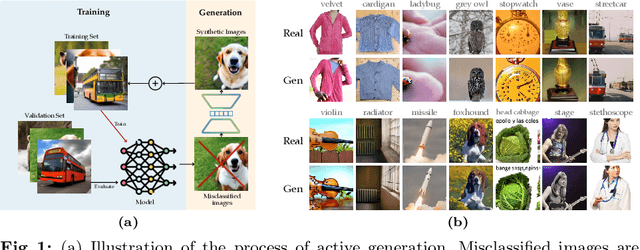
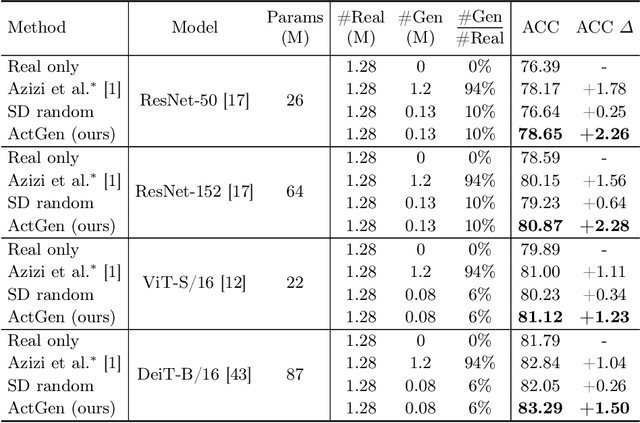
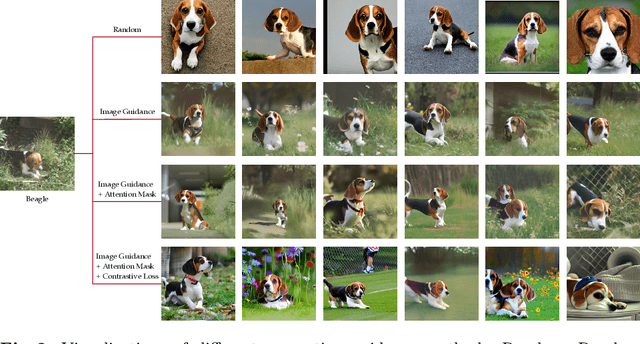
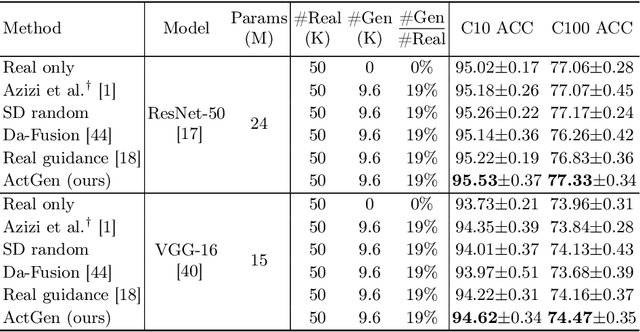
Recently, the growing capabilities of deep generative models have underscored their potential in enhancing image classification accuracy. However, existing methods often demand the generation of a disproportionately large number of images compared to the original dataset, while having only marginal improvements in accuracy. This computationally expensive and time-consuming process hampers the practicality of such approaches. In this paper, we propose to address the efficiency of image generation by focusing on the specific needs and characteristics of the model. With a central tenet of active learning, our method, named ActGen, takes a training-aware approach to image generation. It aims to create images akin to the challenging or misclassified samples encountered by the current model and incorporates these generated images into the training set to augment model performance. ActGen introduces an attentive image guidance technique, using real images as guides during the denoising process of a diffusion model. The model's attention on class prompt is leveraged to ensure the preservation of similar foreground object while diversifying the background. Furthermore, we introduce a gradient-based generation guidance method, which employs two losses to generate more challenging samples and prevent the generated images from being too similar to previously generated ones. Experimental results on the CIFAR and ImageNet datasets demonstrate that our method achieves better performance with a significantly reduced number of generated images.