 Add to Chrome
 Add to Firefox
 Add to Edge
Vision Superalignment: Weak-to-Strong Generalization for Vision Foundation Models
Feb 06, 2024
Recent advancements in large language models have sparked interest in their extraordinary and near-superhuman capabilities, leading researchers to explore methods for evaluating and optimizing these abilities, which is called superalignment. In this context, our paper delves into the realm of vision foundation models, focusing on the concept of weak-to-strong generalization, which involves using a weaker model to supervise a stronger one, aiming to enhance the latter's capabilities beyond the former's limits. We introduce a novel and adaptively adjustable loss function for weak-to-strong supervision. Our comprehensive experiments span various scenarios, including few-shot learning, transfer learning, noisy label learning, and common knowledge distillation settings. The results are striking: our approach not only exceeds the performance benchmarks set by strong-to-strong generalization but also surpasses the outcomes of fine-tuning strong models with whole datasets. This compelling evidence underscores the significant potential of weak-to-strong generalization, showcasing its capability to substantially elevate the performance of vision foundation models. The code is available at https://github.com/ggjy/vision_weak_to_strong.

Accelerated Cloud for Artificial Intelligence (ACAI)
Jan 30, 2024Training an effective Machine learning (ML) model is an iterative process that requires effort in multiple dimensions. Vertically, a single pipeline typically includes an initial ETL (Extract, Transform, Load) of raw datasets, a model training stage, and an evaluation stage where the practitioners obtain statistics of the model performance. Horizontally, many such pipelines may be required to find the best model within a search space of model configurations. Many practitioners resort to maintaining logs manually and writing simple glue code to automate the workflow. However, carrying out this process on the cloud is not a trivial task in terms of resource provisioning, data management, and bookkeeping of job histories to make sure the results are reproducible. We propose an end-to-end cloud-based machine learning platform, Accelerated Cloud for AI (ACAI), to help improve the productivity of ML practitioners. ACAI achieves this goal by enabling cloud-based storage of indexed, labeled, and searchable data, as well as automatic resource provisioning, job scheduling, and experiment tracking. Specifically, ACAI provides practitioners (1) a data lake for storing versioned datasets and their corresponding metadata, and (2) an execution engine for executing ML jobs on the cloud with automatic resource provisioning (auto-provision), logging and provenance tracking. To evaluate ACAI, we test the efficacy of our auto-provisioner on the MNIST handwritten digit classification task, and we study the usability of our system using experiments and interviews. We show that our auto-provisioner produces a 1.7x speed-up and 39% cost reduction, and our system reduces experiment time for ML scientists by 20% on typical ML use cases.
Visual Imitation Learning with Calibrated Contrastive Representation
Jan 21, 2024Adversarial Imitation Learning (AIL) allows the agent to reproduce expert behavior with low-dimensional states and actions. However, challenges arise in handling visual states due to their less distinguishable representation compared to low-dimensional proprioceptive features. While existing methods resort to adopt complex network architectures or separate the process of learning representation and decision-making, they overlook valuable intra-agent information within demonstrations. To address this problem, this paper proposes a simple and effective solution by incorporating calibrated contrastive representative learning into visual AIL framework. Specifically, we present an image encoder in visual AIL, utilizing a combination of unsupervised and supervised contrastive learning to extract valuable features from visual states. Based on the fact that the improved agent often produces demonstrations of varying quality, we propose to calibrate the contrastive loss by treating each agent demonstrations as a mixed sample. The incorporation of contrastive learning can be jointly optimized with the AIL framework, without modifying the architecture or incurring significant computational costs. Experimental results on DMControl Suite demonstrate our proposed method is sample efficient and can outperform other compared methods from different aspects.
Robust Tiny Object Detection in Aerial Images amidst Label Noise
Jan 16, 2024Precise detection of tiny objects in remote sensing imagery remains a significant challenge due to their limited visual information and frequent occurrence within scenes. This challenge is further exacerbated by the practical burden and inherent errors associated with manual annotation: annotating tiny objects is laborious and prone to errors (i.e., label noise). Training detectors for such objects using noisy labels often leads to suboptimal performance, with networks tending to overfit on noisy labels. In this study, we address the intricate issue of tiny object detection under noisy label supervision. We systematically investigate the impact of various types of noise on network training, revealing the vulnerability of object detectors to class shifts and inaccurate bounding boxes for tiny objects. To mitigate these challenges, we propose a DeNoising Tiny Object Detector (DN-TOD), which incorporates a Class-aware Label Correction (CLC) scheme to address class shifts and a Trend-guided Learning Strategy (TLS) to handle bounding box noise. CLC mitigates inaccurate class supervision by identifying and filtering out class-shifted positive samples, while TLS reduces noisy box-induced erroneous supervision through sample reweighting and bounding box regeneration. Additionally, Our method can be seamlessly integrated into both one-stage and two-stage object detection pipelines. Comprehensive experiments conducted on synthetic (i.e., noisy AI-TOD-v2.0 and DOTA-v2.0) and real-world (i.e., AI-TOD) noisy datasets demonstrate the robustness of DN-TOD under various types of label noise. Notably, when applied to the strong baseline RFLA, DN-TOD exhibits a noteworthy performance improvement of 4.9 points under 40% mixed noise. Datasets, codes, and models will be made publicly available.
Not All Steps are Equal: Efficient Generation with Progressive Diffusion Models
Jan 02, 2024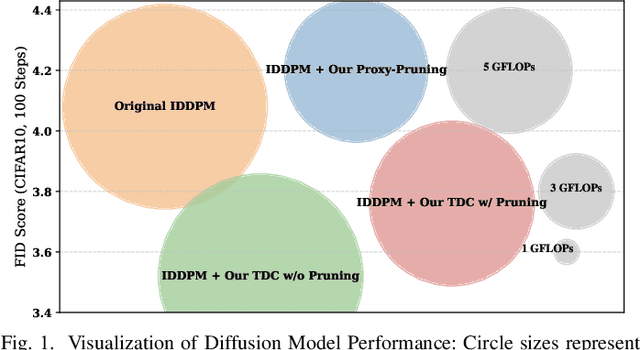
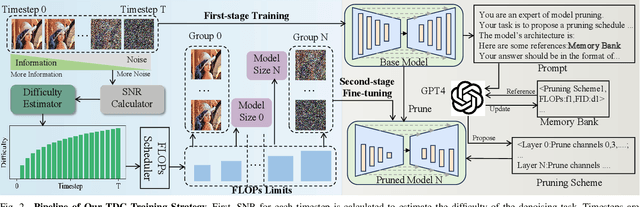
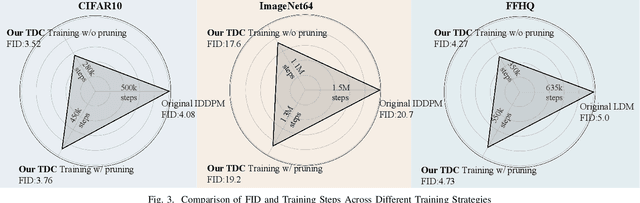
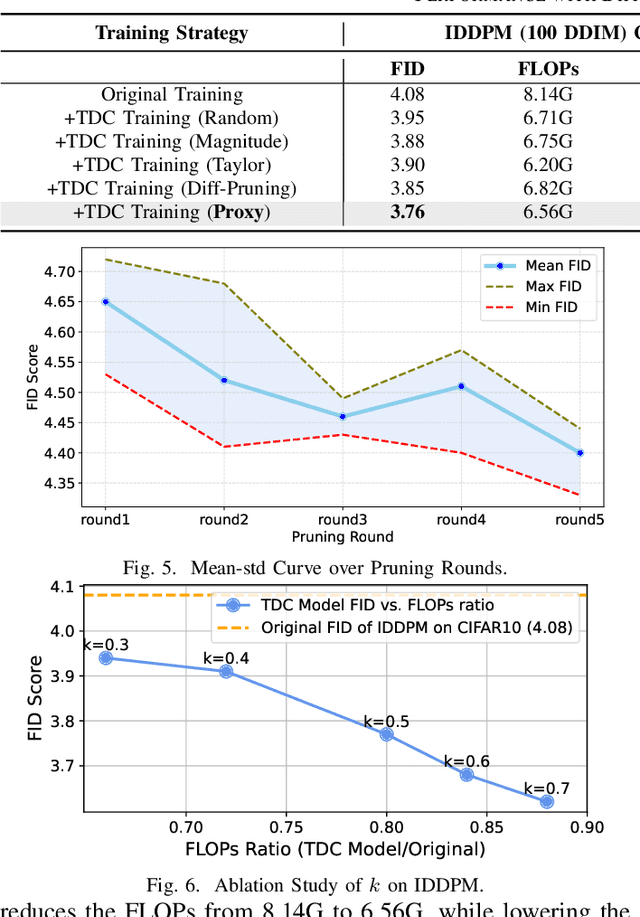
Diffusion models have demonstrated remarkable efficacy in various generative tasks with the predictive prowess of denoising model. Currently, these models employ a uniform denoising approach across all timesteps. However, the inherent variations in noisy latents at each timestep lead to conflicts during training, constraining the potential of diffusion models. To address this challenge, we propose a novel two-stage training strategy termed Step-Adaptive Training. In the initial stage, a base denoising model is trained to encompass all timesteps. Subsequently, we partition the timesteps into distinct groups, fine-tuning the model within each group to achieve specialized denoising capabilities. Recognizing that the difficulties of predicting noise at different timesteps vary, we introduce a diverse model size requirement. We dynamically adjust the model size for each timestep by estimating task difficulty based on its signal-to-noise ratio before fine-tuning. This adjustment is facilitated by a proxy-based structural importance assessment mechanism, enabling precise and efficient pruning of the base denoising model. Our experiments validate the effectiveness of the proposed training strategy, demonstrating an improvement in the FID score on CIFAR10 by over 0.3 while utilizing only 80\% of the computational resources. This innovative approach not only enhances model performance but also significantly reduces computational costs, opening new avenues for the development and application of diffusion models.
Detecting Any Human-Object Interaction Relationship: Universal HOI Detector with Spatial Prompt Learning on Foundation Models
Nov 07, 2023
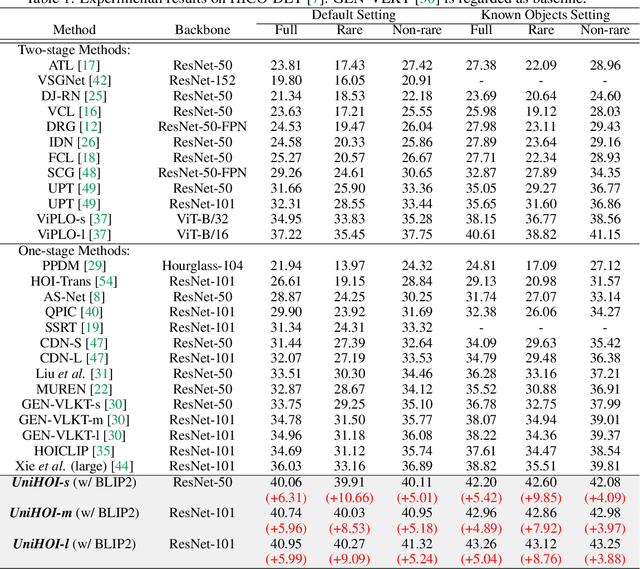
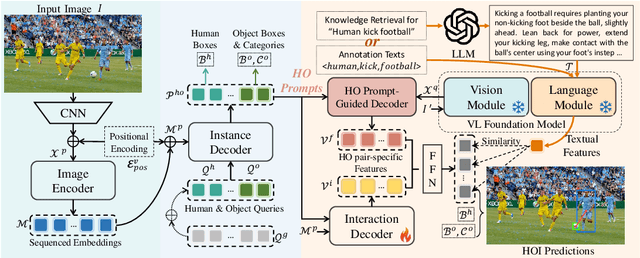
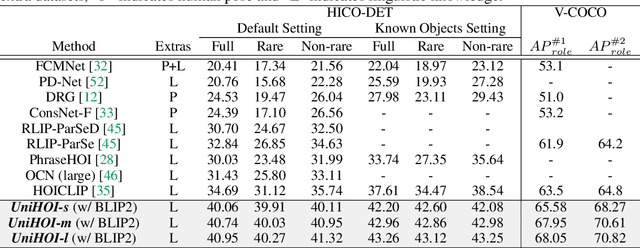
Human-object interaction (HOI) detection aims to comprehend the intricate relationships between humans and objects, predicting $<human, action, object>$ triplets, and serving as the foundation for numerous computer vision tasks. The complexity and diversity of human-object interactions in the real world, however, pose significant challenges for both annotation and recognition, particularly in recognizing interactions within an open world context. This study explores the universal interaction recognition in an open-world setting through the use of Vision-Language (VL) foundation models and large language models (LLMs). The proposed method is dubbed as \emph{\textbf{UniHOI}}. We conduct a deep analysis of the three hierarchical features inherent in visual HOI detectors and propose a method for high-level relation extraction aimed at VL foundation models, which we call HO prompt-based learning. Our design includes an HO Prompt-guided Decoder (HOPD), facilitates the association of high-level relation representations in the foundation model with various HO pairs within the image. Furthermore, we utilize a LLM (\emph{i.e.} GPT) for interaction interpretation, generating a richer linguistic understanding for complex HOIs. For open-category interaction recognition, our method supports either of two input types: interaction phrase or interpretive sentence. Our efficient architecture design and learning methods effectively unleash the potential of the VL foundation models and LLMs, allowing UniHOI to surpass all existing methods with a substantial margin, under both supervised and zero-shot settings. The code and pre-trained weights are available at: \url{https://github.com/Caoyichao/UniHOI}.
One-for-All: Bridge the Gap Between Heterogeneous Architectures in Knowledge Distillation
Oct 30, 2023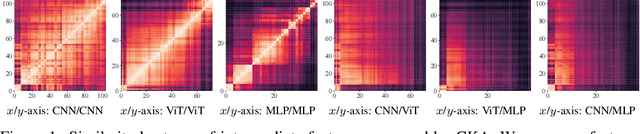
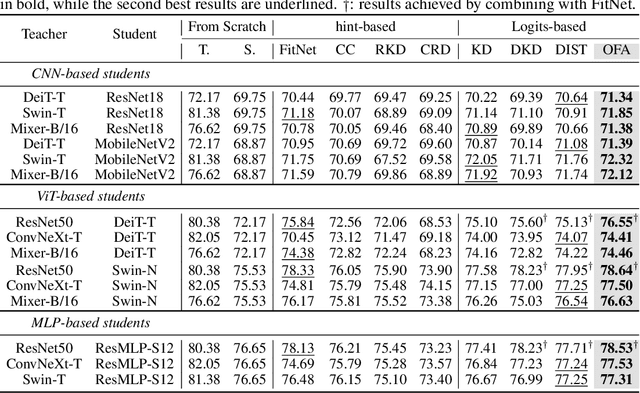
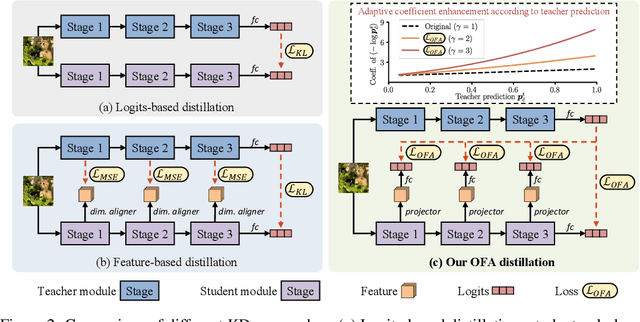
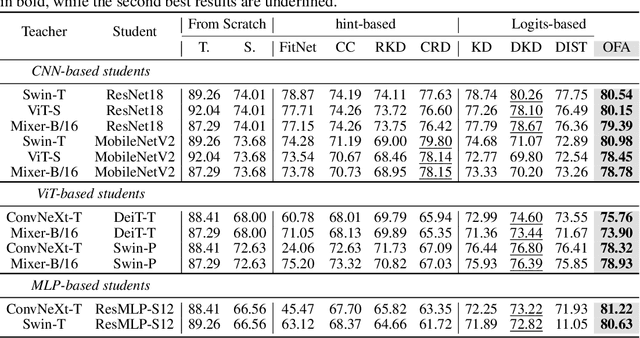
Knowledge distillation~(KD) has proven to be a highly effective approach for enhancing model performance through a teacher-student training scheme. However, most existing distillation methods are designed under the assumption that the teacher and student models belong to the same model family, particularly the hint-based approaches. By using centered kernel alignment (CKA) to compare the learned features between heterogeneous teacher and student models, we observe significant feature divergence. This divergence illustrates the ineffectiveness of previous hint-based methods in cross-architecture distillation. To tackle the challenge in distilling heterogeneous models, we propose a simple yet effective one-for-all KD framework called OFA-KD, which significantly improves the distillation performance between heterogeneous architectures. Specifically, we project intermediate features into an aligned latent space such as the logits space, where architecture-specific information is discarded. Additionally, we introduce an adaptive target enhancement scheme to prevent the student from being disturbed by irrelevant information. Extensive experiments with various architectures, including CNN, Transformer, and MLP, demonstrate the superiority of our OFA-KD framework in enabling distillation between heterogeneous architectures. Specifically, when equipped with our OFA-KD, the student models achieve notable performance improvements, with a maximum gain of 8.0% on the CIFAR-100 dataset and 0.7% on the ImageNet-1K dataset. PyTorch code and checkpoints can be found at https://github.com/Hao840/OFAKD.
Rethinking Scale Imbalance in Semi-supervised Object Detection for Aerial Images
Oct 23, 2023

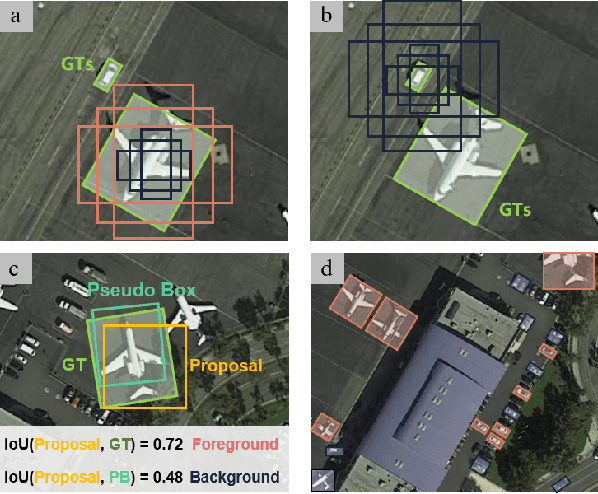
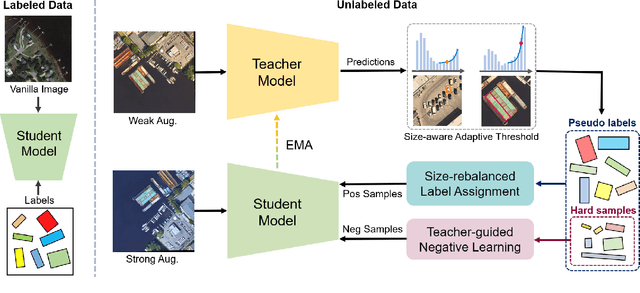
This paper focuses on the scale imbalance problem of semi-supervised object detection(SSOD) in aerial images. Compared to natural images, objects in aerial images show smaller sizes and larger quantities per image, increasing the difficulty of manual annotation. Meanwhile, the advanced SSOD technique can train superior detectors by leveraging limited labeled data and massive unlabeled data, saving annotation costs. However, as an understudied task in aerial images, SSOD suffers from a drastic performance drop when facing a large proportion of small objects. By analyzing the predictions between small and large objects, we identify three imbalance issues caused by the scale bias, i.e., pseudo-label imbalance, label assignment imbalance, and negative learning imbalance. To tackle these issues, we propose a novel Scale-discriminative Semi-Supervised Object Detection (S^3OD) learning pipeline for aerial images. In our S^3OD, three key components, Size-aware Adaptive Thresholding (SAT), Size-rebalanced Label Assignment (SLA), and Teacher-guided Negative Learning (TNL), are proposed to warrant scale unbiased learning. Specifically, SAT adaptively selects appropriate thresholds to filter pseudo-labels for objects at different scales. SLA balances positive samples of objects at different scales through resampling and reweighting. TNL alleviates the imbalance in negative samples by leveraging information generated by a teacher model. Extensive experiments conducted on the DOTA-v1.5 benchmark demonstrate the superiority of our proposed methods over state-of-the-art competitors. Codes will be released soon.
Imitation Learning from Purified Demonstration
Oct 11, 2023Imitation learning has emerged as a promising approach for addressing sequential decision-making problems, with the assumption that expert demonstrations are optimal. However, in real-world scenarios, expert demonstrations are often imperfect, leading to challenges in effectively applying imitation learning. While existing research has focused on optimizing with imperfect demonstrations, the training typically requires a certain proportion of optimal demonstrations to guarantee performance. To tackle these problems, we propose to purify the potential perturbations in imperfect demonstrations and subsequently conduct imitation learning from purified demonstrations. Motivated by the success of diffusion models, we introduce a two-step purification via the diffusion process. In the first step, we apply a forward diffusion process to effectively smooth out the potential perturbations in imperfect demonstrations by introducing additional noise. Subsequently, a reverse generative process is utilized to recover the optimal expert demonstrations from the diffused ones. We provide theoretical evidence supporting our approach, demonstrating that total variance distance between the purified and optimal demonstration distributions can be upper-bounded. The evaluation results on MuJoCo demonstrate the effectiveness of our method from different aspects.
DiffNAS: Bootstrapping Diffusion Models by Prompting for Better Architectures
Oct 10, 2023Diffusion models have recently exhibited remarkable performance on synthetic data. After a diffusion path is selected, a base model, such as UNet, operates as a denoising autoencoder, primarily predicting noises that need to be eliminated step by step. Consequently, it is crucial to employ a model that aligns with the expected budgets to facilitate superior synthetic performance. In this paper, we meticulously analyze the diffusion model and engineer a base model search approach, denoted "DiffNAS". Specifically, we leverage GPT-4 as a supernet to expedite the search, supplemented with a search memory to enhance the results. Moreover, we employ RFID as a proxy to promptly rank the experimental outcomes produced by GPT-4. We also adopt a rapid-convergence training strategy to boost search efficiency. Rigorous experimentation corroborates that our algorithm can augment the search efficiency by 2 times under GPT-based scenarios, while also attaining a performance of 2.82 with 0.37 improvement in FID on CIFAR10 relative to the benchmark IDDPM algorithm.