 Add to Chrome
 Add to Firefox
 Add to Edge
XPolicyLab: A Unified Standard and Open Ecosystem for Robot Policy Evaluation and Deployment
Aug 11, 2026
Robot policy evaluation and deployment remain fragmented by model-specific software dependencies, data representations, and runtime interfaces, so that connecting N policies to M evaluation environments requires O(NM) separate integrations. We present XPolicyLab, a unified standard and open ecosystem that reduces this cost to O(N+M). XPolicyLab specifies common observation, action, and trajectory schemas together with a minimal adapter interface for observation updates, action prediction, batched execution, and episode reset, while a dependency-isolated client/server architecture separates policy inference from environment execution, so that each side retains its native software stack and may run locally or remotely. The ecosystem integrates 42 robot policies and standardizes their installation, debugging, serving, and evaluation workflows. Across these adapters, model-specific code varies by an order of magnitude while the environment-facing loop stays within a few lines of a fixed reference, confirming that the contract confines heterogeneity to the policy side. In a controlled study, conforming to the standard reduces the integration effort of a representative policy from over five hours to two hours, and packaged agent skills reduce it further to thirty minutes. The same adapters serve RoboTwin, RoboDojo simulation, and standardized real-robot evaluation through one interface. XPolicyLab is released as shared infrastructure for reproducible policy comparison and standardized deployment across simulation and physical platforms. Project website: https://xpolicylab.github.io/.

TriPAH: Imbalance-Aware Tri-Prompt Affinity Hashing for Cross-Modal Medical Retrieval
Jun 25, 2026In the era of big medical data, efficient cross-modal retrieval is pivotal for evidence-based diagnosis and large-scale case management. Cross-modal medical hashing retrieval aims to enable efficient image-text search and support downstream tasks such as case-based reasoning and decision support by learning compact, semantically aligned binary codes. However, current methods suffer from semantic fragmentation due to noisy clinical language, long-tailed labels, and brittle quantization that weakens alignment. We propose TriPAH, a Tri-Prompt Affinity Hashing framework. TriPAH synthesizes ontology-grounded, patient-level prompts conditioned on normalized clinical cues to yield low-noise textual representations for initial alignment. A lightweight prompt-token mixer performs hierarchical, multi-granularity alignment and produces quantization-ready features under an asymmetric multi-task objective coupling multi-positive contrastive alignment, imbalance-aware classification, and progressive quantization regularization. A patient-level consistency module further stabilizes codes across complementary views. Extensive experiments on three public datasets demonstrate that TriPAH significantly outperforms state-of-the-art methods.
COAL: Counterfactual and Observation-Enhanced Alignment Learning for Discriminative Referring Multi-Object Tracking
May 14, 2026Referring Multi-Object Tracking (RMOT) faces a fundamental structural contradiction between the high-discriminability demand and the sparse semantic supervision. This mismatch is particularly acute in highly homogeneous scenarios that require fine-grained discrimination over complex compositional semantics. However, under sparse supervision, models overfit to salient yet insufficient cues, thereby encouraging shortcut learning and semantic collapse. To resolve this, we propose COAL (Counterfactual and Observation-enhanced Alignment Learning), a framework that advances RMOT beyond isolated structural optimization through knowledge regularization. First, we introduce Explicit Semantic Injection (ESI) via a VLM to densify the observation space and enhance instance discriminability. Second, leveraging LLM reasoning, we propose Counterfactual Learning (CFL) to augment supervision, enforcing strict attribute verification for robust compositional recognition. These strategies are unified within a Hierarchical Multi-Stream Integration (HMSI) architecture, which distills external knowledge into domain-specific discriminative representations. Experiments on Refer-KITTI and Refer-KITTI-V2 benchmarks validate COAL's efficacy. Notably, it surpasses the state-of-the-art by 7.28% HOTA on the highly challenging Refer-KITTI-V2. These results demonstrate the effectiveness of knowledge regularization for resolving the sparsity-discriminability paradox in RMOT.
FocusTrack: One-Stage Focus-and-Suppress Framework for 3D Point Cloud Object Tracking
Feb 27, 2026In 3D point cloud object tracking, the motion-centric methods have emerged as a promising avenue due to its superior performance in modeling inter-frame motion. However, existing two-stage motion-based approaches suffer from fundamental limitations: (1) error accumulation due to decoupled optimization caused by explicit foreground segmentation prior to motion estimation, and (2) computational bottlenecks from sequential processing. To address these challenges, we propose FocusTrack, a novel one-stage paradigms tracking framework that unifies motion-semantics co-modeling through two core innovations: Inter-frame Motion Modeling (IMM) and Focus-and-Suppress Attention. The IMM module employs a temp-oral-difference siamese encoder to capture global motion patterns between adjacent frames. The Focus-and-Suppress attention that enhance the foreground semantics via motion-salient feature gating and suppress the background noise based on the temporal-aware motion context from IMM without explicit segmentation. Based on above two designs, FocusTrack enables end-to-end training with compact one-stage pipeline. Extensive experiments on prominent 3D tracking benchmarks, such as KITTI, nuScenes, and Waymo, demonstrate that the FocusTrack achieves new SOTA performance while running at a high speed with 105 FPS.
CompTrack: Information Bottleneck-Guided Low-Rank Dynamic Token Compression for Point Cloud Tracking
Nov 19, 20253D single object tracking (SOT) in LiDAR point clouds is a critical task in computer vision and autonomous driving. Despite great success having been achieved, the inherent sparsity of point clouds introduces a dual-redundancy challenge that limits existing trackers: (1) vast spatial redundancy from background noise impairs accuracy, and (2) informational redundancy within the foreground hinders efficiency. To tackle these issues, we propose CompTrack, a novel end-to-end framework that systematically eliminates both forms of redundancy in point clouds. First, CompTrack incorporates a Spatial Foreground Predictor (SFP) module to filter out irrelevant background noise based on information entropy, addressing spatial redundancy. Subsequently, its core is an Information Bottleneck-guided Dynamic Token Compression (IB-DTC) module that eliminates the informational redundancy within the foreground. Theoretically grounded in low-rank approximation, this module leverages an online SVD analysis to adaptively compress the redundant foreground into a compact and highly informative set of proxy tokens. Extensive experiments on KITTI, nuScenes and Waymo datasets demonstrate that CompTrack achieves top-performing tracking performance with superior efficiency, running at a real-time 90 FPS on a single RTX 3090 GPU.
Multi-object Tracking by Detection and Query: an efficient end-to-end manner
Nov 09, 2024


Multi-object tracking is advancing through two dominant paradigms: traditional tracking by detection and newly emerging tracking by query. In this work, we fuse them together and propose the tracking-by-detection-and-query paradigm, which is achieved by a Learnable Associator. Specifically, the basic information interaction module and the content-position alignment module are proposed for thorough information Interaction among object queries. Tracking results are directly Decoded from these queries. Hence, we name the method as LAID. Compared to tracking-by-query models, LAID achieves competitive tracking accuracy with notably higher training efficiency. With regard to tracking-by-detection methods, experimental results on DanceTrack show that LAID significantly surpasses the state-of-the-art heuristic method by 3.9% on HOTA metric and 6.1% on IDF1 metric. On SportsMOT, LAID also achieves the best score on HOTA metric. By holding low training cost, strong tracking capabilities, and an elegant end-to-end approach all at once, LAID presents a forward-looking direction for the field.
Training-free Long Video Generation with Chain of Diffusion Model Experts
Aug 27, 2024Video generation models hold substantial potential in areas such as filmmaking. However, current video diffusion models need high computational costs and produce suboptimal results due to high complexity of video generation task. In this paper, we propose \textbf{ConFiner}, an efficient high-quality video generation framework that decouples video generation into easier subtasks: structure \textbf{con}trol and spatial-temporal re\textbf{fine}ment. It can generate high-quality videos with chain of off-the-shelf diffusion model experts, each expert responsible for a decoupled subtask. During the refinement, we introduce coordinated denoising, which can merge multiple diffusion experts' capabilities into a single sampling. Furthermore, we design ConFiner-Long framework, which can generate long coherent video with three constraint strategies on ConFiner. Experimental results indicate that with only 10\% of the inference cost, our ConFiner surpasses representative models like Lavie and Modelscope across all objective and subjective metrics. And ConFiner-Long can generate high-quality and coherent videos with up to 600 frames.
MAMCA -- Optimal on Accuracy and Efficiency for Automatic Modulation Classification with Extended Signal Length
May 18, 2024With the rapid growth of the Internet of Things ecosystem, Automatic Modulation Classification (AMC) has become increasingly paramount. However, extended signal lengths offer a bounty of information, yet impede the model's adaptability, introduce more noise interference, extend the training and inference time, and increase storage overhead. To bridge the gap between these requisites, we propose a novel AMC framework, designated as the Mamba-based Automatic Modulation ClassificAtion (MAMCA). Our method adeptly addresses the accuracy and efficiency requirements for long-sequence AMC. Specifically, we introduce the Selective State Space Model as the backbone, enhancing the model efficiency by reducing the dimensions of the state matrices and diminishing the frequency of information exchange across GPU memories. We design a denoising-capable unit to elevate the network's performance under low signal-to-noise radio. Rigorous experimental evaluations on the publicly available dataset RML2016.10, along with our synthetic dataset within multiple quadrature amplitude modulations and lengths, affirm that MAMCA delivers superior recognition accuracy while necessitating minimal computational time and memory occupancy. Codes are available on https://github.com/ZhangYezhuo/MAMCA.
Attributes Grouping and Mining Hashing for Fine-Grained Image Retrieval
Nov 10, 2023In recent years, hashing methods have been popular in the large-scale media search for low storage and strong representation capabilities. To describe objects with similar overall appearance but subtle differences, more and more studies focus on hashing-based fine-grained image retrieval. Existing hashing networks usually generate both local and global features through attention guidance on the same deep activation tensor, which limits the diversity of feature representations. To handle this limitation, we substitute convolutional descriptors for attention-guided features and propose an Attributes Grouping and Mining Hashing (AGMH), which groups and embeds the category-specific visual attributes in multiple descriptors to generate a comprehensive feature representation for efficient fine-grained image retrieval. Specifically, an Attention Dispersion Loss (ADL) is designed to force the descriptors to attend to various local regions and capture diverse subtle details. Moreover, we propose a Stepwise Interactive External Attention (SIEA) to mine critical attributes in each descriptor and construct correlations between fine-grained attributes and objects. The attention mechanism is dedicated to learning discrete attributes, which will not cost additional computations in hash codes generation. Finally, the compact binary codes are learned by preserving pairwise similarities. Experimental results demonstrate that AGMH consistently yields the best performance against state-of-the-art methods on fine-grained benchmark datasets.
Detecting Any Human-Object Interaction Relationship: Universal HOI Detector with Spatial Prompt Learning on Foundation Models
Nov 07, 2023
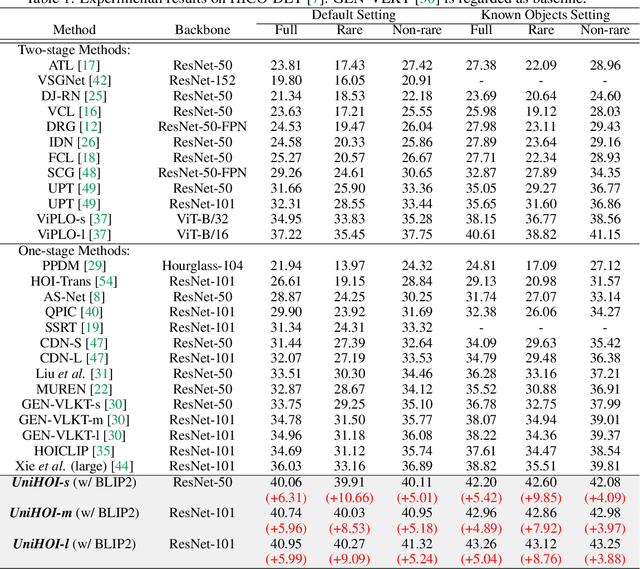
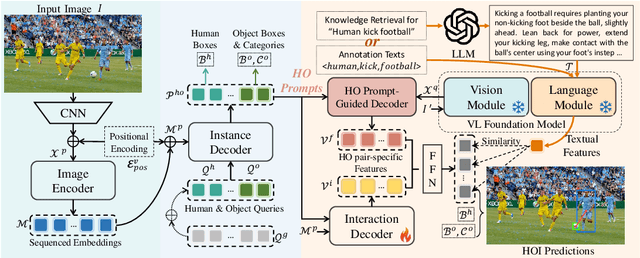
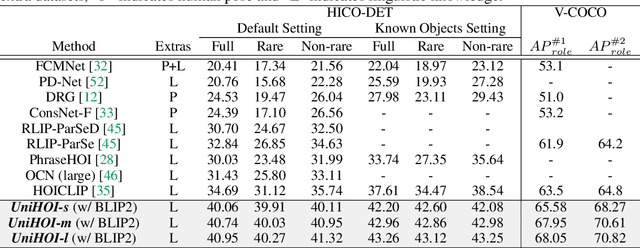
Human-object interaction (HOI) detection aims to comprehend the intricate relationships between humans and objects, predicting $<human, action, object>$ triplets, and serving as the foundation for numerous computer vision tasks. The complexity and diversity of human-object interactions in the real world, however, pose significant challenges for both annotation and recognition, particularly in recognizing interactions within an open world context. This study explores the universal interaction recognition in an open-world setting through the use of Vision-Language (VL) foundation models and large language models (LLMs). The proposed method is dubbed as \emph{\textbf{UniHOI}}. We conduct a deep analysis of the three hierarchical features inherent in visual HOI detectors and propose a method for high-level relation extraction aimed at VL foundation models, which we call HO prompt-based learning. Our design includes an HO Prompt-guided Decoder (HOPD), facilitates the association of high-level relation representations in the foundation model with various HO pairs within the image. Furthermore, we utilize a LLM (\emph{i.e.} GPT) for interaction interpretation, generating a richer linguistic understanding for complex HOIs. For open-category interaction recognition, our method supports either of two input types: interaction phrase or interpretive sentence. Our efficient architecture design and learning methods effectively unleash the potential of the VL foundation models and LLMs, allowing UniHOI to surpass all existing methods with a substantial margin, under both supervised and zero-shot settings. The code and pre-trained weights are available at: \url{https://github.com/Caoyichao/UniHOI}.