 Add to Chrome
 Add to Firefox
 Add to Edge
W2S-AlignTree: Weak-to-Strong Inference-Time Alignment for Large Language Models via Monte Carlo Tree Search
Nov 14, 2025

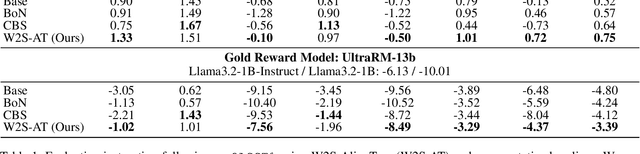
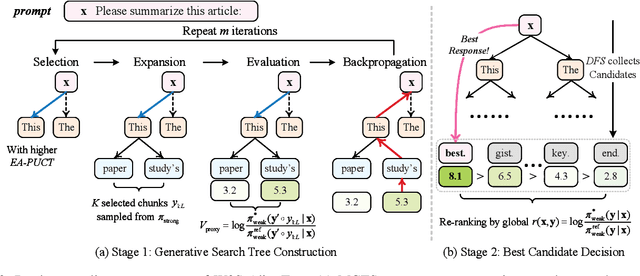
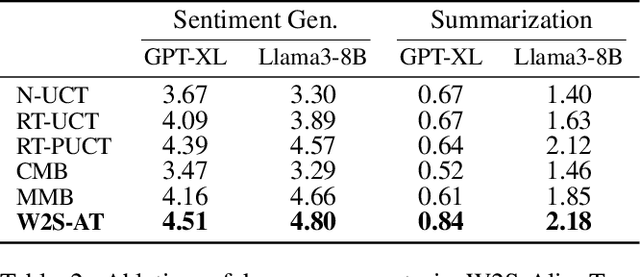
Large Language Models (LLMs) demonstrate impressive capabilities, yet their outputs often suffer from misalignment with human preferences due to the inadequacy of weak supervision and a lack of fine-grained control. Training-time alignment methods like Reinforcement Learning from Human Feedback (RLHF) face prohibitive costs in expert supervision and inherent scalability limitations, offering limited dynamic control during inference. Consequently, there is an urgent need for scalable and adaptable alignment mechanisms. To address this, we propose W2S-AlignTree, a pioneering plug-and-play inference-time alignment framework that synergistically combines Monte Carlo Tree Search (MCTS) with the Weak-to-Strong Generalization paradigm for the first time. W2S-AlignTree formulates LLM alignment as an optimal heuristic search problem within a generative search tree. By leveraging weak model's real-time, step-level signals as alignment proxies and introducing an Entropy-Aware exploration mechanism, W2S-AlignTree enables fine-grained guidance during strong model's generation without modifying its parameters. The approach dynamically balances exploration and exploitation in high-dimensional generation search trees. Experiments across controlled sentiment generation, summarization, and instruction-following show that W2S-AlignTree consistently outperforms strong baselines. Notably, W2S-AlignTree raises the performance of Llama3-8B from 1.89 to 2.19, a relative improvement of 15.9 on the summarization task.

Farseer: A Refined Scaling Law in Large Language Models
Jun 12, 2025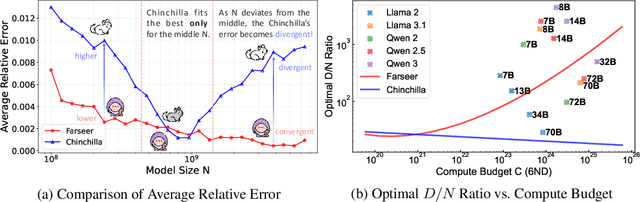
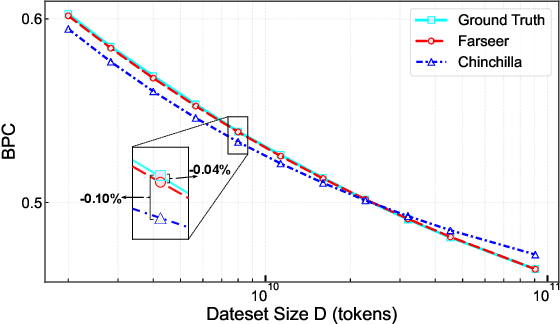

Training Large Language Models (LLMs) is prohibitively expensive, creating a critical scaling gap where insights from small-scale experiments often fail to transfer to resource-intensive production systems, thereby hindering efficient innovation. To bridge this, we introduce Farseer, a novel and refined scaling law offering enhanced predictive accuracy across scales. By systematically constructing a model loss surface $L(N,D)$, Farseer achieves a significantly better fit to empirical data than prior laws (e.g., Chinchilla's law). Our methodology yields accurate, robust, and highly generalizable predictions, demonstrating excellent extrapolation capabilities, improving upon Chinchilla's law by reducing extrapolation error by 433\%. This allows for the reliable evaluation of competing training strategies across all $(N,D)$ settings, enabling conclusions from small-scale ablation studies to be confidently extrapolated to predict large-scale performance. Furthermore, Farseer provides new insights into optimal compute allocation, better reflecting the nuanced demands of modern LLM training. To validate our approach, we trained an extensive suite of approximately 1,000 LLMs across diverse scales and configurations, consuming roughly 3 million NVIDIA H100 GPU hours. We are comprehensively open-sourcing all models, data, results, and logs at https://github.com/Farseer-Scaling-Law/Farseer to foster further research.