 Add to Chrome
 Add to Firefox
 Add to Edge
A Replay-Constrained Simulation Framework for Personalization of Powered Knee--Ankle Prosthesis Controllers
Jul 24, 2026
Personalization of impedance controllers for powered prosthetic legs is critical to accommodating individual gait biomechanics but remains challenging. Existing methods rely on time-intensive human-in-the-loop exploration and/or constrain optimization to low-dimensional, single-joint parameter subspaces. Sim-to-real transfer has enabled high-dimensional locomotion control for legged robots, but in assistive device control the human partner remains un-modelable. We present a replay-constrained simulation framework: a MuJoCo-based simulator reproduces prosthetic knee-ankle dynamics while replaying recorded hip kinematics and feedback-based ground reaction forces from individual walking data, bypassing the need to model complex human neuromuscular control mechanisms. We demonstrate the framework with a deep reinforcement learning policy that personalizes phase-dependent stiffness, damping, and equilibrium angle at both joints simultaneously, maximizing a biomimicry-based reward computed solely from onboard prosthesis measurements. Experiments with three participants with transfemoral amputation during level-ground walking at 0.8~m/s demonstrate strong simulation-to-hardware predictive validity (Pearson $r=0.96$--$0.997$). The best-performing policy on hardware was consistently predicted within the top five simulation policies for all participants. The learned controllers improved overall biomimicry rewards by 42--59\% relative to the unpersonalized baseline. The framework supports scalable high-dimensional personalization of powered prosthetic legs and is amenable to extension to higher-dimensional controller parameterizations such as neural-network controllers.

InteractiveAvatar: Real-Time Streaming Video Generation for Consistent and Intent-Aware Avatars
Jun 22, 2026Recent diffusion-based models have enabled realistic audio-driven avatar generation in real-time streaming. However, existing approaches struggle to maintain visual temporal consistency and fail to explicitly perceive user intent in complex interactive streaming scenarios. To address these challenges, we propose InteractiveAvatar, a real-time infinite-streaming video generation framework that supports visually consistent avatar video generation and intent-aware interactions. With autoregressive distillation, InteractiveAvatar achieves real-time str-eaming generation of human avatars over arbitrarily long durations. For visual consistency, we introduce a Long-Short Visual Memory (LSVM) mechanism that flexibly compresses historical visual information into compact tokens, preserving both short-range coherence and long-term consistency. To generate avatars with speeches and actions aligned with user intent, we propose a Reasoning-Reaction Module (RRM), which incorporates a State-Cycling strategy and a Cache-Switching mechanism. Extensive experimental results over diverse scenarios demonstrate that our method achieves state-of-the-art visual consistency in long-duration generation, while enabling complex user-avatar interaction in real time.
GeoMMBench and GeoMMAgent: Toward Expert-Level Multimodal Intelligence in Geoscience and Remote Sensing
Apr 10, 2026Recent advances in multimodal large language models (MLLMs) have accelerated progress in domain-oriented AI, yet their development in geoscience and remote sensing (RS) remains constrained by distinctive challenges: wide-ranging disciplinary knowledge, heterogeneous sensor modalities, and a fragmented spectrum of tasks. To bridge these gaps, we introduce GeoMMBench, a comprehensive multimodal question-answering benchmark covering diverse RS disciplines, sensors, and tasks, enabling broader and more rigorous evaluation than prior benchmarks. Using GeoMMBench, we assess 36 open-source and proprietary large language models, uncovering systematic deficiencies in domain knowledge, perceptual grounding, and reasoning--capabilities essential for expert-level geospatial interpretation. Beyond evaluation, we propose GeoMMAgent, a multi-agent framework that strategically integrates retrieval, perception, and reasoning through domain-specific RS models and tools. Extensive experimental results demonstrate that GeoMMAgent significantly outperforms standalone LLMs, underscoring the importance of tool-augmented agents for dynamically tackling complex geoscience and RS challenges.
OwlSight: A Robust Illumination Adaptation Framework for Dark Video Human Action Recognition
Mar 30, 2025Human action recognition in low-light environments is crucial for various real-world applications. However, the existing approaches overlook the full utilization of brightness information throughout the training phase, leading to suboptimal performance. To address this limitation, we propose OwlSight, a biomimetic-inspired framework with whole-stage illumination enhancement to interact with action classification for accurate dark video human action recognition. Specifically, OwlSight incorporates a Time-Consistency Module (TCM) to capture shallow spatiotemporal features meanwhile maintaining temporal coherence, which are then processed by a Luminance Adaptation Module (LAM) to dynamically adjust the brightness based on the input luminance distribution. Furthermore, a Reflect Augmentation Module (RAM) is presented to maximize illumination utilization and simultaneously enhance action recognition via two interactive paths. Additionally, we build Dark-101, a large-scale dataset comprising 18,310 dark videos across 101 action categories, significantly surpassing existing datasets (e.g., ARID1.5 and Dark-48) in scale and diversity. Extensive experiments demonstrate that the proposed OwlSight achieves state-of-the-art performance across four low-light action recognition benchmarks. Notably, it outperforms previous best approaches by 5.36% on ARID1.5 and 1.72% on Dark-101, highlighting its effectiveness in challenging dark environments.
Deep Convolutional Neural Network and Transfer Learning for Locomotion Intent Prediction
Sep 26, 2022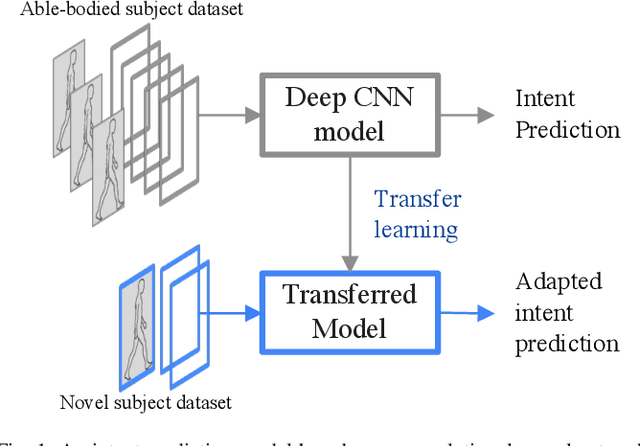
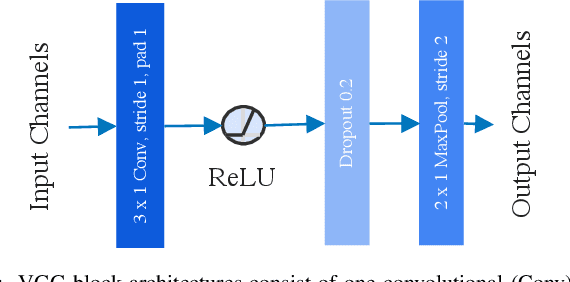
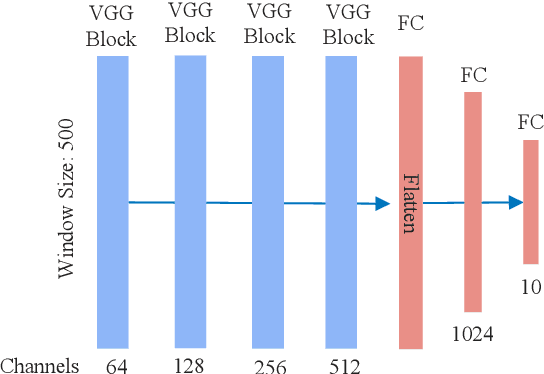
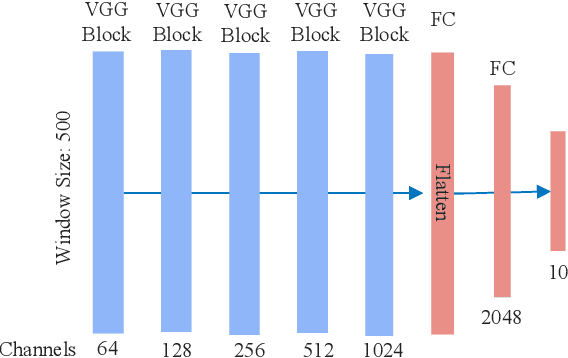
Powered prosthetic legs must anticipate the user's intent when switching between different locomotion modes (e.g., level walking, stair ascent/descent, ramp ascent/descent). Numerous data-driven classification techniques have demonstrated promising results for predicting user intent, but the performance of these intent prediction models on novel subjects remains undesirable. In other domains (e.g., image classification), transfer learning has improved classification accuracy by using previously learned features from a large dataset (i.e., pre-trained models) and then transferring this learned model to a new task where a smaller dataset is available. In this paper, we develop a deep convolutional neural network with intra-subject (subject-dependent) and inter-subject (subject-independent) validations based on a human locomotion dataset. We then apply transfer learning for the subject-independent model using a small portion (10%) of the data from the left-out subject. We compare the performance of these three models. Our results indicate that the transfer learning (TL) model outperforms the subject-independent (IND) model and is comparable to the subject-dependent (DEP) model (DEP Error: 0.74 $\pm$ 0.002%, IND Error: 11.59 $\pm$ 0.076%, TL Error: 3.57 $\pm$ 0.02% with 10% data). Moreover, as expected, transfer learning accuracy increases with the availability of more data from the left-out subject. We also evaluate the performance of the intent prediction system in various sensor configurations that may be available in a prosthetic leg application. Our results suggest that a thigh IMU on the the prosthesis is sufficient to predict locomotion intent in practice.