 Add to Chrome
 Add to Firefox
 Add to Edge
Seeing Through Deception: Uncovering Misleading Creator Intent in Multimodal News with Vision-Language Models
May 21, 2025
The real-world impact of misinformation stems from the underlying misleading narratives that creators seek to convey. As such, interpreting misleading creator intent is essential for multimodal misinformation detection (MMD) systems aimed at effective information governance. In this paper, we introduce an automated framework that simulates real-world multimodal news creation by explicitly modeling creator intent through two components: the desired influence and the execution plan. Using this framework, we construct DeceptionDecoded, a large-scale benchmark comprising 12,000 image-caption pairs aligned with trustworthy reference articles. The dataset captures both misleading and non-misleading intents and spans manipulations across visual and textual modalities. We conduct a comprehensive evaluation of 14 state-of-the-art vision-language models (VLMs) on three intent-centric tasks: (1) misleading intent detection, (2) misleading source attribution, and (3) creator desire inference. Despite recent advances, we observe that current VLMs fall short in recognizing misleading intent, often relying on spurious cues such as superficial cross-modal consistency, stylistic signals, and heuristic authenticity hints. Our findings highlight the pressing need for intent-aware modeling in MMD and open new directions for developing systems capable of deeper reasoning about multimodal misinformation.

GuardReasoner-VL: Safeguarding VLMs via Reinforced Reasoning
May 16, 2025To enhance the safety of VLMs, this paper introduces a novel reasoning-based VLM guard model dubbed GuardReasoner-VL. The core idea is to incentivize the guard model to deliberatively reason before making moderation decisions via online RL. First, we construct GuardReasoner-VLTrain, a reasoning corpus with 123K samples and 631K reasoning steps, spanning text, image, and text-image inputs. Then, based on it, we cold-start our model's reasoning ability via SFT. In addition, we further enhance reasoning regarding moderation through online RL. Concretely, to enhance diversity and difficulty of samples, we conduct rejection sampling followed by data augmentation via the proposed safety-aware data concatenation. Besides, we use a dynamic clipping parameter to encourage exploration in early stages and exploitation in later stages. To balance performance and token efficiency, we design a length-aware safety reward that integrates accuracy, format, and token cost. Extensive experiments demonstrate the superiority of our model. Remarkably, it surpasses the runner-up by 19.27% F1 score on average. We release data, code, and models (3B/7B) of GuardReasoner-VL at https://github.com/yueliu1999/GuardReasoner-VL/
Beyond 'Aha!': Toward Systematic Meta-Abilities Alignment in Large Reasoning Models
May 15, 2025Large reasoning models (LRMs) already possess a latent capacity for long chain-of-thought reasoning. Prior work has shown that outcome-based reinforcement learning (RL) can incidentally elicit advanced reasoning behaviors such as self-correction, backtracking, and verification phenomena often referred to as the model's "aha moment". However, the timing and consistency of these emergent behaviors remain unpredictable and uncontrollable, limiting the scalability and reliability of LRMs' reasoning capabilities. To address these limitations, we move beyond reliance on prompts and coincidental "aha moments". Instead, we explicitly align models with three meta-abilities: deduction, induction, and abduction, using automatically generated, self-verifiable tasks. Our three stage-pipeline individual alignment, parameter-space merging, and domain-specific reinforcement learning, boosting performance by over 10\% relative to instruction-tuned baselines. Furthermore, domain-specific RL from the aligned checkpoint yields an additional 2\% average gain in the performance ceiling across math, coding, and science benchmarks, demonstrating that explicit meta-ability alignment offers a scalable and dependable foundation for reasoning. Code is available at: https://github.com/zhiyuanhubj/Meta-Ability-Alignment
Guiding VLM Agents with Process Rewards at Inference Time for GUI Navigation
Apr 22, 2025Recent advancements in visual language models (VLMs) have notably enhanced their capabilities in handling complex Graphical User Interface (GUI) interaction tasks. Despite these improvements, current frameworks often struggle to generate correct actions in challenging GUI environments. State-of-the-art commercial VLMs are black-boxes, and fine-tuning open-source VLMs for GUI tasks requires significant resources. Additionally, existing trajectory-level evaluation and refinement techniques frequently fall short due to delayed feedback and local optimization issues. To address these challenges, we propose an approach that guides VLM agents with process supervision by a reward model during GUI navigation and control at inference time. This guidance allows the VLM agent to optimize actions at each inference step, thereby improving performance in both static and dynamic environments. In particular, our method demonstrates significant performance gains in three GUI navigation tasks, achieving a 3.4% improvement in single step action accuracy for static environments, along with a around 33% increase in task success rate in one dynamic environment. With further integration of trajectory reflection and retry mechanisms, we also demonstrate even greater enhancement in task success.
FlowReasoner: Reinforcing Query-Level Meta-Agents
Apr 21, 2025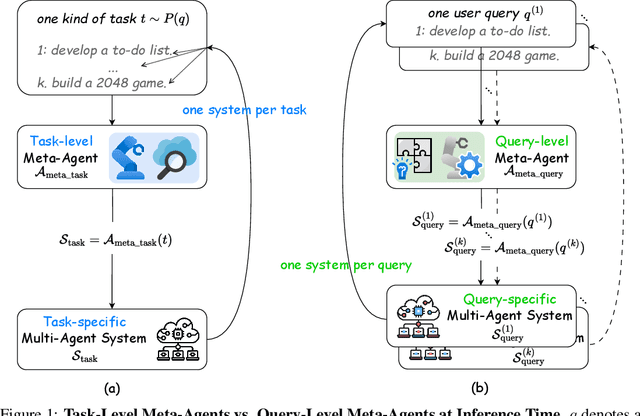
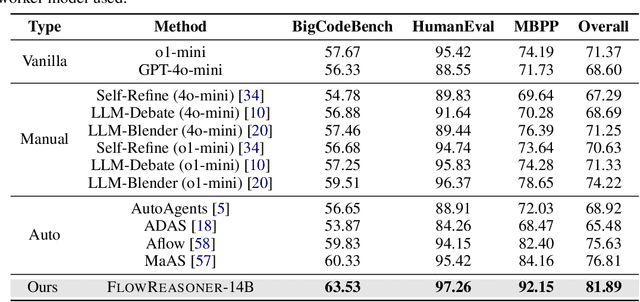
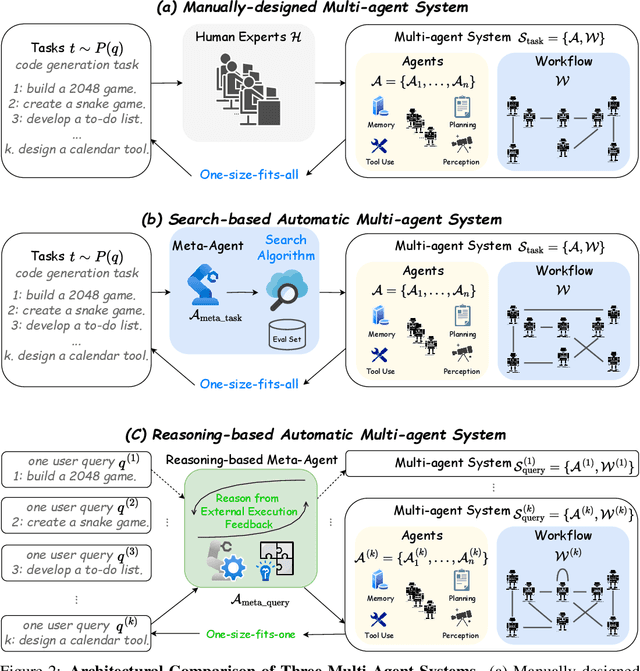
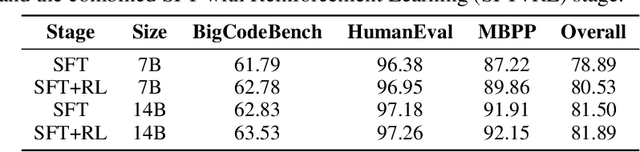
This paper proposes a query-level meta-agent named FlowReasoner to automate the design of query-level multi-agent systems, i.e., one system per user query. Our core idea is to incentivize a reasoning-based meta-agent via external execution feedback. Concretely, by distilling DeepSeek R1, we first endow the basic reasoning ability regarding the generation of multi-agent systems to FlowReasoner. Then, we further enhance it via reinforcement learning (RL) with external execution feedback. A multi-purpose reward is designed to guide the RL training from aspects of performance, complexity, and efficiency. In this manner, FlowReasoner is enabled to generate a personalized multi-agent system for each user query via deliberative reasoning. Experiments on both engineering and competition code benchmarks demonstrate the superiority of FlowReasoner. Remarkably, it surpasses o1-mini by 10.52% accuracy across three benchmarks. The code is available at https://github.com/sail-sg/FlowReasoner.
Geneshift: Impact of different scenario shift on Jailbreaking LLM
Apr 10, 2025Jailbreak attacks, which aim to cause LLMs to perform unrestricted behaviors, have become a critical and challenging direction in AI safety. Despite achieving the promising attack success rate using dictionary-based evaluation, existing jailbreak attack methods fail to output detailed contents to satisfy the harmful request, leading to poor performance on GPT-based evaluation. To this end, we propose a black-box jailbreak attack termed GeneShift, by using a genetic algorithm to optimize the scenario shifts. Firstly, we observe that the malicious queries perform optimally under different scenario shifts. Based on it, we develop a genetic algorithm to evolve and select the hybrid of scenario shifts. It guides our method to elicit detailed and actionable harmful responses while keeping the seemingly benign facade, improving stealthiness. Extensive experiments demonstrate the superiority of GeneShift. Notably, GeneShift increases the jailbreak success rate from 0% to 60% when direct prompting alone would fail.
Text Speaks Louder than Vision: ASCII Art Reveals Textual Biases in Vision-Language Models
Apr 02, 2025Vision-language models (VLMs) have advanced rapidly in processing multimodal information, but their ability to reconcile conflicting signals across modalities remains underexplored. This work investigates how VLMs process ASCII art, a unique medium where textual elements collectively form visual patterns, potentially creating semantic-visual conflicts. We introduce a novel evaluation framework that systematically challenges five state-of-the-art models (including GPT-4o, Claude, and Gemini) using adversarial ASCII art, where character-level semantics deliberately contradict global visual patterns. Our experiments reveal a strong text-priority bias: VLMs consistently prioritize textual information over visual patterns, with visual recognition ability declining dramatically as semantic complexity increases. Various mitigation attempts through visual parameter tuning and prompt engineering yielded only modest improvements, suggesting that this limitation requires architectural-level solutions. These findings uncover fundamental flaws in how current VLMs integrate multimodal information, providing important guidance for future model development while highlighting significant implications for content moderation systems vulnerable to adversarial examples.
How does Watermarking Affect Visual Language Models in Document Understanding?
Apr 01, 2025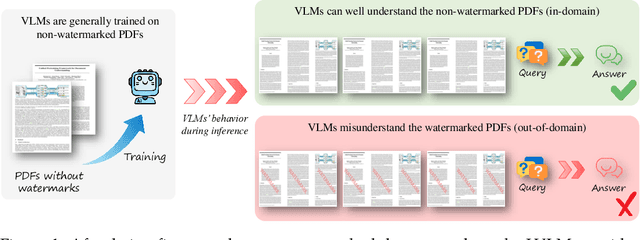
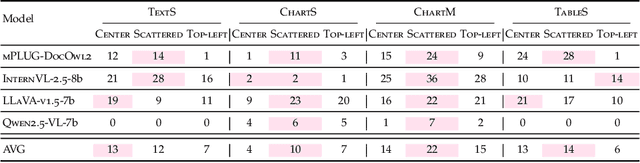
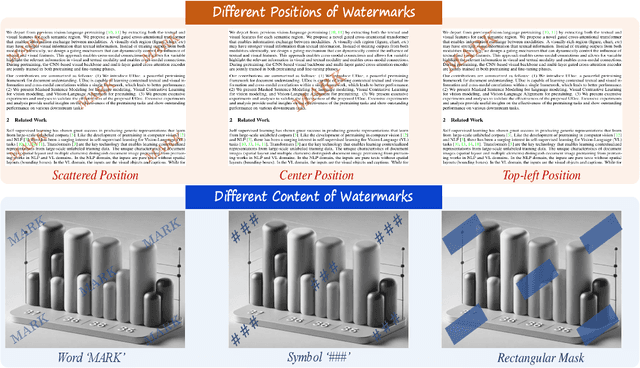
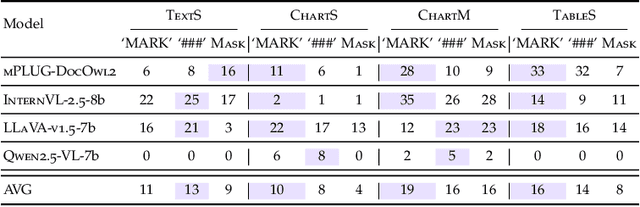
Visual Language Models (VLMs) have become foundational models for document understanding tasks, widely used in the processing of complex multimodal documents across domains such as finance, law, and academia. However, documents often contain noise-like information, such as watermarks, which inevitably leads us to inquire: \emph{Do watermarks degrade the performance of VLMs in document understanding?} To address this, we propose a novel evaluation framework to investigate the effect of visible watermarks on VLMs performance. We takes into account various factors, including different types of document data, the positions of watermarks within documents and variations in watermark content. Our experimental results reveal that VLMs performance can be significantly compromised by watermarks, with performance drop rates reaching up to 36\%. We discover that \emph{scattered} watermarks cause stronger interference than centralized ones, and that \emph{semantic contents} in watermarks creates greater disruption than simple visual occlusion. Through attention mechanism analysis and embedding similarity examination, we find that the performance drops are mainly attributed to that watermarks 1) force widespread attention redistribution, and 2) alter semantic representation in the embedding space. Our research not only highlights significant challenges in deploying VLMs for document understanding, but also provides insights towards developing robust inference mechanisms on watermarked documents.
JudgeLRM: Large Reasoning Models as a Judge
Mar 31, 2025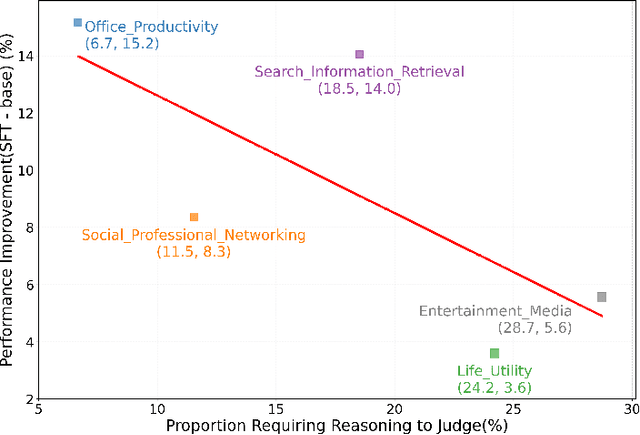
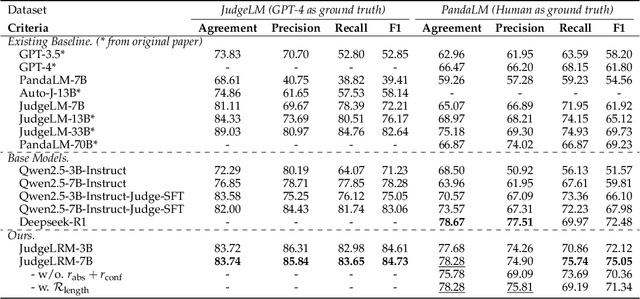
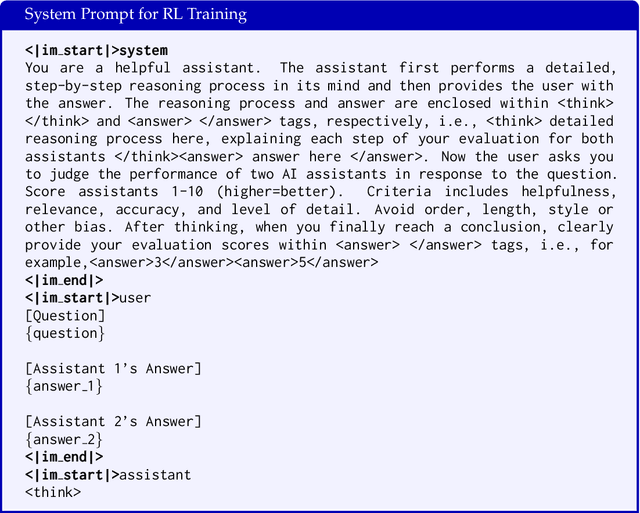
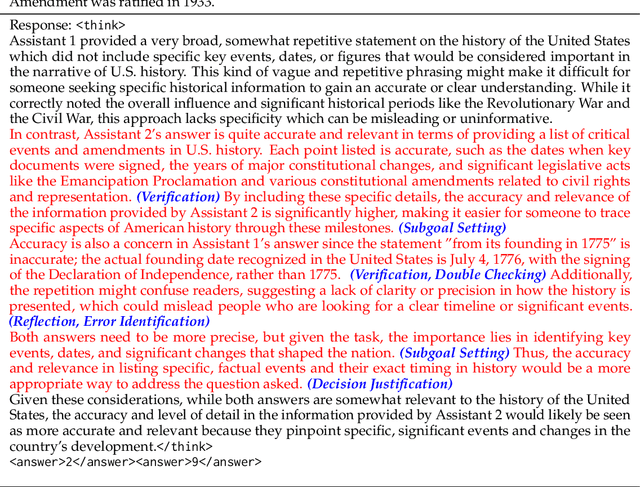
The rise of Large Language Models (LLMs) as evaluators offers a scalable alternative to human annotation, yet existing Supervised Fine-Tuning (SFT) for judges approaches often fall short in domains requiring complex reasoning. In this work, we investigate whether LLM judges truly benefit from enhanced reasoning capabilities. Through a detailed analysis of reasoning requirements across evaluation tasks, we reveal a negative correlation between SFT performance gains and the proportion of reasoning-demanding samples - highlighting the limitations of SFT in such scenarios. To address this, we introduce JudgeLRM, a family of judgment-oriented LLMs trained using reinforcement learning (RL) with judge-wise, outcome-driven rewards. JudgeLRM models consistently outperform both SFT-tuned and state-of-the-art reasoning models. Notably, JudgeLRM-3B surpasses GPT-4, and JudgeLRM-7B outperforms DeepSeek-R1 by 2.79% in F1 score, particularly excelling in judge tasks requiring deep reasoning.
Efficient Inference for Large Reasoning Models: A Survey
Mar 29, 2025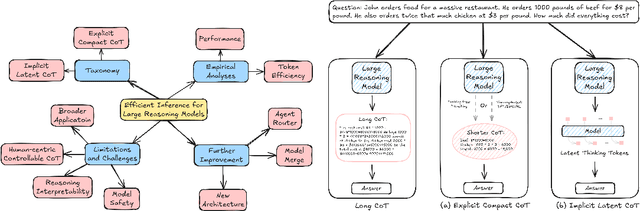
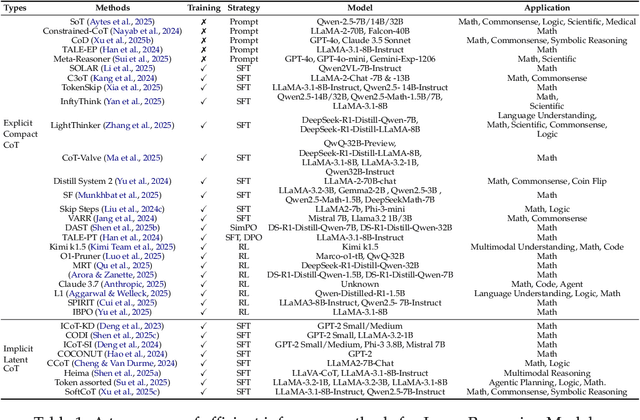
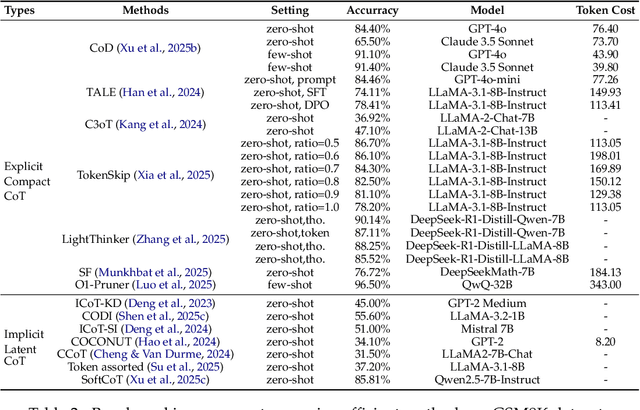
Large Reasoning Models (LRMs) significantly improve the reasoning ability of Large Language Models (LLMs) by learning to reason, exhibiting promising performance in complex task-solving. However, their deliberative reasoning process leads to inefficiencies in token usage, memory consumption, and inference time. Thus, this survey provides a review of efficient inference methods designed specifically for LRMs, focusing on mitigating token inefficiency while preserving the reasoning quality. First, we introduce a taxonomy to group the recent methods into two main categories: (a) explicit compact Chain-of-Thought (CoT), which reduces tokens while keeping the explicit reasoning structure, and (b) implicit latent CoT, which encodes reasoning steps within hidden representations instead of explicit tokens. Meanwhile, we discuss their strengths and weaknesses. Then, we conduct empirical analyses on existing methods from performance and efficiency aspects. Besides, we present open challenges in this field, including human-centric controllable reasoning, trade-off between interpretability and efficiency of reasoning, ensuring safety of efficient reasoning, and broader applications of efficient reasoning. In addition, we highlight key insights for enhancing LRMs' inference efficiency via techniques such as model merging, new architectures, and agent routers. We hope this work serves as a valuable guide, helping researchers overcome challenges in this vibrant field\footnote{https://github.com/yueliu1999/Awesome-Efficient-Inference-for-LRMs}.