 Add to Chrome
 Add to Firefox
 Add to Edge
Enhancing CVRP Solver through LLM-driven Automatic Heuristic Design
Feb 26, 2026
The Capacitated Vehicle Routing Problem (CVRP), a fundamental combinatorial optimization challenge, focuses on optimizing fleet operations under vehicle capacity constraints. While extensively studied in operational research, the NP-hard nature of CVRP continues to pose significant computational challenges, particularly for large-scale instances. This study presents AILS-AHD (Adaptive Iterated Local Search with Automatic Heuristic Design), a novel approach that leverages Large Language Models (LLMs) to revolutionize CVRP solving. Our methodology integrates an evolutionary search framework with LLMs to dynamically generate and optimize ruin heuristics within the AILS method. Additionally, we introduce an LLM-based acceleration mechanism to enhance computational efficiency. Comprehensive experimental evaluations against state-of-the-art solvers, including AILS-II and HGS, demonstrate the superior performance of AILS-AHD across both moderate and large-scale instances. Notably, our approach establishes new best-known solutions for 8 out of 10 instances in the CVRPLib large-scale benchmark, underscoring the potential of LLM-driven heuristic design in advancing the field of vehicle routing optimization.

Monte Carlo Tree Search for Comprehensive Exploration in LLM-Based Automatic Heuristic Design
Jan 16, 2025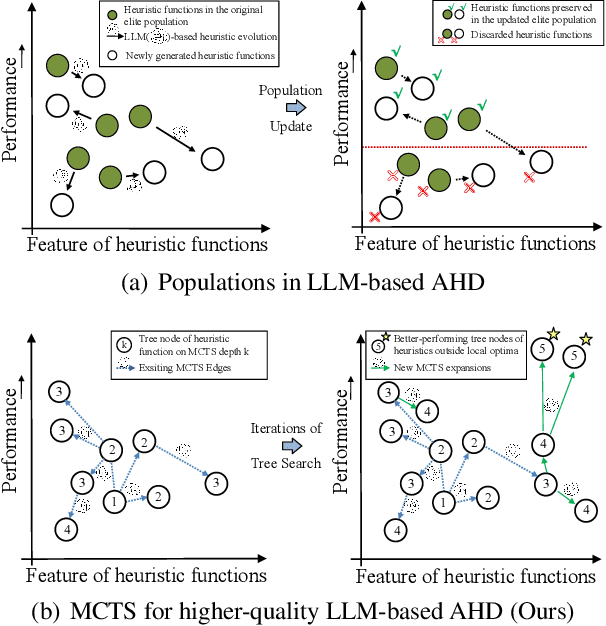
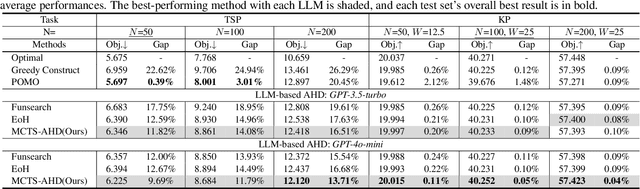
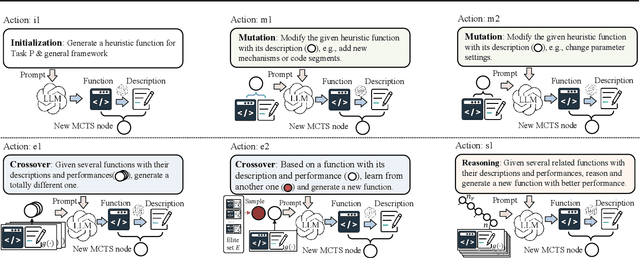
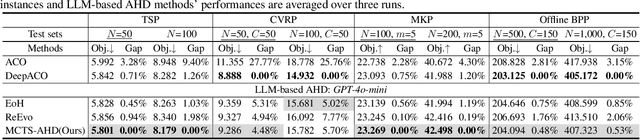
Handcrafting heuristics for solving complex planning tasks (e.g., NP-hard combinatorial optimization (CO) problems) is a common practice but requires extensive domain knowledge. Recently, Large Language Model (LLM)-based automatic heuristics design (AHD) methods have shown promise in generating high-quality heuristics without manual intervention. Existing LLM-based AHD methods employ a population to maintain a fixed number of top-performing LLM-generated heuristics and introduce evolutionary computation (EC) to enhance the population iteratively. However, the population-based procedure brings greedy properties, often resulting in convergence to local optima. Instead, to more comprehensively explore the space of heuristics, we propose using Monte Carlo Tree Search (MCTS) for LLM-based heuristic evolution while preserving all LLM-generated heuristics in a tree structure. With a novel thought-alignment process and an exploration-decay technique, the proposed MCTS-AHD method delivers significantly higher-quality heuristics on various complex tasks. Our code is available at https://github.com/zz1358m/MCTS-AHD-master.
LLM4AD: A Platform for Algorithm Design with Large Language Model
Dec 23, 2024

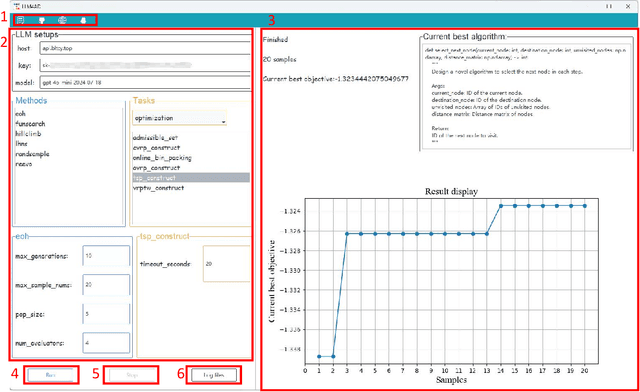
We introduce LLM4AD, a unified Python platform for algorithm design (AD) with large language models (LLMs). LLM4AD is a generic framework with modularized blocks for search methods, algorithm design tasks, and LLM interface. The platform integrates numerous key methods and supports a wide range of algorithm design tasks across various domains including optimization, machine learning, and scientific discovery. We have also designed a unified evaluation sandbox to ensure a secure and robust assessment of algorithms. Additionally, we have compiled a comprehensive suite of support resources, including tutorials, examples, a user manual, online resources, and a dedicated graphical user interface (GUI) to enhance the usage of LLM4AD. We believe this platform will serve as a valuable tool for fostering future development in the merging research direction of LLM-assisted algorithm design.