 Add to Chrome
 Add to Firefox
 Add to Edge
Re-ViLM: Retrieval-Augmented Visual Language Model for Zero and Few-Shot Image Captioning
Feb 09, 2023
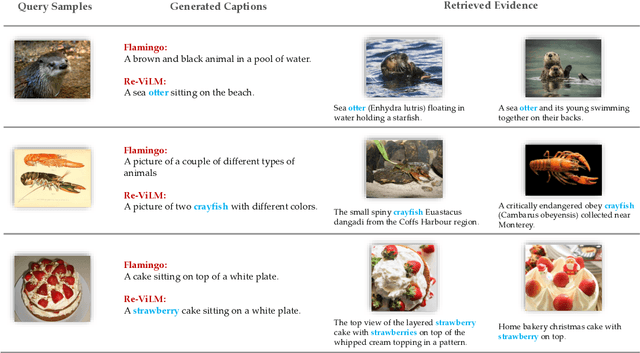
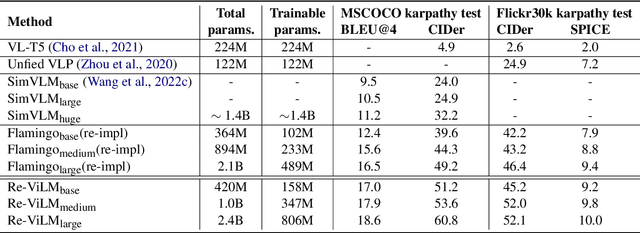
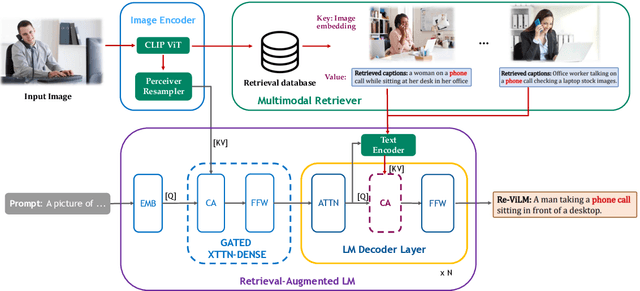
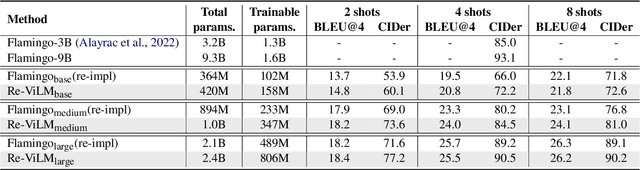
Augmenting pretrained language models (LMs) with a vision encoder (e.g., Flamingo) has obtained state-of-the-art results in image-to-text generation. However, these models store all the knowledge within their parameters, thus often requiring enormous model parameters to model the abundant visual concepts and very rich textual descriptions. Additionally, they are inefficient in incorporating new data, requiring a computational-expensive fine-tuning process. In this work, we introduce a Retrieval-augmented Visual Language Model, Re-ViLM, built upon the Flamingo, that supports retrieving the relevant knowledge from the external database for zero and in-context few-shot image-to-text generations. By storing certain knowledge explicitly in the external database, our approach reduces the number of model parameters and can easily accommodate new data during evaluation by simply updating the database. We also construct an interleaved image and text data that facilitates in-context few-shot learning capabilities. We demonstrate that Re-ViLM significantly boosts performance for image-to-text generation tasks, especially for zero-shot and few-shot generation in out-of-domain settings with 4 times less parameters compared with baseline methods.

Interpolation for Robust Learning: Data Augmentation on Geodesics
Feb 07, 2023We propose to study and promote the robustness of a model as per its performance through the interpolation of training data distributions. Specifically, (1) we augment the data by finding the worst-case Wasserstein barycenter on the geodesic connecting subpopulation distributions of different categories. (2) We regularize the model for smoother performance on the continuous geodesic path connecting subpopulation distributions. (3) Additionally, we provide a theoretical guarantee of robustness improvement and investigate how the geodesic location and the sample size contribute, respectively. Experimental validations of the proposed strategy on four datasets, including CIFAR-100 and ImageNet, establish the efficacy of our method, e.g., our method improves the baselines' certifiable robustness on CIFAR10 up to $7.7\%$, with $16.8\%$ on empirical robustness on CIFAR-100. Our work provides a new perspective of model robustness through the lens of Wasserstein geodesic-based interpolation with a practical off-the-shelf strategy that can be combined with existing robust training methods.
Efficient Domain Adaptation for Speech Foundation Models
Feb 03, 2023Foundation models (FMs), that are trained on broad data at scale and are adaptable to a wide range of downstream tasks, have brought large interest in the research community. Benefiting from the diverse data sources such as different modalities, languages and application domains, foundation models have demonstrated strong generalization and knowledge transfer capabilities. In this paper, we present a pioneering study towards building an efficient solution for FM-based speech recognition systems. We adopt the recently developed self-supervised BEST-RQ for pretraining, and propose the joint finetuning with both source and unsupervised target domain data using JUST Hydra. The FM encoder adapter and decoder are then finetuned to the target domain with a small amount of supervised in-domain data. On a large-scale YouTube and Voice Search task, our method is shown to be both data and model parameter efficient. It achieves the same quality with only 21.6M supervised in-domain data and 130.8M finetuned parameters, compared to the 731.1M model trained from scratch on additional 300M supervised in-domain data.
Defensive ML: Defending Architectural Side-channels with Adversarial Obfuscation
Feb 03, 2023Side-channel attacks that use machine learning (ML) for signal analysis have become prominent threats to computer security, as ML models easily find patterns in signals. To address this problem, this paper explores using Adversarial Machine Learning (AML) methods as a defense at the computer architecture layer to obfuscate side channels. We call this approach Defensive ML, and the generator to obfuscate signals, defender. Defensive ML is a workflow to design, implement, train, and deploy defenders for different environments. First, we design a defender architecture given the physical characteristics and hardware constraints of the side-channel. Next, we use our DefenderGAN structure to train the defender. Finally, we apply defensive ML to thwart two side-channel attacks: one based on memory contention and the other on application power. The former uses a hardware defender with ns-level response time that attains a high level of security with half the performance impact of a traditional scheme; the latter uses a software defender with ms-level response time that provides better security than a traditional scheme with only 70% of its power overhead.
Automatic Intrinsic Reward Shaping for Exploration in Deep Reinforcement Learning
Jan 26, 2023We present AIRS: Automatic Intrinsic Reward Shaping that intelligently and adaptively provides high-quality intrinsic rewards to enhance exploration in reinforcement learning (RL). More specifically, AIRS selects shaping function from a predefined set based on the estimated task return in real-time, providing reliable exploration incentives and alleviating the biased objective problem. Moreover, we develop an intrinsic reward toolkit to provide efficient and reliable implementations of diverse intrinsic reward approaches. We test AIRS on various tasks of Procgen games and DeepMind Control Suite. Extensive simulation demonstrates that AIRS can outperform the benchmarking schemes and achieve superior performance with simple architecture.
From English to More Languages: Parameter-Efficient Model Reprogramming for Cross-Lingual Speech Recognition
Jan 19, 2023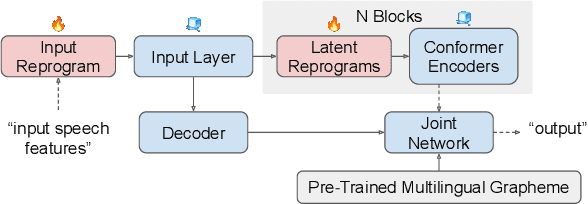
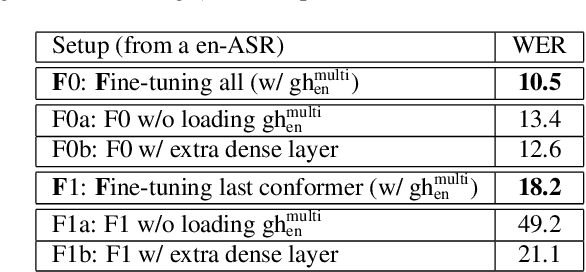
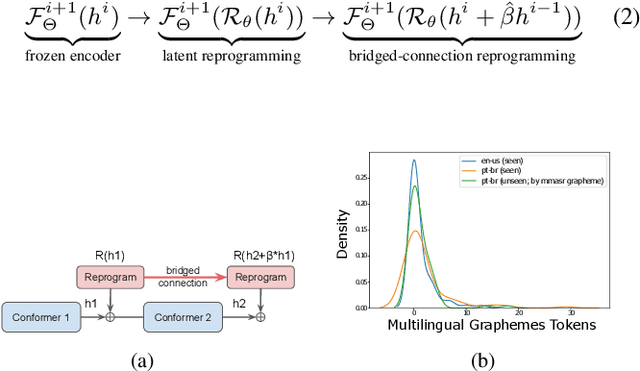
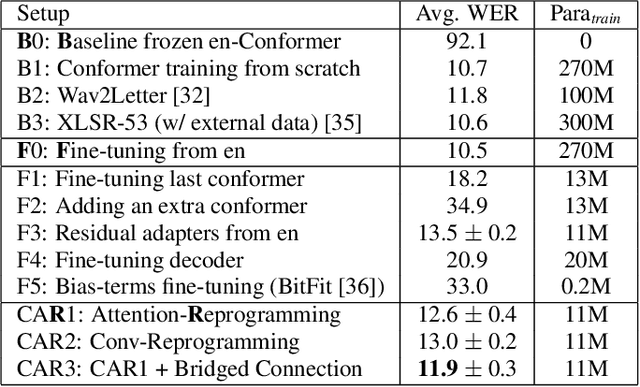
In this work, we propose a new parameter-efficient learning framework based on neural model reprogramming for cross-lingual speech recognition, which can \textbf{re-purpose} well-trained English automatic speech recognition (ASR) models to recognize the other languages. We design different auxiliary neural architectures focusing on learnable pre-trained feature enhancement that, for the first time, empowers model reprogramming on ASR. Specifically, we investigate how to select trainable components (i.e., encoder) of a conformer-based RNN-Transducer, as a frozen pre-trained backbone. Experiments on a seven-language multilingual LibriSpeech speech (MLS) task show that model reprogramming only requires 4.2% (11M out of 270M) to 6.8% (45M out of 660M) of its original trainable parameters from a full ASR model to perform competitive results in a range of 11.9% to 8.1% WER averaged across different languages. In addition, we discover different setups to make large-scale pre-trained ASR succeed in both monolingual and multilingual speech recognition. Our methods outperform existing ASR tuning architectures and their extension with self-supervised losses (e.g., w2v-bert) in terms of lower WER and better training efficiency.
Proportional Fairness in Obnoxious Facility Location
Jan 11, 2023We consider the obnoxious facility location problem (in which agents prefer the facility location to be far from them) and propose a hierarchy of distance-based proportional fairness concepts for the problem. These fairness axioms ensure that groups of agents at the same location are guaranteed to be a distance from the facility proportional to their group size. We consider deterministic and randomized mechanisms, and compute tight bounds on the price of proportional fairness. In the deterministic setting, not only are our proportional fairness axioms incompatible with strategyproofness, the Nash equilibria may not guarantee welfare within a constant factor of the optimal welfare. On the other hand, in the randomized setting, we identify proportionally fair and strategyproof mechanisms that give an expected welfare within a constant factor of the optimal welfare.
Sequence Generation with Label Augmentation for Relation Extraction
Dec 29, 2022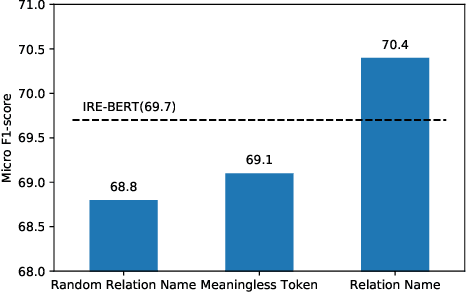

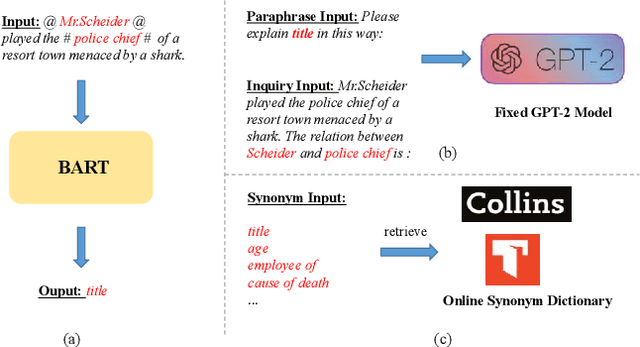
Sequence generation demonstrates promising performance in recent information extraction efforts, by incorporating large-scale pre-trained Seq2Seq models. This paper investigates the merits of employing sequence generation in relation extraction, finding that with relation names or synonyms as generation targets, their textual semantics and the correlation (in terms of word sequence pattern) among them affect model performance. We then propose Relation Extraction with Label Augmentation (RELA), a Seq2Seq model with automatic label augmentation for RE. By saying label augmentation, we mean prod semantically synonyms for each relation name as the generation target. Besides, we present an in-depth analysis of the Seq2Seq model's behavior when dealing with RE. Experimental results show that RELA achieves competitive results compared with previous methods on four RE datasets.
Reviewing Labels: Label Graph Network with Top-k Prediction Set for Relation Extraction
Dec 29, 2022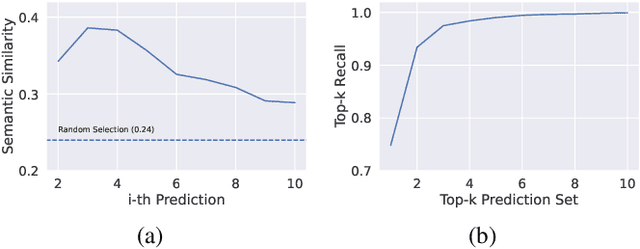
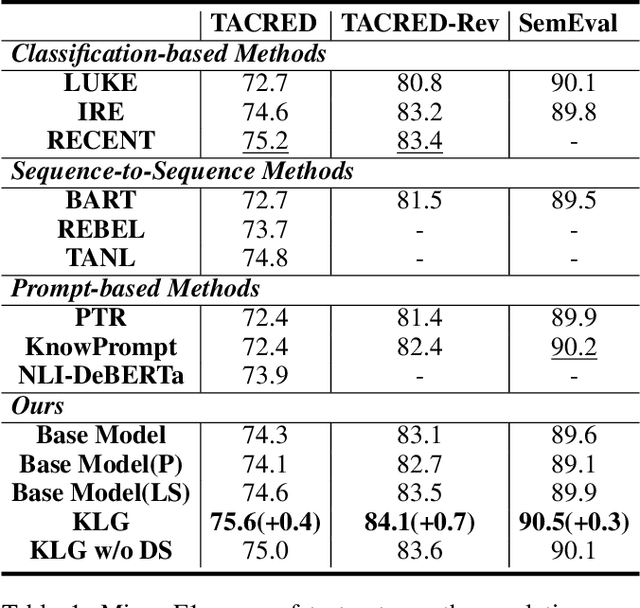
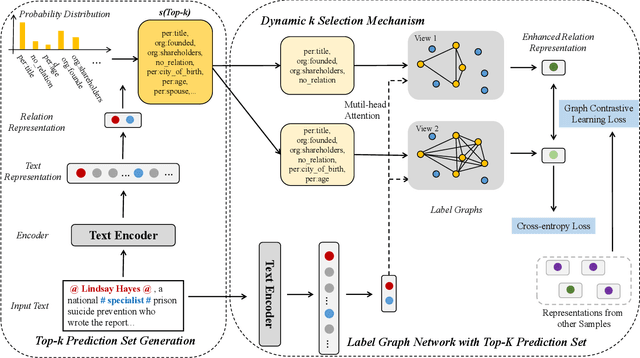
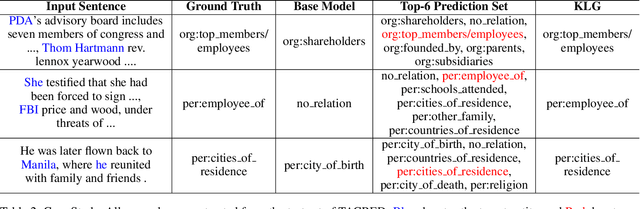
The typical way for relation extraction is fine-tuning large pre-trained language models on task-specific datasets, then selecting the label with the highest probability of the output distribution as the final prediction. However, the usage of the Top-k prediction set for a given sample is commonly overlooked. In this paper, we first reveal that the Top-k prediction set of a given sample contains useful information for predicting the correct label. To effectively utilizes the Top-k prediction set, we propose Label Graph Network with Top-k Prediction Set, termed as KLG. Specifically, for a given sample, we build a label graph to review candidate labels in the Top-k prediction set and learn the connections between them. We also design a dynamic $k$-selection mechanism to learn more powerful and discriminative relation representation. Our experiments show that KLG achieves the best performances on three relation extraction datasets. Moreover, we observe that KLG is more effective in dealing with long-tailed classes.
EDoG: Adversarial Edge Detection For Graph Neural Networks
Dec 27, 2022Graph Neural Networks (GNNs) have been widely applied to different tasks such as bioinformatics, drug design, and social networks. However, recent studies have shown that GNNs are vulnerable to adversarial attacks which aim to mislead the node or subgraph classification prediction by adding subtle perturbations. Detecting these attacks is challenging due to the small magnitude of perturbation and the discrete nature of graph data. In this paper, we propose a general adversarial edge detection pipeline EDoG without requiring knowledge of the attack strategies based on graph generation. Specifically, we propose a novel graph generation approach combined with link prediction to detect suspicious adversarial edges. To effectively train the graph generative model, we sample several sub-graphs from the given graph data. We show that since the number of adversarial edges is usually low in practice, with low probability the sampled sub-graphs will contain adversarial edges based on the union bound. In addition, considering the strong attacks which perturb a large number of edges, we propose a set of novel features to perform outlier detection as the preprocessing for our detection. Extensive experimental results on three real-world graph datasets including a private transaction rule dataset from a major company and two types of synthetic graphs with controlled properties show that EDoG can achieve above 0.8 AUC against four state-of-the-art unseen attack strategies without requiring any knowledge about the attack type; and around 0.85 with knowledge of the attack type. EDoG significantly outperforms traditional malicious edge detection baselines. We also show that an adaptive attack with full knowledge of our detection pipeline is difficult to bypass it.