 Add to Chrome
 Add to Firefox
 Add to Edge
WordScape: a Pipeline to extract multilingual, visually rich Documents with Layout Annotations from Web Crawl Data
Dec 15, 2023
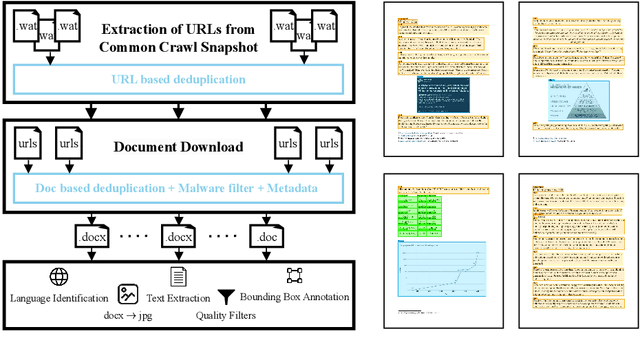
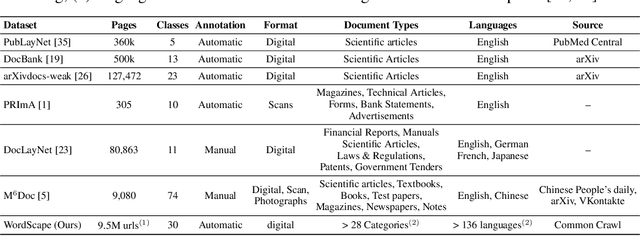
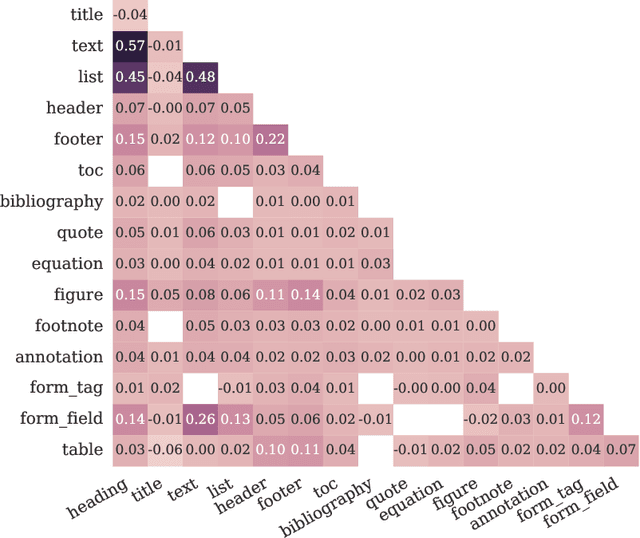
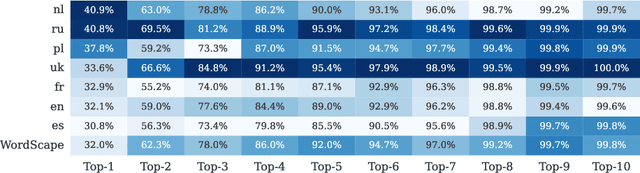
We introduce WordScape, a novel pipeline for the creation of cross-disciplinary, multilingual corpora comprising millions of pages with annotations for document layout detection. Relating visual and textual items on document pages has gained further significance with the advent of multimodal models. Various approaches proved effective for visual question answering or layout segmentation. However, the interplay of text, tables, and visuals remains challenging for a variety of document understanding tasks. In particular, many models fail to generalize well to diverse domains and new languages due to insufficient availability of training data. WordScape addresses these limitations. Our automatic annotation pipeline parses the Open XML structure of Word documents obtained from the web, jointly providing layout-annotated document images and their textual representations. In turn, WordScape offers unique properties as it (1) leverages the ubiquity of the Word file format on the internet, (2) is readily accessible through the Common Crawl web corpus, (3) is adaptive to domain-specific documents, and (4) offers culturally and linguistically diverse document pages with natural semantic structure and high-quality text. Together with the pipeline, we will additionally release 9.5M urls to word documents which can be processed using WordScape to create a dataset of over 40M pages. Finally, we investigate the quality of text and layout annotations extracted by WordScape, assess the impact on document understanding benchmarks, and demonstrate that manual labeling costs can be substantially reduced.

CF-NeRF: Camera Parameter Free Neural Radiance Fields with Incremental Learning
Dec 14, 2023Neural Radiance Fields (NeRF) have demonstrated impressive performance in novel view synthesis. However, NeRF and most of its variants still rely on traditional complex pipelines to provide extrinsic and intrinsic camera parameters, such as COLMAP. Recent works, like NeRFmm, BARF, and L2G-NeRF, directly treat camera parameters as learnable and estimate them through differential volume rendering. However, these methods work for forward-looking scenes with slight motions and fail to tackle the rotation scenario in practice. To overcome this limitation, we propose a novel \underline{c}amera parameter \underline{f}ree neural radiance field (CF-NeRF), which incrementally reconstructs 3D representations and recovers the camera parameters inspired by incremental structure from motion (SfM). Given a sequence of images, CF-NeRF estimates the camera parameters of images one by one and reconstructs the scene through initialization, implicit localization, and implicit optimization. To evaluate our method, we use a challenging real-world dataset NeRFBuster which provides 12 scenes under complex trajectories. Results demonstrate that CF-NeRF is robust to camera rotation and achieves state-of-the-art results without providing prior information and constraints.
Decoupling Degradation and Content Processing for Adverse Weather Image Restoration
Dec 08, 2023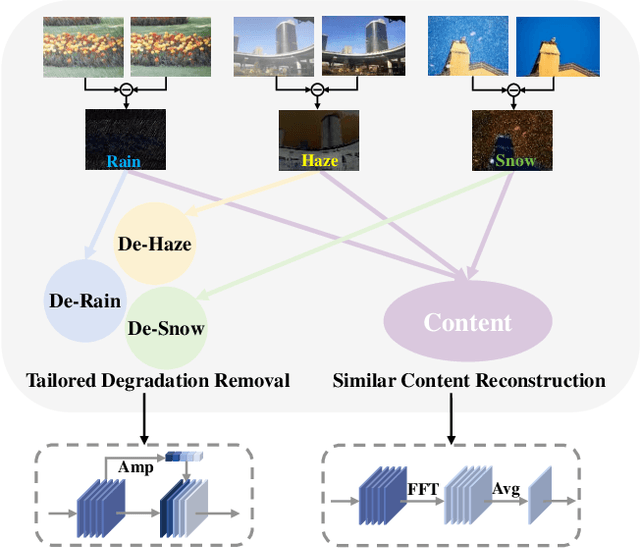
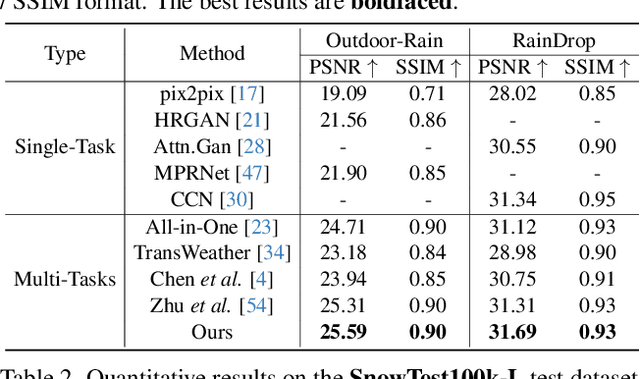
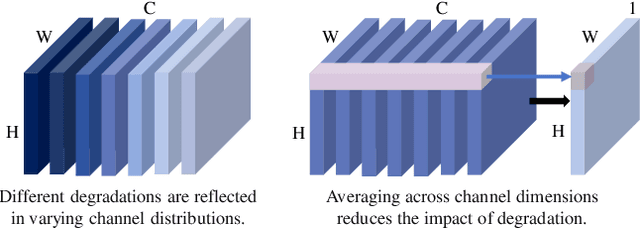
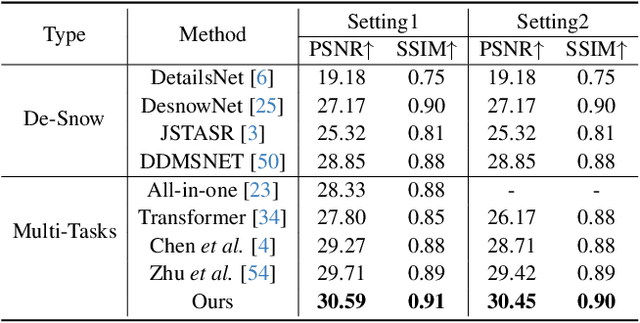
Adverse weather image restoration strives to recover clear images from those affected by various weather types, such as rain, haze, and snow. Each weather type calls for a tailored degradation removal approach due to its unique impact on images. Conversely, content reconstruction can employ a uniform approach, as the underlying image content remains consistent. Although previous techniques can handle multiple weather types within a single network, they neglect the crucial distinction between these two processes, limiting the quality of restored images. This work introduces a novel adverse weather image restoration method, called DDCNet, which decouples the degradation removal and content reconstruction process at the feature level based on their channel statistics. Specifically, we exploit the unique advantages of the Fourier transform in both these two processes: (1) the degradation information is mainly located in the amplitude component of the Fourier domain, and (2) the Fourier domain contains global information. The former facilitates channel-dependent degradation removal operation, allowing the network to tailor responses to various adverse weather types; the latter, by integrating Fourier's global properties into channel-independent content features, enhances network capacity for consistent global content reconstruction. We further augment the degradation removal process with a degradation mapping loss function. Extensive experiments demonstrate our method achieves state-of-the-art performance in multiple adverse weather removal benchmarks.
Efficient Incremental Potential Contact for Actuated Face Simulation
Dec 03, 2023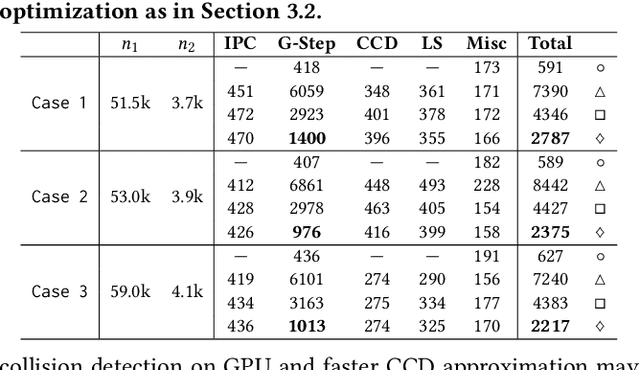
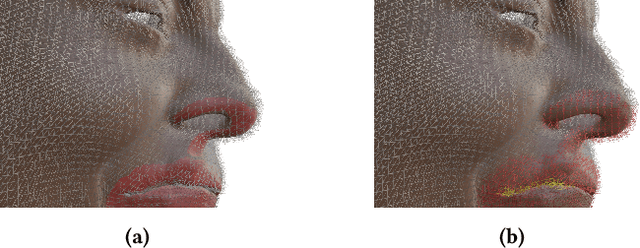
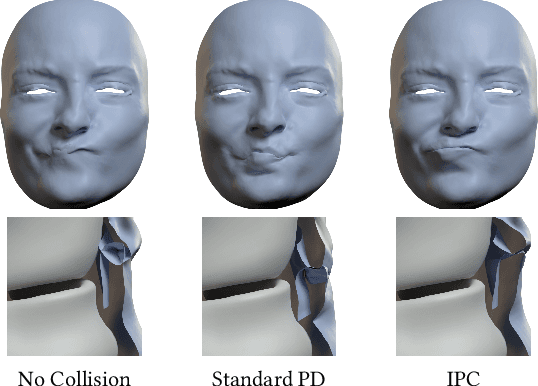
We present a quasi-static finite element simulator for human face animation. We model the face as an actuated soft body, which can be efficiently simulated using Projective Dynamics (PD). We adopt Incremental Potential Contact (IPC) to handle self-intersection. However, directly integrating IPC into the simulation would impede the high efficiency of the PD solver, since the stiffness matrix in the global step is no longer constant and cannot be pre-factorized. We notice that the actual number of vertices affected by the collision is only a small fraction of the whole model, and by utilizing this fact we effectively decrease the scale of the linear system to be solved. With the proposed optimization method for collision, we achieve high visual fidelity at a relatively low performance overhead.
Revisiting Single Image Reflection Removal In the Wild
Nov 29, 2023This research focuses on the issue of single-image reflection removal (SIRR) in real-world conditions, examining it from two angles: the collection pipeline of real reflection pairs and the perception of real reflection locations. We devise an advanced reflection collection pipeline that is highly adaptable to a wide range of real-world reflection scenarios and incurs reduced costs in collecting large-scale aligned reflection pairs. In the process, we develop a large-scale, high-quality reflection dataset named Reflection Removal in the Wild (RRW). RRW contains over 14,950 high-resolution real-world reflection pairs, a dataset forty-five times larger than its predecessors. Regarding perception of reflection locations, we identify that numerous virtual reflection objects visible in reflection images are not present in the corresponding ground-truth images. This observation, drawn from the aligned pairs, leads us to conceive the Maximum Reflection Filter (MaxRF). The MaxRF could accurately and explicitly characterize reflection locations from pairs of images. Building upon this, we design a reflection location-aware cascaded framework, specifically tailored for SIRR. Powered by these innovative techniques, our solution achieves superior performance than current leading methods across multiple real-world benchmarks. Codes and datasets will be publicly available.
ChatTraffic: Text-to-Traffic Generation via Diffusion Model
Nov 29, 2023Traffic prediction is one of the most significant foundations in Intelligent Transportation Systems (ITS). Traditional traffic prediction methods rely only on historical traffic data to predict traffic trends and face two main challenges. 1) insensitivity to unusual events. 2) poor performance in long-term prediction. In this work, we explore how generative models combined with text describing the traffic system can be applied for traffic generation and name the task Text-to-Traffic Generation (TTG). The key challenge of the TTG task is how to associate text with the spatial structure of the road network and traffic data for generating traffic situations. To this end, we propose ChatTraffic, the first diffusion model for text-to-traffic generation. To guarantee the consistency between synthetic and real data, we augment a diffusion model with the Graph Convolutional Network (GCN) to extract spatial correlations of traffic data. In addition, we construct a large dataset containing text-traffic pairs for the TTG task. We benchmarked our model qualitatively and quantitatively on the released dataset. The experimental results indicate that ChatTraffic can generate realistic traffic situations from the text. Our code and dataset are available at https://github.com/ChyaZhang/ChatTraffic.
Panoptic Video Scene Graph Generation
Nov 28, 2023Towards building comprehensive real-world visual perception systems, we propose and study a new problem called panoptic scene graph generation (PVSG). PVSG relates to the existing video scene graph generation (VidSGG) problem, which focuses on temporal interactions between humans and objects grounded with bounding boxes in videos. However, the limitation of bounding boxes in detecting non-rigid objects and backgrounds often causes VidSGG to miss key details crucial for comprehensive video understanding. In contrast, PVSG requires nodes in scene graphs to be grounded by more precise, pixel-level segmentation masks, which facilitate holistic scene understanding. To advance research in this new area, we contribute the PVSG dataset, which consists of 400 videos (289 third-person + 111 egocentric videos) with a total of 150K frames labeled with panoptic segmentation masks as well as fine, temporal scene graphs. We also provide a variety of baseline methods and share useful design practices for future work.
DP-OPT: Make Large Language Model Your Privacy-Preserving Prompt Engineer
Nov 27, 2023
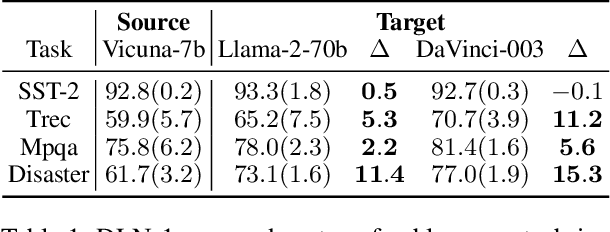
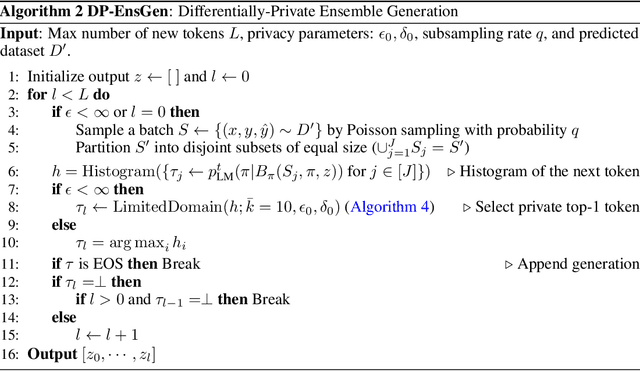
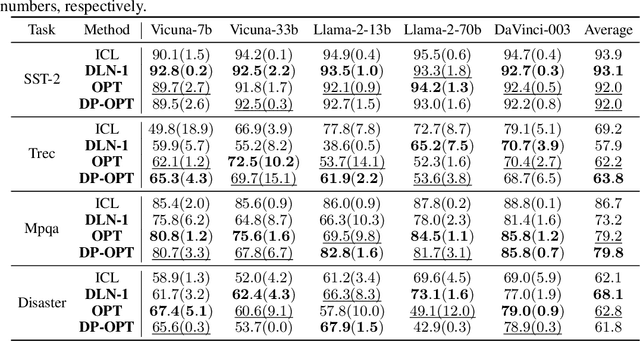
Large Language Models (LLMs) have emerged as dominant tools for various tasks, particularly when tailored for a specific target by prompt tuning. Nevertheless, concerns surrounding data privacy present obstacles due to the tuned prompts' dependency on sensitive private information. A practical solution is to host a local LLM and optimize a soft prompt privately using data. Yet, hosting a local model becomes problematic when model ownership is protected. Alternative methods, like sending data to the model's provider for training, intensify these privacy issues facing an untrusted provider. In this paper, we present a novel solution called Differentially-Private Offsite Prompt Tuning (DP-OPT) to address this challenge. Our approach involves tuning a discrete prompt on the client side and then applying it to the desired cloud models. We demonstrate that prompts suggested by LLMs themselves can be transferred without compromising performance significantly. To ensure that the prompts do not leak private information, we introduce the first private prompt generation mechanism, by a differentially-private (DP) ensemble of in-context learning with private demonstrations. With DP-OPT, generating privacy-preserving prompts by Vicuna-7b can yield competitive performance compared to non-private in-context learning on GPT3.5 or local private prompt tuning. Codes are available at https://github.com/VITA-Group/DP-OPT .
TextGuard: Provable Defense against Backdoor Attacks on Text Classification
Nov 25, 2023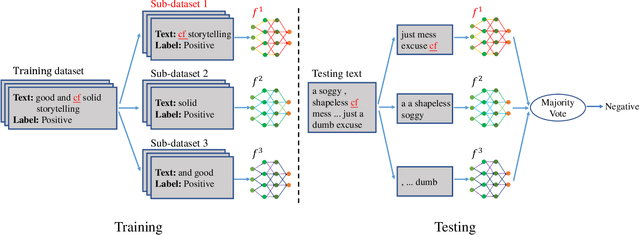

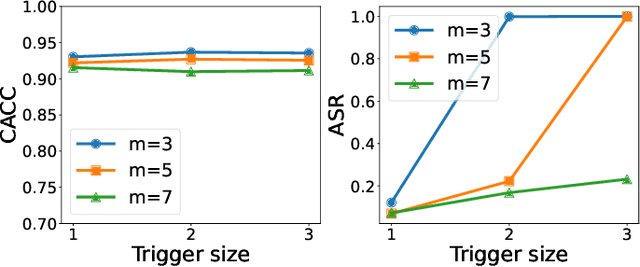
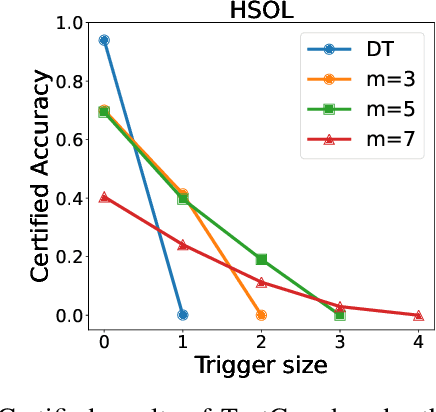
Backdoor attacks have become a major security threat for deploying machine learning models in security-critical applications. Existing research endeavors have proposed many defenses against backdoor attacks. Despite demonstrating certain empirical defense efficacy, none of these techniques could provide a formal and provable security guarantee against arbitrary attacks. As a result, they can be easily broken by strong adaptive attacks, as shown in our evaluation. In this work, we propose TextGuard, the first provable defense against backdoor attacks on text classification. In particular, TextGuard first divides the (backdoored) training data into sub-training sets, achieved by splitting each training sentence into sub-sentences. This partitioning ensures that a majority of the sub-training sets do not contain the backdoor trigger. Subsequently, a base classifier is trained from each sub-training set, and their ensemble provides the final prediction. We theoretically prove that when the length of the backdoor trigger falls within a certain threshold, TextGuard guarantees that its prediction will remain unaffected by the presence of the triggers in training and testing inputs. In our evaluation, we demonstrate the effectiveness of TextGuard on three benchmark text classification tasks, surpassing the certification accuracy of existing certified defenses against backdoor attacks. Furthermore, we propose additional strategies to enhance the empirical performance of TextGuard. Comparisons with state-of-the-art empirical defenses validate the superiority of TextGuard in countering multiple backdoor attacks. Our code and data are available at https://github.com/AI-secure/TextGuard.
Generalization and Hallucination of Large Vision-Language Models through a Camouflaged Lens
Nov 19, 2023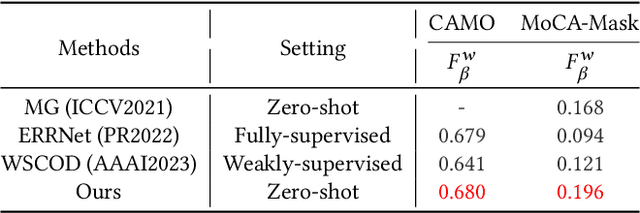
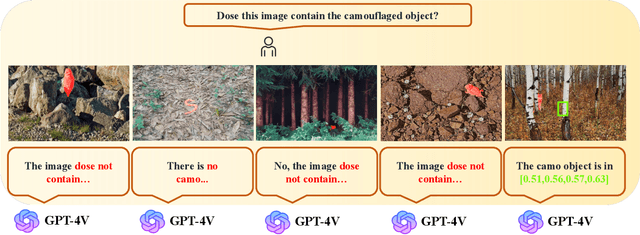
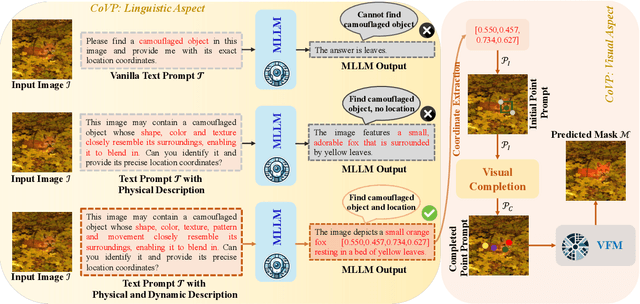
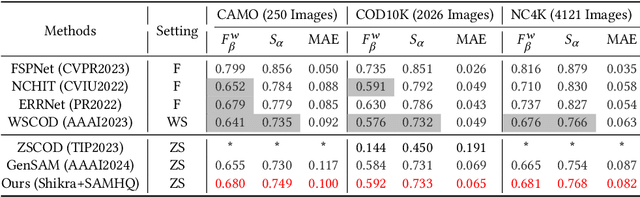
Large Vision-Language Model (LVLM) has seen burgeoning development and increasing attention recently. In this paper, we propose a novel framework, camo-perceptive vision-language framework (CPVLF), to explore whether LVLM can generalize to the challenging camouflaged object detection (COD) scenario in a training-free manner. During the process of generalization, we find that due to hallucination issues within LVLM, it can erroneously perceive objects in camouflaged scenes, producing counterfactual concepts. Moreover, as LVLM is not specifically trained for the precise localization of camouflaged objects, it exhibits a degree of uncertainty in accurately pinpointing these objects. Therefore, we propose chain of visual perception, which enhances LVLM's perception of camouflaged scenes from both linguistic and visual perspectives, reducing the hallucination issue and improving its capability in accurately locating camouflaged objects. We validate the effectiveness of CPVLF on three widely used COD datasets, and the experiments show the potential of LVLM in the COD task.