 Add to Chrome
 Add to Firefox
 Add to Edge
Dynamics of Meta-learning Representation in the Teacher-student Scenario
Aug 22, 2024
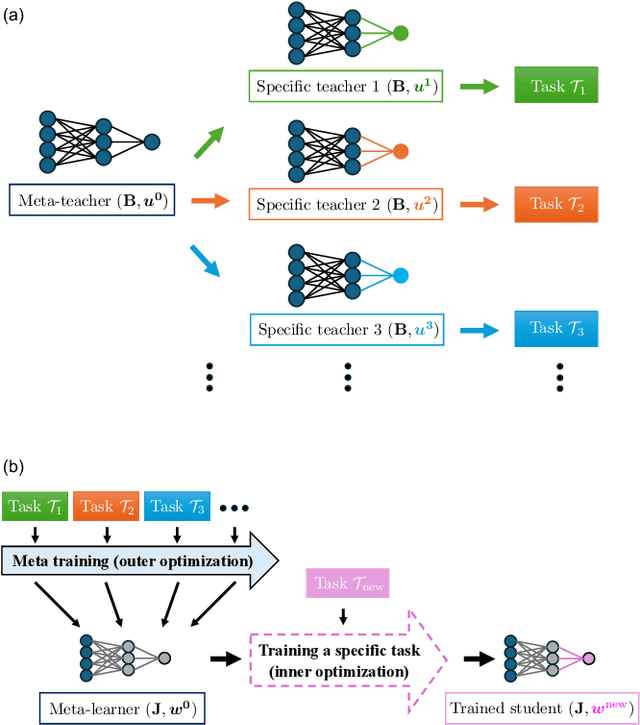

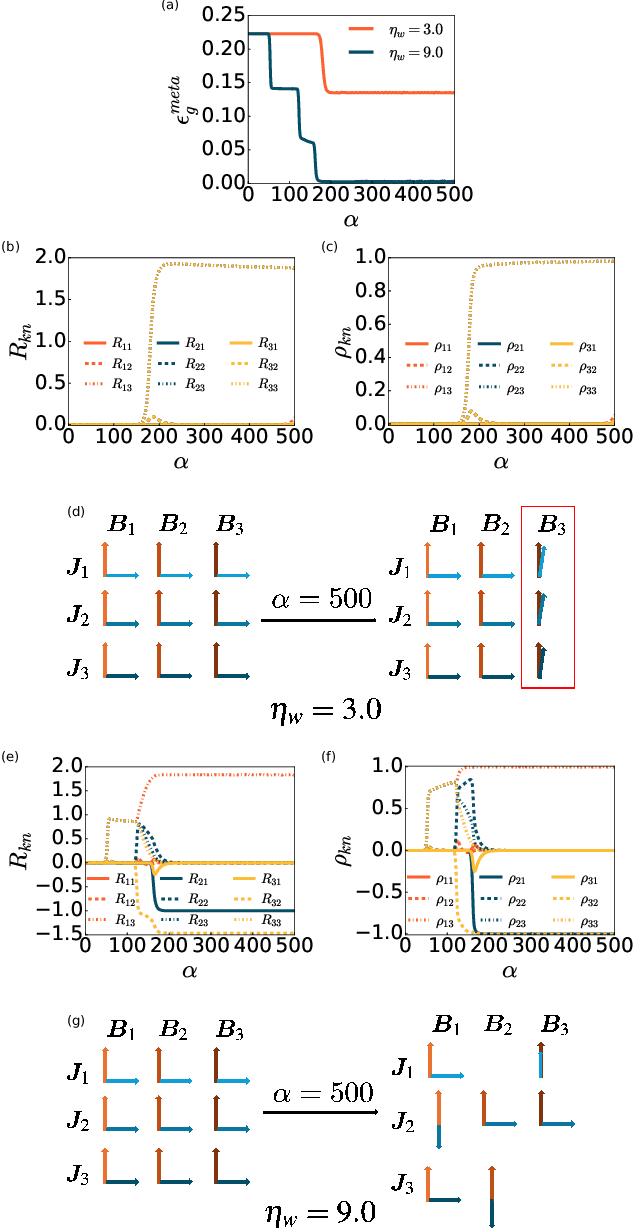
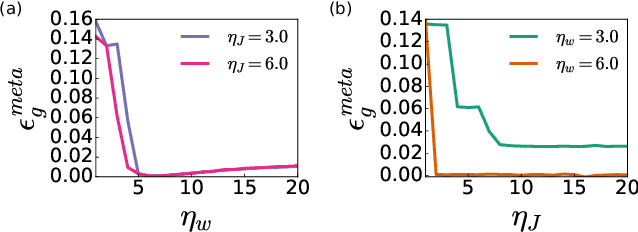
Gradient-based meta-learning algorithms have gained popularity for their ability to train models on new tasks using limited data. Empirical observations indicate that such algorithms are able to learn a shared representation across tasks, which is regarded as a key factor in their success. However, the in-depth theoretical understanding of the learning dynamics and the origin of the shared representation remains underdeveloped. In this work, we investigate the meta-learning dynamics of the non-linear two-layer neural networks trained on streaming tasks in the teach-student scenario. Through the lens of statistical physics analysis, we characterize the macroscopic behavior of the meta-training processes, the formation of the shared representation, and the generalization ability of the model on new tasks. The analysis also points to the importance of the choice of certain hyper-parameters of the learning algorithms.

Constructing Domain-Specific Evaluation Sets for LLM-as-a-judge
Aug 16, 2024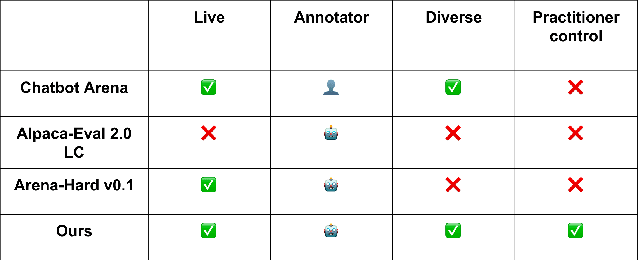

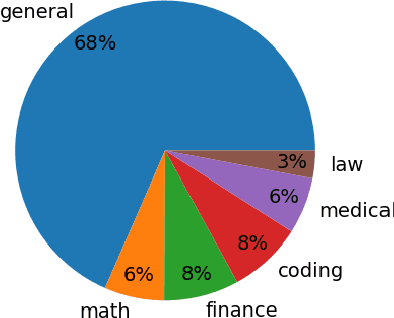
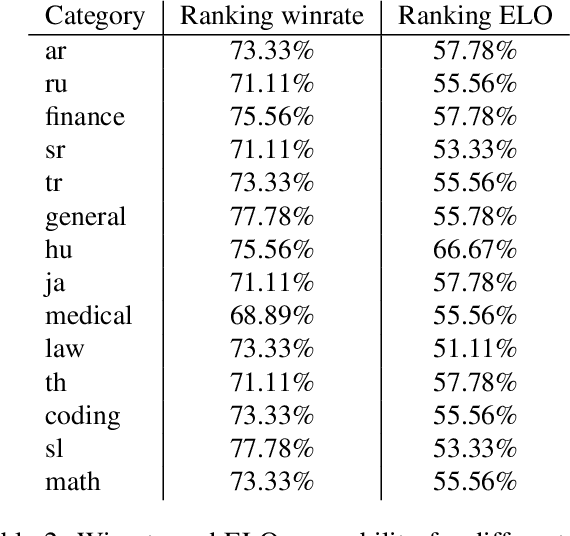
Large Language Models (LLMs) have revolutionized the landscape of machine learning, yet current benchmarks often fall short in capturing the diverse behavior of these models in real-world applications. A benchmark's usefulness is determined by its ability to clearly differentiate between models of varying capabilities (separability) and closely align with human preferences. Existing frameworks like Alpaca-Eval 2.0 LC \cite{dubois2024lengthcontrolledalpacaevalsimpleway} and Arena-Hard v0.1 \cite{li2024crowdsourced} are limited by their focus on general-purpose queries and lack of diversity across domains such as law, medicine, and multilingual contexts. In this paper, we address these limitations by introducing a novel data pipeline that curates diverse, domain-specific evaluation sets tailored for LLM-as-a-Judge frameworks. Our approach leverages a combination of manual curation, semi-supervised learning to generate clusters, and stratified sampling to ensure balanced representation across a wide range of domains and languages. The resulting evaluation set, which includes 1573 samples across 14 categories, demonstrates high separability (84\%) across ten top-ranked models, and agreement (84\%) with Chatbot Arena and (0.915) Spearman correlation. The agreement values are 9\% better than Arena Hard and 20\% better than AlpacaEval 2.0 LC, while the Spearman coefficient is 0.7 more than the next best benchmark, showcasing a significant improvement in the usefulness of the benchmark. We further provide an open-source evaluation tool that enables fine-grained analysis of model performance across user-defined categories, offering valuable insights for practitioners. This work contributes to the ongoing effort to enhance the transparency, diversity, and effectiveness of LLM evaluation methodologies.
LLaVA-OneVision: Easy Visual Task Transfer
Aug 06, 2024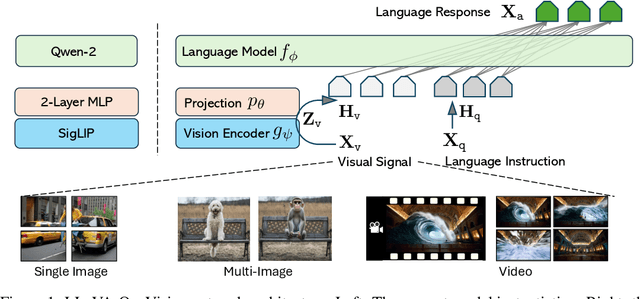


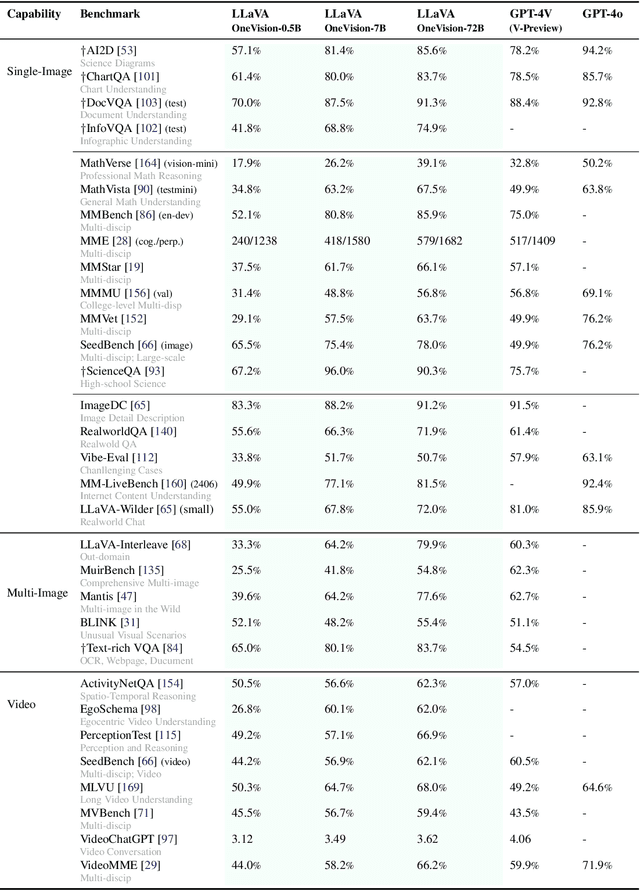
We present LLaVA-OneVision, a family of open large multimodal models (LMMs) developed by consolidating our insights into data, models, and visual representations in the LLaVA-NeXT blog series. Our experimental results demonstrate that LLaVA-OneVision is the first single model that can simultaneously push the performance boundaries of open LMMs in three important computer vision scenarios: single-image, multi-image, and video scenarios. Importantly, the design of LLaVA-OneVision allows strong transfer learning across different modalities/scenarios, yielding new emerging capabilities. In particular, strong video understanding and cross-scenario capabilities are demonstrated through task transfer from images to videos.
From LLMs to LLM-based Agents for Software Engineering: A Survey of Current, Challenges and Future
Aug 05, 2024


With the rise of large language models (LLMs), researchers are increasingly exploring their applications in var ious vertical domains, such as software engineering. LLMs have achieved remarkable success in areas including code generation and vulnerability detection. However, they also exhibit numerous limitations and shortcomings. LLM-based agents, a novel tech nology with the potential for Artificial General Intelligence (AGI), combine LLMs as the core for decision-making and action-taking, addressing some of the inherent limitations of LLMs such as lack of autonomy and self-improvement. Despite numerous studies and surveys exploring the possibility of using LLMs in software engineering, it lacks a clear distinction between LLMs and LLM based agents. It is still in its early stage for a unified standard and benchmarking to qualify an LLM solution as an LLM-based agent in its domain. In this survey, we broadly investigate the current practice and solutions for LLMs and LLM-based agents for software engineering. In particular we summarise six key topics: requirement engineering, code generation, autonomous decision-making, software design, test generation, and software maintenance. We review and differentiate the work of LLMs and LLM-based agents from these six topics, examining their differences and similarities in tasks, benchmarks, and evaluation metrics. Finally, we discuss the models and benchmarks used, providing a comprehensive analysis of their applications and effectiveness in software engineering. We anticipate this work will shed some lights on pushing the boundaries of LLM-based agents in software engineering for future research.
Tamper-Resistant Safeguards for Open-Weight LLMs
Aug 01, 2024
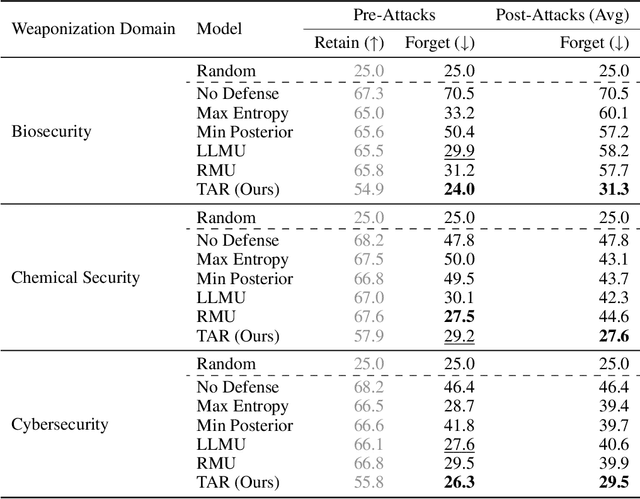
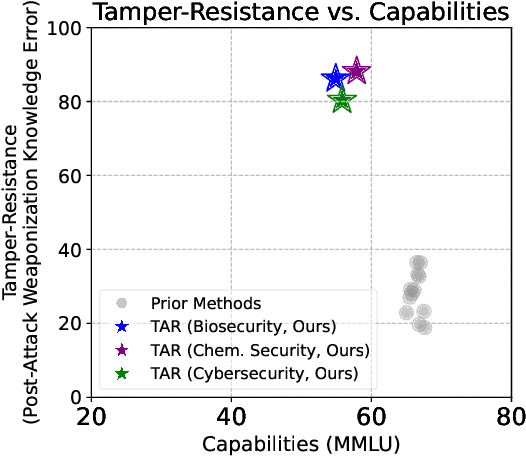

Rapid advances in the capabilities of large language models (LLMs) have raised widespread concerns regarding their potential for malicious use. Open-weight LLMs present unique challenges, as existing safeguards lack robustness to tampering attacks that modify model weights. For example, recent works have demonstrated that refusal and unlearning safeguards can be trivially removed with a few steps of fine-tuning. These vulnerabilities necessitate new approaches for enabling the safe release of open-weight LLMs. We develop a method, called TAR, for building tamper-resistant safeguards into open-weight LLMs such that adversaries cannot remove the safeguards even after thousands of steps of fine-tuning. In extensive evaluations and red teaming analyses, we find that our method greatly improves tamper-resistance while preserving benign capabilities. Our results demonstrate that tamper-resistance is a tractable problem, opening up a promising new avenue to improve the safety and security of open-weight LLMs.
Evaluating SAM2's Role in Camouflaged Object Detection: From SAM to SAM2
Jul 31, 2024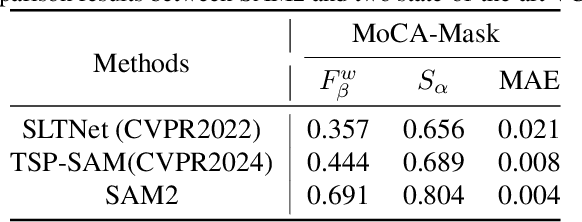
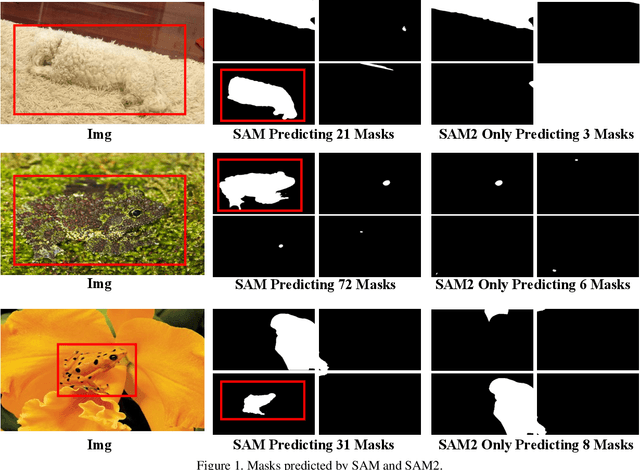
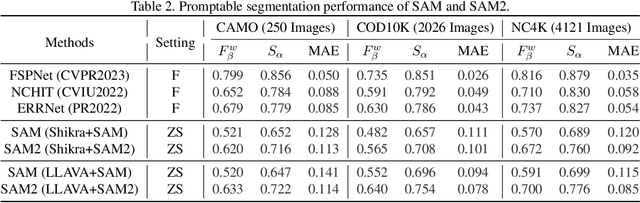
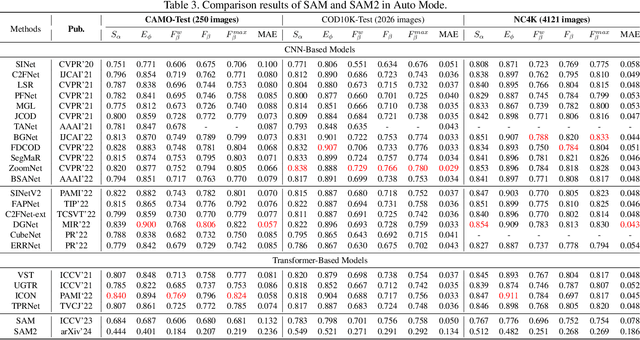
The Segment Anything Model (SAM), introduced by Meta AI Research as a generic object segmentation model, quickly garnered widespread attention and significantly influenced the academic community. To extend its application to video, Meta further develops Segment Anything Model 2 (SAM2), a unified model capable of both video and image segmentation. SAM2 shows notable improvements over its predecessor in terms of applicable domains, promptable segmentation accuracy, and running speed. However, this report reveals a decline in SAM2's ability to perceive different objects in images without prompts in its auto mode, compared to SAM. Specifically, we employ the challenging task of camouflaged object detection to assess this performance decrease, hoping to inspire further exploration of the SAM model family by researchers. The results of this paper are provided in \url{https://github.com/luckybird1994/SAMCOD}.
Improved Bounds for Pure Private Agnostic Learning: Item-Level and User-Level Privacy
Jul 30, 2024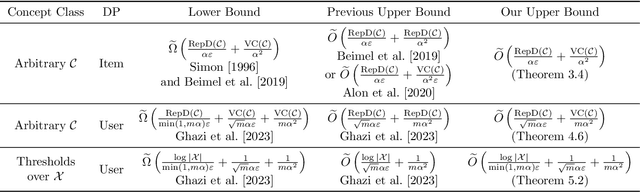
Machine Learning has made remarkable progress in a wide range of fields. In many scenarios, learning is performed on datasets involving sensitive information, in which privacy protection is essential for learning algorithms. In this work, we study pure private learning in the agnostic model -- a framework reflecting the learning process in practice. We examine the number of users required under item-level (where each user contributes one example) and user-level (where each user contributes multiple examples) privacy and derive several improved upper bounds. For item-level privacy, our algorithm achieves a near optimal bound for general concept classes. We extend this to the user-level setting, rendering a tighter upper bound than the one proved by Ghazi et al. (2023). Lastly, we consider the problem of learning thresholds under user-level privacy and present an algorithm with a nearly tight user complexity.
OmniBal: Towards Fast Instruct-tuning for Vision-Language Models via Omniverse Computation Balance
Jul 30, 2024


Recently, vision-language instruct-tuning models have made significant progress due to their more comprehensive understanding of the world. In this work, we discovered that large-scale 3D parallel training on those models leads to an imbalanced computation load across different devices. The vision and language parts are inherently heterogeneous: their data distribution and model architecture differ significantly, which affects distributed training efficiency. We rebalanced the computational loads from data, model, and memory perspectives to address this issue, achieving more balanced computation across devices. These three components are not independent but are closely connected, forming an omniverse balanced training framework. Specifically, for the data, we grouped instances into new balanced mini-batches within and across devices. For the model, we employed a search-based method to achieve a more balanced partitioning. For memory optimization, we adaptively adjusted the re-computation strategy for each partition to utilize the available memory fully. We conducted extensive experiments to validate the effectiveness of our method. Compared with the open-source training code of InternVL-Chat, we significantly reduced GPU days, achieving about 1.8x speed-up. Our method's efficacy and generalizability were further demonstrated across various models and datasets. Codes will be released at https://github.com/ModelTC/OmniBal.
Balancing Complementarity and Consistency via Delayed Activation in Incomplete Multi-view Clustering
Jul 25, 2024This paper study one challenging issue in incomplete multi-view clustering, where valuable complementary information from other views is always ignored. To be specific, we propose a framework that effectively balances Complementarity and Consistency information in Incomplete Multi-view Clustering (CoCo-IMC). Specifically, we design a dual network of delayed activation, which achieves a balance of complementarity and consistency among different views. The delayed activation could enriches the complementarity information that was ignored during consistency learning. Then, we recover the incomplete information and enhance the consistency learning by minimizing the conditional entropy and maximizing the mutual information across different views. This could be the first theoretical attempt to incorporate delayed activation into incomplete data recovery and the balance of complementarity and consistency. We have proved the effectiveness of CoCo-IMC in extensive comparative experiments with 12 state-of-the-art baselines on four publicly available datasets.
SAFNet: Selective Alignment Fusion Network for Efficient HDR Imaging
Jul 23, 2024Multi-exposure High Dynamic Range (HDR) imaging is a challenging task when facing truncated texture and complex motion. Existing deep learning-based methods have achieved great success by either following the alignment and fusion pipeline or utilizing attention mechanism. However, the large computation cost and inference delay hinder them from deploying on resource limited devices. In this paper, to achieve better efficiency, a novel Selective Alignment Fusion Network (SAFNet) for HDR imaging is proposed. After extracting pyramid features, it jointly refines valuable area masks and cross-exposure motion in selected regions with shared decoders, and then fuses high quality HDR image in an explicit way. This approach can focus the model on finding valuable regions while estimating their easily detectable and meaningful motion. For further detail enhancement, a lightweight refine module is introduced which enjoys privileges from previous optical flow, selection masks and initial prediction. Moreover, to facilitate learning on samples with large motion, a new window partition cropping method is presented during training. Experiments on public and newly developed challenging datasets show that proposed SAFNet not only exceeds previous SOTA competitors quantitatively and qualitatively, but also runs order of magnitude faster. Code and dataset is available at https://github.com/ltkong218/SAFNet.