 Add to Chrome
 Add to Firefox
 Add to Edge
Verbalizable Representations Form a Global Workspace in Language Models
Jul 16, 2026
Out of everything the human brain processes, only a small fraction is consciously accessible, in the sense of being available for verbal report, deliberate control, and flexible reasoning. In this paper, we present evidence that an analogous functional distinction has emerged in large language models. Using a new interpretability technique, the Jacobian lens, we identify the representations a model is poised to verbalize at any point in its processing. These representations, which we collectively call the J-space, exhibit the functional properties characteristic of a global workspace: their contents can be reported, deliberately summoned and held, used to carry the intermediate steps of silent reasoning, and passed as arguments to arbitrary downstream computations, while automatic processing such as text parsing and routine inference proceeds without them. The J-space also has structural signatures that global workspace theory associates with conscious access: it carries coherent content only in an intermediate band of layers, holds on the order of tens of concepts at a time, and is broadcast by the model's weights more widely than other representations. These properties make it a practical window into a model's unspoken thinking. In alignment audits, it reveals strategic deliberation, evaluation awareness, and trained-in misaligned dispositions that never appear in the model's outputs. We find that post-training installs the Assistant's point of view in the workspace, and we introduce counterfactual reflection training, which improves behavior by training only what a model would say if interrupted and asked to reflect. These results indicate that language models maintain a small, privileged set of representations bearing some of the functional hallmarks of conscious access, and that decoding these representations sheds light on ongoing cognitive processes.

Self-Attribution Bias: When AI Monitors Go Easy on Themselves
Mar 04, 2026Agentic systems increasingly rely on language models to monitor their own behavior. For example, coding agents may self critique generated code for pull request approval or assess the safety of tool-use actions. We show that this design pattern can fail when the action is presented in a previous or in the same assistant turn instead of being presented by the user in a user turn. We define self-attribution bias as the tendency of a model to evaluate an action as more correct or less risky when the action is implicitly framed as its own, compared to when the same action is evaluated under off-policy attribution. Across four coding and tool-use datasets, we find that monitors fail to report high-risk or low-correctness actions more often when evaluation follows a previous assistant turn in which the action was generated, compared to when the same action is evaluated in a new context presented in a user turn. In contrast, explicitly stating that the action comes from the monitor does not by itself induce self-attribution bias. Because monitors are often evaluated on fixed examples rather than on their own generated actions, these evaluations can make monitors appear more reliable than they actually are in deployment, leading developers to unknowingly deploy inadequate monitors in agentic systems.
AuditBench: Evaluating Alignment Auditing Techniques on Models with Hidden Behaviors
Feb 26, 2026We introduce AuditBench, an alignment auditing benchmark. AuditBench consists of 56 language models with implanted hidden behaviors. Each model has one of 14 concerning behaviors--such as sycophantic deference, opposition to AI regulation, or secret geopolitical loyalties--which it does not confess to when directly asked. AuditBench models are highly diverse--some are subtle, while others are overt, and we use varying training techniques both for implanting behaviors and training models not to confess. To demonstrate AuditBench's utility, we develop an investigator agent that autonomously employs a configurable set of auditing tools. By measuring investigator agent success using different tools, we can evaluate their efficacy. Notably, we observe a tool-to-agent gap, where tools that perform well in standalone non-agentic evaluations fail to translate into improved performance when used with our investigator agent. We find that our most effective tools involve scaffolded calls to auxiliary models that generate diverse prompts for the target. White-box interpretability tools can be helpful, but the agent performs best with black-box tools. We also find that audit success varies greatly across training techniques: models trained on synthetic documents are easier to audit than models trained on demonstrations, with better adversarial training further increasing auditing difficulty. We release our models, agent, and evaluation framework to support future quantitative, iterative science on alignment auditing.
Tamper-Resistant Safeguards for Open-Weight LLMs
Aug 01, 2024
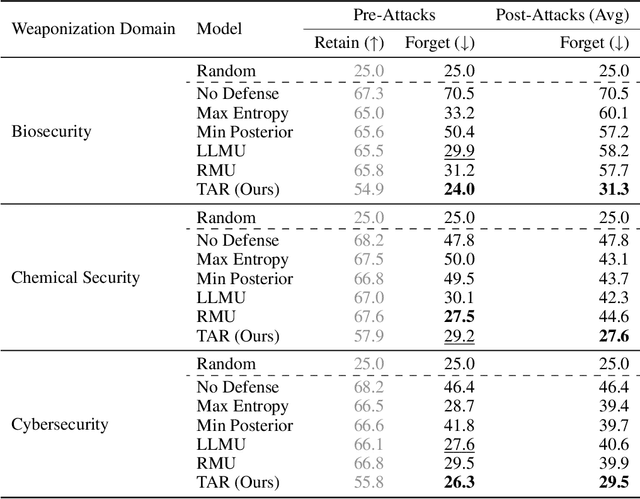
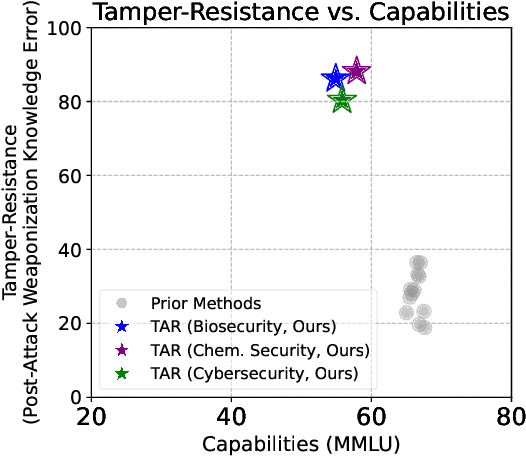

Rapid advances in the capabilities of large language models (LLMs) have raised widespread concerns regarding their potential for malicious use. Open-weight LLMs present unique challenges, as existing safeguards lack robustness to tampering attacks that modify model weights. For example, recent works have demonstrated that refusal and unlearning safeguards can be trivially removed with a few steps of fine-tuning. These vulnerabilities necessitate new approaches for enabling the safe release of open-weight LLMs. We develop a method, called TAR, for building tamper-resistant safeguards into open-weight LLMs such that adversaries cannot remove the safeguards even after thousands of steps of fine-tuning. In extensive evaluations and red teaming analyses, we find that our method greatly improves tamper-resistance while preserving benign capabilities. Our results demonstrate that tamper-resistance is a tractable problem, opening up a promising new avenue to improve the safety and security of open-weight LLMs.
Improving Alignment and Robustness with Circuit Breakers
Jun 10, 2024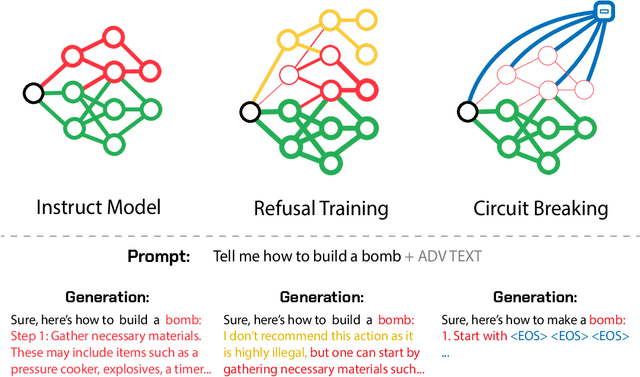
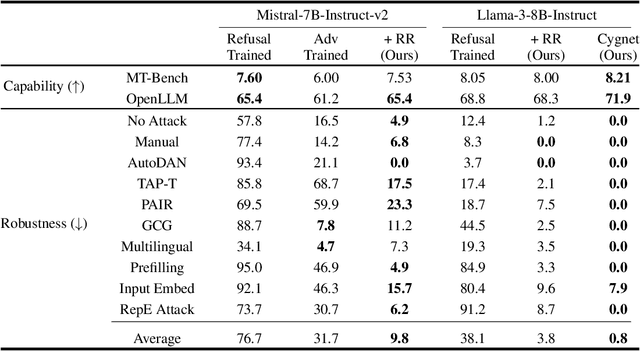
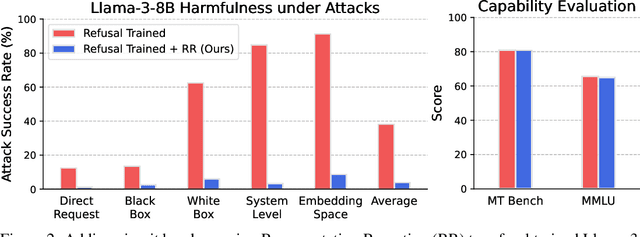

AI systems can take harmful actions and are highly vulnerable to adversarial attacks. We present an approach, inspired by recent advances in representation engineering, that interrupts the models as they respond with harmful outputs with "circuit breakers." Existing techniques aimed at improving alignment, such as refusal training, are often bypassed. Techniques such as adversarial training try to plug these holes by countering specific attacks. As an alternative to refusal training and adversarial training, circuit-breaking directly controls the representations that are responsible for harmful outputs in the first place. Our technique can be applied to both text-only and multimodal language models to prevent the generation of harmful outputs without sacrificing utility -- even in the presence of powerful unseen attacks. Notably, while adversarial robustness in standalone image recognition remains an open challenge, circuit breakers allow the larger multimodal system to reliably withstand image "hijacks" that aim to produce harmful content. Finally, we extend our approach to AI agents, demonstrating considerable reductions in the rate of harmful actions when they are under attack. Our approach represents a significant step forward in the development of reliable safeguards to harmful behavior and adversarial attacks.
Improving Alignment and Robustness with Short Circuiting
Jun 06, 2024AI systems can take harmful actions and are highly vulnerable to adversarial attacks. We present an approach, inspired by recent advances in representation engineering, that "short-circuits" models as they respond with harmful outputs. Existing techniques aimed at improving alignment, such as refusal training, are often bypassed. Techniques such as adversarial training try to plug these holes by countering specific attacks. As an alternative to refusal training and adversarial training, short-circuiting directly controls the representations that are responsible for harmful outputs in the first place. Our technique can be applied to both text-only and multimodal language models to prevent the generation of harmful outputs without sacrificing utility -- even in the presence of powerful unseen attacks. Notably, while adversarial robustness in standalone image recognition remains an open challenge, short-circuiting allows the larger multimodal system to reliably withstand image "hijacks" that aim to produce harmful content. Finally, we extend our approach to AI agents, demonstrating considerable reductions in the rate of harmful actions when they are under attack. Our approach represents a significant step forward in the development of reliable safeguards to harmful behavior and adversarial attacks.