 Add to Chrome
 Add to Firefox
 Add to Edge
Exploiting Modality-Specific Features For Multi-Modal Manipulation Detection And Grounding
Sep 22, 2023
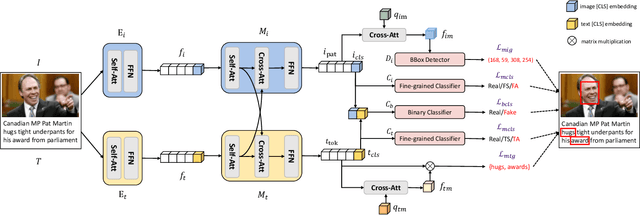
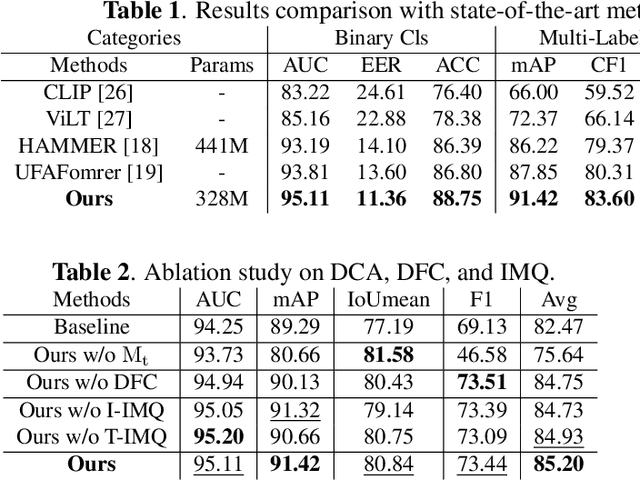
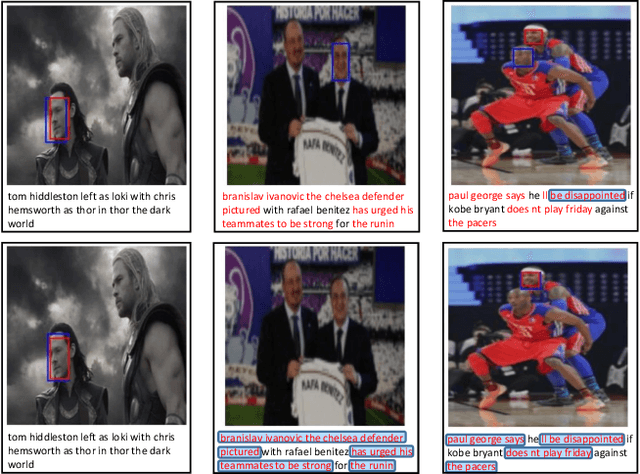
AI-synthesized text and images have gained significant attention, particularly due to the widespread dissemination of multi-modal manipulations on the internet, which has resulted in numerous negative impacts on society. Existing methods for multi-modal manipulation detection and grounding primarily focus on fusing vision-language features to make predictions, while overlooking the importance of modality-specific features, leading to sub-optimal results. In this paper, we construct a simple and novel transformer-based framework for multi-modal manipulation detection and grounding tasks. Our framework simultaneously explores modality-specific features while preserving the capability for multi-modal alignment. To achieve this, we introduce visual/language pre-trained encoders and dual-branch cross-attention (DCA) to extract and fuse modality-unique features. Furthermore, we design decoupled fine-grained classifiers (DFC) to enhance modality-specific feature mining and mitigate modality competition. Moreover, we propose an implicit manipulation query (IMQ) that adaptively aggregates global contextual cues within each modality using learnable queries, thereby improving the discovery of forged details. Extensive experiments on the $\rm DGM^4$ dataset demonstrate the superior performance of our proposed model compared to state-of-the-art approaches.

Emotion-Aware Prosodic Phrasing for Expressive Text-to-Speech
Sep 21, 2023Prosodic phrasing is crucial to the naturalness and intelligibility of end-to-end Text-to-Speech (TTS). There exist both linguistic and emotional prosody in natural speech. As the study of prosodic phrasing has been linguistically motivated, prosodic phrasing for expressive emotion rendering has not been well studied. In this paper, we propose an emotion-aware prosodic phrasing model, termed \textit{EmoPP}, to mine the emotional cues of utterance accurately and predict appropriate phrase breaks. We first conduct objective observations on the ESD dataset to validate the strong correlation between emotion and prosodic phrasing. Then the objective and subjective evaluations show that the EmoPP outperforms all baselines and achieves remarkable performance in terms of emotion expressiveness. The audio samples and the code are available at \url{https://github.com/AI-S2-Lab/EmoPP}.
SoccerNet 2023 Challenges Results
Sep 12, 2023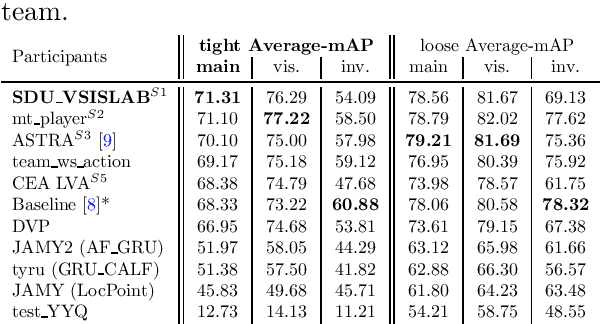
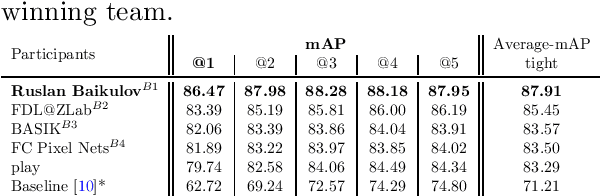
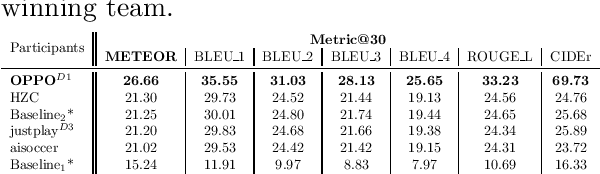
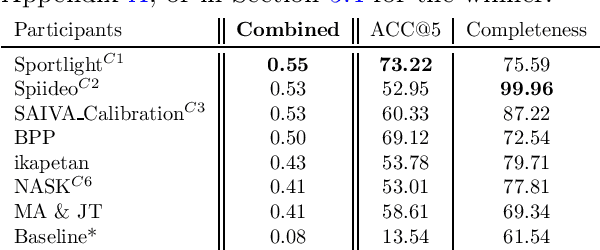
The SoccerNet 2023 challenges were the third annual video understanding challenges organized by the SoccerNet team. For this third edition, the challenges were composed of seven vision-based tasks split into three main themes. The first theme, broadcast video understanding, is composed of three high-level tasks related to describing events occurring in the video broadcasts: (1) action spotting, focusing on retrieving all timestamps related to global actions in soccer, (2) ball action spotting, focusing on retrieving all timestamps related to the soccer ball change of state, and (3) dense video captioning, focusing on describing the broadcast with natural language and anchored timestamps. The second theme, field understanding, relates to the single task of (4) camera calibration, focusing on retrieving the intrinsic and extrinsic camera parameters from images. The third and last theme, player understanding, is composed of three low-level tasks related to extracting information about the players: (5) re-identification, focusing on retrieving the same players across multiple views, (6) multiple object tracking, focusing on tracking players and the ball through unedited video streams, and (7) jersey number recognition, focusing on recognizing the jersey number of players from tracklets. Compared to the previous editions of the SoccerNet challenges, tasks (2-3-7) are novel, including new annotations and data, task (4) was enhanced with more data and annotations, and task (6) now focuses on end-to-end approaches. More information on the tasks, challenges, and leaderboards are available on https://www.soccer-net.org. Baselines and development kits can be found on https://github.com/SoccerNet.
An Efficient Approach to Unsupervised Out-of-Distribution Detection with Variational Autoencoders
Sep 06, 2023This paper is concerned with deep generative models (DGMs) for unsupervised out-of-distribution (OOD) detection. In particular, we focus on vanilla Variational Autoencoders (VAE) that use a standard normal prior distribution for the latent variables. These models have a smaller model size, enabling faster training and inference, making them well-suited for resource-limited applications compared to more complex DGMs. We propose a novel OOD score called Error Reduction (ER) specifically designed for vanilla VAE. ER incorporate the idea of reconstructing image inputs from their lossy counterparts and takes into account the Kolmogorov complexity of the images. Experimental results on diverse datasets demonstrate the superiority of our approach over baseline methods. Our code is available at: https://github.com/ZJLAB-AMMI/VAE4OOD.
Contrastive Learning of Temporal Distinctiveness for Survival Analysis in Electronic Health Records
Aug 24, 2023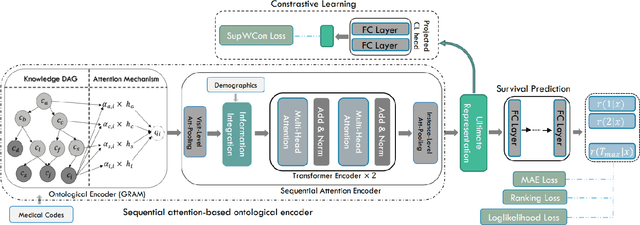
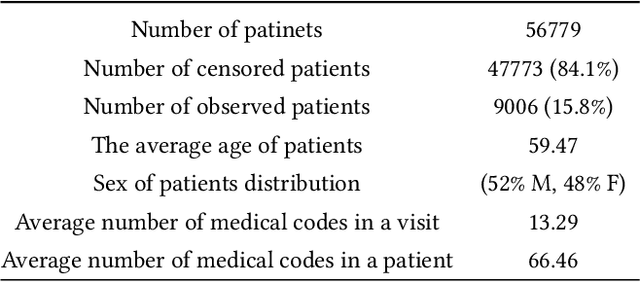
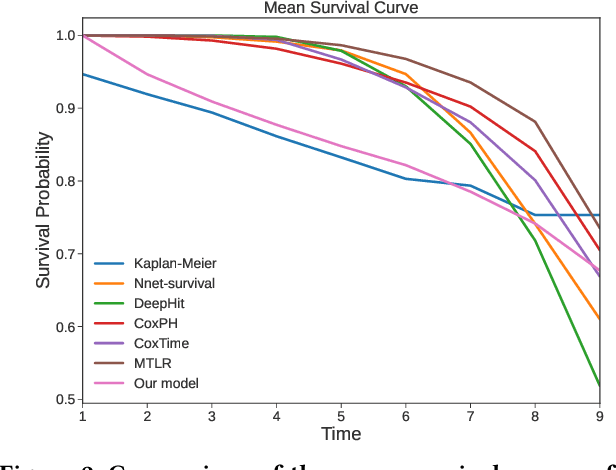
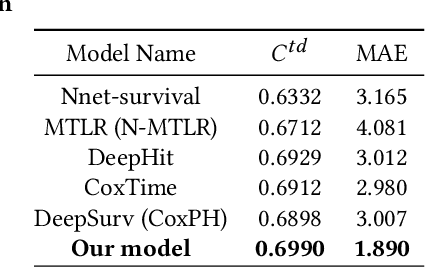
Survival analysis plays a crucial role in many healthcare decisions, where the risk prediction for the events of interest can support an informative outlook for a patient's medical journey. Given the existence of data censoring, an effective way of survival analysis is to enforce the pairwise temporal concordance between censored and observed data, aiming to utilize the time interval before censoring as partially observed time-to-event labels for supervised learning. Although existing studies mostly employed ranking methods to pursue an ordering objective, contrastive methods which learn a discriminative embedding by having data contrast against each other, have not been explored thoroughly for survival analysis. Therefore, in this paper, we propose a novel Ontology-aware Temporality-based Contrastive Survival (OTCSurv) analysis framework that utilizes survival durations from both censored and observed data to define temporal distinctiveness and construct negative sample pairs with adjustable hardness for contrastive learning. Specifically, we first use an ontological encoder and a sequential self-attention encoder to represent the longitudinal EHR data with rich contexts. Second, we design a temporal contrastive loss to capture varying survival durations in a supervised setting through a hardness-aware negative sampling mechanism. Last, we incorporate the contrastive task into the time-to-event predictive task with multiple loss components. We conduct extensive experiments using a large EHR dataset to forecast the risk of hospitalized patients who are in danger of developing acute kidney injury (AKI), a critical and urgent medical condition. The effectiveness and explainability of the proposed model are validated through comprehensive quantitative and qualitative studies.
Video Captioning with Aggregated Features Based on Dual Graphs and Gated Fusion
Aug 13, 2023The application of video captioning models aims at translating the content of videos by using accurate natural language. Due to the complex nature inbetween object interaction in the video, the comprehensive understanding of spatio-temporal relations of objects remains a challenging task. Existing methods often fail in generating sufficient feature representations of video content. In this paper, we propose a video captioning model based on dual graphs and gated fusion: we adapt two types of graphs to generate feature representations of video content and utilize gated fusion to further understand these different levels of information. Using a dual-graphs model to generate appearance features and motion features respectively can utilize the content correlation in frames to generate various features from multiple perspectives. Among them, dual-graphs reasoning can enhance the content correlation in frame sequences to generate advanced semantic features; The gated fusion, on the other hand, aggregates the information in multiple feature representations for comprehensive video content understanding. The experiments conducted on worldly used datasets MSVD and MSR-VTT demonstrate state-of-the-art performance of our proposed approach.
Debiased Pairwise Learning from Positive-Unlabeled Implicit Feedback
Jul 29, 2023


Learning contrastive representations from pairwise comparisons has achieved remarkable success in various fields, such as natural language processing, computer vision, and information retrieval. Collaborative filtering algorithms based on pairwise learning also rooted in this paradigm. A significant concern is the absence of labels for negative instances in implicit feedback data, which often results in the random selected negative instances contains false negatives and inevitably, biased embeddings. To address this issue, we introduce a novel correction method for sampling bias that yields a modified loss for pairwise learning called debiased pairwise loss (DPL). The key idea underlying DPL is to correct the biased probability estimates that result from false negatives, thereby correcting the gradients to approximate those of fully supervised data. The implementation of DPL only requires a small modification of the codes. Experimental studies on five public datasets validate the effectiveness of proposed learning method.
Unveiling the Potential of Knowledge-Prompted ChatGPT for Enhancing Drug Trafficking Detection on Social Media
Jul 07, 2023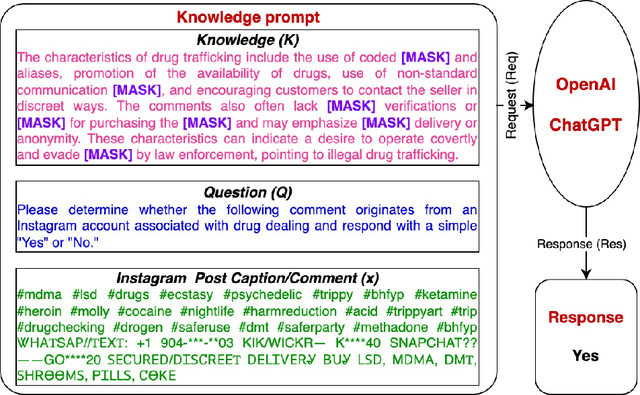
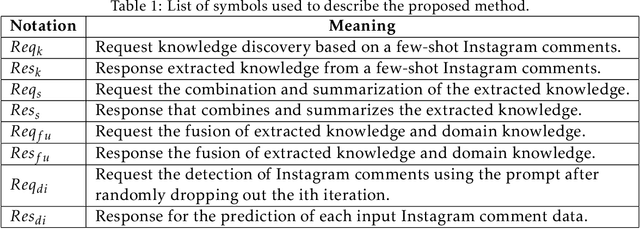
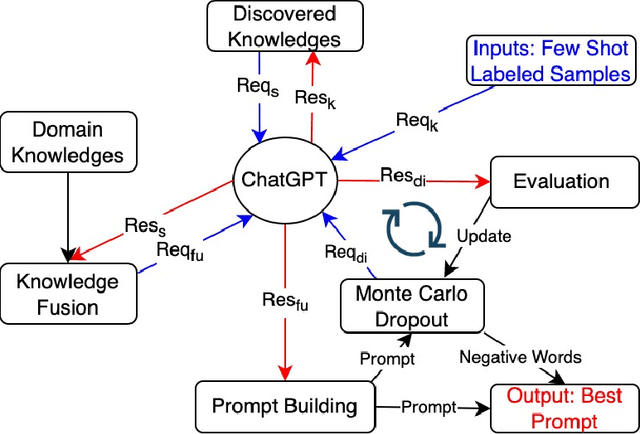
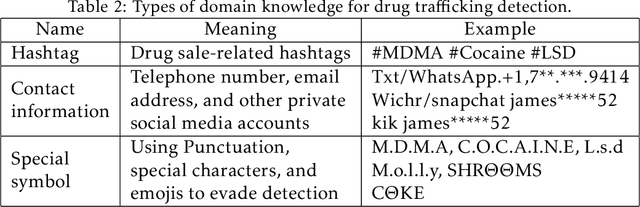
Social media platforms such as Instagram and Twitter have emerged as critical channels for drug marketing and illegal sale. Detecting and labeling online illicit drug trafficking activities becomes important in addressing this issue. However, the effectiveness of conventional supervised learning methods in detecting drug trafficking heavily relies on having access to substantial amounts of labeled data, while data annotation is time-consuming and resource-intensive. Furthermore, these models often face challenges in accurately identifying trafficking activities when drug dealers use deceptive language and euphemisms to avoid detection. To overcome this limitation, we conduct the first systematic study on leveraging large language models (LLMs), such as ChatGPT, to detect illicit drug trafficking activities on social media. We propose an analytical framework to compose \emph{knowledge-informed prompts}, which serve as the interface that humans can interact with and use LLMs to perform the detection task. Additionally, we design a Monte Carlo dropout based prompt optimization method to further to improve performance and interpretability. Our experimental findings demonstrate that the proposed framework outperforms other baseline language models in terms of drug trafficking detection accuracy, showing a remarkable improvement of nearly 12\%. By integrating prior knowledge and the proposed prompts, ChatGPT can effectively identify and label drug trafficking activities on social networks, even in the presence of deceptive language and euphemisms used by drug dealers to evade detection. The implications of our research extend to social networks, emphasizing the importance of incorporating prior knowledge and scenario-based prompts into analytical tools to improve online security and public safety.
MAE-DFER: Efficient Masked Autoencoder for Self-supervised Dynamic Facial Expression Recognition
Jul 05, 2023Dynamic facial expression recognition (DFER) is essential to the development of intelligent and empathetic machines. Prior efforts in this field mainly fall into supervised learning paradigm, which is restricted by the limited labeled data in existing datasets. Inspired by recent unprecedented success of masked autoencoders (e.g., VideoMAE), this paper proposes MAE-DFER, a novel self-supervised method which leverages large-scale self-supervised pre-training on abundant unlabeled data to advance the development of DFER. Since the vanilla Vision Transformer (ViT) employed in VideoMAE requires substantial computation during fine-tuning, MAE-DFER develops an efficient local-global interaction Transformer (LGI-Former) as the encoder. LGI-Former first constrains self-attention in local spatiotemporal regions and then utilizes a small set of learnable representative tokens to achieve efficient local-global information exchange, thus avoiding the expensive computation of global space-time self-attention in ViT. Moreover, in addition to the standalone appearance content reconstruction in VideoMAE, MAE-DFER also introduces explicit facial motion modeling to encourage LGI-Former to excavate both static appearance and dynamic motion information. Extensive experiments on six datasets show that MAE-DFER consistently outperforms state-of-the-art supervised methods by significant margins, verifying that it can learn powerful dynamic facial representations via large-scale self-supervised pre-training. Besides, it has comparable or even better performance than VideoMAE, while largely reducing the computational cost (about 38\% FLOPs). We believe MAE-DFER has paved a new way for the advancement of DFER and can inspire more relavant research in this field and even other related tasks. Codes and models are publicly available at https://github.com/sunlicai/MAE-DFER.
MotionGPT: Finetuned LLMs are General-Purpose Motion Generators
Jun 19, 2023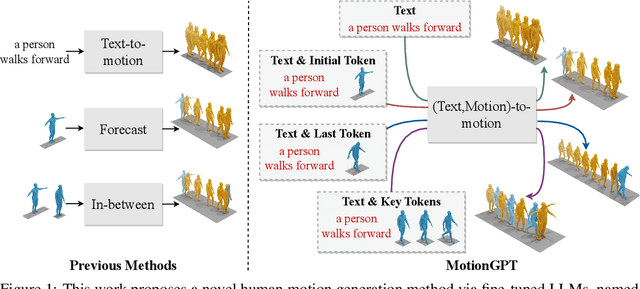
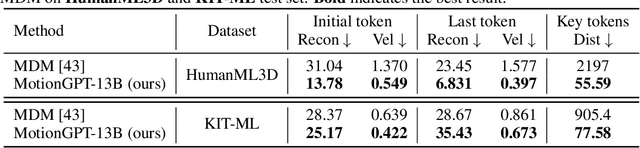
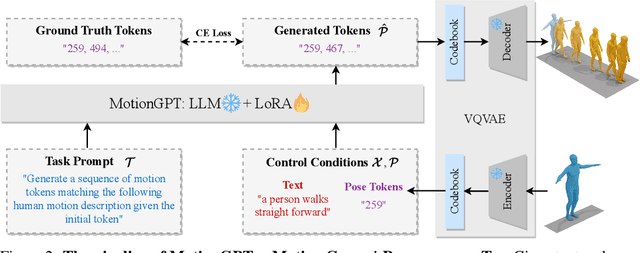
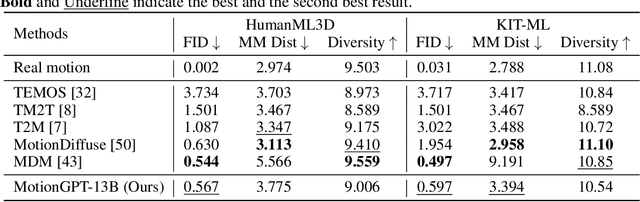
Generating realistic human motion from given action descriptions has experienced significant advancements because of the emerging requirement of digital humans. While recent works have achieved impressive results in generating motion directly from textual action descriptions, they often support only a single modality of the control signal, which limits their application in the real digital human industry. This paper presents a Motion General-Purpose generaTor (MotionGPT) that can use multimodal control signals, e.g., text and single-frame poses, for generating consecutive human motions by treating multimodal signals as special input tokens in large language models (LLMs). Specifically, we first quantize multimodal control signals into discrete codes and then formulate them in a unified prompt instruction to ask the LLMs to generate the motion answer. Our MotionGPT demonstrates a unified human motion generation model with multimodal control signals by tuning a mere 0.4% of LLM parameters. To the best of our knowledge, MotionGPT is the first method to generate human motion by multimodal control signals, which we hope can shed light on this new direction. Codes shall be released upon acceptance.