 Add to Chrome
 Add to Firefox
 Add to Edge
Token Prediction as Implicit Classification to Identify LLM-Generated Text
Nov 15, 2023
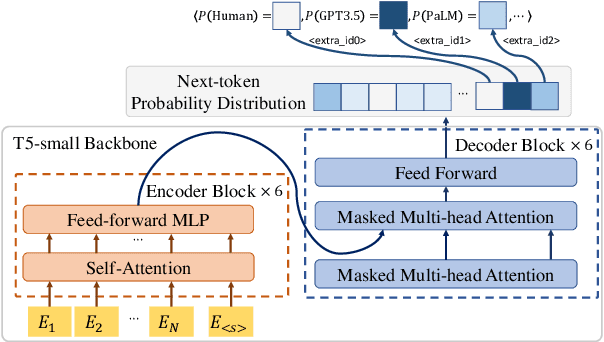
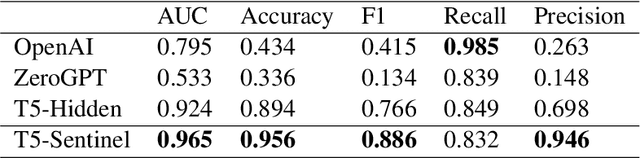
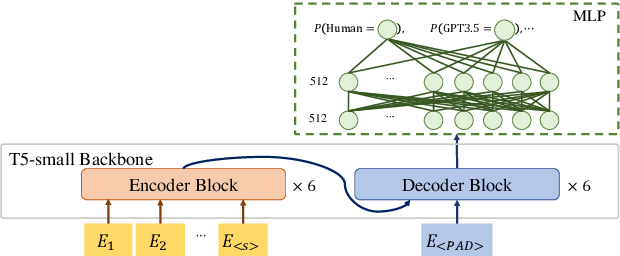
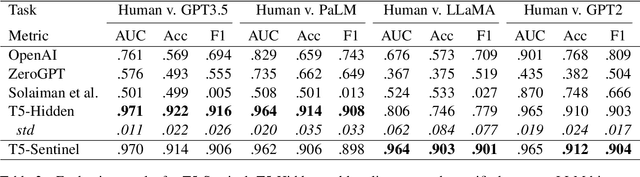
This paper introduces a novel approach for identifying the possible large language models (LLMs) involved in text generation. Instead of adding an additional classification layer to a base LM, we reframe the classification task as a next-token prediction task and directly fine-tune the base LM to perform it. We utilize the Text-to-Text Transfer Transformer (T5) model as the backbone for our experiments. We compared our approach to the more direct approach of utilizing hidden states for classification. Evaluation shows the exceptional performance of our method in the text classification task, highlighting its simplicity and efficiency. Furthermore, interpretability studies on the features extracted by our model reveal its ability to differentiate distinctive writing styles among various LLMs even in the absence of an explicit classifier. We also collected a dataset named OpenLLMText, containing approximately 340k text samples from human and LLMs, including GPT3.5, PaLM, LLaMA, and GPT2.

Pairwise Similarity Learning is SimPLE
Oct 13, 2023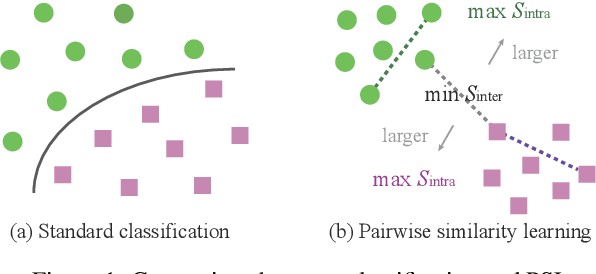
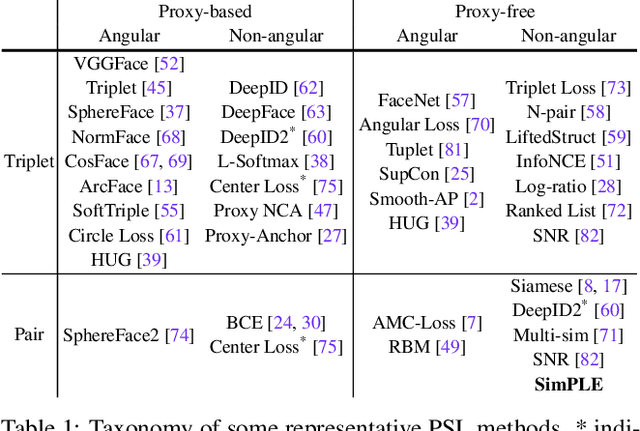
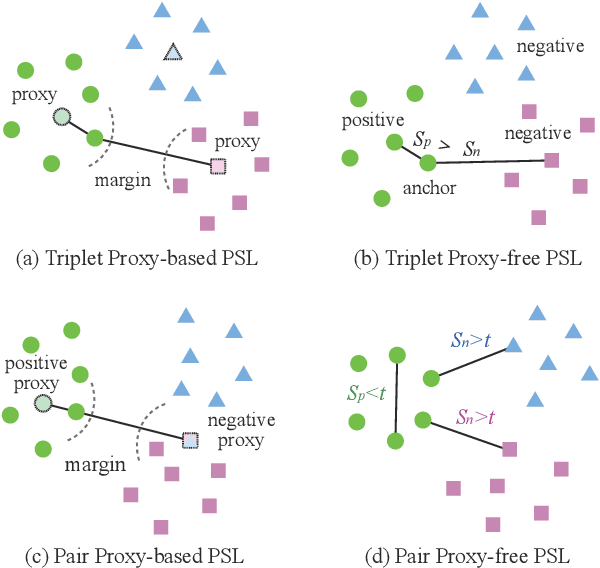
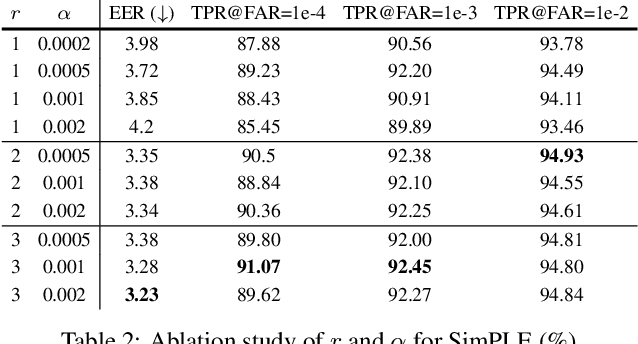
In this paper, we focus on a general yet important learning problem, pairwise similarity learning (PSL). PSL subsumes a wide range of important applications, such as open-set face recognition, speaker verification, image retrieval and person re-identification. The goal of PSL is to learn a pairwise similarity function assigning a higher similarity score to positive pairs (i.e., a pair of samples with the same label) than to negative pairs (i.e., a pair of samples with different label). We start by identifying a key desideratum for PSL, and then discuss how existing methods can achieve this desideratum. We then propose a surprisingly simple proxy-free method, called SimPLE, which requires neither feature/proxy normalization nor angular margin and yet is able to generalize well in open-set recognition. We apply the proposed method to three challenging PSL tasks: open-set face recognition, image retrieval and speaker verification. Comprehensive experimental results on large-scale benchmarks show that our method performs significantly better than current state-of-the-art methods.
Psychoacoustic Challenges Of Speech Enhancement On VoIP Platforms
Oct 11, 2023


Within the ambit of VoIP (Voice over Internet Protocol) telecommunications, the complexities introduced by acoustic transformations merit rigorous analysis. This research, rooted in the exploration of proprietary sender-side denoising effects, meticulously evaluates platforms such as Google Meets and Zoom. The study draws upon the Deep Noise Suppression (DNS) 2020 dataset, ensuring a structured examination tailored to various denoising settings and receiver interfaces. A methodological novelty is introduced via the Oaxaca decomposition, traditionally an econometric tool, repurposed herein to analyze acoustic-phonetic perturbations within VoIP systems. To further ground the implications of these transformations, psychoacoustic metrics, specifically PESQ and STOI, were harnessed to furnish a comprehensive understanding of speech alterations. Cumulatively, the insights garnered underscore the intricate landscape of VoIP-influenced acoustic dynamics. In addition to the primary findings, a multitude of metrics are reported, extending the research purview. Moreover, out-of-domain benchmarking for both time and time-frequency domain speech enhancement models is included, thereby enhancing the depth and applicability of this inquiry.
Privacy-oriented manipulation of speaker representations
Oct 10, 2023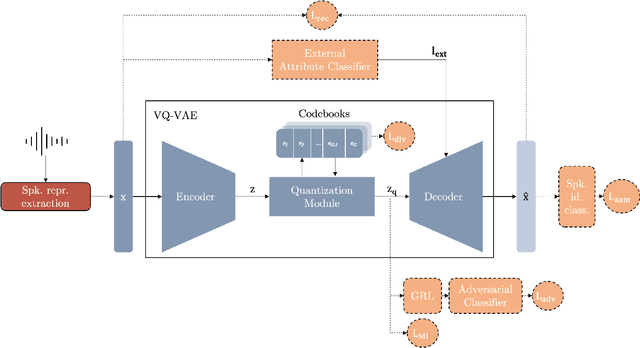
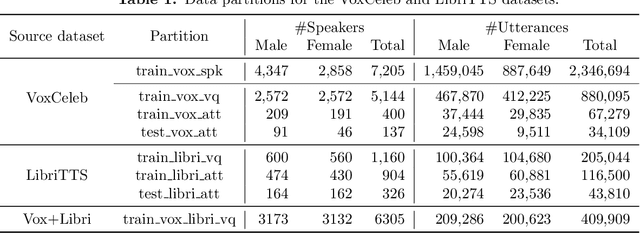
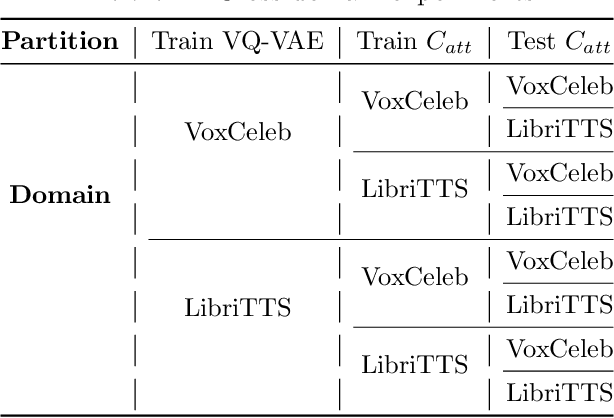
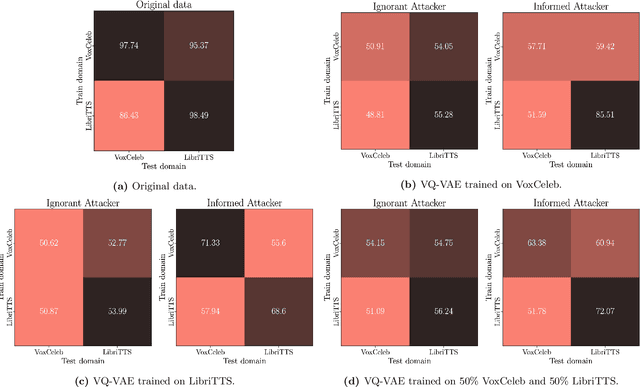
Speaker embeddings are ubiquitous, with applications ranging from speaker recognition and diarization to speech synthesis and voice anonymisation. The amount of information held by these embeddings lends them versatility, but also raises privacy concerns. Speaker embeddings have been shown to contain information on age, sex, health and more, which speakers may want to keep private, especially when this information is not required for the target task. In this work, we propose a method for removing and manipulating private attributes from speaker embeddings that leverages a Vector-Quantized Variational Autoencoder architecture, combined with an adversarial classifier and a novel mutual information loss. We validate our model on two attributes, sex and age, and perform experiments with ignorant and fully-informed attackers, and with in-domain and out-of-domain data.
Prompting Audios Using Acoustic Properties For Emotion Representation
Oct 05, 2023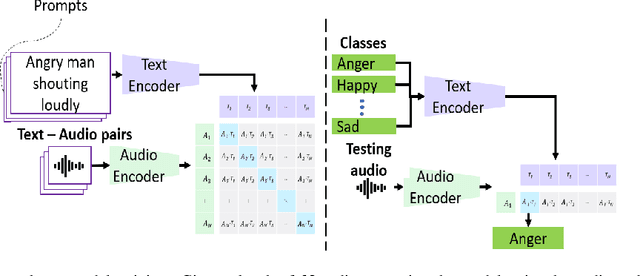
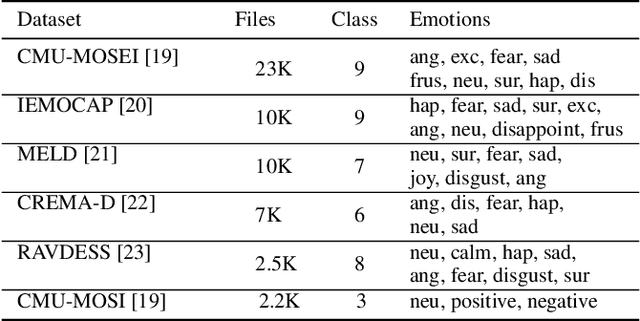
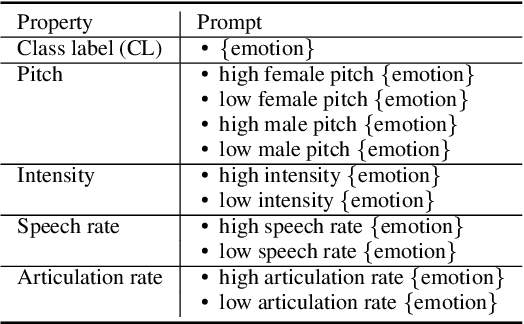
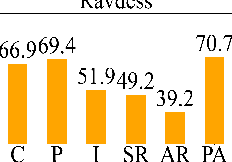
Emotions lie on a continuum, but current models treat emotions as a finite valued discrete variable. This representation does not capture the diversity in the expression of emotion. To better represent emotions we propose the use of natural language descriptions (or prompts). In this work, we address the challenge of automatically generating these prompts and training a model to better learn emotion representations from audio and prompt pairs. We use acoustic properties that are correlated to emotion like pitch, intensity, speech rate, and articulation rate to automatically generate prompts i.e. 'acoustic prompts'. We use a contrastive learning objective to map speech to their respective acoustic prompts. We evaluate our model on Emotion Audio Retrieval and Speech Emotion Recognition. Our results show that the acoustic prompts significantly improve the model's performance in EAR, in various Precision@K metrics. In SER, we observe a 3.8% relative accuracy improvement on the Ravdess dataset.
Continual Contrastive Spoken Language Understanding
Oct 04, 2023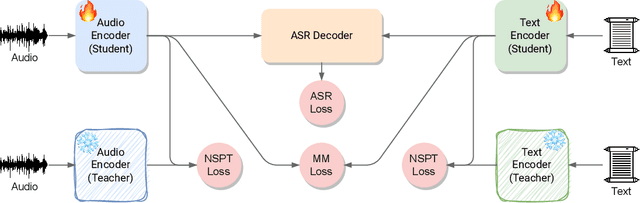
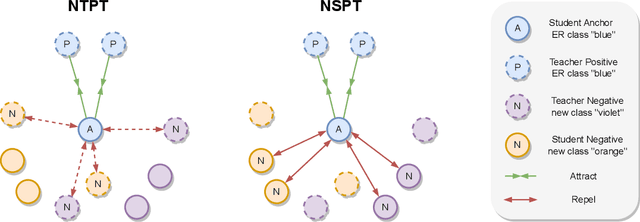
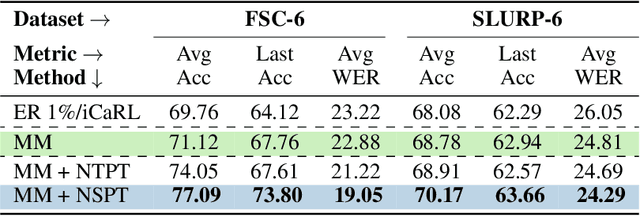
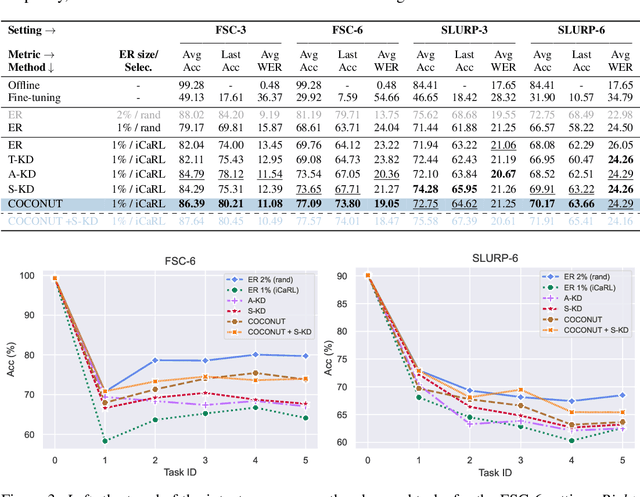
Recently, neural networks have shown impressive progress across diverse fields, with speech processing being no exception. However, recent breakthroughs in this area require extensive offline training using large datasets and tremendous computing resources. Unfortunately, these models struggle to retain their previously acquired knowledge when learning new tasks continually, and retraining from scratch is almost always impractical. In this paper, we investigate the problem of learning sequence-to-sequence models for spoken language understanding in a class-incremental learning (CIL) setting and we propose COCONUT, a CIL method that relies on the combination of experience replay and contrastive learning. Through a modified version of the standard supervised contrastive loss applied only to the rehearsal samples, COCONUT preserves the learned representations by pulling closer samples from the same class and pushing away the others. Moreover, we leverage a multimodal contrastive loss that helps the model learn more discriminative representations of the new data by aligning audio and text features. We also investigate different contrastive designs to combine the strengths of the contrastive loss with teacher-student architectures used for distillation. Experiments on two established SLU datasets reveal the effectiveness of our proposed approach and significant improvements over the baselines. We also show that COCONUT can be combined with methods that operate on the decoder side of the model, resulting in further metrics improvements.
LoFT: Local Proxy Fine-tuning For Improving Transferability Of Adversarial Attacks Against Large Language Model
Oct 02, 2023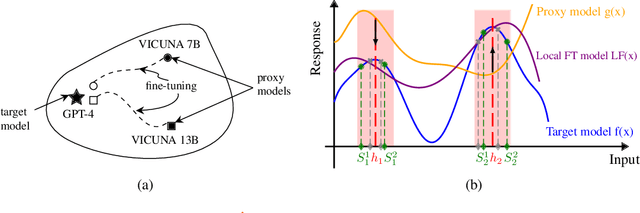

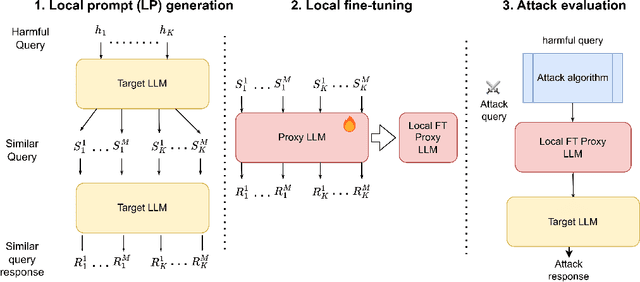

It has been shown that Large Language Model (LLM) alignments can be circumvented by appending specially crafted attack suffixes with harmful queries to elicit harmful responses. To conduct attacks against private target models whose characterization is unknown, public models can be used as proxies to fashion the attack, with successful attacks being transferred from public proxies to private target models. The success rate of attack depends on how closely the proxy model approximates the private model. We hypothesize that for attacks to be transferrable, it is sufficient if the proxy can approximate the target model in the neighborhood of the harmful query. Therefore, in this paper, we propose \emph{Local Fine-Tuning (LoFT)}, \textit{i.e.}, fine-tuning proxy models on similar queries that lie in the lexico-semantic neighborhood of harmful queries to decrease the divergence between the proxy and target models. First, we demonstrate three approaches to prompt private target models to obtain similar queries given harmful queries. Next, we obtain data for local fine-tuning by eliciting responses from target models for the generated similar queries. Then, we optimize attack suffixes to generate attack prompts and evaluate the impact of our local fine-tuning on the attack's success rate. Experiments show that local fine-tuning of proxy models improves attack transferability and increases attack success rate by $39\%$, $7\%$, and $0.5\%$ (absolute) on target models ChatGPT, GPT-4, and Claude respectively.
uSee: Unified Speech Enhancement and Editing with Conditional Diffusion Models
Oct 02, 2023Speech enhancement aims to improve the quality of speech signals in terms of quality and intelligibility, and speech editing refers to the process of editing the speech according to specific user needs. In this paper, we propose a Unified Speech Enhancement and Editing (uSee) model with conditional diffusion models to handle various tasks at the same time in a generative manner. Specifically, by providing multiple types of conditions including self-supervised learning embeddings and proper text prompts to the score-based diffusion model, we can enable controllable generation of the unified speech enhancement and editing model to perform corresponding actions on the source speech. Our experiments show that our proposed uSee model can achieve superior performance in both speech denoising and dereverberation compared to other related generative speech enhancement models, and can perform speech editing given desired environmental sound text description, signal-to-noise ratios (SNR), and room impulse responses (RIR). Demos of the generated speech are available at https://muqiaoy.github.io/usee.
Evaluating Speech Synthesis by Training Recognizers on Synthetic Speech
Oct 01, 2023Modern speech synthesis systems have improved significantly, with synthetic speech being indistinguishable from real speech. However, efficient and holistic evaluation of synthetic speech still remains a significant challenge. Human evaluation using Mean Opinion Score (MOS) is ideal, but inefficient due to high costs. Therefore, researchers have developed auxiliary automatic metrics like Word Error Rate (WER) to measure intelligibility. Prior works focus on evaluating synthetic speech based on pre-trained speech recognition models, however, this can be limiting since this approach primarily measures speech intelligibility. In this paper, we propose an evaluation technique involving the training of an ASR model on synthetic speech and assessing its performance on real speech. Our main assumption is that by training the ASR model on the synthetic speech, the WER on real speech reflects the similarity between distributions, a broader assessment of synthetic speech quality beyond intelligibility. Our proposed metric demonstrates a strong correlation with both MOS naturalness and MOS intelligibility when compared to SpeechLMScore and MOSNet on three recent Text-to-Speech (TTS) systems: MQTTS, StyleTTS, and YourTTS.
Completing Visual Objects via Bridging Generation and Segmentation
Oct 01, 2023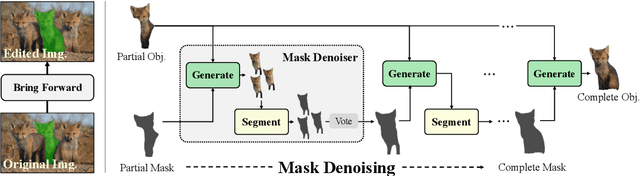
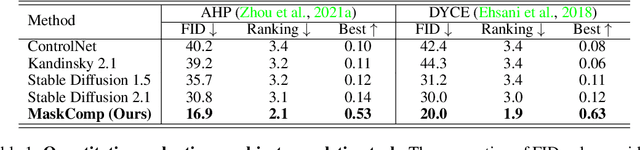
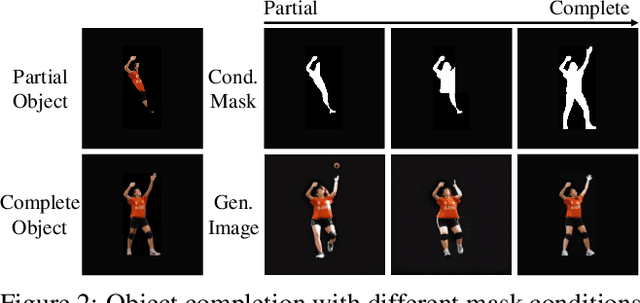

This paper presents a novel approach to object completion, with the primary goal of reconstructing a complete object from its partially visible components. Our method, named MaskComp, delineates the completion process through iterative stages of generation and segmentation. In each iteration, the object mask is provided as an additional condition to boost image generation, and, in return, the generated images can lead to a more accurate mask by fusing the segmentation of images. We demonstrate that the combination of one generation and one segmentation stage effectively functions as a mask denoiser. Through alternation between the generation and segmentation stages, the partial object mask is progressively refined, providing precise shape guidance and yielding superior object completion results. Our experiments demonstrate the superiority of MaskComp over existing approaches, e.g., ControlNet and Stable Diffusion, establishing it as an effective solution for object completion.