 Add to Chrome
 Add to Firefox
 Add to Edge
CARE: A Multimodal Corpus for Studying Speech and Non-Verbal Communication Across Multiple Medical Conditions
Jul 28, 2026
Automatic analysis of multimodal speech has shown strong potential for computationally detecting and monitoring a wide range of neurological, psychiatric, and respiratory conditions. However, progress in this field is limited by existing publicly accessible datasets, which are often small in scale, focused on a single condition or disease, and primarily speech focused. Moreover, if key confounding variables such as education, medication use, comorbidities, or mood state are insufficiently documented, the reliability and interpretability of computational analyses are further compromised. To address these limitations, we introduce CARE v1.0, a curated multimodal English dataset of approximately 144 hours of short video interviews collected from 612 individuals across 12 medical conditions plus a control cohort. For each video, a comprehensive set of clinically relevant multimodal descriptors is provided, alongside structured metadata covering factors such as medication, life impacts, and expressed emotions. The corpus's breadth and heterogeneity support a wide range of applications, including automatic disease and symptom detection, multimodal modelling of speech and non-verbal behaviour under emotionally charged contexts, and studies of disease trajectories and coping processes.

ESPnet3: Infrastructure for Scalable Speech and Audio Research in the Foundation Model Era
Jun 20, 2026Recent speech research involves increasingly large datasets, complex models, and diverse experimental workflows. However, existing frameworks require substantial engineering effort to support such experiments. We present ESPnet3, a speech and audio research framework built on a modular system architecture with configuration-driven dataset composition and unified Python-based workflows. ESPnet3 introduces a DataOrganizer abstraction for flexible dataset integration and dataset sharding for memory-efficient large-scale training, while allowing recipe-specific logic through lightweight stage overrides. In OWSM pre-training experiments, ESPnet3 reduces per-epoch training time by \emph{21.1 minutes} compared to ESPnet2 and achieves \emph{>80\% GPU utilization} in multi-node training. Fine-tuning experiments show that new models and datasets can be integrated with around \emph{46 lines of additional code}. ESPnet3 will be publicly released with model checkpoints and training logs.
Rethinking Depth: A study of the Recursive-Transformer for Speech Recognition
Jun 08, 2026Transformer-based architectures have led to significant improvements in Automatic Speech Recognition (ASR), often at the cost of substantially increased model sizes. A promising approach to address this issue is layer sharing through depth recursion, commonly referred to as the Recursive-Transformer, which involves repeatedly applying the same layers within the model. Despite its potential shown in other fields, this technique remains relatively unexplored in ASR. In this paper, we present an experimental study of the Recursive-Transformer applied to ASR encoder architectures. We systematically investigate the impact of recursion depth and layer allocation within the Recursive-based Transformer. Our results demonstrate that the Recursive-Transformer is a viable alternative, especially when recurrence is applied in the latent space with a restricted number of loops, obtaining comparable performance while reducing the parameter count by 66%.
FalAR: A Large-scale Speaker-Annotated European Portuguese Speech Corpus of Parliamentary Sessions
May 26, 2026State-of-the-art performance for Automatic Speech Recognition (ASR) largely depends on the availability of large-scale labeled corpora. This creates a demand for increased data collection efforts, particularly for under-represented languages and dialectal varieties. Due to having considerably fewer speakers (around 11 million), European Portuguese (EP) is overshadowed by Brazilian Portuguese (BP) (around 200 million speakers) in currently available large-scale speech data resources, resulting in under-performing speech-based systems for EP users. To address this gap, and following similar data collection efforts for other languages, we present FalAR, a large-scale, speaker-annotated speech corpus of European Portuguese parliamentary sessions. Spanning approximately 20 years, FalAR comprises 5,800 hours of speech data. In addition, 4,850 hours have speaker identity annotations, for a total of 1,180 speakers with associated metadata including age, gender, political affiliation, and parliamentary role. The corpus was built using a state-of-the-art EP CAMÕES ASR model for transcription-reference alignment. In this paper, we describe the data collection process, together with the main characteristics of the FalAR corpus. Furthermore, we evaluate the trade-off between data quantity and alignment accuracy on ASR performance, with our experiments demonstrating that incorporating FalAR as pre-training data yields up to 14% relative WER improvement over baseline models.
Exploring the potential and limitations of Model Merging for Multi-Domain Adaptation in ASR
Mar 05, 2026Model merging is a scalable alternative to multi-task training that combines the capabilities of multiple specialised models into a single model. This is particularly attractive for large speech foundation models, which are typically adapted through domain-specific fine-tuning, resulting in multiple customised checkpoints, for which repeating full fine-tuning when new data becomes available is computationally prohibitive. In this work, we study model merging for multi-domain ASR and benchmark 11 merging algorithms for 10 European Portuguese domains, evaluating in-domain accuracy, robustness under distribution shift, as well as English and multilingual performance. We further propose BoostedTSV-M, a new merging algorithm based on TSV-M that mitigates rank collapse via singular-value boosting and improves numerical stability. Overall, our approach outperforms full fine-tuning on European Portuguese while preserving out-of-distribution generalisation in a single model.
CAMÕES: A Comprehensive Automatic Speech Recognition Benchmark for European Portuguese
Aug 27, 2025Existing resources for Automatic Speech Recognition in Portuguese are mostly focused on Brazilian Portuguese, leaving European Portuguese (EP) and other varieties under-explored. To bridge this gap, we introduce CAM\~OES, the first open framework for EP and other Portuguese varieties. It consists of (1) a comprehensive evaluation benchmark, including 46h of EP test data spanning multiple domains; and (2) a collection of state-of-the-art models. For the latter, we consider multiple foundation models, evaluating their zero-shot and fine-tuned performances, as well as E-Branchformer models trained from scratch. A curated set of 425h of EP was used for both fine-tuning and training. Our results show comparable performance for EP between fine-tuned foundation models and the E-Branchformer. Furthermore, the best-performing models achieve relative improvements above 35% WER, compared to the strongest zero-shot foundation model, establishing a new state-of-the-art for EP and other varieties.
On the Relevance of Clinical Assessment Tasks for the Automatic Detection of Parkinson's Disease Medication State from Speech
May 21, 2025The automatic identification of medication states of Parkinson's disease (PD) patients can assist clinicians in monitoring and scheduling personalized treatments, as well as studying the effects of medication in alleviating the motor symptoms that characterize the disease. This paper explores speech as a non-invasive and accessible biomarker for identifying PD medication states, introducing a novel approach that addresses this task from a speaker-independent perspective. While traditional machine learning models achieve competitive results, self-supervised speech representations prove essential for optimal performance, significantly surpassing knowledge-based acoustic descriptors. Experiments across diverse speech assessment tasks highlight the relevance of prosody and continuous speech in distinguishing medication states, reaching an F1-score of 88.2%. These findings may streamline clinicians' work and reduce patient effort in voice recordings.
Tackling Cognitive Impairment Detection from Speech: A submission to the PROCESS Challenge
Dec 30, 2024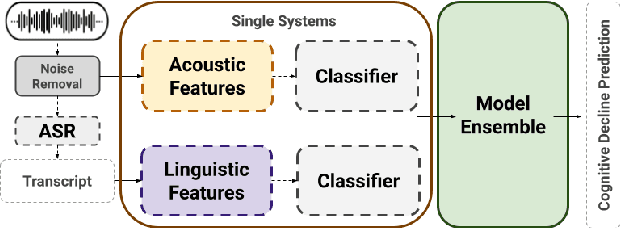


This work describes our group's submission to the PROCESS Challenge 2024, with the goal of assessing cognitive decline through spontaneous speech, using three guided clinical tasks. This joint effort followed a holistic approach, encompassing both knowledge-based acoustic and text-based feature sets, as well as LLM-based macrolinguistic descriptors, pause-based acoustic biomarkers, and multiple neural representations (e.g., LongFormer, ECAPA-TDNN, and Trillson embeddings). Combining these feature sets with different classifiers resulted in a large pool of models, from which we selected those that provided the best balance between train, development, and individual class performance. Our results show that our best performing systems correspond to combinations of models that are complementary to each other, relying on acoustic and textual information from all three clinical tasks.
Unveiling Interpretability in Self-Supervised Speech Representations for Parkinson's Diagnosis
Dec 02, 2024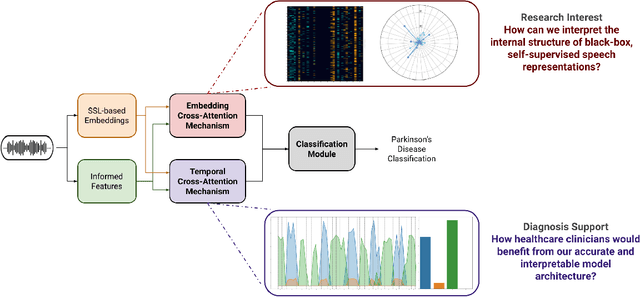
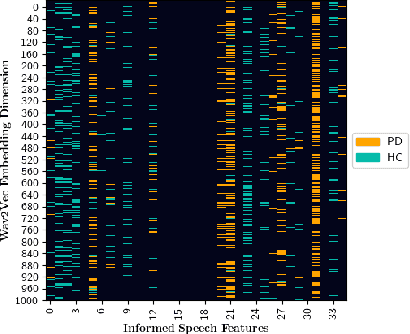
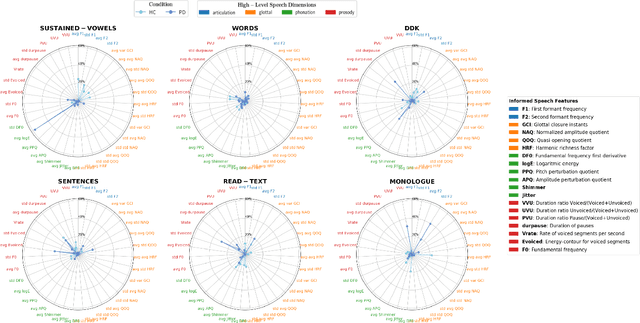
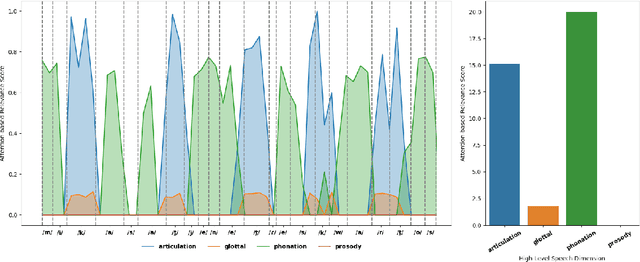
Recent works in pathological speech analysis have increasingly relied on powerful self-supervised speech representations, leading to promising results. However, the complex, black-box nature of these embeddings and the limited research on their interpretability significantly restrict their adoption for clinical diagnosis. To address this gap, we propose a novel, interpretable framework specifically designed to support Parkinson's Disease (PD) diagnosis. Through the design of simple yet effective cross-attention mechanisms for both embedding- and temporal-level analysis, the proposed framework offers interpretability from two distinct but complementary perspectives. Experimental findings across five well-established speech benchmarks for PD detection demonstrate the framework's capability to identify meaningful speech patterns within self-supervised representations for a wide range of assessment tasks. Fine-grained temporal analyses further underscore its potential to enhance the interpretability of deep-learning pathological speech models, paving the way for the development of more transparent, trustworthy, and clinically applicable computer-assisted diagnosis systems in this domain. Moreover, in terms of classification accuracy, our method achieves results competitive with state-of-the-art approaches, while also demonstrating robustness in cross-lingual scenarios when applied to spontaneous speech production.
AC-Mix: Self-Supervised Adaptation for Low-Resource Automatic Speech Recognition using Agnostic Contrastive Mixup
Oct 18, 2024Self-supervised learning (SSL) leverages large amounts of unlabelled data to learn rich speech representations, fostering improvements in automatic speech recognition (ASR), even when only a small amount of labelled data is available for fine-tuning. Despite the advances in SSL, a significant challenge remains when the data used for pre-training (source domain) mismatches the fine-tuning data (target domain). To tackle this domain mismatch challenge, we propose a new domain adaptation method for low-resource ASR focused on contrastive mixup for joint-embedding architectures named AC-Mix (agnostic contrastive mixup). In this approach, the SSL model is adapted through additional pre-training using mixed data views created by interpolating samples from the source and the target domains. Our proposed adaptation method consistently outperforms the baseline system, using approximately 11 hours of adaptation data and requiring only 1 hour of adaptation time on a single GPU with WavLM-Large.