 Add to Chrome
 Add to Firefox
 Add to Edge
A Multi-Grained Symmetric Differential Equation Model for Learning Protein-Ligand Binding Dynamics
Feb 01, 2024
In drug discovery, molecular dynamics (MD) simulation for protein-ligand binding provides a powerful tool for predicting binding affinities, estimating transport properties, and exploring pocket sites. There has been a long history of improving the efficiency of MD simulations through better numerical methods and, more recently, by utilizing machine learning (ML) methods. Yet, challenges remain, such as accurate modeling of extended-timescale simulations. To address this issue, we propose NeuralMD, the first ML surrogate that can facilitate numerical MD and provide accurate simulations in protein-ligand binding. We propose a principled approach that incorporates a novel physics-informed multi-grained group symmetric framework. Specifically, we propose (1) a BindingNet model that satisfies group symmetry using vector frames and captures the multi-level protein-ligand interactions, and (2) an augmented neural differential equation solver that learns the trajectory under Newtonian mechanics. For the experiment, we design ten single-trajectory and three multi-trajectory binding simulation tasks. We show the efficiency and effectiveness of NeuralMD, with a 2000$\times$ speedup over standard numerical MD simulation and outperforming all other ML approaches by up to 80% under the stability metric. We further qualitatively show that NeuralMD reaches more stable binding predictions compared to other machine learning methods.

Equivariant Graph Neural Operator for Modeling 3D Dynamics
Jan 19, 2024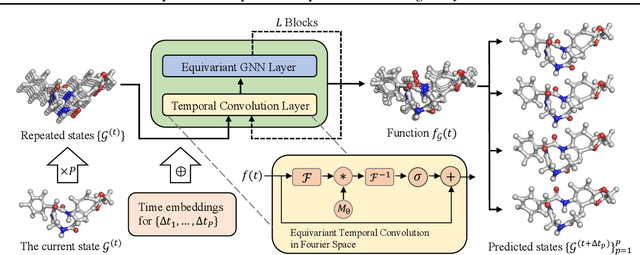
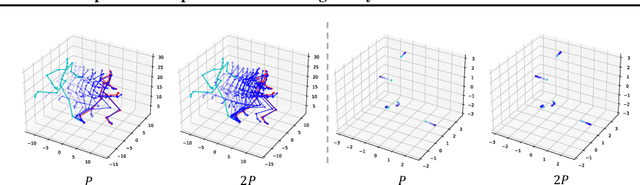
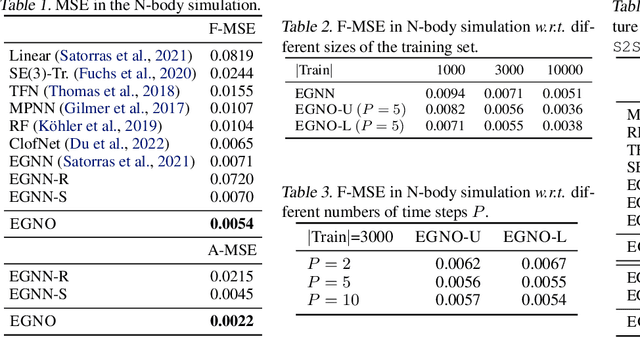
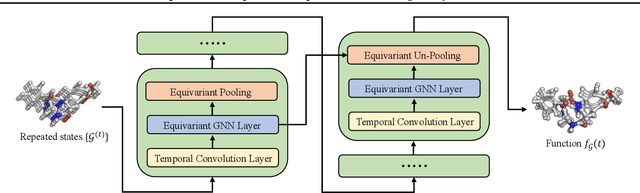
Modeling the complex three-dimensional (3D) dynamics of relational systems is an important problem in the natural sciences, with applications ranging from molecular simulations to particle mechanics. Machine learning methods have achieved good success by learning graph neural networks to model spatial interactions. However, these approaches do not faithfully capture temporal correlations since they only model next-step predictions. In this work, we propose Equivariant Graph Neural Operator (EGNO), a novel and principled method that directly models dynamics as trajectories instead of just next-step prediction. Different from existing methods, EGNO explicitly learns the temporal evolution of 3D dynamics where we formulate the dynamics as a function over time and learn neural operators to approximate it. To capture the temporal correlations while keeping the intrinsic SE(3)-equivariance, we develop equivariant temporal convolutions parameterized in the Fourier space and build EGNO by stacking the Fourier layers over equivariant networks. EGNO is the first operator learning framework that is capable of modeling solution dynamics functions over time while retaining 3D equivariance. Comprehensive experiments in multiple domains, including particle simulations, human motion capture, and molecular dynamics, demonstrate the significantly superior performance of EGNO against existing methods, thanks to the equivariant temporal modeling.
Fully Attentional Networks with Self-emerging Token Labeling
Jan 08, 2024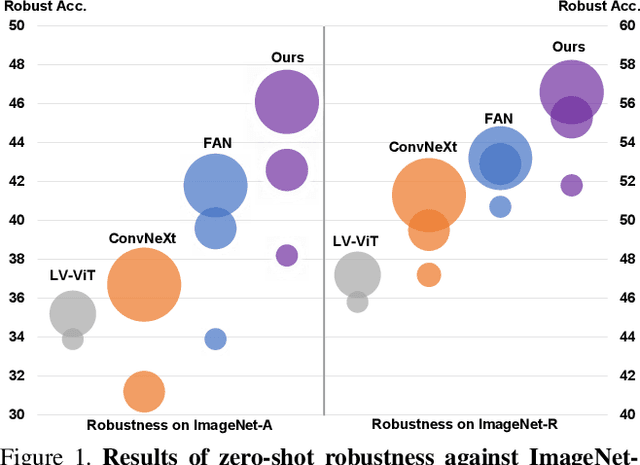
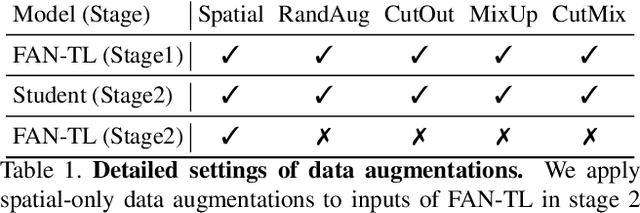
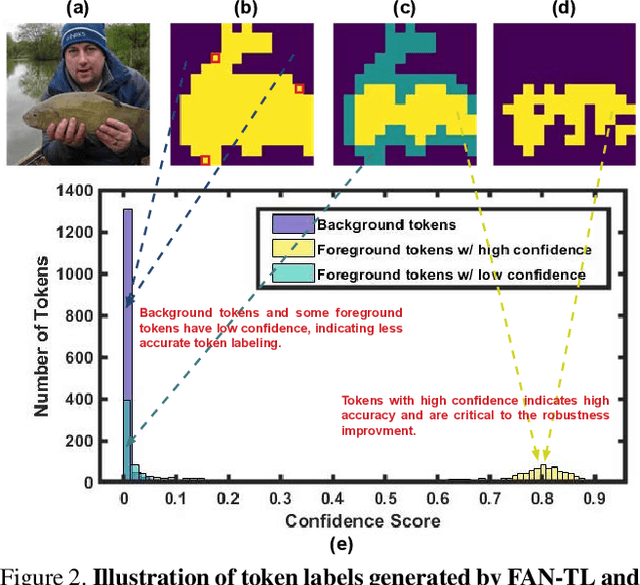
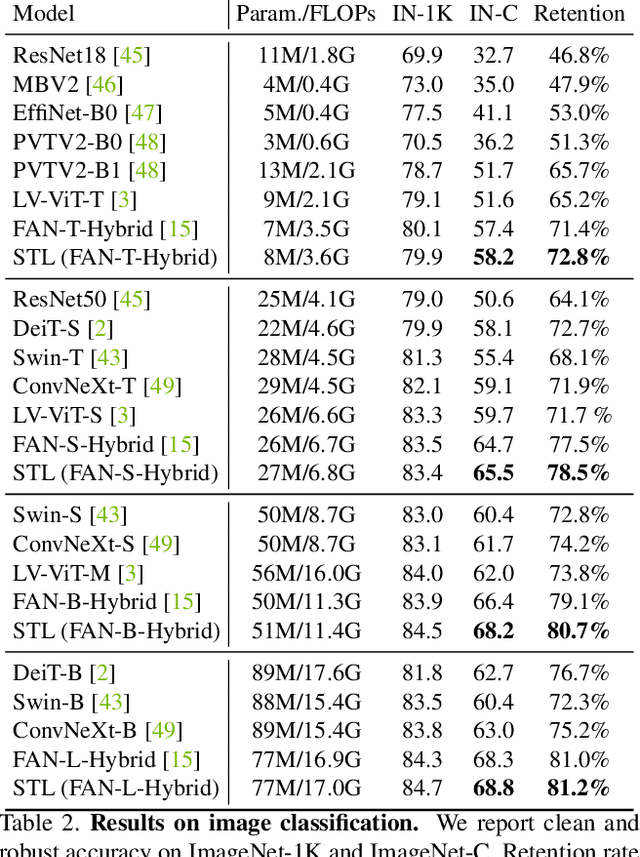
Recent studies indicate that Vision Transformers (ViTs) are robust against out-of-distribution scenarios. In particular, the Fully Attentional Network (FAN) - a family of ViT backbones, has achieved state-of-the-art robustness. In this paper, we revisit the FAN models and improve their pre-training with a self-emerging token labeling (STL) framework. Our method contains a two-stage training framework. Specifically, we first train a FAN token labeler (FAN-TL) to generate semantically meaningful patch token labels, followed by a FAN student model training stage that uses both the token labels and the original class label. With the proposed STL framework, our best model based on FAN-L-Hybrid (77.3M parameters) achieves 84.8% Top-1 accuracy and 42.1% mCE on ImageNet-1K and ImageNet-C, and sets a new state-of-the-art for ImageNet-A (46.1%) and ImageNet-R (56.6%) without using extra data, outperforming the original FAN counterpart by significant margins. The proposed framework also demonstrates significantly enhanced performance on downstream tasks such as semantic segmentation, with up to 1.7% improvement in robustness over the counterpart model. Code is available at https://github.com/NVlabs/STL.
Perspectives on the State and Future of Deep Learning - 2023
Dec 19, 2023The goal of this series is to chronicle opinions and issues in the field of machine learning as they stand today and as they change over time. The plan is to host this survey periodically until the AI singularity paperclip-frenzy-driven doomsday, keeping an updated list of topical questions and interviewing new community members for each edition. In this issue, we probed people's opinions on interpretable AI, the value of benchmarking in modern NLP, the state of progress towards understanding deep learning, and the future of academia.
Deep Multimodal Fusion for Surgical Feedback Classification
Dec 06, 2023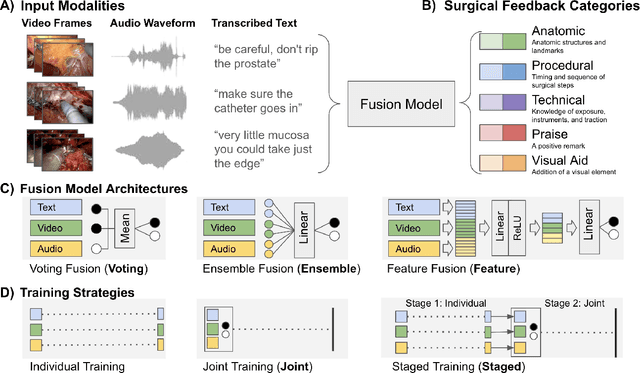

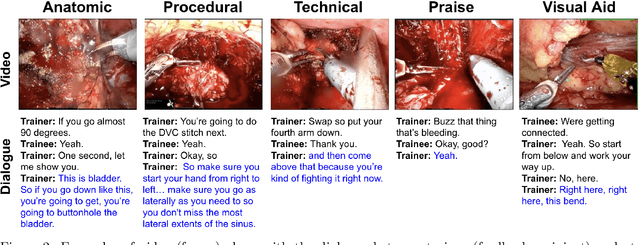
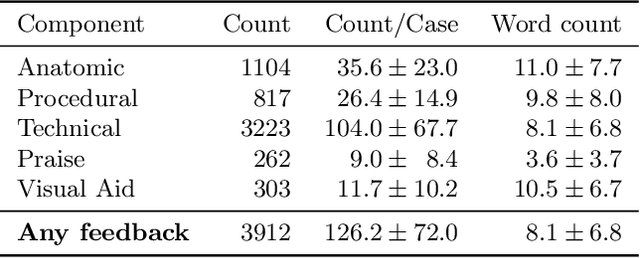
Quantification of real-time informal feedback delivered by an experienced surgeon to a trainee during surgery is important for skill improvements in surgical training. Such feedback in the live operating room is inherently multimodal, consisting of verbal conversations (e.g., questions and answers) as well as non-verbal elements (e.g., through visual cues like pointing to anatomic elements). In this work, we leverage a clinically-validated five-category classification of surgical feedback: "Anatomic", "Technical", "Procedural", "Praise" and "Visual Aid". We then develop a multi-label machine learning model to classify these five categories of surgical feedback from inputs of text, audio, and video modalities. The ultimate goal of our work is to help automate the annotation of real-time contextual surgical feedback at scale. Our automated classification of surgical feedback achieves AUCs ranging from 71.5 to 77.6 with the fusion improving performance by 3.1%. We also show that high-quality manual transcriptions of feedback audio from experts improve AUCs to between 76.5 and 96.2, which demonstrates a clear path toward future improvements. Empirically, we find that the Staged training strategy, with first pre-training each modality separately and then training them jointly, is more effective than training different modalities altogether. We also present intuitive findings on the importance of modalities for different feedback categories. This work offers an important first look at the feasibility of automated classification of real-world live surgical feedback based on text, audio, and video modalities.
Exploring Social Bias in Downstream Applications of Text-to-Image Foundation Models
Dec 05, 2023Text-to-image diffusion models have been adopted into key commercial workflows, such as art generation and image editing. Characterising the implicit social biases they exhibit, such as gender and racial stereotypes, is a necessary first step in avoiding discriminatory outcomes. While existing studies on social bias focus on image generation, the biases exhibited in alternate applications of diffusion-based foundation models remain under-explored. We propose methods that use synthetic images to probe two applications of diffusion models, image editing and classification, for social bias. Using our methodology, we uncover meaningful and significant inter-sectional social biases in \textit{Stable Diffusion}, a state-of-the-art open-source text-to-image model. Our findings caution against the uninformed adoption of text-to-image foundation models for downstream tasks and services.
Plasma Surrogate Modelling using Fourier Neural Operators
Nov 10, 2023Predicting plasma evolution within a Tokamak reactor is crucial to realizing the goal of sustainable fusion. Capabilities in forecasting the spatio-temporal evolution of plasma rapidly and accurately allow us to quickly iterate over design and control strategies on current Tokamak devices and future reactors. Modelling plasma evolution using numerical solvers is often expensive, consuming many hours on supercomputers, and hence, we need alternative inexpensive surrogate models. We demonstrate accurate predictions of plasma evolution both in simulation and experimental domains using deep learning-based surrogate modelling tools, viz., Fourier Neural Operators (FNO). We show that FNO has a speedup of six orders of magnitude over traditional solvers in predicting the plasma dynamics simulated from magnetohydrodynamic models, while maintaining a high accuracy (MSE $\approx$ $10^{-5}$). Our modified version of the FNO is capable of solving multi-variable Partial Differential Equations (PDE), and can capture the dependence among the different variables in a single model. FNOs can also predict plasma evolution on real-world experimental data observed by the cameras positioned within the MAST Tokamak, i.e., cameras looking across the central solenoid and the divertor in the Tokamak. We show that FNOs are able to accurately forecast the evolution of plasma and have the potential to be deployed for real-time monitoring. We also illustrate their capability in forecasting the plasma shape, the locations of interactions of the plasma with the central solenoid and the divertor for the full duration of the plasma shot within MAST. The FNO offers a viable alternative for surrogate modelling as it is quick to train and infer, and requires fewer data points, while being able to do zero-shot super-resolution and getting high-fidelity solutions.
EKGNet: A 10.96μW Fully Analog Neural Network for Intra-Patient Arrhythmia Classification
Oct 24, 2023


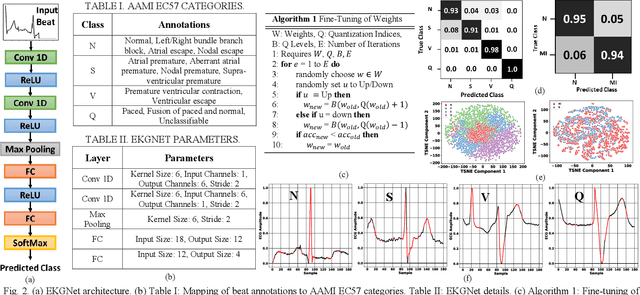
We present an integrated approach by combining analog computing and deep learning for electrocardiogram (ECG) arrhythmia classification. We propose EKGNet, a hardware-efficient and fully analog arrhythmia classification architecture that archives high accuracy with low power consumption. The proposed architecture leverages the energy efficiency of transistors operating in the subthreshold region, eliminating the need for analog-to-digital converters (ADC) and static random access memory (SRAM). The system design includes a novel analog sequential Multiply-Accumulate (MAC) circuit that mitigates process, supply voltage, and temperature variations. Experimental evaluations on PhysioNet's MIT-BIH and PTB Diagnostics datasets demonstrate the effectiveness of the proposed method, achieving average balanced accuracy of 95% and 94.25% for intra-patient arrhythmia classification and myocardial infarction (MI) classification, respectively. This innovative approach presents a promising avenue for developing low-power arrhythmia classification systems with enhanced accuracy and transferability in biomedical applications.
Eureka: Human-Level Reward Design via Coding Large Language Models
Oct 19, 2023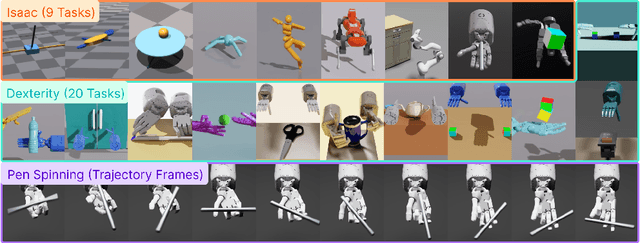
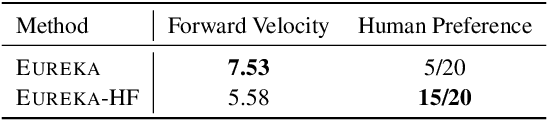
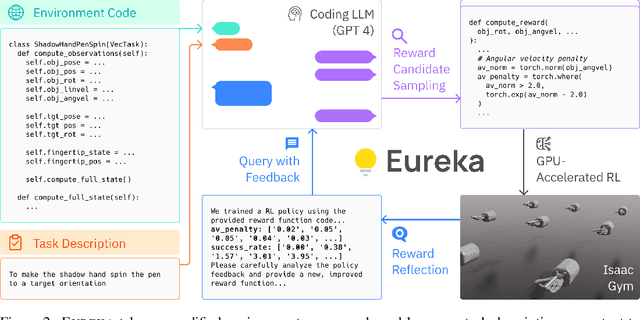
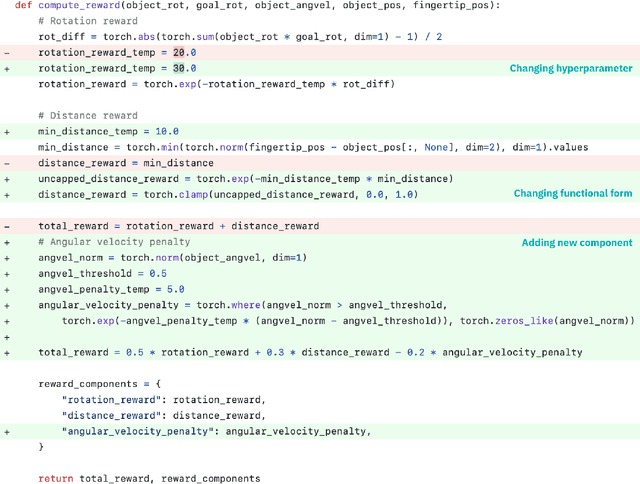
Large Language Models (LLMs) have excelled as high-level semantic planners for sequential decision-making tasks. However, harnessing them to learn complex low-level manipulation tasks, such as dexterous pen spinning, remains an open problem. We bridge this fundamental gap and present Eureka, a human-level reward design algorithm powered by LLMs. Eureka exploits the remarkable zero-shot generation, code-writing, and in-context improvement capabilities of state-of-the-art LLMs, such as GPT-4, to perform evolutionary optimization over reward code. The resulting rewards can then be used to acquire complex skills via reinforcement learning. Without any task-specific prompting or pre-defined reward templates, Eureka generates reward functions that outperform expert human-engineered rewards. In a diverse suite of 29 open-source RL environments that include 10 distinct robot morphologies, Eureka outperforms human experts on 83% of the tasks, leading to an average normalized improvement of 52%. The generality of Eureka also enables a new gradient-free in-context learning approach to reinforcement learning from human feedback (RLHF), readily incorporating human inputs to improve the quality and the safety of the generated rewards without model updating. Finally, using Eureka rewards in a curriculum learning setting, we demonstrate for the first time, a simulated Shadow Hand capable of performing pen spinning tricks, adeptly manipulating a pen in circles at rapid speed.
DeepSpeed4Science Initiative: Enabling Large-Scale Scientific Discovery through Sophisticated AI System Technologies
Oct 11, 2023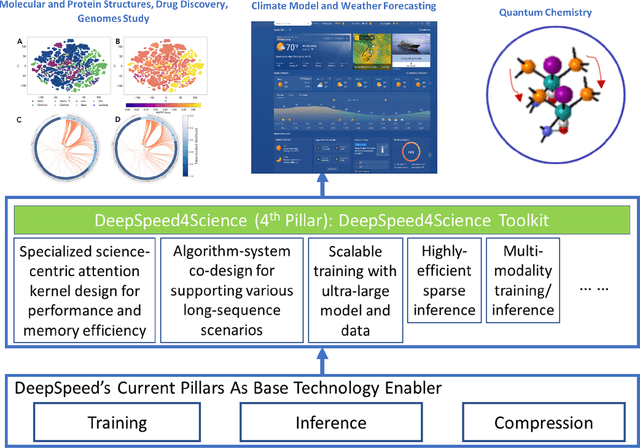
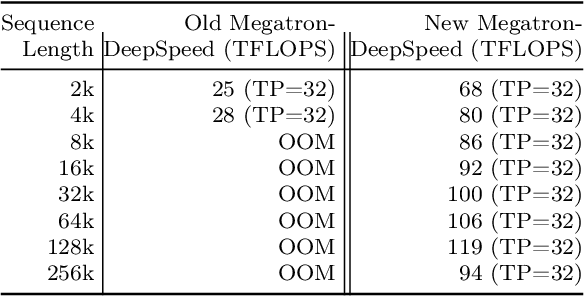
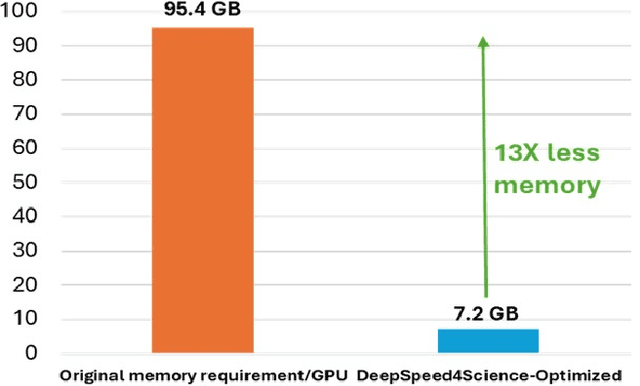
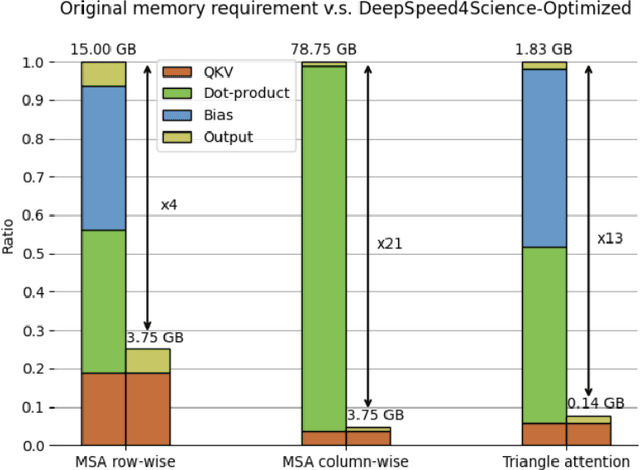
In the upcoming decade, deep learning may revolutionize the natural sciences, enhancing our capacity to model and predict natural occurrences. This could herald a new era of scientific exploration, bringing significant advancements across sectors from drug development to renewable energy. To answer this call, we present DeepSpeed4Science initiative (deepspeed4science.ai) which aims to build unique capabilities through AI system technology innovations to help domain experts to unlock today's biggest science mysteries. By leveraging DeepSpeed's current technology pillars (training, inference and compression) as base technology enablers, DeepSpeed4Science will create a new set of AI system technologies tailored for accelerating scientific discoveries by addressing their unique complexity beyond the common technical approaches used for accelerating generic large language models (LLMs). In this paper, we showcase the early progress we made with DeepSpeed4Science in addressing two of the critical system challenges in structural biology research.