 Add to Chrome
 Add to Firefox
 Add to Edge
Global Exponential Stabilization of the Kinematic Bicycle Model of a Car in Polar Coordinates
Jul 29, 2026
At parking speeds, the kinematic bicycle is the prevailing model for car-like vehicles. Yet, despite its wide use, stabilizing feedback laws for this system are scarce in the literature, and existing designs often do not reproduce realistic parking maneuvers. This limitation is inherent to the Cartesian coordinates, where Brockett's condition rules out smooth static feedback stabilization. We bypass this obstruction by transforming the system into polar coordinates together with additional range-normalized coordinates that encode the geometry of human-like parking maneuvers. In the transformed coordinates, the dynamics take a strict-feedback form, enabling a nonconventional backstepping design. We exploit the particular structure to develop smooth feedback laws that achieve global exponential stabilization in the transformed coordinates which in turn generates parking trajectories resembling the one performed by human drivers through feedback alone.

Families of Control-Cost-Parametrized Inverse-Optimal Universal Stabilizers
Jun 08, 2026A classical universal stabilization formula offers the practitioner no design freedom: it is a single, parameter-free object. We introduce a cost-parametrized family of stabilizing feedback laws, where (1) the user chooses a function that serves as the running cost on control in an inverse-optimal cost functional, and (2) obtains, through a formula, a nonlinear "expander" of a pre-existing universal controller, which solves an infinite-horizon optimal control problem with a meaningful cost on the state. The cost-to-expander formula is a three-step construction, involving, inter alia, cost differentiation and function inversion-overall, a nonlinear infinite-dimensional operator. The cost-to-expander operator is proven Lipschitz, which enables uniform neural operator approximation of the entire family and supports both offline performance exploration and online adaptation. Semiglobal practical asymptotic stability and second-order suboptimality bounds are established under the approximation. The operator learning and its use in semiglobal stabilization are illustrated numerically. We call the result 'half-direct-optimal' because the paper's design is less than a general 'direct optimal' (HJB-inducing) control, but more than the fully inverse optimal, since the user performs minimization for an arbitrary given cost on control. The dual to the half-direct problem we solve is the problem in which the cost on the state is arbitrary and given. This dual problem is easier and outside of the scope of the paper.
Lotka-Sharpe Neural Operators for Control of Population PDEs
Apr 04, 2026Age-structured predator-prey integro-partial differential equations provide models of interacting populations in ecology, epidemiology, and biotechnology. A key challenge in feedback design for these systems is the scalar $ζ$, defined implicitly by the Lotka-Sharpe nonlinear integral condition, as a mapping from fertility and mortality rates to $ζ$. To solve this challenge with operator learning, we first prove that the Lotka-Sharpe operator is Lipschitz continuous, guaranteeing the existence of arbitrarily accurate neural operator approximations over a compact set of fertility and mortality functions. We then show that the resulting approximate feedback law preserves semi-global practical asymptotic stability under propagation of the operator approximation error through various other nonlinear operators, all the way through to the control input. In the numerical results, not only do we learn ``once-and-for-all'' the canonical Lotka-Sharpe (LS) operator, and thus make it available for future uses in control of other age-structured population interconnections, but we demonstrate the online usage of the neural LS operator under estimation of the fertility and mortality functions.
Sampling-Horizon Neural Operator Predictors for Nonlinear Control under Delayed Inputs
Mar 31, 2026Modern control systems frequently operate under input delays and sampled state measurements. A common delay-compensation strategy is predictor feedback; however, practical implementations require solving an implicit ODE online, resulting in intractable computational cost. Moreover, predictor formulations typically assume continuously available state measurements, whereas in practice measurements may be sampled, irregular, or temporarily missing due to hardware faults. In this work, we develop two neural-operator predictor-feedback designs for nonlinear systems with delayed inputs and sampled measurements. In the first design, we introduce a sampling-horizon prediction operator that maps the current measurement and input history to the predicted state trajectory over the next sampling interval. In the second design, the neural operator approximates only the delay-compensating predictor, which is then composed with the closed-loop flow between measurements. The first approach requires uniform sampling but yields residual bounds that scale directly with the operator approximation error. In contrast, the second accommodates non-uniform, but bounded sampling schedules at the cost of amplified approximation error, revealing a practical tradeoff between sampling flexibility and approximation sensitivity for the control engineer. For both schemes, we establish semi-global practical stability with explicit neural operator error-dependent bounds. Numerical experiments on a 6-link nonlinear robotic manipulator demonstrate accurate tracking and substantial computational speedup of 25$\times$ over a baseline approach.
Predictor-Based Output-Feedback Control of Linear Systems with Time-Varying Input and Measurement Delays via Neural-Approximated Prediction Horizons
Mar 31, 2026Due to simplicity and strong stability guarantees, predictor feedback methods have stood as a popular approach for time delay systems since the 1950s. For time-varying delays, however, implementation requires computing a prediction horizon defined by the inverse of the delay function, which is rarely available in closed form and must be approximated. In this work, we formulate the inverse delay mapping as an operator learning problem and study predictor feedback under approximation of the prediction horizon. We propose two approaches: (i) a numerical method based on time integration of an equivalent ODE, and (ii) a data-driven method using neural operators to learn the inverse mapping. We show that both approaches achieve arbitrary approximation accuracy over compact sets, with complementary trade-offs in computational cost and scalability. Building on these approximations, we then develop an output-feedback predictor design for systems with delays in both the input and the measurement. We prove that the resulting closed-loop system is globally exponentially stable when the prediction horizon is approximated with sufficiently small error. Lastly, numerical experiments validate the proposed methods and illustrate their trade-offs between accuracy and computational efficiency.
Nonholonomic Robot Parking by Feedback -- Part I: Modular Strict CLF Designs
Nov 19, 2025It has been known in the robotics literature since about 1995 that, in polar coordinates, the nonholonomic unicycle is asymptotically stabilizable by smooth feedback, even globally. We introduce a modular design framework that selects the forward velocity to decouple the radial coordinate, allowing the steering subsystem to be stabilized independently. Within this structure, we develop families of feedback laws using passivity, backstepping, and integrator forwarding. Each law is accompanied by a strict control Lyapunov function, including barrier variants that enforce angular constraints. These strict CLFs provide constructive class KL convergence estimates and enable eigenvalue assignment at the target equilibrium. The framework generalizes and extends prior modular and nonmodular approaches, while preparing the ground for inverse optimal and adaptive redesigns in the sequel paper.
Stabilization of nonlinear systems with unknown delays via delay-adaptive neural operator approximate predictors
Sep 30, 2025This work establishes the first rigorous stability guarantees for approximate predictors in delay-adaptive control of nonlinear systems, addressing a key challenge in practical implementations where exact predictors are unavailable. We analyze two scenarios: (i) when the actuated input is directly measurable, and (ii) when it is estimated online. For the measurable input case, we prove semi-global practical asymptotic stability with an explicit bound proportional to the approximation error $\epsilon$. For the unmeasured input case, we demonstrate local practical asymptotic stability, with the region of attraction explicitly dependent on both the initial delay estimate and the predictor approximation error. To bridge theory and practice, we show that neural operators-a flexible class of neural network-based approximators-can achieve arbitrarily small approximation errors, thus satisfying the conditions of our stability theorems. Numerical experiments on two nonlinear benchmark systems-a biological protein activator/repressor model and a micro-organism growth Chemostat model-validate our theoretical results. In particular, our numerical simulations confirm stability under approximate predictors, highlight the strong generalization capabilities of neural operators, and demonstrate a substantial computational speedup of up to 15x compared to a baseline fixed-point method.
Neural Operators for Predictor Feedback Control of Nonlinear Delay Systems
Nov 28, 2024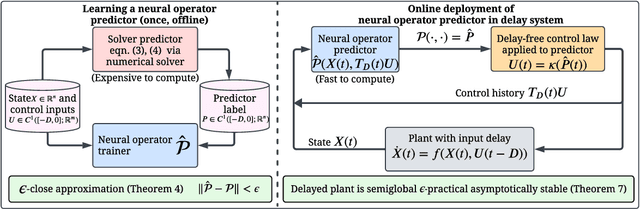

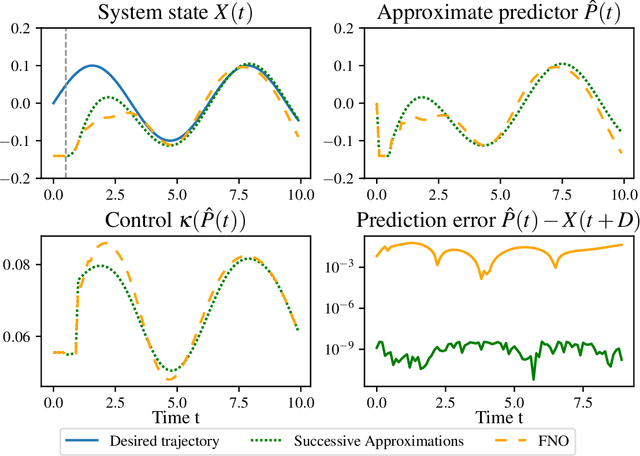

Predictor feedback designs are critical for delay-compensating controllers in nonlinear systems. However, these designs are limited in practical applications as predictors cannot be directly implemented, but require numerical approximation schemes. These numerical schemes, typically combining finite difference and successive approximations, become computationally prohibitive when the dynamics of the system are expensive to compute. To alleviate this issue, we propose approximating the predictor mapping via a neural operator. In particular, we introduce a new perspective on predictor designs by recasting the predictor formulation as an operator learning problem. We then prove the existence of an arbitrarily accurate neural operator approximation of the predictor operator. Under the approximated-predictor, we achieve semiglobal practical stability of the closed-loop nonlinear system. The estimate is semiglobal in a unique sense - namely, one can increase the set of initial states as large as desired but this will naturally increase the difficulty of training a neural operator approximation which appears practically in the stability estimate. Furthermore, we emphasize that our result holds not just for neural operators, but any black-box predictor satisfying a universal approximation error bound. From a computational perspective, the advantage of the neural operator approach is clear as it requires training once, offline and then is deployed with very little computational cost in the feedback controller. We conduct experiments controlling a 5-link robotic manipulator with different state-of-the-art neural operator architectures demonstrating speedups on the magnitude of $10^2$ compared to traditional predictor approximation schemes.
Adaptive control of reaction-diffusion PDEs via neural operator-approximated gain kernels
Jul 01, 2024Neural operator approximations of the gain kernels in PDE backstepping has emerged as a viable method for implementing controllers in real time. With such an approach, one approximates the gain kernel, which maps the plant coefficient into the solution of a PDE, with a neural operator. It is in adaptive control that the benefit of the neural operator is realized, as the kernel PDE solution needs to be computed online, for every updated estimate of the plant coefficient. We extend the neural operator methodology from adaptive control of a hyperbolic PDE to adaptive control of a benchmark parabolic PDE (a reaction-diffusion equation with a spatially-varying and unknown reaction coefficient). We prove global stability and asymptotic regulation of the plant state for a Lyapunov design of parameter adaptation. The key technical challenge of the result is handling the 2D nature of the gain kernels and proving that the target system with two distinct sources of perturbation terms, due to the parameter estimation error and due to the neural approximation error, is Lyapunov stable. To verify our theoretical result, we present simulations achieving calculation speedups up to 45x relative to the traditional finite difference solvers for every timestep in the simulation trajectory.
PDE Control Gym: A Benchmark for Data-Driven Boundary Control of Partial Differential Equations
May 18, 2024
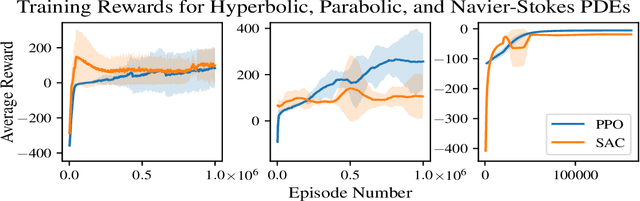

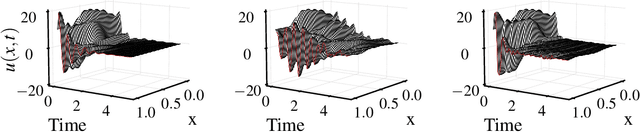
Over the last decade, data-driven methods have surged in popularity, emerging as valuable tools for control theory. As such, neural network approximations of control feedback laws, system dynamics, and even Lyapunov functions have attracted growing attention. With the ascent of learning based control, the need for accurate, fast, and easy-to-use benchmarks has increased. In this work, we present the first learning-based environment for boundary control of PDEs. In our benchmark, we introduce three foundational PDE problems - a 1D transport PDE, a 1D reaction-diffusion PDE, and a 2D Navier-Stokes PDE - whose solvers are bundled in an user-friendly reinforcement learning gym. With this gym, we then present the first set of model-free, reinforcement learning algorithms for solving this series of benchmark problems, achieving stability, although at a higher cost compared to model-based PDE backstepping. With the set of benchmark environments and detailed examples, this work significantly lowers the barrier to entry for learning-based PDE control - a topic largely unexplored by the data-driven control community. The entire benchmark is available on Github along with detailed documentation and the presented reinforcement learning models are open sourced.