 Add to Chrome
 Add to Firefox
 Add to Edge
Geometry-Aware Superpixel Graph Transformer with Metadata for Skin Lesion Classification
Jun 18, 2026
Automated skin cancer classification from dermoscopic images remains challenging due to heterogeneous lesion structure, strong intra-class variability, and subtle visual differences between benign and malignant cases. Existing CNN/ViT pipelines typically rely on global or patch-level features and often combine patient metadata via late fusion, which limits spatially grounded multimodal reasoning. We present a novel region-based graph learning framework that explicitly models lesions as graphs of spatially coherent superpixel regions represented as frozen CNN features. To capture fine-grained lesion arrangements, we encode inter-regional geometry as edge attributes and introduce a dedicated metadata context node connected to all regions, providing structured integration of demographic/clinical variables within the same relational space. Node representations are updated using our edge-aware graph transformer followed by attention-driven propagation, and a final graph-level embedding for benign-malignant classification. Experiments on four public benchmarks demonstrate that explicit region-level relational modeling and graph-native multimodal fusion yield consistent gains over the state-of-the-art. Consequently, we establish a new graph-centric perspective in which CNN features are modeled as relational nodes and improved through contextual integration, yielding more expressive and robust classifications.

TimeLens: On-Device Artifact Recognition with Retrieval-Augmented Question Answering for the Grand Egyptian Museum
Jun 11, 2026TimeLens is an AI-powered bilingual mobile guide for the Grand Egyptian Museum (GEM). Pointing a phone at an exhibit, a visitor sees the artifact recognized in real time and can ask follow-up questions answered in English or Arabic. The work addresses three problems specific to in-gallery deployment: fine-grained visual similarity among 51 catalogued artifacts (many near-identical Ramesside statues), the gap between curated training data and handheld camera conditions, and the risk of an AI guide stating unsupported historical facts. Two engineering contributions are reported. First, an on-device artifact detector was developed through a data-quality-driven iteration study -- from foundation-model auto-annotation (YOLO-World), through spatial label-cleaning rules, to a fully hand-annotated dataset -- isolating label quality as the decisive factor: the final YOLOv8n model resolves every previously failing class while remaining a 5.97 MB TensorFlow Lite asset that runs in real time on a mid-range phone (mAP@0.5 = 0.995, mAP@0.5:0.95 = 0.924). Second, a bilingual Retrieval-Augmented Generation (RAG) guide, grounded in a 108-record ChromaDB knowledge base, was benchmarked across seven candidate language models, with Gemma 4 E2B (Q4 K M) selected; ten targeted optimizations reduce end-to-end latency from over 30 s to approximately 10 s. Both subsystems are integrated in a production Flutter application with bilingual interface, museum location gating, and text-to-speech support.
Semantic Density Effect (SDE): Maximizing Information Per Token Improves LLM Accuracy
Apr 19, 2026We introduce the Semantic Density Effect (SDE): the empirical finding that prompts carrying higher semantic information per token consistently produce more accurate, focused, and less hallucinated outputs across all major LLM families. SDE is defined as the ratio of semantically loaded tokens to total prompt tokens, adjusted for redundancy and concreteness. Unlike prior prompt optimization techniques that add tokens (Chain of Thought), duplicate the prompt (Prompt Repetition), or reorder components (Instruction Placement Effect), SDE improves performance by removing or replacing low-information tokens while preserving or sharpening the semantic signal. Evaluated across five frontier models and seven benchmarks, ultra-dense prompts (SDE > 0.80) outperform diluted counterparts by an average of +8.4 percentage points with 0 additional tokens and 0 latency overhead. Combined with Instruction Placement Effect (IPE), the gain reaches +11.7 percentage points
HistDiT: A Structure-Aware Latent Conditional Diffusion Model for High-Fidelity Virtual Staining in Histopathology
Apr 09, 2026Immunohistochemistry (IHC) is essential for assessing specific immune biomarkers like Human Epidermal growth-factor Receptor 2 (HER2) in breast cancer. However, the traditional protocols of obtaining IHC stains are resource-intensive, time-consuming, and prone to structural damages. Virtual staining has emerged as a scalable alternative, but it faces significant challenges in preserving fine-grained cellular structures while accurately translating biochemical expressions. Current state-of-the-art methods still rely on Generative Adversarial Networks (GANs) or standard convolutional U-Net diffusion models that often struggle with "structure and staining trade-offs". The generated samples are either structurally relevant but blurry, or texturally realistic but have artifacts that compromise their diagnostic use. In this paper, we introduce HistDiT, a novel latent conditional Diffusion Transformer (DiT) architecture that establishes a new benchmark for visual fidelity in virtual histological staining. The novelty introduced in this work is, a) the Dual-Stream Conditioning strategy that explicitly maintains a balance between spatial constraints via VAE-encoded latents and semantic phenotype guidance via UNI embeddings; b) the multi-objective loss function that contributes to sharper images with clear morphological structure; and c) the use of the Structural Correlation Metric (SCM) to focus on the core morphological structure for precise assessment of sample quality. Consequently, our model outperforms existing baselines, as demonstrated through rigorous quantitative and qualitative evaluations.
Training-Only Heterogeneous Image-Patch-Text Graph Supervision for Advancing Few-Shot Learning Adapters
Mar 18, 2026Recent adapter-based CLIP tuning (e.g., Tip-Adapter) is a strong few-shot learner, achieving efficiency by caching support features for fast prototype matching. However, these methods rely on global uni-modal feature vectors, overlooking fine-grained patch relations and their structural alignment with class text. To bridge this gap without incurring inference costs, we introduce a novel asymmetric training-only framework. Instead of altering the lightweight adapter, we construct a high-capacity auxiliary Heterogeneous Graph Teacher that operates solely during training. This teacher (i) integrates multi-scale visual patches and text prompts into a unified graph, (ii) performs deep cross-modal reasoning via a Modality-aware Graph Transformer (MGT), and (iii) applies discriminative node filtering to extract high-fidelity class features. Crucially, we employ a cache-aware dual-objective strategy to supervise this relational knowledge directly into the Tip-Adapter's key-value cache, effectively upgrading the prototypes while the graph teacher is discarded at test time. Thus, inference remains identical to Tip-Adapter with zero extra latency or memory. Across standard 1-16-shot benchmarks, our method consistently establishes a new state-of-the-art. Ablations confirm that the auxiliary graph supervision, text-guided reasoning, and node filtering are the essential ingredients for robust few-shot adaptation. Code is available at https://github.com/MR-Sherif/TOGA.git.
Inference-time Unlearning Using Conformal Prediction
Feb 03, 2026Machine unlearning is the process of efficiently removing specific information from a trained machine learning model without retraining from scratch. Existing unlearning methods, which often provide provable guarantees, typically involve retraining a subset of model parameters based on a forget set. While these approaches show promise in certain scenarios, their underlying assumptions are often challenged in real-world applications -- particularly when applied to generative models. Furthermore, updating parameters using these unlearning procedures often degrades the general-purpose capabilities the model acquired during pre-training. Motivated by these shortcomings, this paper considers the paradigm of inference time unlearning -- wherein, the generative model is equipped with an (approximately correct) verifier that judges whether the model's response satisfies appropriate unlearning guarantees. This paper introduces a framework that iteratively refines the quality of the generated responses using feedback from the verifier without updating the model parameters. The proposed framework leverages conformal prediction to reduce computational overhead and provide distribution-free unlearning guarantees. This paper's approach significantly outperforms existing state-of-the-art methods, reducing unlearning error by up to 93% across challenging unlearning benchmarks.
Fundamental Limits of Perfect Concept Erasure
Mar 25, 2025Concept erasure is the task of erasing information about a concept (e.g., gender or race) from a representation set while retaining the maximum possible utility -- information from original representations. Concept erasure is useful in several applications, such as removing sensitive concepts to achieve fairness and interpreting the impact of specific concepts on a model's performance. Previous concept erasure techniques have prioritized robustly erasing concepts over retaining the utility of the resultant representations. However, there seems to be an inherent tradeoff between erasure and retaining utility, making it unclear how to achieve perfect concept erasure while maintaining high utility. In this paper, we offer a fresh perspective toward solving this problem by quantifying the fundamental limits of concept erasure through an information-theoretic lens. Using these results, we investigate constraints on the data distribution and the erasure functions required to achieve the limits of perfect concept erasure. Empirically, we show that the derived erasure functions achieve the optimal theoretical bounds. Additionally, we show that our approach outperforms existing methods on a range of synthetic and real-world datasets using GPT-4 representations.
Linear Transformer Topological Masking with Graph Random Features
Oct 04, 2024
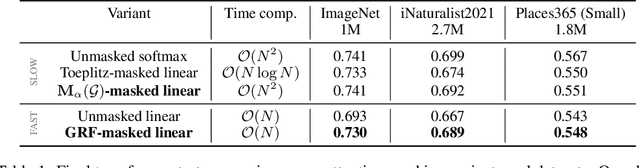


When training transformers on graph-structured data, incorporating information about the underlying topology is crucial for good performance. Topological masking, a type of relative position encoding, achieves this by upweighting or downweighting attention depending on the relationship between the query and keys in a graph. In this paper, we propose to parameterise topological masks as a learnable function of a weighted adjacency matrix -- a novel, flexible approach which incorporates a strong structural inductive bias. By approximating this mask with graph random features (for which we prove the first known concentration bounds), we show how this can be made fully compatible with linear attention, preserving $\mathcal{O}(N)$ time and space complexity with respect to the number of input tokens. The fastest previous alternative was $\mathcal{O}(N \log N)$ and only suitable for specific graphs. Our efficient masking algorithms provide strong performance gains for tasks on image and point cloud data, including with $>30$k nodes.
Conditioned Language Policy: A General Framework for Steerable Multi-Objective Finetuning
Jul 22, 2024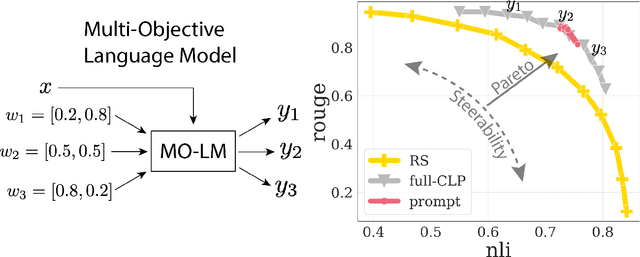
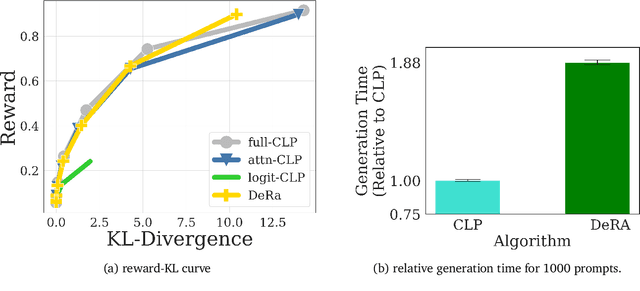

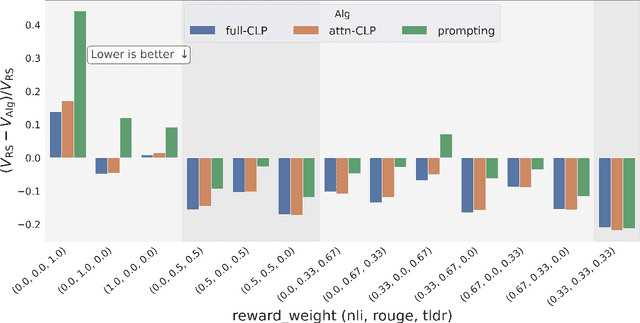
Reward-based finetuning is crucial for aligning language policies with intended behaviors (e.g., creativity and safety). A key challenge here is to develop steerable language models that trade-off multiple (conflicting) objectives in a flexible and efficient manner. This paper presents Conditioned Language Policy (CLP), a general framework for finetuning language models on multiple objectives. Building on techniques from multi-task training and parameter-efficient finetuning, CLP can learn steerable models that effectively trade-off conflicting objectives at inference time. Notably, this does not require training or maintaining multiple models to achieve different trade-offs between the objectives. Through an extensive set of experiments and ablations, we show that the CLP framework learns steerable models that outperform and Pareto-dominate the current state-of-the-art approaches for multi-objective finetuning.
Incremental Extractive Opinion Summarization Using Cover Trees
Jan 16, 2024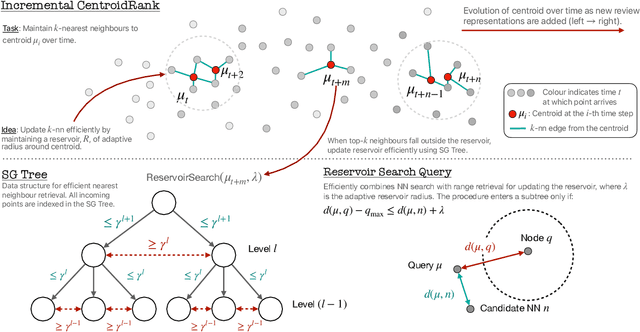
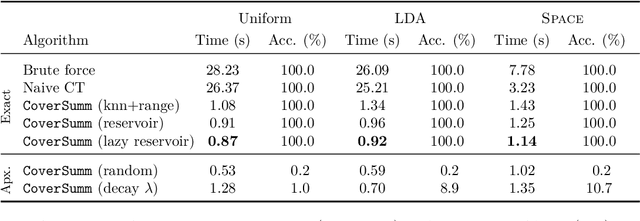
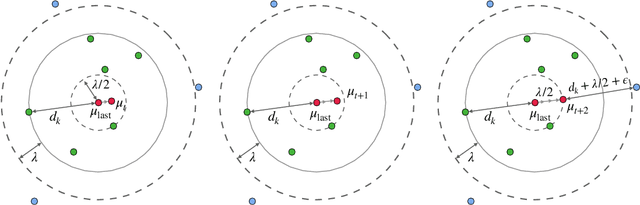
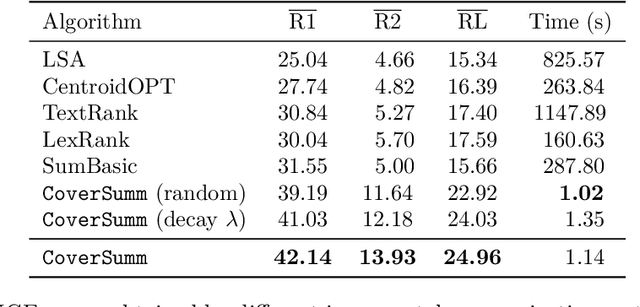
Extractive opinion summarization involves automatically producing a summary of text about an entity (e.g., a product's reviews) by extracting representative sentences that capture prevalent opinions in the review set. Typically, in online marketplaces user reviews accrue over time, and opinion summaries need to be updated periodically to provide customers with up-to-date information. In this work, we study the task of extractive opinion summarization in an incremental setting, where the underlying review set evolves over time. Many of the state-of-the-art extractive opinion summarization approaches are centrality-based, such as CentroidRank. CentroidRank performs extractive summarization by selecting a subset of review sentences closest to the centroid in the representation space as the summary. However, these methods are not capable of operating efficiently in an incremental setting, where reviews arrive one at a time. In this paper, we present an efficient algorithm for accurately computing the CentroidRank summaries in an incremental setting. Our approach, CoverSumm, relies on indexing review representations in a cover tree and maintaining a reservoir of candidate summary review sentences. CoverSumm's efficacy is supported by a theoretical and empirical analysis of running time. Empirically, on a diverse collection of data (both real and synthetically created to illustrate scaling considerations), we demonstrate that CoverSumm is up to 25x faster than baseline methods, and capable of adapting to nuanced changes in data distribution. We also conduct human evaluations of the generated summaries and find that CoverSumm is capable of producing informative summaries consistent with the underlying review set.