 Add to Chrome
 Add to Firefox
 Add to Edge
TIPSv2: Advancing Vision-Language Pretraining with Enhanced Patch-Text Alignment
Apr 13, 2026
Recent progress in vision-language pretraining has enabled significant improvements to many downstream computer vision applications, such as classification, retrieval, segmentation and depth prediction. However, a fundamental capability that these models still struggle with is aligning dense patch representations with text embeddings of corresponding concepts. In this work, we investigate this critical issue and propose novel techniques to enhance this capability in foundational vision-language models. First, we reveal that a patch-level distillation procedure significantly boosts dense patch-text alignment -- surprisingly, the patch-text alignment of the distilled student model strongly surpasses that of the teacher model. This observation inspires us to consider modifications to pretraining recipes, leading us to propose iBOT++, an upgrade to the commonly-used iBOT masked image objective, where unmasked tokens also contribute directly to the loss. This dramatically enhances patch-text alignment of pretrained models. Additionally, to improve vision-language pretraining efficiency and effectiveness, we modify the exponential moving average setup in the learning recipe, and introduce a caption sampling strategy to benefit from synthetic captions at different granularities. Combining these components, we develop TIPSv2, a new family of image-text encoder models suitable for a wide range of downstream applications. Through comprehensive experiments on 9 tasks and 20 datasets, we demonstrate strong performance, generally on par with or better than recent vision encoder models. Code and models are released via our project page at https://gdm-tipsv2.github.io/ .

Linear Transformer Topological Masking with Graph Random Features
Oct 04, 2024
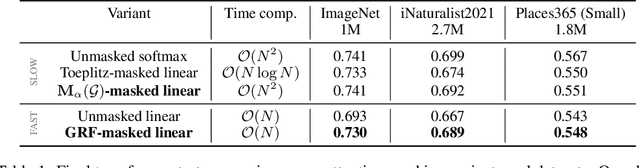


When training transformers on graph-structured data, incorporating information about the underlying topology is crucial for good performance. Topological masking, a type of relative position encoding, achieves this by upweighting or downweighting attention depending on the relationship between the query and keys in a graph. In this paper, we propose to parameterise topological masks as a learnable function of a weighted adjacency matrix -- a novel, flexible approach which incorporates a strong structural inductive bias. By approximating this mask with graph random features (for which we prove the first known concentration bounds), we show how this can be made fully compatible with linear attention, preserving $\mathcal{O}(N)$ time and space complexity with respect to the number of input tokens. The fastest previous alternative was $\mathcal{O}(N \log N)$ and only suitable for specific graphs. Our efficient masking algorithms provide strong performance gains for tasks on image and point cloud data, including with $>30$k nodes.