 Add to Chrome
 Add to Firefox
 Add to Edge
Simultaneous Localization And Mapping
Papers and Code
Super LiDAR Reflectance for Robotic Perception
Aug 14, 2025
Conventionally, human intuition often defines vision as a modality of passive optical sensing, while active optical sensing is typically regarded as measuring rather than the default modality of vision. However, the situation now changes: sensor technologies and data-driven paradigms empower active optical sensing to redefine the boundaries of vision, ushering in a new era of active vision. Light Detection and Ranging (LiDAR) sensors capture reflectance from object surfaces, which remains invariant under varying illumination conditions, showcasing significant potential in robotic perception tasks such as detection, recognition, segmentation, and Simultaneous Localization and Mapping (SLAM). These applications often rely on dense sensing capabilities, typically achieved by high-resolution, expensive LiDAR sensors. A key challenge with low-cost LiDARs lies in the sparsity of scan data, which limits their broader application. To address this limitation, this work introduces an innovative framework for generating dense LiDAR reflectance images from sparse data, leveraging the unique attributes of non-repeating scanning LiDAR (NRS-LiDAR). We tackle critical challenges, including reflectance calibration and the transition from static to dynamic scene domains, facilitating the reconstruction of dense reflectance images in real-world settings. The key contributions of this work include a comprehensive dataset for LiDAR reflectance image densification, a densification network tailored for NRS-LiDAR, and diverse applications such as loop closure and traffic lane detection using the generated dense reflectance images.

The Monado SLAM Dataset for Egocentric Visual-Inertial Tracking
Jul 31, 2025Humanoid robots and mixed reality headsets benefit from the use of head-mounted sensors for tracking. While advancements in visual-inertial odometry (VIO) and simultaneous localization and mapping (SLAM) have produced new and high-quality state-of-the-art tracking systems, we show that these are still unable to gracefully handle many of the challenging settings presented in the head-mounted use cases. Common scenarios like high-intensity motions, dynamic occlusions, long tracking sessions, low-textured areas, adverse lighting conditions, saturation of sensors, to name a few, continue to be covered poorly by existing datasets in the literature. In this way, systems may inadvertently overlook these essential real-world issues. To address this, we present the Monado SLAM dataset, a set of real sequences taken from multiple virtual reality headsets. We release the dataset under a permissive CC BY 4.0 license, to drive advancements in VIO/SLAM research and development.
Relative Localization of UAV Swarms in GNSS-Denied Conditions
Sep 04, 2025Relative localization of unmanned aerial vehicle (UAV) swarms in global navigation satellite system (GNSS) denied environments is essential for emergency rescue and battlefield reconnaissance. Existing methods suffer from significant localization errors among UAVs due to packet loss and high computational complexity in large swarms. This paper proposes a clustering-based framework where the UAVs simultaneously use communication signals for channel estimation and ranging. Firstly, the spectral clustering is utilized to divide the UAV swarm into different sub-clusters, where matrix completion and multidimensional scaling yield high-precision relative coordinates. Subsequently, a global map is created by the inter-cluster anchor fusion. A case study of UAV integrated communication and sensing (ISAC) system is presented, where the Orthogonal Time Frequency Space (OTFS) is adopted for ranging and communication. Experimental results show that the proposed method reduces localization errors in large swarms and loss of range information. It also explores the impact of signal parameters on communication and localization, highlighting the interplay between communication and localization performance.
UAVScenes: A Multi-Modal Dataset for UAVs
Jul 30, 2025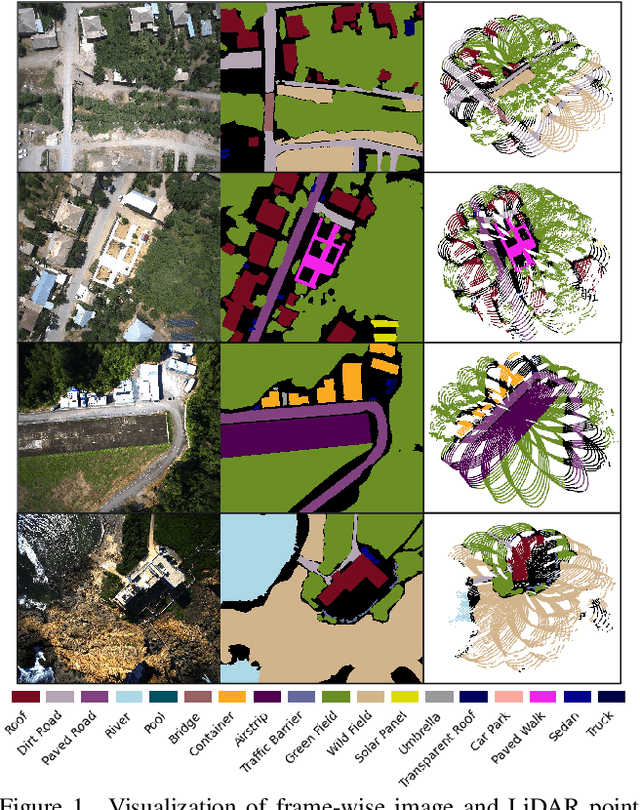
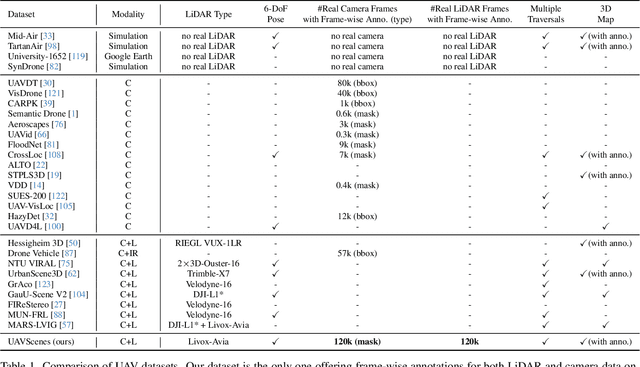
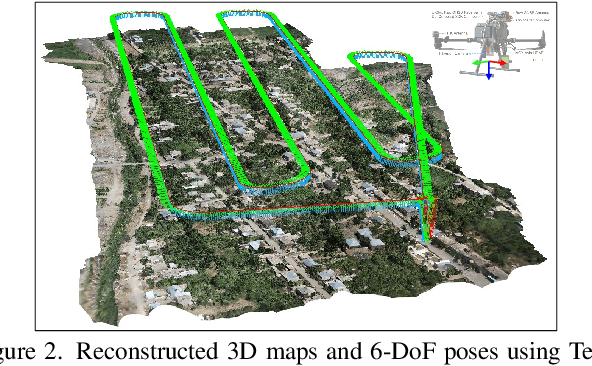
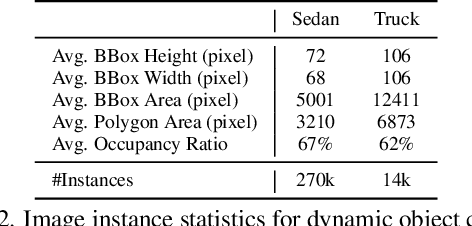
Multi-modal perception is essential for unmanned aerial vehicle (UAV) operations, as it enables a comprehensive understanding of the UAVs' surrounding environment. However, most existing multi-modal UAV datasets are primarily biased toward localization and 3D reconstruction tasks, or only support map-level semantic segmentation due to the lack of frame-wise annotations for both camera images and LiDAR point clouds. This limitation prevents them from being used for high-level scene understanding tasks. To address this gap and advance multi-modal UAV perception, we introduce UAVScenes, a large-scale dataset designed to benchmark various tasks across both 2D and 3D modalities. Our benchmark dataset is built upon the well-calibrated multi-modal UAV dataset MARS-LVIG, originally developed only for simultaneous localization and mapping (SLAM). We enhance this dataset by providing manually labeled semantic annotations for both frame-wise images and LiDAR point clouds, along with accurate 6-degree-of-freedom (6-DoF) poses. These additions enable a wide range of UAV perception tasks, including segmentation, depth estimation, 6-DoF localization, place recognition, and novel view synthesis (NVS). Our dataset is available at https://github.com/sijieaaa/UAVScenes
Tree-SLAM: semantic object SLAM for efficient mapping of individual trees in orchards
Jul 16, 2025Accurate mapping of individual trees is an important component for precision agriculture in orchards, as it allows autonomous robots to perform tasks like targeted operations or individual tree monitoring. However, creating these maps is challenging because GPS signals are often unreliable under dense tree canopies. Furthermore, standard Simultaneous Localization and Mapping (SLAM) approaches struggle in orchards because the repetitive appearance of trees can confuse the system, leading to mapping errors. To address this, we introduce Tree-SLAM, a semantic SLAM approach tailored for creating maps of individual trees in orchards. Utilizing RGB-D images, our method detects tree trunks with an instance segmentation model, estimates their location and re-identifies them using a cascade-graph-based data association algorithm. These re-identified trunks serve as landmarks in a factor graph framework that integrates noisy GPS signals, odometry, and trunk observations. The system produces maps of individual trees with a geo-localization error as low as 18 cm, which is less than 20\% of the planting distance. The proposed method was validated on diverse datasets from apple and pear orchards across different seasons, demonstrating high mapping accuracy and robustness in scenarios with unreliable GPS signals.
Next-Gen Museum Guides: Autonomous Navigation and Visitor Interaction with an Agentic Robot
Jul 16, 2025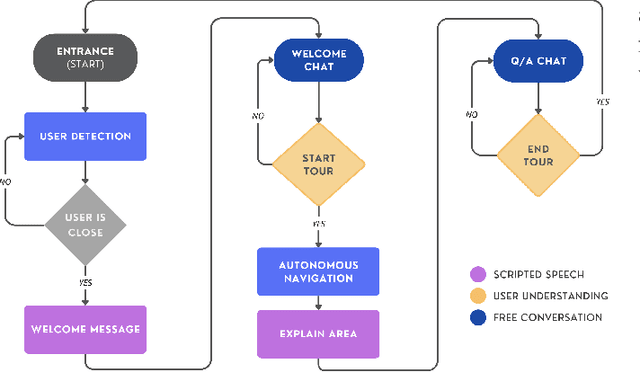
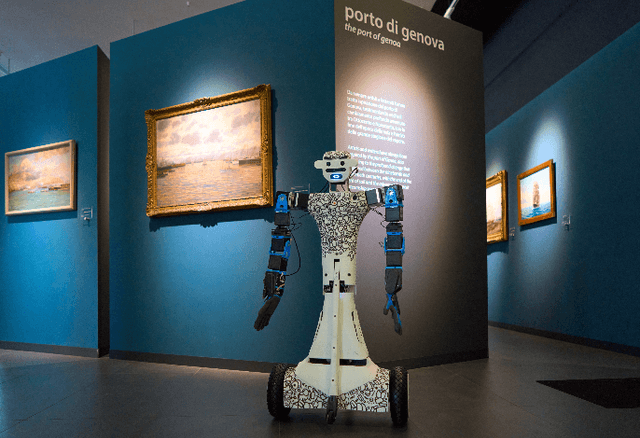
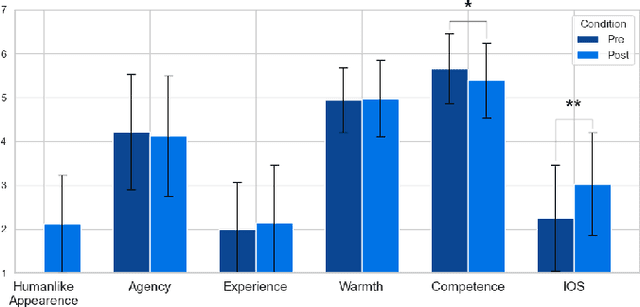
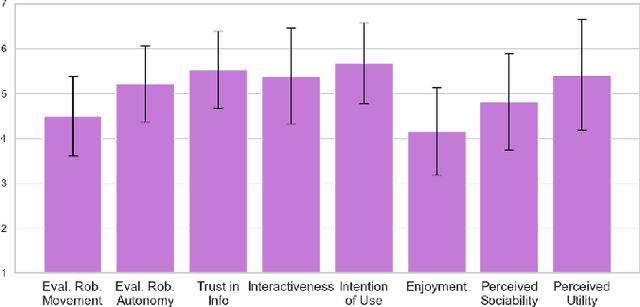
Autonomous robots are increasingly being tested into public spaces to enhance user experiences, particularly in cultural and educational settings. This paper presents the design, implementation, and evaluation of the autonomous museum guide robot Alter-Ego equipped with advanced navigation and interactive capabilities. The robot leverages state-of-the-art Large Language Models (LLMs) to provide real-time, context aware question-and-answer (Q&A) interactions, allowing visitors to engage in conversations about exhibits. It also employs robust simultaneous localization and mapping (SLAM) techniques, enabling seamless navigation through museum spaces and route adaptation based on user requests. The system was tested in a real museum environment with 34 participants, combining qualitative analysis of visitor-robot conversations and quantitative analysis of pre and post interaction surveys. Results showed that the robot was generally well-received and contributed to an engaging museum experience, despite some limitations in comprehension and responsiveness. This study sheds light on HRI in cultural spaces, highlighting not only the potential of AI-driven robotics to support accessibility and knowledge acquisition, but also the current limitations and challenges of deploying such technologies in complex, real-world environments.
LoopDB: A Loop Closure Dataset for Large Scale Simultaneous Localization and Mapping
Jun 07, 2025In this study, we introduce LoopDB, which is a challenging loop closure dataset comprising over 1000 images captured across diverse environments, including parks, indoor scenes, parking spaces, as well as centered around individual objects. Each scene is represented by a sequence of five consecutive images. The dataset was collected using a high resolution camera, providing suitable imagery for benchmarking the accuracy of loop closure algorithms, typically used in simultaneous localization and mapping. As ground truth information, we provide computed rotations and translations between each consecutive images. Additional to its benchmarking goal, the dataset can be used to train and fine-tune loop closure methods based on deep neural networks. LoopDB is publicly available at https://github.com/RovisLab/LoopDB.
EditMF: Drawing an Invisible Fingerprint for Your Large Language Models
Aug 12, 2025Training large language models (LLMs) is resource-intensive and expensive, making protecting intellectual property (IP) for LLMs crucial. Recently, embedding fingerprints into LLMs has emerged as a prevalent method for establishing model ownership. However, existing back-door-based methods suffer from limited stealth and efficiency. To simultaneously address these issues, we propose EditMF, a training-free fingerprinting paradigm that achieves highly imperceptible fingerprint embedding with minimal computational overhead. Ownership bits are mapped to compact, semantically coherent triples drawn from an encrypted artificial knowledge base (e.g., virtual author-novel-protagonist facts). Causal tracing localizes the minimal set of layers influencing each triple, and a zero-space update injects the fingerprint without perturbing unrelated knowledge. Verification requires only a single black-box query and succeeds when the model returns the exact pre-embedded protagonist. Empirical results on LLaMA and Qwen families show that EditMF combines high imperceptibility with negligible model's performance loss, while delivering robustness far beyond LoRA-based fingerprinting and approaching that of SFT embeddings. Extensive experiments demonstrate that EditMF is an effective and low-overhead solution for secure LLM ownership verification.
EndoFlow-SLAM: Real-Time Endoscopic SLAM with Flow-Constrained Gaussian Splatting
Jun 26, 2025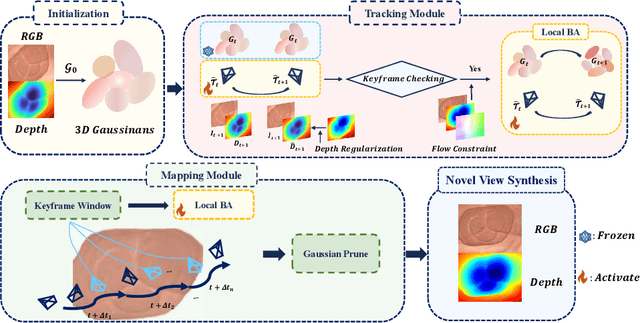
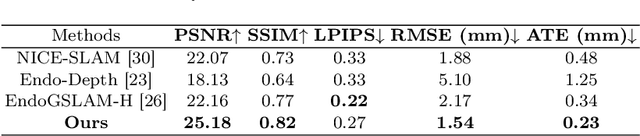
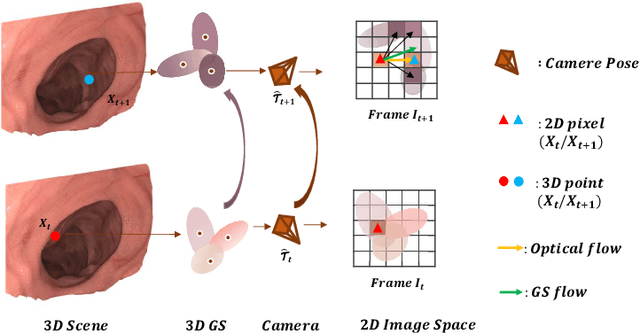
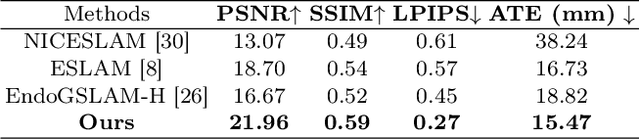
Efficient three-dimensional reconstruction and real-time visualization are critical in surgical scenarios such as endoscopy. In recent years, 3D Gaussian Splatting (3DGS) has demonstrated remarkable performance in efficient 3D reconstruction and rendering. Most 3DGS-based Simultaneous Localization and Mapping (SLAM) methods only rely on the appearance constraints for optimizing both 3DGS and camera poses. However, in endoscopic scenarios, the challenges include photometric inconsistencies caused by non-Lambertian surfaces and dynamic motion from breathing affects the performance of SLAM systems. To address these issues, we additionally introduce optical flow loss as a geometric constraint, which effectively constrains both the 3D structure of the scene and the camera motion. Furthermore, we propose a depth regularisation strategy to mitigate the problem of photometric inconsistencies and ensure the validity of 3DGS depth rendering in endoscopic scenes. In addition, to improve scene representation in the SLAM system, we improve the 3DGS refinement strategy by focusing on viewpoints corresponding to Keyframes with suboptimal rendering quality frames, achieving better rendering results. Extensive experiments on the C3VD static dataset and the StereoMIS dynamic dataset demonstrate that our method outperforms existing state-of-the-art methods in novel view synthesis and pose estimation, exhibiting high performance in both static and dynamic surgical scenes. The source code will be publicly available upon paper acceptance.
VIMS: A Visual-Inertial-Magnetic-Sonar SLAM System in Underwater Environments
Jun 18, 2025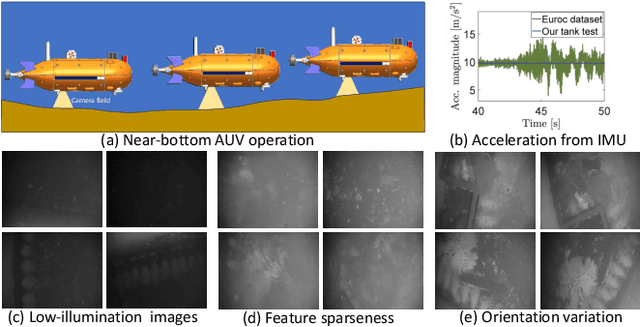
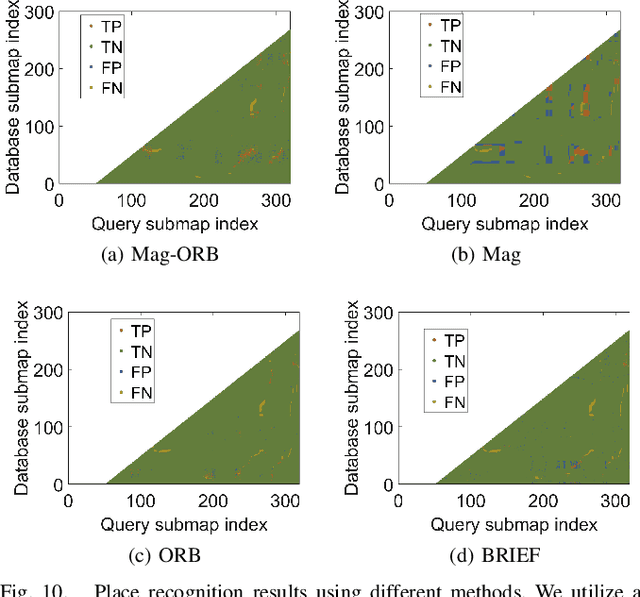
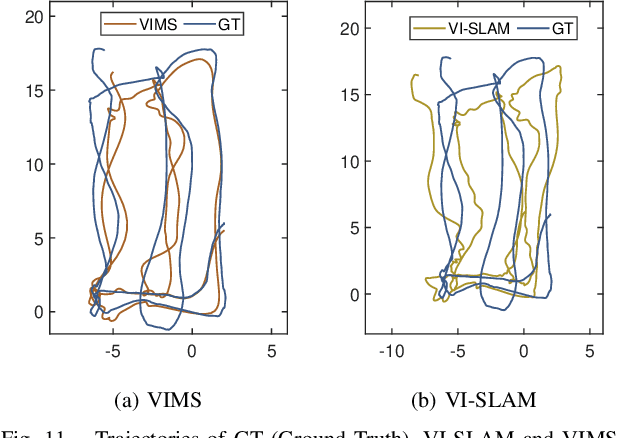
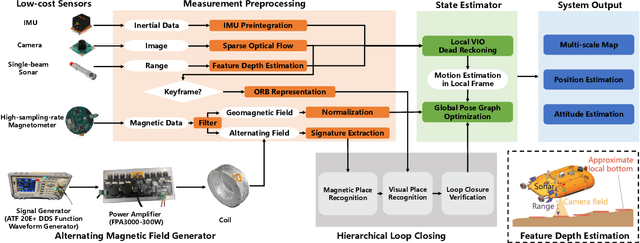
In this study, we present a novel simultaneous localization and mapping (SLAM) system, VIMS, designed for underwater navigation. Conventional visual-inertial state estimators encounter significant practical challenges in perceptually degraded underwater environments, particularly in scale estimation and loop closing. To address these issues, we first propose leveraging a low-cost single-beam sonar to improve scale estimation. Then, VIMS integrates a high-sampling-rate magnetometer for place recognition by utilizing magnetic signatures generated by an economical magnetic field coil. Building on this, a hierarchical scheme is developed for visual-magnetic place recognition, enabling robust loop closure. Furthermore, VIMS achieves a balance between local feature tracking and descriptor-based loop closing, avoiding additional computational burden on the front end. Experimental results highlight the efficacy of the proposed VIMS, demonstrating significant improvements in both the robustness and accuracy of state estimation within underwater environments.