 Add to Chrome
 Add to Firefox
 Add to Edge
Mapping Embodied Affective Touch Strategies on a Humanoid Robot
May 12, 2026
Affective touch in human-robot interaction is shaped not only by emotional intent, but also by robot embodiment, including touch location, physical constraints, and perceived agency or social role. Existing HRI studies typically focus on one or two isolated body parts, limiting understanding of how affective touch generalises across the full humanoid body. We present a study with 32 participants interacting with the iCub robot, which is equipped with full-body distributed tactile sensors. Participants expressed eight emotions under three conditions: free touch, arm-only touch, and torso-only touch. Results show that body region and spatial constraints jointly shaped both touch location and dynamics. In free touch, participants preferred socially accessible upper-body regions, while less frequently touched areas showed stronger emotion-specific selectivity. Emotion-related variation was more evident in motion features for arm-only touch and pressure features for torso-only touch. Touch strategies also did not transfer directly between free and constrained conditions, even within the same coarse body region. Participants reported increased closeness to the robot after interaction, with around 30 percent reporting a change in perceived social relationship. Together, these findings show that affective touch expression is strongly body-region dependent and shaped by embodiment constraints.

Exploring Temporal Representation in Neural Processes for Multimodal Action Prediction
Apr 09, 2026Inspired by the human ability to understand and predict others, we study the applicability of Conditional Neural Processes (CNP) to the task of self-supervised multimodal action prediction in robotics. Following recent results regarding the ontogeny of the Mirror Neuron System (MNS), we focus on the preliminary objective of self-actions prediction. We find a good MNS-inspired model in the existing Deep Modality Blending Network (DMBN), able to reconstruct the visuo-motor sensory signal during a partially observed action sequence by leveraging the probabilistic generation of CNP. After a qualitative and quantitative evaluation, we highlight its difficulties in generalizing to unseen action sequences, and identify the cause in its inner representation of time. Therefore, we propose a revised version, termed DMBN-Positional Time Encoding (DMBN-PTE), that facilitates learning a more robust representation of temporal information, and provide preliminary results of its effectiveness in expanding the applicability of the architecture. DMBN-PTE figures as a first step in the development of robotic systems that autonomously learn to forecast actions on longer time scales refining their predictions with incoming observations.
Next-Gen Museum Guides: Autonomous Navigation and Visitor Interaction with an Agentic Robot
Jul 16, 2025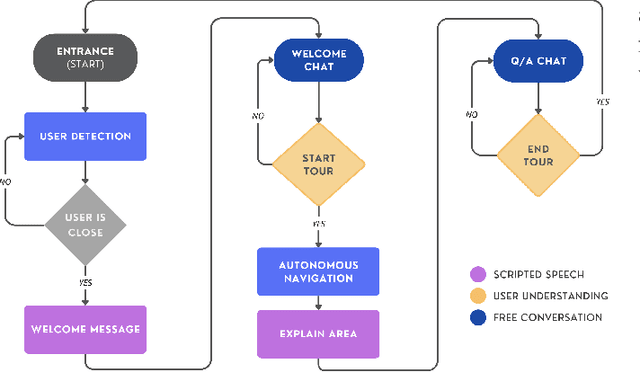
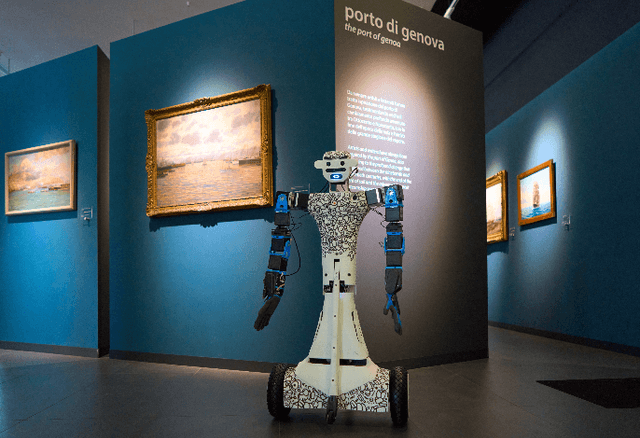
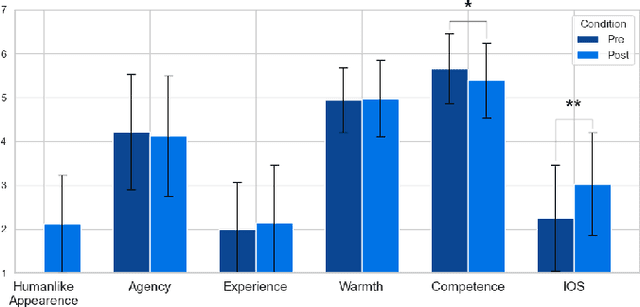
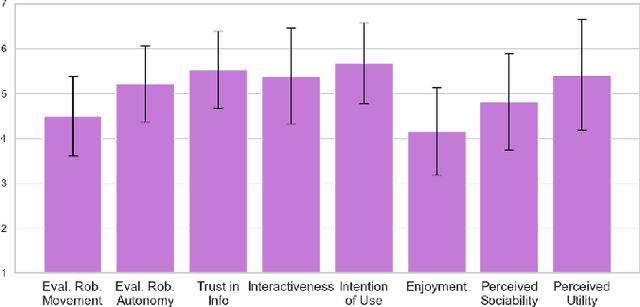
Autonomous robots are increasingly being tested into public spaces to enhance user experiences, particularly in cultural and educational settings. This paper presents the design, implementation, and evaluation of the autonomous museum guide robot Alter-Ego equipped with advanced navigation and interactive capabilities. The robot leverages state-of-the-art Large Language Models (LLMs) to provide real-time, context aware question-and-answer (Q&A) interactions, allowing visitors to engage in conversations about exhibits. It also employs robust simultaneous localization and mapping (SLAM) techniques, enabling seamless navigation through museum spaces and route adaptation based on user requests. The system was tested in a real museum environment with 34 participants, combining qualitative analysis of visitor-robot conversations and quantitative analysis of pre and post interaction surveys. Results showed that the robot was generally well-received and contributed to an engaging museum experience, despite some limitations in comprehension and responsiveness. This study sheds light on HRI in cultural spaces, highlighting not only the potential of AI-driven robotics to support accessibility and knowledge acquisition, but also the current limitations and challenges of deploying such technologies in complex, real-world environments.
Building Knowledge from Interactions: An LLM-Based Architecture for Adaptive Tutoring and Social Reasoning
Apr 02, 2025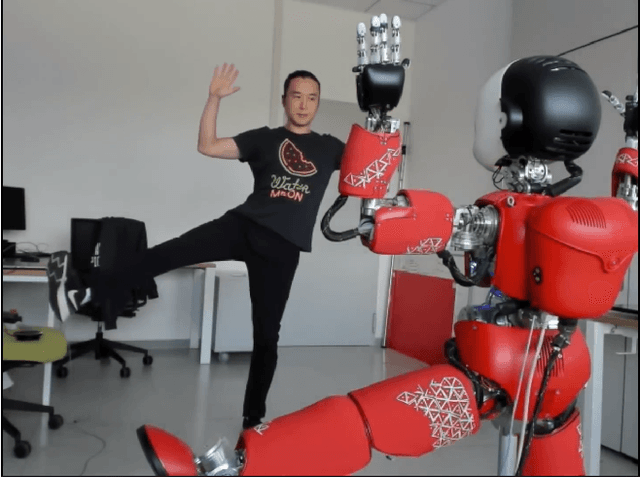
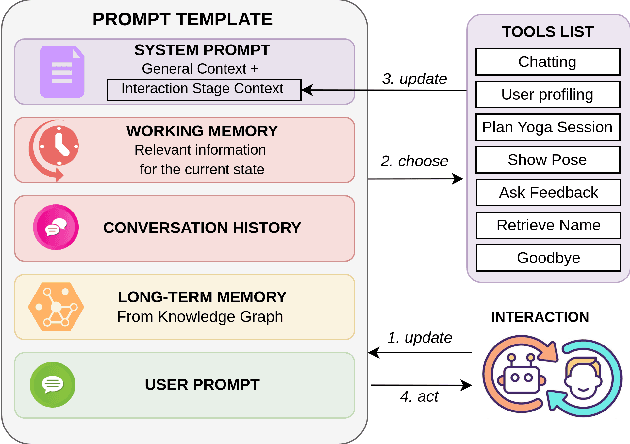
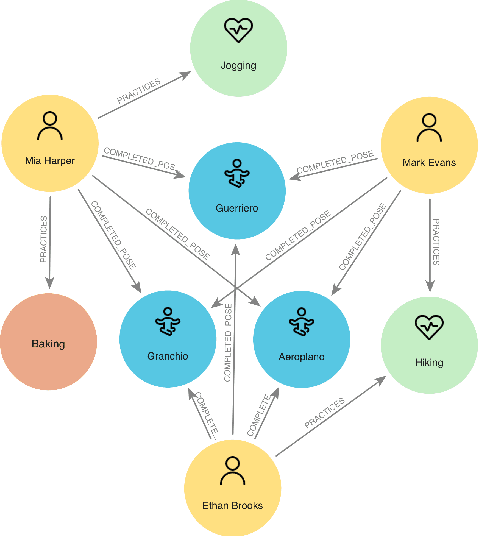
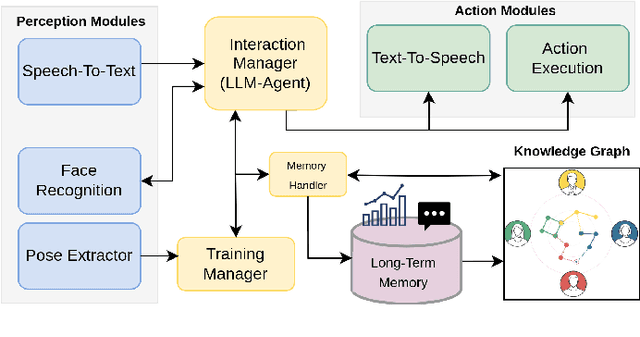
Integrating robotics into everyday scenarios like tutoring or physical training requires robots capable of adaptive, socially engaging, and goal-oriented interactions. While Large Language Models show promise in human-like communication, their standalone use is hindered by memory constraints and contextual incoherence. This work presents a multimodal, cognitively inspired framework that enhances LLM-based autonomous decision-making in social and task-oriented Human-Robot Interaction. Specifically, we develop an LLM-based agent for a robot trainer, balancing social conversation with task guidance and goal-driven motivation. To further enhance autonomy and personalization, we introduce a memory system for selecting, storing and retrieving experiences, facilitating generalized reasoning based on knowledge built across different interactions. A preliminary HRI user study and offline experiments with a synthetic dataset validate our approach, demonstrating the system's ability to manage complex interactions, autonomously drive training tasks, and build and retrieve contextual memories, advancing socially intelligent robotics.
Let people fail! Exploring the influence of explainable virtual and robotic agents in learning-by-doing tasks
Nov 15, 2024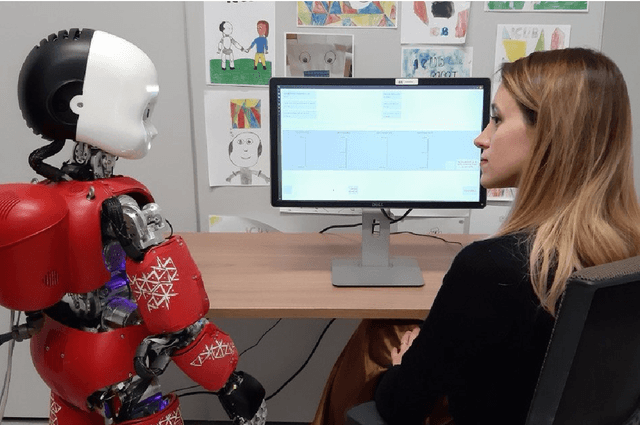
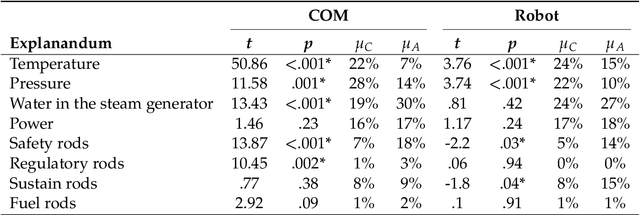
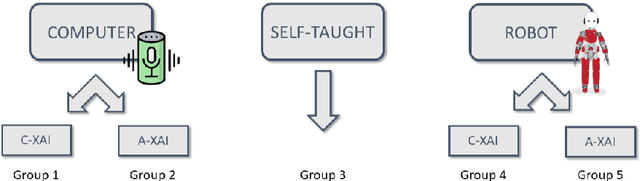
Collaborative decision-making with artificial intelligence (AI) agents presents opportunities and challenges. While human-AI performance often surpasses that of individuals, the impact of such technology on human behavior remains insufficiently understood, primarily when AI agents can provide justifiable explanations for their suggestions. This study compares the effects of classic vs. partner-aware explanations on human behavior and performance during a learning-by-doing task. Three participant groups were involved: one interacting with a computer, another with a humanoid robot, and a third one without assistance. Results indicated that partner-aware explanations influenced participants differently based on the type of artificial agents involved. With the computer, participants enhanced their task completion times. At the same time, those interacting with the humanoid robot were more inclined to follow its suggestions, although they did not reduce their timing. Interestingly, participants autonomously performing the learning-by-doing task demonstrated superior knowledge acquisition than those assisted by explainable AI (XAI). These findings raise profound questions and have significant implications for automated tutoring and human-AI collaboration.
A Roadmap for Embodied and Social Grounding in LLMs
Sep 25, 2024The fusion of Large Language Models (LLMs) and robotic systems has led to a transformative paradigm in the robotic field, offering unparalleled capabilities not only in the communication domain but also in skills like multimodal input handling, high-level reasoning, and plan generation. The grounding of LLMs knowledge into the empirical world has been considered a crucial pathway to exploit the efficiency of LLMs in robotics. Nevertheless, connecting LLMs' representations to the external world with multimodal approaches or with robots' bodies is not enough to let them understand the meaning of the language they are manipulating. Taking inspiration from humans, this work draws attention to three necessary elements for an agent to grasp and experience the world. The roadmap for LLMs grounding is envisaged in an active bodily system as the reference point for experiencing the environment, a temporally structured experience for a coherent, self-related interaction with the external world, and social skills to acquire a common-grounded shared experience.
The Effects of Selected Object Features on a Pick-and-Place Task: a Human Multimodal Dataset
Jul 18, 2024We propose a dataset to study the influence of object-specific characteristics on human pick-and-place movements and compare the quality of the motion kinematics extracted by various sensors. This dataset is also suitable for promoting a broader discussion on general learning problems in the hand-object interaction domain, such as intention recognition or motion generation with applications in the Robotics field. The dataset consists of the recordings of 15 subjects performing 80 repetitions of a pick-and-place action under various experimental conditions, for a total of 1200 pick-and-places. The data has been collected thanks to a multimodal setup composed of multiple cameras, observing the actions from different perspectives, a motion capture system, and a wrist-worn inertial measurement unit. All the objects manipulated in the experiments are identical in shape, size, and appearance but differ in weight and liquid filling, which influences the carefulness required for their handling.
* Camera ready version. Full paper available in open-access at https://doi.org/10.1177/02783649231210965 Dataset available on Kaggle (DOI: 10.34740/KAGGLE/DS/2319925, https://www.kaggle.com/datasets/alessandrocarf/effects-of-object-characteristics-on-manipulations)
How much informative is your XAI? A decision-making assessment task to objectively measure the goodness of explanations
Dec 07, 2023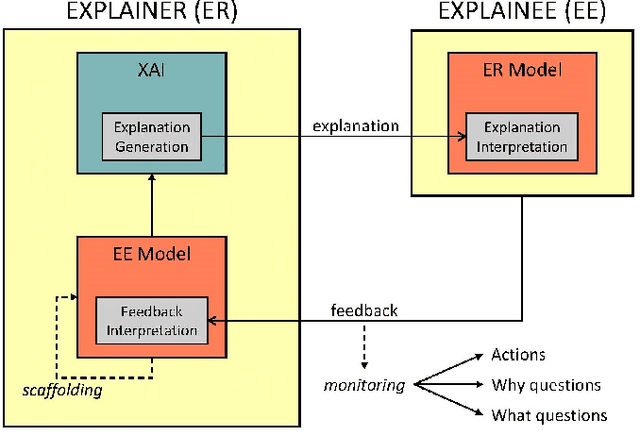

There is an increasing consensus about the effectiveness of user-centred approaches in the explainable artificial intelligence (XAI) field. Indeed, the number and complexity of personalised and user-centred approaches to XAI have rapidly grown in recent years. Often, these works have a two-fold objective: (1) proposing novel XAI techniques able to consider the users and (2) assessing the \textit{goodness} of such techniques with respect to others. From these new works, it emerged that user-centred approaches to XAI positively affect the interaction between users and systems. However, so far, the goodness of XAI systems has been measured through indirect measures, such as performance. In this paper, we propose an assessment task to objectively and quantitatively measure the goodness of XAI systems in terms of their \textit{information power}, which we intended as the amount of information the system provides to the users during the interaction. Moreover, we plan to use our task to objectively compare two XAI techniques in a human-robot decision-making task to understand deeper whether user-centred approaches are more informative than classical ones.
Real-time Addressee Estimation: Deployment of a Deep-Learning Model on the iCub Robot
Nov 09, 2023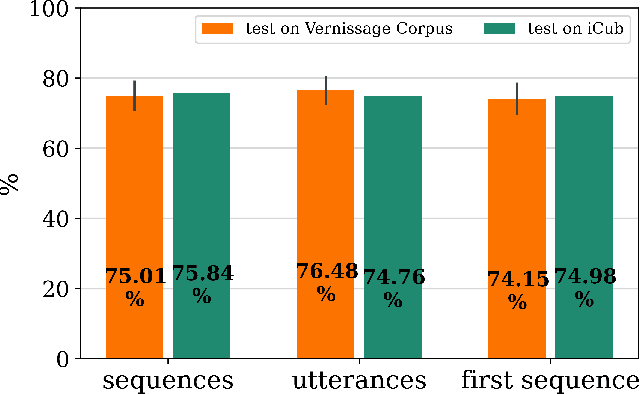
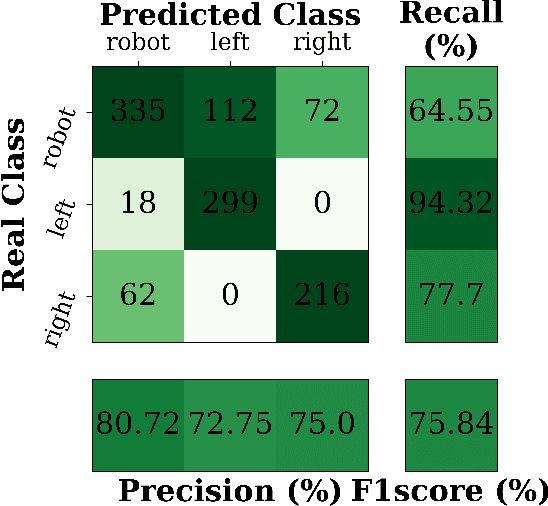

Addressee Estimation is the ability to understand to whom a person is talking, a skill essential for social robots to interact smoothly with humans. In this sense, it is one of the problems that must be tackled to develop effective conversational agents in multi-party and unstructured scenarios. As humans, one of the channels that mainly lead us to such estimation is the non-verbal behavior of speakers: first of all, their gaze and body pose. Inspired by human perceptual skills, in the present work, a deep-learning model for Addressee Estimation relying on these two non-verbal features is designed, trained, and deployed on an iCub robot. The study presents the procedure of such implementation and the performance of the model deployed in real-time human-robot interaction compared to previous tests on the dataset used for the training.
All by Myself: Learning Individualized Competitive Behaviour with a Contrastive Reinforcement Learning optimization
Oct 02, 2023


In a competitive game scenario, a set of agents have to learn decisions that maximize their goals and minimize their adversaries' goals at the same time. Besides dealing with the increased dynamics of the scenarios due to the opponents' actions, they usually have to understand how to overcome the opponent's strategies. Most of the common solutions, usually based on continual learning or centralized multi-agent experiences, however, do not allow the development of personalized strategies to face individual opponents. In this paper, we propose a novel model composed of three neural layers that learn a representation of a competitive game, learn how to map the strategy of specific opponents, and how to disrupt them. The entire model is trained online, using a composed loss based on a contrastive optimization, to learn competitive and multiplayer games. We evaluate our model on a pokemon duel scenario and the four-player competitive Chef's Hat card game. Our experiments demonstrate that our model achieves better performance when playing against offline, online, and competitive-specific models, in particular when playing against the same opponent multiple times. We also present a discussion on the impact of our model, in particular on how well it deals with on specific strategy learning for each of the two scenarios.