 Add to Chrome
 Add to Firefox
 Add to Edge
Simultaneous Localization And Mapping
Papers and Code
Bag-of-Word-Groups (BoWG): A Robust and Efficient Loop Closure Detection Method Under Perceptual Aliasing
Oct 26, 2025
Loop closure is critical in Simultaneous Localization and Mapping (SLAM) systems to reduce accumulative drift and ensure global mapping consistency. However, conventional methods struggle in perceptually aliased environments, such as narrow pipes, due to vector quantization, feature sparsity, and repetitive textures, while existing solutions often incur high computational costs. This paper presents Bag-of-Word-Groups (BoWG), a novel loop closure detection method that achieves superior precision-recall, robustness, and computational efficiency. The core innovation lies in the introduction of word groups, which captures the spatial co-occurrence and proximity of visual words to construct an online dictionary. Additionally, drawing inspiration from probabilistic transition models, we incorporate temporal consistency directly into similarity computation with an adaptive scheme, substantially improving precision-recall performance. The method is further strengthened by a feature distribution analysis module and dedicated post-verification mechanisms. To evaluate the effectiveness of our method, we conduct experiments on both public datasets and a confined-pipe dataset we constructed. Results demonstrate that BoWG surpasses state-of-the-art methods, including both traditional and learning-based approaches, in terms of precision-recall and computational efficiency. Our approach also exhibits excellent scalability, achieving an average processing time of 16 ms per image across 17,565 images in the Bicocca25b dataset.

Policies over Poses: Reinforcement Learning based Distributed Pose-Graph Optimization for Multi-Robot SLAM
Oct 26, 2025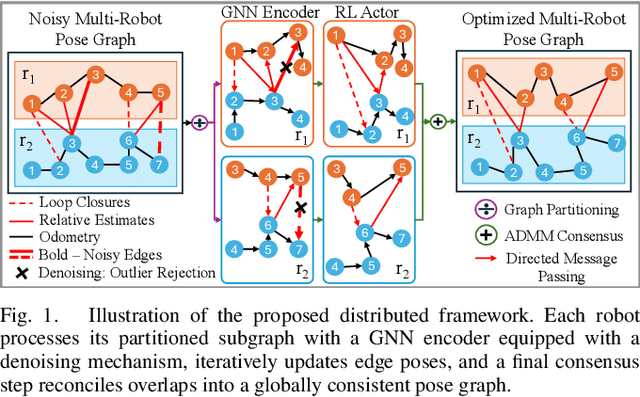
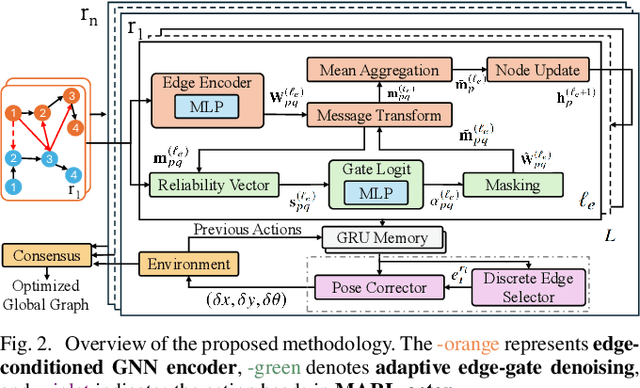
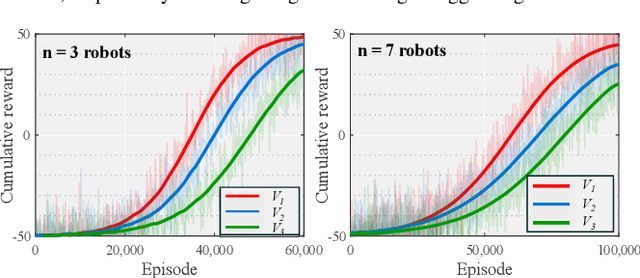
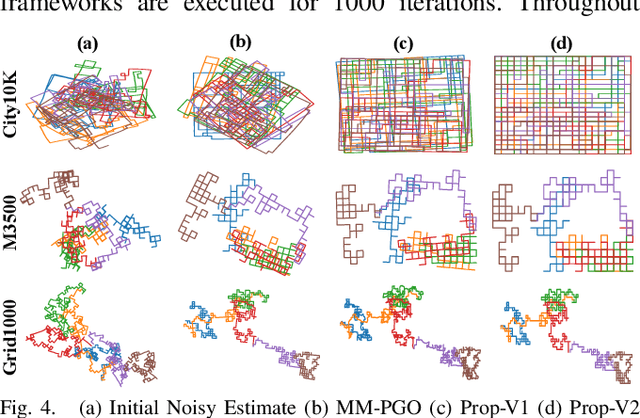
We consider the distributed pose-graph optimization (PGO) problem, which is fundamental in accurate trajectory estimation in multi-robot simultaneous localization and mapping (SLAM). Conventional iterative approaches linearize a highly non-convex optimization objective, requiring repeated solving of normal equations, which often converge to local minima and thus produce suboptimal estimates. We propose a scalable, outlier-robust distributed planar PGO framework using Multi-Agent Reinforcement Learning (MARL). We cast distributed PGO as a partially observable Markov game defined on local pose-graphs, where each action refines a single edge's pose estimate. A graph partitioner decomposes the global pose graph, and each robot runs a recurrent edge-conditioned Graph Neural Network (GNN) encoder with adaptive edge-gating to denoise noisy edges. Robots sequentially refine poses through a hybrid policy that utilizes prior action memory and graph embeddings. After local graph correction, a consensus scheme reconciles inter-robot disagreements to produce a globally consistent estimate. Our extensive evaluations on a comprehensive suite of synthetic and real-world datasets demonstrate that our learned MARL-based actors reduce the global objective by an average of 37.5% more than the state-of-the-art distributed PGO framework, while enhancing inference efficiency by at least 6X. We also demonstrate that actor replication allows a single learned policy to scale effortlessly to substantially larger robot teams without any retraining. Code is publicly available at https://github.com/herolab-uga/policies-over-poses.
OKVIS2-X: Open Keyframe-based Visual-Inertial SLAM Configurable with Dense Depth or LiDAR, and GNSS
Oct 06, 2025To empower mobile robots with usable maps as well as highest state estimation accuracy and robustness, we present OKVIS2-X: a state-of-the-art multi-sensor Simultaneous Localization and Mapping (SLAM) system building dense volumetric occupancy maps, while scalable to large environments and operating in realtime. Our unified SLAM framework seamlessly integrates different sensor modalities: visual, inertial, measured or learned depth, LiDAR and Global Navigation Satellite System (GNSS) measurements. Unlike most state-of-the-art SLAM systems, we advocate using dense volumetric map representations when leveraging depth or range-sensing capabilities. We employ an efficient submapping strategy that allows our system to scale to large environments, showcased in sequences of up to 9 kilometers. OKVIS2-X enhances its accuracy and robustness by tightly-coupling the estimator and submaps through map alignment factors. Our system provides globally consistent maps, directly usable for autonomous navigation. To further improve the accuracy of OKVIS2-X, we also incorporate the option of performing online calibration of camera extrinsics. Our system achieves the highest trajectory accuracy in EuRoC against state-of-the-art alternatives, outperforms all competitors in the Hilti22 VI-only benchmark, while also proving competitive in the LiDAR version, and showcases state of the art accuracy in the diverse and large-scale sequences from the VBR dataset.
Non-Rigid Structure-from-Motion via Differential Geometry with Recoverable Conformal Scale
Oct 02, 2025Non-rigid structure-from-motion (NRSfM), a promising technique for addressing the mapping challenges in monocular visual deformable simultaneous localization and mapping (SLAM), has attracted growing attention. We introduce a novel method, called Con-NRSfM, for NRSfM under conformal deformations, encompassing isometric deformations as a subset. Our approach performs point-wise reconstruction using 2D selected image warps optimized through a graph-based framework. Unlike existing methods that rely on strict assumptions, such as locally planar surfaces or locally linear deformations, and fail to recover the conformal scale, our method eliminates these constraints and accurately computes the local conformal scale. Additionally, our framework decouples constraints on depth and conformal scale, which are inseparable in other approaches, enabling more precise depth estimation. To address the sensitivity of the formulated problem, we employ a parallel separable iterative optimization strategy. Furthermore, a self-supervised learning framework, utilizing an encoder-decoder network, is incorporated to generate dense 3D point clouds with texture. Simulation and experimental results using both synthetic and real datasets demonstrate that our method surpasses existing approaches in terms of reconstruction accuracy and robustness. The code for the proposed method will be made publicly available on the project website: https://sites.google.com/view/con-nrsfm.
EC3R-SLAM: Efficient and Consistent Monocular Dense SLAM with Feed-Forward 3D Reconstruction
Oct 02, 2025The application of monocular dense Simultaneous Localization and Mapping (SLAM) is often hindered by high latency, large GPU memory consumption, and reliance on camera calibration. To relax this constraint, we propose EC3R-SLAM, a novel calibration-free monocular dense SLAM framework that jointly achieves high localization and mapping accuracy, low latency, and low GPU memory consumption. This enables the framework to achieve efficiency through the coupling of a tracking module, which maintains a sparse map of feature points, and a mapping module based on a feed-forward 3D reconstruction model that simultaneously estimates camera intrinsics. In addition, both local and global loop closures are incorporated to ensure mid-term and long-term data association, enforcing multi-view consistency and thereby enhancing the overall accuracy and robustness of the system. Experiments across multiple benchmarks show that EC3R-SLAM achieves competitive performance compared to state-of-the-art methods, while being faster and more memory-efficient. Moreover, it runs effectively even on resource-constrained platforms such as laptops and Jetson Orin NX, highlighting its potential for real-world robotics applications.
HyPerNav: Hybrid Perception for Object-Oriented Navigation in Unknown Environment
Oct 27, 2025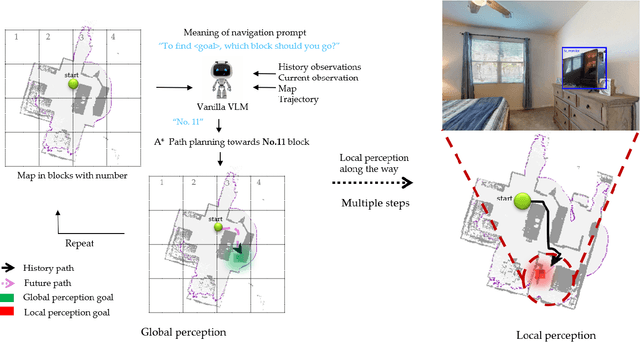
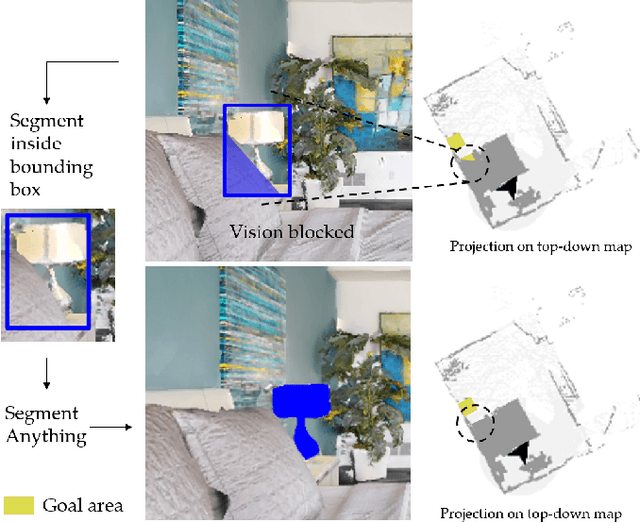
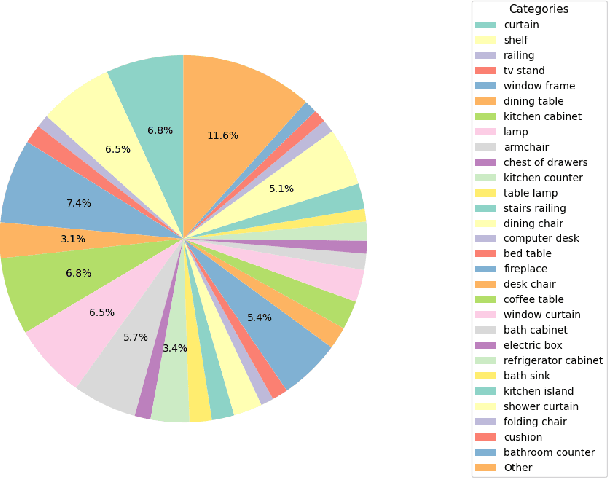
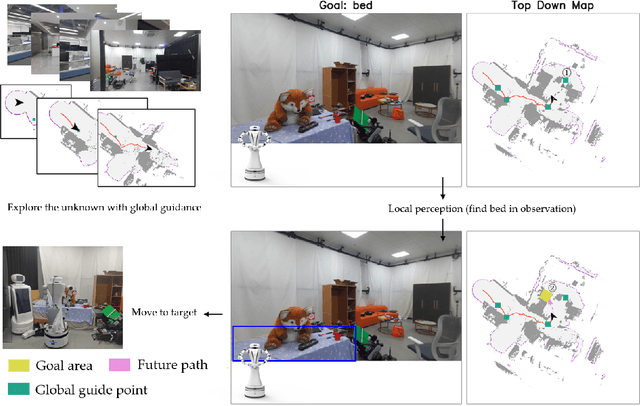
Objective-oriented navigation(ObjNav) enables robot to navigate to target object directly and autonomously in an unknown environment. Effective perception in navigation in unknown environment is critical for autonomous robots. While egocentric observations from RGB-D sensors provide abundant local information, real-time top-down maps offer valuable global context for ObjNav. Nevertheless, the majority of existing studies focus on a single source, seldom integrating these two complementary perceptual modalities, despite the fact that humans naturally attend to both. With the rapid advancement of Vision-Language Models(VLMs), we propose Hybrid Perception Navigation (HyPerNav), leveraging VLMs' strong reasoning and vision-language understanding capabilities to jointly perceive both local and global information to enhance the effectiveness and intelligence of navigation in unknown environments. In both massive simulation evaluation and real-world validation, our methods achieved state-of-the-art performance against popular baselines. Benefiting from hybrid perception approach, our method captures richer cues and finds the objects more effectively, by simultaneously leveraging information understanding from egocentric observations and the top-down map. Our ablation study further proved that either of the hybrid perception contributes to the navigation performance.
Benchmarking Egocentric Visual-Inertial SLAM at City Scale
Sep 30, 2025Precise 6-DoF simultaneous localization and mapping (SLAM) from onboard sensors is critical for wearable devices capturing egocentric data, which exhibits specific challenges, such as a wider diversity of motions and viewpoints, prevalent dynamic visual content, or long sessions affected by time-varying sensor calibration. While recent progress on SLAM has been swift, academic research is still driven by benchmarks that do not reflect these challenges or do not offer sufficiently accurate ground truth poses. In this paper, we introduce a new dataset and benchmark for visual-inertial SLAM with egocentric, multi-modal data. We record hours and kilometers of trajectories through a city center with glasses-like devices equipped with various sensors. We leverage surveying tools to obtain control points as indirect pose annotations that are metric, centimeter-accurate, and available at city scale. This makes it possible to evaluate extreme trajectories that involve walking at night or traveling in a vehicle. We show that state-of-the-art systems developed by academia are not robust to these challenges and we identify components that are responsible for this. In addition, we design tracks with different levels of difficulty to ease in-depth analysis and evaluation of less mature approaches. The dataset and benchmark are available at https://www.lamaria.ethz.ch.
Radio-based Multi-Robot Odometry and Relative Localization
Sep 30, 2025Radio-based methods such as Ultra-Wideband (UWB) and RAdio Detection And Ranging (radar), which have traditionally seen limited adoption in robotics, are experiencing a boost in popularity thanks to their robustness to harsh environmental conditions and cluttered environments. This work proposes a multi-robot UGV-UAV localization system that leverages the two technologies with inexpensive and readily-available sensors, such as Inertial Measurement Units (IMUs) and wheel encoders, to estimate the relative position of an aerial robot with respect to a ground robot. The first stage of the system pipeline includes a nonlinear optimization framework to trilaterate the location of the aerial platform based on UWB range data, and a radar pre-processing module with loosely coupled ego-motion estimation which has been adapted for a multi-robot scenario. Then, the pre-processed radar data as well as the relative transformation are fed to a pose-graph optimization framework with odometry and inter-robot constraints. The system, implemented for the Robotic Operating System (ROS 2) with the Ceres optimizer, has been validated in Software-in-the-Loop (SITL) simulations and in a real-world dataset. The proposed relative localization module outperforms state-of-the-art closed-form methods which are less robust to noise. Our SITL environment includes a custom Gazebo plugin for generating realistic UWB measurements modeled after real data. Conveniently, the proposed factor graph formulation makes the system readily extensible to full Simultaneous Localization And Mapping (SLAM). Finally, all the code and experimental data is publicly available to support reproducibility and to serve as a common open dataset for benchmarking.
MATTER: Multiscale Attention for Registration Error Regression
Sep 16, 2025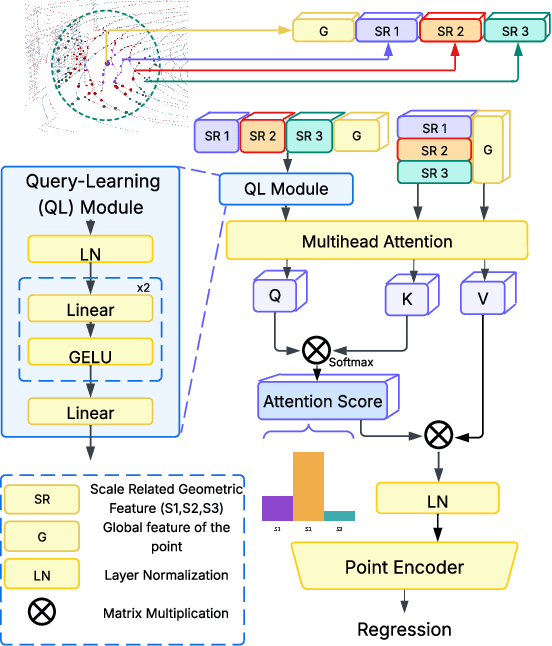
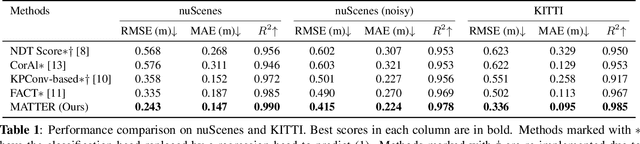
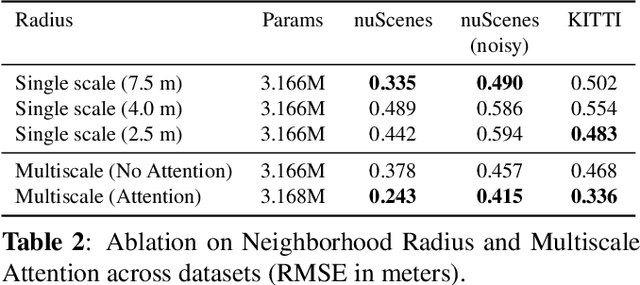
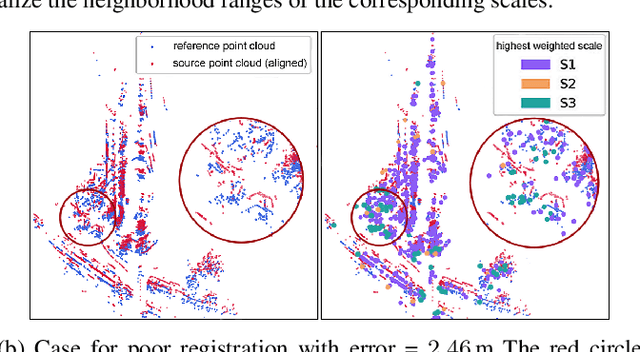
Point cloud registration (PCR) is crucial for many downstream tasks, such as simultaneous localization and mapping (SLAM) and object tracking. This makes detecting and quantifying registration misalignment, i.e.,~{\it PCR quality validation}, an important task. All existing methods treat validation as a classification task, aiming to assign the PCR quality to a few classes. In this work, we instead use regression for PCR validation, allowing for a more fine-grained quantification of the registration quality. We also extend previously used misalignment-related features by using multiscale extraction and attention-based aggregation. This leads to accurate and robust registration error estimation on diverse datasets, especially for point clouds with heterogeneous spatial densities. Furthermore, when used to guide a mapping downstream task, our method significantly improves the mapping quality for a given amount of re-registered frames, compared to the state-of-the-art classification-based method.
Human Interaction for Collaborative Semantic SLAM using Extended Reality
Sep 18, 2025Semantic SLAM (Simultaneous Localization and Mapping) systems enrich robot maps with structural and semantic information, enabling robots to operate more effectively in complex environments. However, these systems struggle in real-world scenarios with occlusions, incomplete data, or ambiguous geometries, as they cannot fully leverage the higher-level spatial and semantic knowledge humans naturally apply. We introduce HICS-SLAM, a Human-in-the-Loop semantic SLAM framework that uses a shared extended reality environment for real-time collaboration. The system allows human operators to directly interact with and visualize the robot's 3D scene graph, and add high-level semantic concepts (e.g., rooms or structural entities) into the mapping process. We propose a graph-based semantic fusion methodology that integrates these human interventions with robot perception, enabling scalable collaboration for enhanced situational awareness. Experimental evaluations on real-world construction site datasets demonstrate improvements in room detection accuracy, map precision, and semantic completeness compared to automated baselines, demonstrating both the effectiveness of the approach and its potential for future extensions.