 Add to Chrome
 Add to Firefox
 Add to Edge
Fake Image Detection
Fake image detection is the process of identifying and detecting fake or manipulated images using deep learning techniques.
Papers and Code
Patch-Discontinuity Mining for Generalized Deepfake Detection
Dec 26, 2025
The rapid advancement of generative artificial intelligence has enabled the creation of highly realistic fake facial images, posing serious threats to personal privacy and the integrity of online information. Existing deepfake detection methods often rely on handcrafted forensic cues and complex architectures, achieving strong performance in intra-domain settings but suffering significant degradation when confronted with unseen forgery patterns. In this paper, we propose GenDF, a simple yet effective framework that transfers a powerful large-scale vision model to the deepfake detection task with a compact and neat network design. GenDF incorporates deepfake-specific representation learning to capture discriminative patterns between real and fake facial images, feature space redistribution to mitigate distribution mismatch, and a classification-invariant feature augmentation strategy to enhance generalization without introducing additional trainable parameters. Extensive experiments demonstrate that GenDF achieves state-of-the-art generalization performance in cross-domain and cross-manipulation settings while requiring only 0.28M trainable parameters, validating the effectiveness and efficiency of the proposed framework.

Agentic Multi-Persona Framework for Evidence-Aware Fake News Detection
Dec 24, 2025The rapid proliferation of online misinformation poses significant risks to public trust, policy, and safety, necessitating reliable automated fake news detection. Existing methods often struggle with multimodal content, domain generalization, and explainability. We propose AMPEND-LS, an agentic multi-persona evidence-grounded framework with LLM-SLM synergy for multimodal fake news detection. AMPEND-LS integrates textual, visual, and contextual signals through a structured reasoning pipeline powered by LLMs, augmented with reverse image search, knowledge graph paths, and persuasion strategy analysis. To improve reliability, we introduce a credibility fusion mechanism combining semantic similarity, domain trustworthiness, and temporal context, and a complementary SLM classifier to mitigate LLM uncertainty and hallucinations. Extensive experiments across three benchmark datasets demonstrate that AMPEND-LS consistently outperformed state-of-the-art baselines in accuracy, F1 score, and robustness. Qualitative case studies further highlight its transparent reasoning and resilience against evolving misinformation. This work advances the development of adaptive, explainable, and evidence-aware systems for safeguarding online information integrity.
AdaptPrompt: Parameter-Efficient Adaptation of VLMs for Generalizable Deepfake Detection
Dec 19, 2025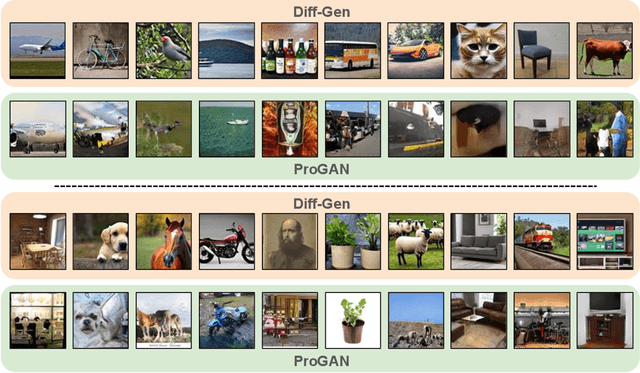
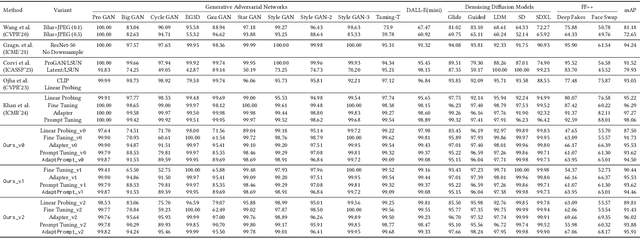
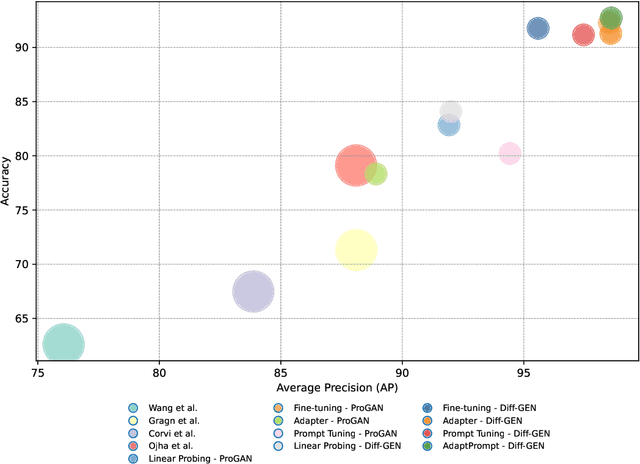
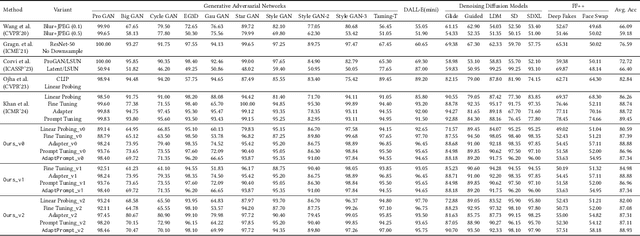
Recent advances in image generation have led to the widespread availability of highly realistic synthetic media, increasing the difficulty of reliable deepfake detection. A key challenge is generalization, as detectors trained on a narrow class of generators often fail when confronted with unseen models. In this work, we address the pressing need for generalizable detection by leveraging large vision-language models, specifically CLIP, to identify synthetic content across diverse generative techniques. First, we introduce Diff-Gen, a large-scale benchmark dataset comprising 100k diffusion-generated fakes that capture broad spectral artifacts unlike traditional GAN datasets. Models trained on Diff-Gen demonstrate stronger cross-domain generalization, particularly on previously unseen image generators. Second, we propose AdaptPrompt, a parameter-efficient transfer learning framework that jointly learns task-specific textual prompts and visual adapters while keeping the CLIP backbone frozen. We further show via layer ablation that pruning the final transformer block of the vision encoder enhances the retention of high-frequency generative artifacts, significantly boosting detection accuracy. Our evaluation spans 25 challenging test sets, covering synthetic content generated by GANs, diffusion models, and commercial tools, establishing a new state-of-the-art in both standard and cross-domain scenarios. We further demonstrate the framework's versatility through few-shot generalization (using as few as 320 images) and source attribution, enabling the precise identification of generator architectures in closed-set settings.
Two-Step Data Augmentation for Masked Face Detection and Recognition: Turning Fake Masks to Real
Dec 13, 2025Data scarcity and distribution shift pose major challenges for masked face detection and recognition. We propose a two-step generative data augmentation framework that combines rule-based mask warping with unpaired image-to-image translation using GANs, enabling the generation of realistic masked-face samples beyond purely synthetic transformations. Compared to rule-based warping alone, the proposed approach yields consistent qualitative improvements and complements existing GAN-based masked face generation methods such as IAMGAN. We introduce a non-mask preservation loss and stochastic noise injection to stabilize training and enhance sample diversity. Experimental observations highlight the effectiveness of the proposed components and suggest directions for future improvements in data-centric augmentation for face recognition tasks.
* 9 pages, 9 figures. Conference version
Adaptive thresholding pattern for fingerprint forgery detection
Nov 19, 2025Fingerprint liveness detection systems have been affected by spoofing, which is a severe threat for fingerprint-based biometric systems. Therefore, it is crucial to develop some techniques to distinguish the fake fingerprints from the real ones. The software based techniques can detect the fingerprint forgery automatically. Also, the scheme shall be resistant against various distortions such as noise contamination, pixel missing and block missing, so that the forgers cannot deceive the detector by adding some distortions to the faked fingerprint. In this paper, we propose a fingerprint forgery detection algorithm based on a suggested adaptive thresholding pattern. The anisotropic diffusion of the input image is passed through three levels of the wavelet transform. The coefficients of different layers are adaptively thresholded and concatenated to produce the feature vector which is classified using the SVM classifier. Another contribution of the paper is to investigate the effect of various distortions such as pixel missing, block missing, and noise contamination. Our suggested approach includes a novel method that exhibits improved resistance against a range of distortions caused by environmental phenomena or manipulations by malicious users. In quantitative comparisons, our proposed method outperforms its counterparts by approximately 8% and 5% in accuracy for missing pixel scenarios of 90% and block missing scenarios of size 70x70 , respectively. This highlights the novelty approach in addressing such challenges.
* 25 pages, 10 figures, Journal paper
Who Made This? Fake Detection and Source Attribution with Diffusion Features
Oct 31, 2025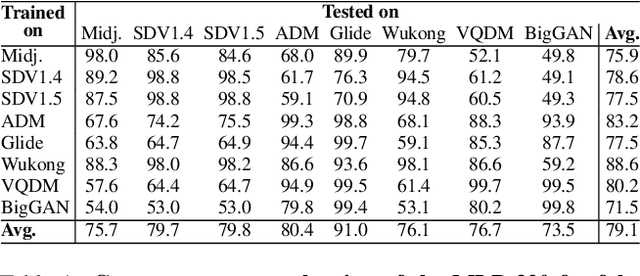
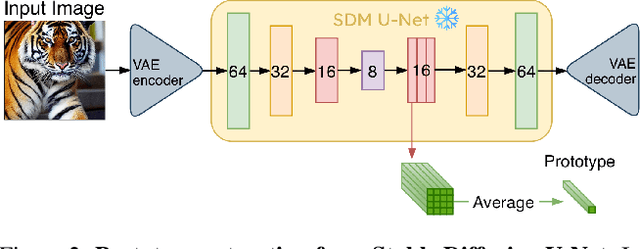
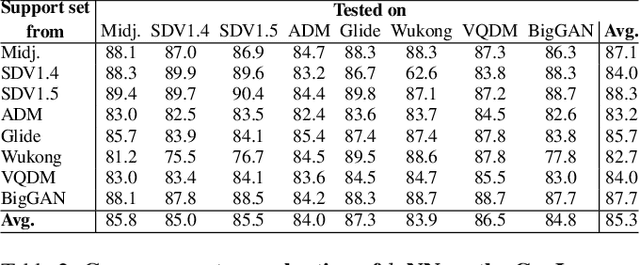
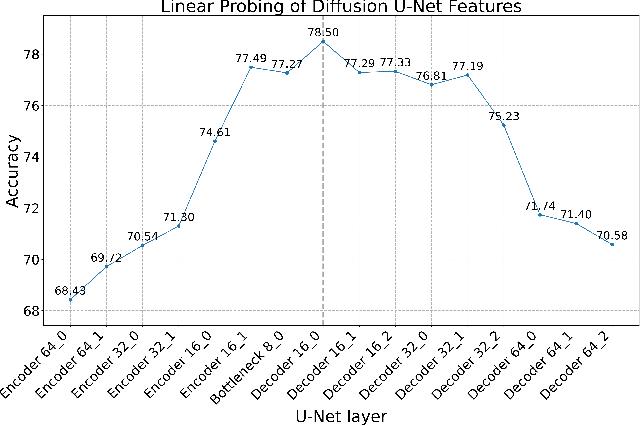
The rapid progress of generative diffusion models has enabled the creation of synthetic images that are increasingly difficult to distinguish from real ones, raising concerns about authenticity, copyright, and misinformation. Existing supervised detectors often struggle to generalize across unseen generators, requiring extensive labeled data and frequent retraining. We introduce FRIDA (Fake-image Recognition and source Identification via Diffusion-features Analysis), a lightweight framework that leverages internal activations from a pre-trained diffusion model for deepfake detection and source generator attribution. A k-nearest-neighbor classifier applied to diffusion features achieves state-of-the-art cross-generator performance without fine-tuning, while a compact neural model enables accurate source attribution. These results show that diffusion representations inherently encode generator-specific patterns, providing a simple and interpretable foundation for synthetic image forensics.
Countering adversarial evasion in regression analysis
Sep 26, 2025Adversarial machine learning challenges the assumption that the underlying distribution remains consistent throughout the training and implementation of a prediction model. In particular, adversarial evasion considers scenarios where adversaries adapt their data to influence particular outcomes from established prediction models, such scenarios arise in applications such as spam email filtering, malware detection and fake-image generation, where security methods must be actively updated to keep up with the ever-improving generation of malicious data. Game theoretic models have been shown to be effective at modelling these scenarios and hence training resilient predictors against such adversaries. Recent advancements in the use of pessimistic bilevel optimsiation which remove assumptions about the convexity and uniqueness of the adversary's optimal strategy have proved to be particularly effective at mitigating threats to classifiers due to its ability to capture the antagonistic nature of the adversary. However, this formulation has not yet been adapted to regression scenarios. This article serves to propose a pessimistic bilevel optimisation program for regression scenarios which makes no assumptions on the convexity or uniqueness of the adversary's solutions.
PRISM: Phase-enhanced Radial-based Image Signature Mapping framework for fingerprinting AI-generated images
Sep 18, 2025A critical need has emerged for generative AI: attribution methods. That is, solutions that can identify the model originating AI-generated content. This feature, generally relevant in multimodal applications, is especially sensitive in commercial settings where users subscribe to paid proprietary services and expect guarantees about the source of the content they receive. To address these issues, we introduce PRISM, a scalable Phase-enhanced Radial-based Image Signature Mapping framework for fingerprinting AI-generated images. PRISM is based on a radial reduction of the discrete Fourier transform that leverages amplitude and phase information to capture model-specific signatures. The output of the above process is subsequently clustered via linear discriminant analysis to achieve reliable model attribution in diverse settings, even if the model's internal details are inaccessible. To support our work, we construct PRISM-36K, a novel dataset of 36,000 images generated by six text-to-image GAN- and diffusion-based models. On this dataset, PRISM achieves an attribution accuracy of 92.04%. We additionally evaluate our method on four benchmarks from the literature, reaching an average accuracy of 81.60%. Finally, we evaluate our methodology also in the binary task of detecting real vs fake images, achieving an average accuracy of 88.41%. We obtain our best result on GenImage with an accuracy of 95.06%, whereas the original benchmark achieved 82.20%. Our results demonstrate the effectiveness of frequency-domain fingerprinting for cross-architecture and cross-dataset model attribution, offering a viable solution for enforcing accountability and trust in generative AI systems.
TrueMoE: Dual-Routing Mixture of Discriminative Experts for Synthetic Image Detection
Sep 19, 2025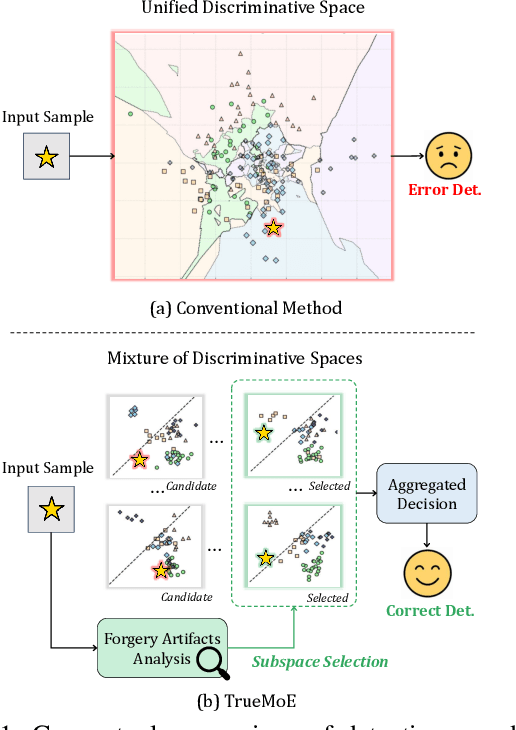
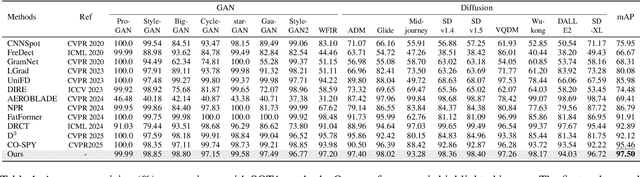
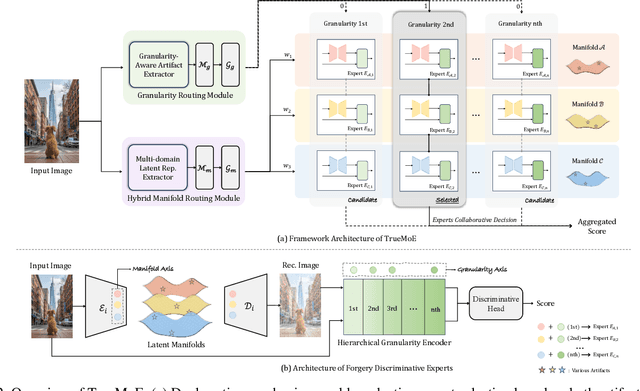
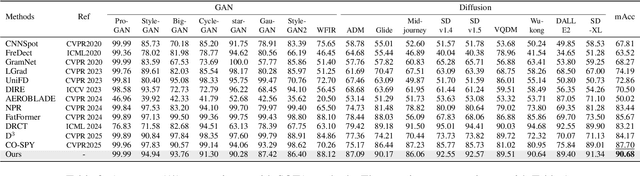
The rapid progress of generative models has made synthetic image detection an increasingly critical task. Most existing approaches attempt to construct a single, universal discriminative space to separate real from fake content. However, such unified spaces tend to be complex and brittle, often struggling to generalize to unseen generative patterns. In this work, we propose TrueMoE, a novel dual-routing Mixture-of-Discriminative-Experts framework that reformulates the detection task as a collaborative inference across multiple specialized and lightweight discriminative subspaces. At the core of TrueMoE is a Discriminative Expert Array (DEA) organized along complementary axes of manifold structure and perceptual granularity, enabling diverse forgery cues to be captured across subspaces. A dual-routing mechanism, comprising a granularity-aware sparse router and a manifold-aware dense router, adaptively assigns input images to the most relevant experts. Extensive experiments across a wide spectrum of generative models demonstrate that TrueMoE achieves superior generalization and robustness.
Toward Medical Deepfake Detection: A Comprehensive Dataset and Novel Method
Sep 19, 2025The rapid advancement of generative AI in medical imaging has introduced both significant opportunities and serious challenges, especially the risk that fake medical images could undermine healthcare systems. These synthetic images pose serious risks, such as diagnostic deception, financial fraud, and misinformation. However, research on medical forensics to counter these threats remains limited, and there is a critical lack of comprehensive datasets specifically tailored for this field. Additionally, existing media forensic methods, which are primarily designed for natural or facial images, are inadequate for capturing the distinct characteristics and subtle artifacts of AI-generated medical images. To tackle these challenges, we introduce \textbf{MedForensics}, a large-scale medical forensics dataset encompassing six medical modalities and twelve state-of-the-art medical generative models. We also propose \textbf{DSKI}, a novel \textbf{D}ual-\textbf{S}tage \textbf{K}nowledge \textbf{I}nfusing detector that constructs a vision-language feature space tailored for the detection of AI-generated medical images. DSKI comprises two core components: 1) a cross-domain fine-trace adapter (CDFA) for extracting subtle forgery clues from both spatial and noise domains during training, and 2) a medical forensic retrieval module (MFRM) that boosts detection accuracy through few-shot retrieval during testing. Experimental results demonstrate that DSKI significantly outperforms both existing methods and human experts, achieving superior accuracy across multiple medical modalities.